
In Hirosaki the day tends to begin with apples: stacked in crates at a roadside stand, baked into pies in a café window, poured as juice, even hiding in the curry. Past the moat and the old gates, a castle keep sits behind stone walls, and the streets around it still follow the plan of a samurai town. This is a small city of northern Honshu for travelers who like to wander slowly through history, orchards and food.
Where is Hirosaki and what is it like?
Hirosaki is a city in western Aomori Prefecture, in the northern Tohoku region of Honshu, the main Japanese island. Aomori itself, the prefectural city, sits at the northern tip of Honshu, and Aomori Airport is the closest airport to Hirosaki. The city grew up as a castle town, and that origin still explains its shape and its mood.
For generations Hirosaki was the seat of the Tsugaru clan, who ruled a domain rated at 100,000 koku. A koku was a measure of rice, the currency of feudal power, so the figure tells you this was a domain of real weight in the north. Wealth of that kind left behind a castle, temples, merchant quarters and samurai districts, and many of those traces are still part of the town’s character.
The climate is a large part of the personality. Summers are hot and winters are cold with heavy snowfall, so the town lives by the calendar. Spring brings the castle grounds back to life, summer is for festivals and green orchards, autumn is for the apple harvest, and winter turns everything white and slows the pace.
Hirosaki is also the largest apple producer in Japan. You feel it everywhere: in shop windows, in souvenir packaging, in the sweets that appear on café menus, and in the orchards around the city. It is a town of everyday food and local craft rather than neon and towers.
It suits travelers who enjoy castles, gardens, regional cooking and the feeling of a place that has its own accent and its own habits. Those who come mainly for big-city nightlife, department-store shopping or a long list of headline sights may find it modest. Think of it as a place to settle into for a couple of days rather than tick off.
What is there to do in Hirosaki?
The reasons to come are a castle, a food culture built on apples, a samurai-era town and a calendar of seasons that changes the whole look of the city. What sets Hirosaki apart from the better-known destinations of Japan is that these things sit together in a town of regional size, with the feel of the north all around them.
Hirosaki Castle and its grounds
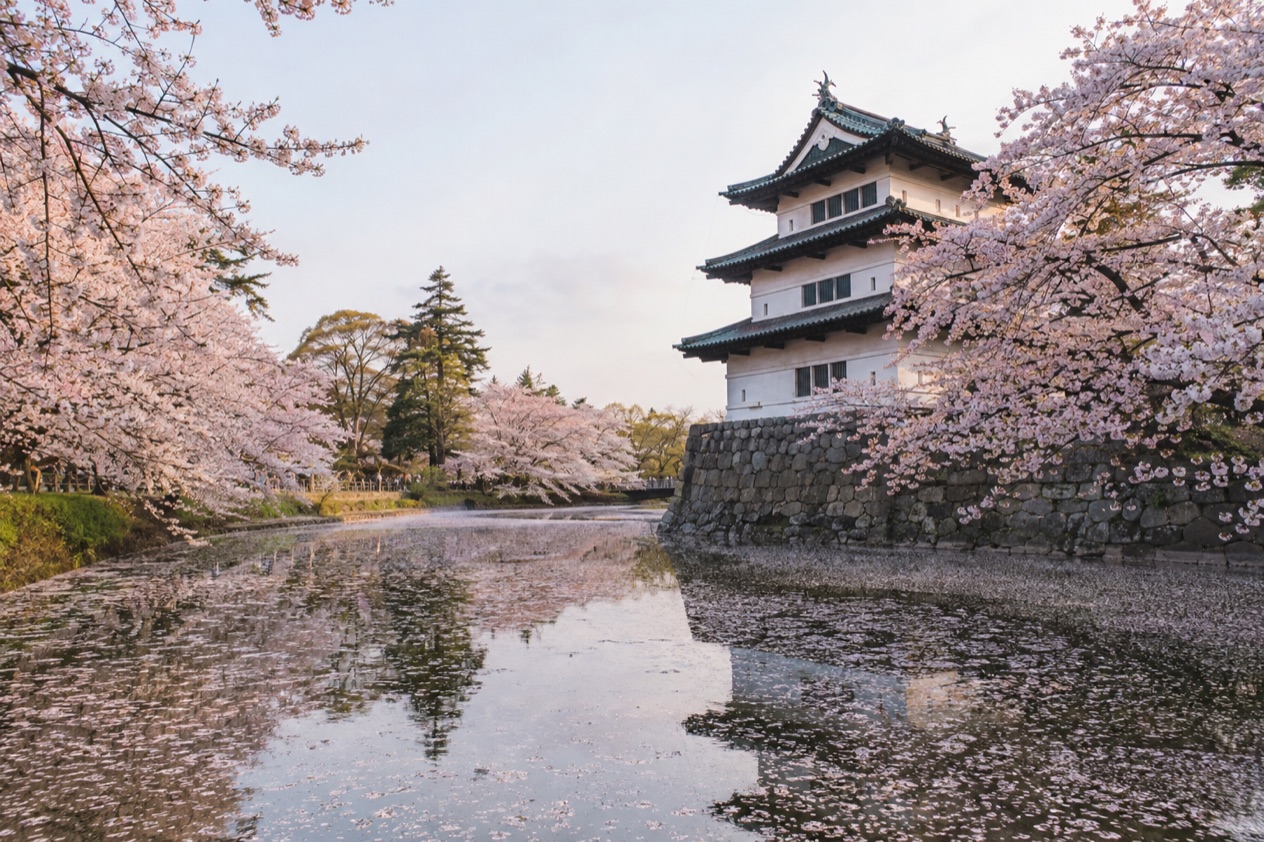
Hirosaki Castle is a hirayama-style castle, meaning it was built on a low hill rather than on a mountaintop or on flat ground, and it dates from 1611. You pass through gates, cross moats and walk along stone walls before reaching the keep, and the whole complex is laid out the way a lord of the Tsugaru clan intended.
The grounds are a park as much as a fortress. Cherry trees are planted around the moats and inner courtyards, and the castle is a gathering place when they flower in spring. In the green months you can follow the water, look at the keep from different angles and pause beside the old walls.
| Site | Open |
|---|---|
| Hirosaki Castle | 9:00 to 17:00, April 1 to November 23 |
| Hirosaki Museum of Contemporary Art | 9:00 to 17:00, closed Tuesdays and during the New Year holiday |
Apples, from orchard to table
Because Hirosaki is the largest apple producer in Japan, the fruit is not a souvenir here but a way of life. Orchards surround the town, and shops and cafés compete to find new things to do with the harvest. Expect apple pie, apple juice, cider, jam, dried apple chips and sweets that you can carry home as gifts.
A good way to taste the region is to move from sweet to savory: a slice of pie with coffee in the afternoon, then an izakaya dinner (a casual Japanese pub) of northern dishes with local sake. Apple trees change with the seasons, with white blossoms in spring, green fruit in summer and red fruit in autumn, so the town looks different on every visit.
A castle town to wander and a museum to visit
Outside the castle walls, Hirosaki rewards a slow walk. The town grew up around the Tsugaru clan, so you find temples, old streets and districts that once housed retainers, together with shops selling regional crafts. Cafés and small restaurants fill in the spaces between them.
For a different pace, the Hirosaki Museum of Contemporary Art offers a modern counterpoint to all that history. Pairing it with the castle shows how a town of samurai heritage looks at the present.
Seasons and festivals
With hot summers and cold, heavy-snow winters, Hirosaki changes its clothes completely. Cherry blossoms frame the castle in spring, summer brings warm evenings and festival season across northern Honshu, autumn is for the harvest, and winter is for snow, hot food and warm baths.
Pairing a festival night in Aomori with time in Hirosaki gives a fuller picture of how the north celebrates summer.
How many days do you need in Hirosaki?
Two days is a comfortable stay for Hirosaki, and a long weekend lets you add a day trip within Aomori Prefecture. The town is compact in what it offers, with a castle, a museum, a food scene and a history to absorb, rather than a long list of separate sights.
With a single day, spend the morning at Hirosaki Castle, moving through the gates and around the moats. Take lunch in town, with apples somewhere on the plate, and use the afternoon for the museum of contemporary art or for the lanes of the old castle town. Finish with dinner of regional cooking.
With two days, you can slow everything down. Give the castle grounds a second visit at a different hour, spend time at cafés and shops that sell apple sweets and local crafts, and wander the streets that belonged to samurai families. A second evening lets you try an izakaya and its northern dishes without rushing.
A longer stay opens the door to the rest of the prefecture. Aomori city, at the northern tip of Honshu, is the obvious pairing, especially in early August when the Nebuta festival fills its streets. Travelers also treat Hirosaki as a stop on a longer journey through Tohoku, linking it with other cities of the north by rail.
Winter visitors should allow a little extra flexibility. Heavy snowfall is part of the season, and the castle is open only from April 1 to November 23, so a cold-weather trip is more about the town, the food and the atmosphere than about the castle grounds.
Where to stay in Hirosaki
The practical choice is between the area around Hirosaki Station and the quarter near the castle. The station is the town’s rail link, served by the Ou Main Line of JR East, so staying near it suits travelers arriving by train who want to drop their bags and go.
The area near the castle suits visitors who want to begin the day among the moats and old walls. Staying there makes the castle the center of your trip, and the surrounding streets give you cafés, shops and temples close at hand. It fits travelers who care about atmosphere more than about proximity to the platform.
Two other stations on the Ou Main Line serve the city, Ishikawa and Naijoshi. They are more local in character, and they matter mainly to travelers who want to explore the edges of the city and its orchard country.
Style of lodging is a matter of taste. A business hotel gives you a tidy room near the station. A ryokan, a traditional inn with tatami floors, offers a different evening, with a regional dinner and a night on a futon, if you want something rooted in Japanese habits. In winter, a warm bath and a hot meal at the end of a snowy day are worth planning around.
Because Hirosaki is small, the choice of area matters less than the choice of season and itinerary. Decide first when you are coming, whether for the castle months, the autumn harvest or the snow, and then choose a base that suits the way you want to spend your days.
How do you get to Hirosaki and get around?
The closest airport to Hirosaki is Aomori Airport (AOJ), and from the Kansai region travelers can fly from Itami Airport in Osaka to Aomori. Hirosaki itself is reached by rail on the Ou Main Line of JR East, which serves Hirosaki Station.
From Tokyo, the JR Tohoku Shinkansen runs regular services to Shin-Aomori, the bullet-train stop for the Aomori area. Bus is another option, since the Konan bus company runs several daytime and overnight services between Ueno Station in Tokyo and Aomori Station.
For foreign tourists heading from Tokyo to Hirosaki, a JR East Rail Pass or the national Japan Rail Pass is the better deal than buying individual tickets. The rail network is how visitors see the north, and Hirosaki fits naturally into a longer trip by train through Tohoku.
Once in town, the places that matter, Hirosaki Castle and the Hirosaki Museum of Contemporary Art, are within the city itself, and the stations of Hirosaki, Ishikawa and Naijoshi tie the city into the rail network. The castle opens from April 1 to November 23, and the museum is closed on Tuesdays, so plan your sightseeing days around those hours.
In snowy months, build a little slack into your schedule. Winters here bring heavy snowfall, and travelers should be ready for slower days and a different rhythm than the green season brings.
When is the best time to visit Hirosaki?
The months from April to November are the natural window for a first visit, because Hirosaki Castle is open from April 1 to November 23. Spring brings cherry blossoms to the castle grounds, and autumn belongs to the apple harvest, so these seasons give the town its strongest identity.
Summer in Hirosaki is hot, and it is the season of festivals in northern Honshu. The Nebuta festival in Aomori city runs every year from August 2 to 7, and a trip timed around it lets you add a festival night to your stay. The orchards are green, the days are long, and the town feels open to the outdoors.
Winters are cold, with heavy snowfall, and the castle is closed from late November until April. A winter visit has its own appeal for travelers who want snow, hot food and a quiet pace in the north, but it is a different trip, centered on the town and its table rather than on its grounds.
Good to know before you go
Japan runs on the yen, and in a regional town like Hirosaki it is sensible to carry some in cash alongside a card. Remove your shoes when you enter a ryokan or a traditional room, and speak softly on trains. Winters bring heavy snow, so warm layers and sturdy footwear belong in the bag for those months.
Sources
- Japan National Tourism Organization, Aomori (https://www.japan.travel/en/destinations/tohoku/aomori/aomori-city-and-around/), checked October 11, 2026
- Wikipedia, Hirosaki (https://en.wikipedia.org/wiki/Hirosaki), checked October 11, 2026
- Wikivoyage, Hirosaki (https://en.wikivoyage.org/wiki/Hirosaki), checked October 11, 2026
To plan your stay
- Best Time to Visit Japan: Cherry Blossoms, Autumn Colors, Weather and Festivals
- Where to Stay in Japan: Ryokan, Temple Stays, Capsule Hotels and the Best Cities to Base In
- Sending Luggage from the Airport in Japan: Hands-Free Travel, Hotel Delivery and Coin Lockers
- Know Before You Go to Japan: Entry, Money, Etiquette and Getting Around