
The plane banks over Tokyo Bay, the grid of the city fills the window, and a few minutes later you are standing in an arrivals lobby with the skyline still fresh in your mind. That is the particular pleasure of Haneda, the airport that sits within the city itself. It is one of the two airports serving Tokyo, and it is the one that drops international travelers closest to the center.
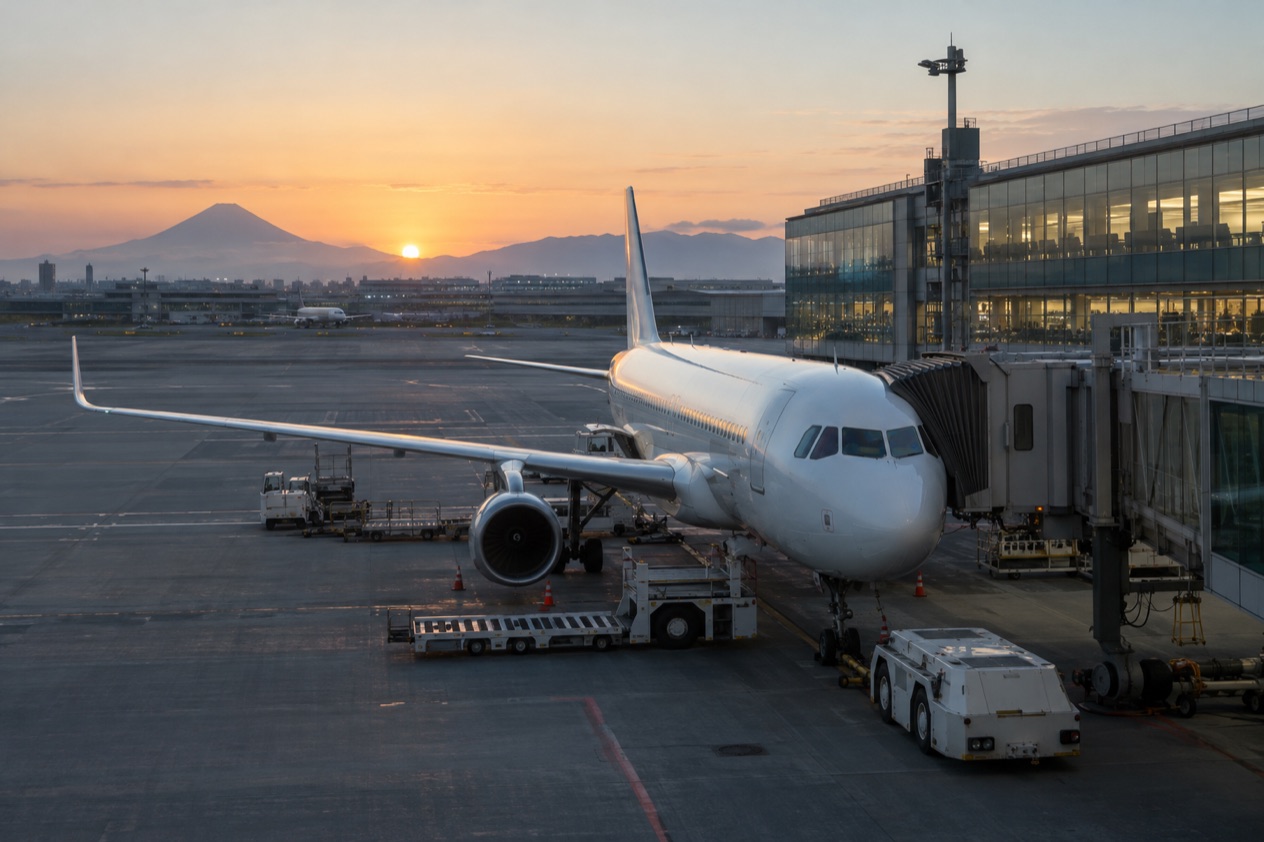
What is Haneda Airport?
Haneda Airport is the airport of Tokyo city, and it is now possible to arrive there directly from international destinations and step into the heart of the capital. Its code is HND, and for most American visitors it is the gateway that puts the least distance between the arrivals hall and a hotel bed.
It shares the work with Narita Airport, the other airport serving the capital, which handles international and domestic destinations as well. Travelers comparing the two will find that Haneda also acts as a domestic hub, with flights fanning out to the north, the south and the islands. The result is an airport where an overseas arrival and a connection to Sapporo or Fukuoka can happen under the same roof system.
A big airport, in three terminals
Haneda has three passenger terminals with 71 gates that have jet bridges. For a first visit, the useful thing to grasp is that the airport splits its life into a daytime domestic world and a round-the-clock international one.
The international side never really sleeps. Terminal 3 and the international flight area of Terminal 2 are open 24 hours a day, so a late arrival or a very early departure does not leave you stranded outside a locked building. The domestic areas keep more traditional hours, closing overnight, which matters if you are planning to connect to a flight within Japan.
Nonstop flights from the United States
Three American carriers fly nonstop to Haneda. Delta Air Lines connects it with Atlanta, Detroit, Honolulu, Los Angeles, Minneapolis/St. Paul and Seattle/Tacoma. American Airlines flies from Dallas/Fort Worth, Los Angeles and New York–JFK.
United Airlines serves Haneda from Chicago–O’Hare, Guam, Los Angeles, Newark, San Francisco and Washington–Dulles. Between the three, travelers from many parts of the country can find a direct route, and Los Angeles appears on all three lists.
Other ways into Japan
Haneda is not the only door. Kansai International Airport (KIX) makes it possible to visit Japan without going through Tokyo at all, and Nagoya’s Central Japan International Airport, known as Centrair, is the hub for flights to and from cities in Asia and Japan.
Fukuoka Airport sits so close to the city that, after collecting your baggage, you can reach Hakata in the heart of Fukuoka by train in five minutes. Most domestic flights from the main island to Hokkaido land at Chitose Airport in southern Hokkaido, while the airplane is the only option for reaching Okinawa from major Japanese cities. Most prefectures have at least one airport, and low-cost carriers reach almost anywhere in the country at a reasonable price.
Which terminals and airlines does it have?
Haneda has three passenger terminals, numbered 1, 2 and 3, and the airlines are spread across them by type of flight. Terminal 3 and the international flight area of Terminal 2 handle the overseas side, while Terminal 1 and the domestic areas of Terminal 2 handle flights within Japan.
Terminal 1 and Terminal 2
Terminal 2 is served by All Nippon Airways, Air Do and Solaseed Air for their domestic flights. Terminal 1 and the domestic flight areas of Terminal 2 are open only from 5:00 am to 12:00 am, so these are the parts of the airport that rest overnight.
An underground walkway connects Terminals 1 and 2. That makes it simple to shift between the two on foot when a connection or a drop-off changes your plans, without going back outside.
Terminal 3 and international arrivals
The airport provides a video showing the route from the Terminal 3 Arrivals lobby to each transportation option, and another from the Terminal 2 International Arrivals lobby, so you can see the way to the trains, monorail and buses before you land.
A free inter-terminal shuttle bus connects all terminals on the landside. If you land in one terminal and your onward transport leaves from another, that bus is the link between them.
Domestic airlines and where they fly
Beyond the big carriers, several domestic airlines use Haneda as a base, and together they cover much of the country. The table lists the cities each one serves from the airport.
| Airline | Destinations from Haneda |
|---|---|
| Air Do | Asahikawa, Hakodate, Kushiro, Memanbetsu, Obihiro, Sapporo–Chitose |
| Skymark Airlines | Fukuoka, Kagoshima, Kobe, Naha, Sapporo–Chitose, Shimojishima |
| Solaseed Air | Kagoshima, Kumamoto, Miyazaki, Nagasaki, Naha, Oita |
| StarFlyer | Fukuoka, Kitakyushu, Osaka–Kansai, Ube |
Read together, the list draws a map: Air Do points toward Hokkaido, Solaseed toward Kyushu, Skymark toward Kyushu and Okinawa, and StarFlyer toward western Japan. Naha, the gateway to Okinawa, appears under both Skymark and Solaseed.
Parking and taxis at the terminals
For those arriving by car, spaces in parking lots P2 through P5 can be reserved in advance, with details on each lot’s own reservation page. Taxis are organized in two kinds of stands, general stands and stands for app-dispatched or reserved taxis.
If you have arranged a taxi through an app or by phone, you use the dedicated stand for reserved taxis. Airports in major Japanese cities generally also have car rental services.
How do you get to Tokyo?
You reach central Tokyo from Haneda by train, monorail, bus or taxi, and airports in major Japanese cities are well served by express trains, buses and taxis. From the Haneda Airport Passenger Terminal, travelers can search for routes, departure and arrival times, and fares for trains, monorails and buses to their destination.
The Tokyo Monorail
The Tokyo Monorail is the line that links Haneda with Monorail Hamamatsucho, running 11 miles (11.1 miles) and serving 11 stations between Monorail Hamamatsucho and Haneda Airport Terminal 2. It opened on September 17, 1964. Haneda Express trains run non-stop between Monorail Hamamatsucho and Haneda Airport, reaching Terminal 3 in 13 minutes.
The monorail operates from around 5:00 a.m. to midnight, with the first departure toward Haneda Airport at 4:58 a.m. and the last at 12:01 a.m. At Monorail Hamamatsucho Station, passengers can transfer to the JR East Yamanote Line and Keihin-Tohoku Line, as well as the Toei Subway Asakusa and Oedo lines via Daimon Station.
Monorail tickets
The monorail sells several kinds of tickets, each with its own validity, summarized here.
| Ticket | Validity |
|---|---|
| One-way | Day of purchase only |
| Return | Two days, or 10 days if returning to any Haneda Airport station |
| Multiple-trip (book of 11) | Three months |
Planning the route and other options
Airlines JAL MaaS and ANA TRAVEL CUBE offer services to search for and book transportation to Haneda Airport. Combined with the airport’s own route search for trains, monorails and buses, they give you a way to plan the ride from your hotel door.
Taxis wait at the general stands, and the dedicated stand handles taxis arranged through an app or by phone. Whichever way you travel, the route videos for Terminal 2 International Arrivals and Terminal 3 Arrivals show the walk from the lobby to each option.
Good to know before you go
Haneda’s international areas run around the clock, but the domestic areas of Terminals 1 and 2 close overnight, so a late connection within Japan deserves a look at the clock. The monorail’s last departure toward the airport leaves just after midnight. If your flight lands in the small hours, the free shuttle bus between terminals and the taxi stands are what remain on the landside.
Sources
- Japan National Tourism Organization, how to reach the city from each international airport (https://www.japan.travel/en/plan/airport-access/), checked October 11, 2026
- Haneda Airport Passenger Terminal, Access (https://tokyo-haneda.com/en/access/index.html), checked October 11, 2026
- Wikipedia, Haneda Airport, airlines and destinations (https://en.wikipedia.org/wiki/Tokyo_International_Airport#Airlines_and_destinations), checked October 11, 2026
- Wikipedia, Tokyo International Airport (https://en.wikipedia.org/wiki/Tokyo_International_Airport), checked October 11, 2026
- Wikipedia, Tokyo Monorail (https://en.wikipedia.org/wiki/Tokyo_Monorail), checked October 11, 2026
To plan your stay
- Best Time to Visit Japan: Cherry Blossoms, Autumn Colors, Weather and Festivals
- Things to Do in Japan: Kyoto Temples, Onsen, Street Food and Day Trips
- Where to Stay in Japan: Ryokan, Temple Stays, Capsule Hotels and the Best Cities to Base In
- Know Before You Go to Japan: Entry, Money, Etiquette and Getting Around