
From the street in Hakodate, Goryokaku shows itself as a wide green hollow ringed by water, with a slim observation tower standing at its edge. Step inside the grounds and the old earthen walls rise beside you, the moat glinting between the trees. It is a visit that mixes a park stroll with a piece of fortress history, on the southern tip of Hokkaido.
Is visiting Goryokaku worth it?
Yes, if you like your history wrapped in open air: Goryokaku suits travelers who enjoy walking a park with a story, anyone curious about the last years of samurai-era Japan, and people who come to Hakodate for the seasons, above all the cherry blossoms. It is a gentle mix of landscape and past rather than a monument you tick off.
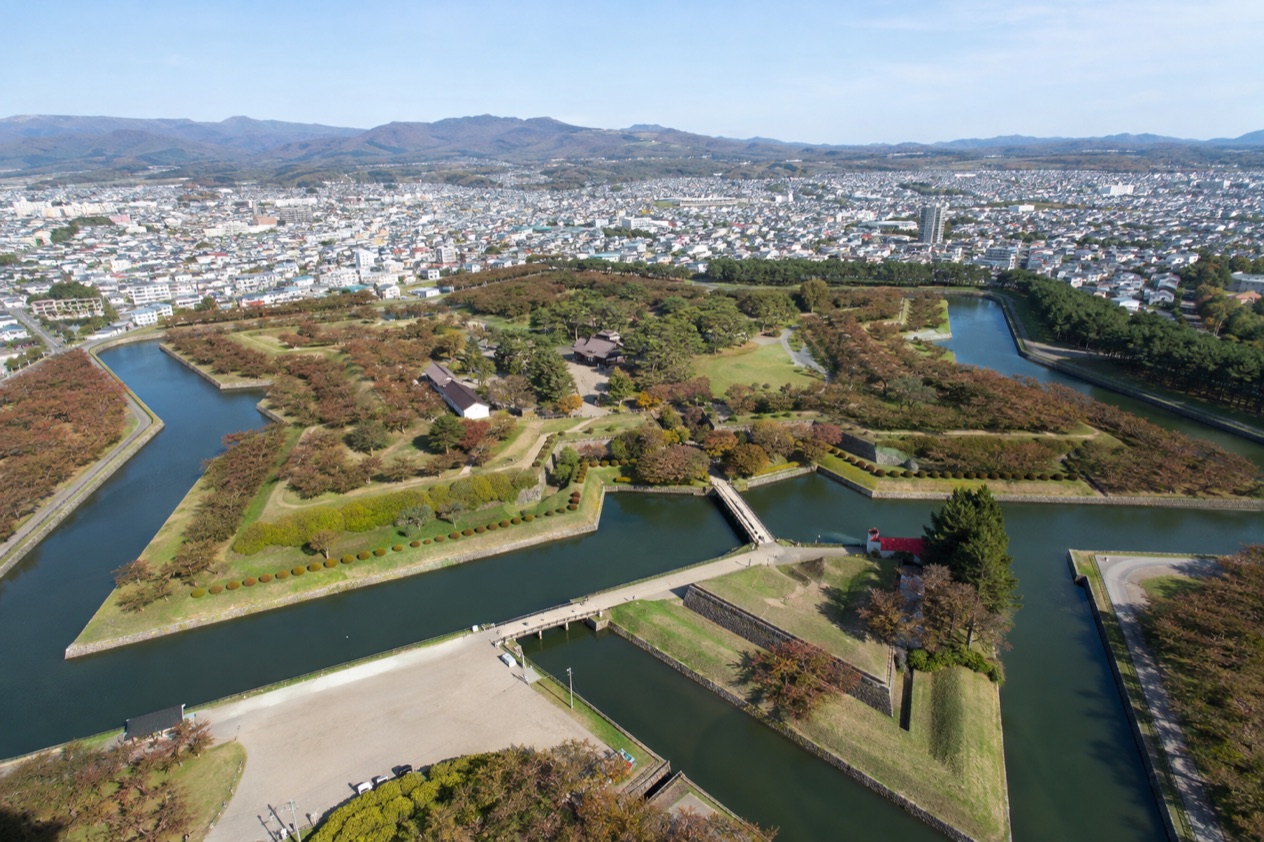
What sets it apart is its shape. This is a star fort, a design with five points that allowed more gun emplacements along its walls and left fewer blind spots for defenders.
Most castle sites in Japan follow a very different logic of keeps, turrets and stone bases, so a pentagram of earthwork and water feels unlike the castles you may have seen elsewhere. You can read the geometry best from above, and that is where the tower next door comes in.
The place has also changed its role more than once. It became a park in 1914 and was declared a Special Historical Site in 1952, so what was built for defense is now where residents walk, picnic and gather under the trees.
In winter the moat had a second life: it was used for collecting ice, which was sold on Honshu as Goryokaku Ice. That small detail says a lot about how the fort fit into the daily economy of the port city around it.
Hakodate itself is a port city at the southern tip of Hokkaido, separated from Honshu by the Tsugaru Strait. Goryokaku gives you a different side of the city from the harbor: broad, green and historical.
What to see at Goryokaku
The grounds reward a slow loop. Start with the big picture from the tower, then come down and let the walls, water and reconstruction fill in the details.
The observation tower and its exhibition
The observation tower stands next to the fortress and gives a bird’s-eye view of the whole fort, the city around it and Mount Hakodate beyond. This is where the five-pointed star finally makes sense: from the ground you see trees, banks and water, but from up here the points of the star are laid out like a diagram.
The tower also holds an exhibition on the history of the fortress and the people tied to it, especially Hijikata Toshizo, a figure remembered from the final turbulent years of the shogunate era. It is a good place to put names to the landscape before you walk it. Look for the way the moat traces the points and how the park spreads inside the star.
The star-shaped walls and moat
At ground level, the walls are grassy earthen banks, and the moat runs along them in a long, angular line. The star design was meant to widen the field of fire from the walls and leave fewer places where attackers could hide. Walking the edge, you notice how the corners project outward and how the water echoes each angle.
This is also the setting for the cherry blossoms, for which the park is a famous spot in spring. Even without flowers, the paths under the trees and along the water make for an unhurried circuit, and the angles of the star give changing views at every turn.
The reconstructed magistrate’s office
Inside the grounds stands a partial reconstruction of the magistrate’s office, completed in 2010. It houses an exhibition about the fort’s history, which makes it the natural complement to the tower display: one gives you the overview and the people, the other the administrative heart of the fortress.
Look at the building’s lines and materials as a way of imagining the daily life of the fort, when officials worked here rather than visitors strolling past. The word partial matters: it is a reconstruction of part of the original, so treat it as a window into the past rather than a complete replica.
| Site | Open |
|---|---|
| Observation tower | Hours given on site |
When to visit Goryokaku
Spring is the season the park is known for. Goryokaku is a famous spot for cherry-blossom viewing, and the trees around the moat turn the star into a ring of pink and white. If you are choosing a month for the flowers, spring is the answer, though the exact timing shifts from one year to the next, so it pays to look at the bloom outlook close to your dates.
Summer and early autumn suit the walk itself. With the trees in full leaf, the moat edges are shaded and the grassy banks make a pleasant place to sit. The tower view across the city to Mount Hakodate gives a broad green-and-blue panorama in these months, and the long loop around the walls is a natural way to spend an unhurried hour or two.
Winter has its own character here. The moat was once harvested for ice in the cold months, and that history gives the frozen season a certain resonance, even if you are simply looking at the bare trees and pale banks. Hokkaido winters ask for warm layers, and the star appears in a stark, clear outline from the tower when the branches are empty.
As for the time of day, the park is a place to wander rather than a ticketed rush, so choose a moment that suits your plan for Hakodate. Travelers pair a tower visit with a walk through the grounds in daylight, since the view over the fort and the city is the point. Whatever the hour, give yourself time for both the height and the ground-level circuit.
Tips for your visit
Plan the visit as two parts: the view from the tower, then the walk through the grounds. Seeing the star from above first makes the walls and moat easier to read when you are down among them, and the exhibitions in the tower and the magistrate’s office add the stories behind the shape.
Bring comfortable shoes for the paths and a layer for the weather, which can turn cool in Hokkaido even when the sun is out. If you come for the blossoms, a camera helps, since the moat doubles every tree with its reflection.
Getting to Hakodate is straightforward on the map. The city has an airport with direct flights from Sapporo (Okadama by JAL, Shin-Chitose by ANA), Tokyo-Haneda, Nagoya-Centrair, Osaka-Itami and Taipei-Taoyuan. By rail, the JR Tohoku/Hokkaido Shinkansen from Tokyo to Shin-Hakodate-Hokuto Station takes 4 hours, and that station is 11 miles north of Hakodate Station, the northernmost terminal for the bullet train.
Once in the city, Goryokaku combines naturally with the rest of Hakodate, a port of a few hundred thousand people facing the Tsugaru Strait. Let the fort take a relaxed stretch of your day, then turn to the harbor side of town. For families and anyone who prefers to go slowly, the park’s open layout lets you split the visit into the tower, the magistrate’s office and a stroll as you like.
Good to know before you go
Goryokaku is a public park with exhibitions inside it, so a visit is mostly a matter of walking outdoors. Dress for Hokkaido weather, keep some yen on hand for the tower and the magistrate’s office, and carry a light rain layer in the warmer months.
Winter calls for proper warm clothing and footwear for cold ground. Take the usual habits of any city park: keep your belongings close and follow signs around the moat edges.
Sources
- Wikipedia, Goryōkaku (https://en.wikipedia.org/wiki/Gory%C5%8Dkaku), checked October 11, 2026
- Japan National Tourism Organization, Hakodate (https://www.japan.travel/en/destinations/hokkaido/hokkaido/hakodate-and-hokkaido-south/), checked October 11, 2026
- Wikipedia, Hakodate (https://en.wikipedia.org/wiki/Hakodate), checked October 11, 2026
- Wikivoyage, Hakodate (https://en.wikivoyage.org/wiki/Hakodate), checked October 11, 2026
To plan your stay
- Best Time to Visit Japan: Cherry Blossoms, Autumn Colors, Weather and Festivals
- Where to Stay in Japan: Ryokan, Temple Stays, Capsule Hotels and the Best Cities to Base In
- Sending Luggage from the Airport in Japan: Hands-Free Travel, Hotel Delivery and Coin Lockers
- Know Before You Go to Japan: Entry, Money, Etiquette and Getting Around