
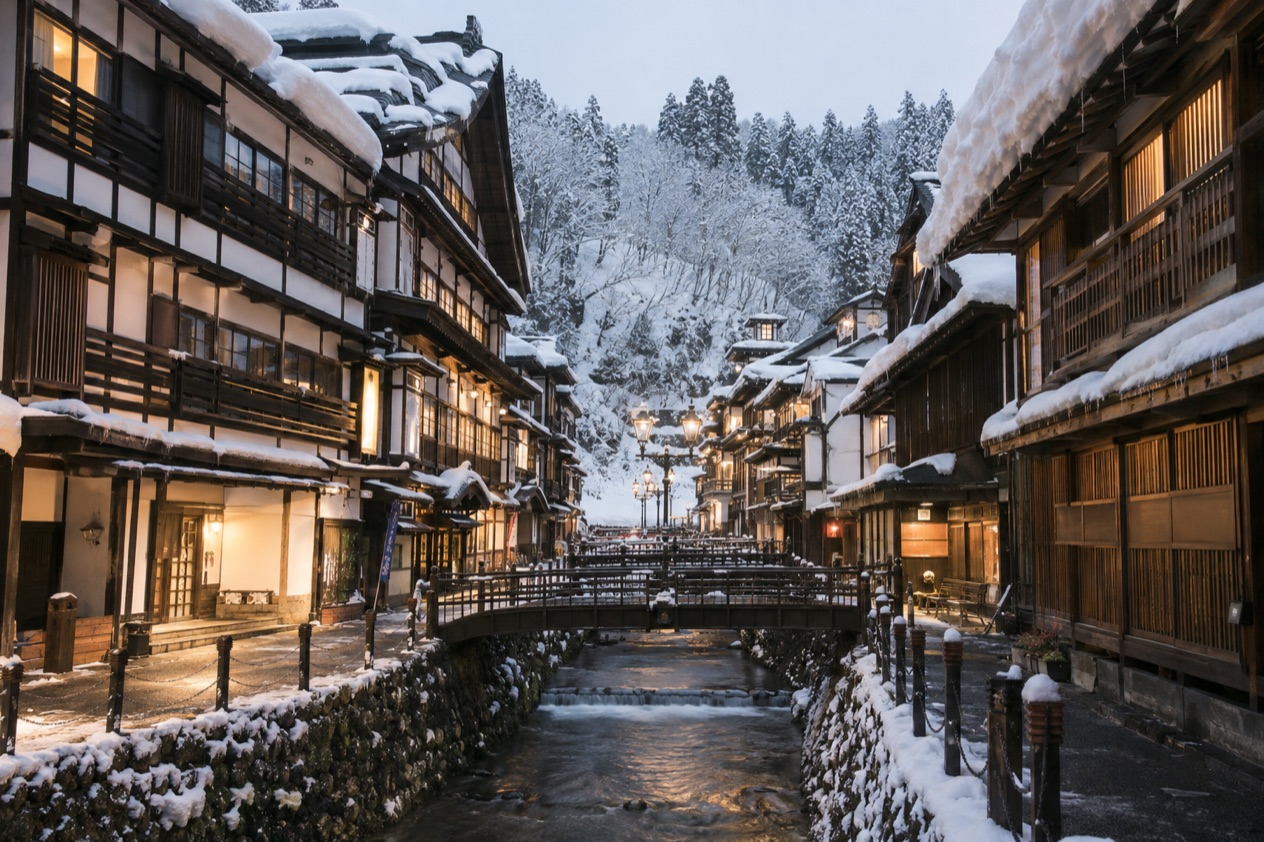
You step onto a wooden bridge over a narrow river, and the street ahead is lined with timber-framed inns trimmed in white plaster, their balconies stacked above the water. There are no cars here, only the sound of footsteps and the river, and after dark the gas lamps come on. Ginzan Onsen, a hot spring village in Obanazawa, Yamagata Prefecture, is a place to walk, soak and stay put for a while.
Is visiting Ginzan Onsen worth it?
Yes, if you want a hot spring town where the setting is the attraction, and it suits couples, photographers and anyone who likes to wander a village on foot more than tick off sights. The center of Ginzan Onsen is a pedestrian-only district, so the whole experience is built around strolling, bathing and eating, with no traffic to dodge.
What sets it apart from other onsen towns in the region is how uniform it looks. Every building is built from bare timber framing and white plaster in the style of the Taisho Era, which gives the village the look of a single stage set rather than a mix of old and new.
Many hot spring areas grow by adding concrete hotels. Here the inns face each other across the river in matching style, and the bridges and streets glow under gaslight once night falls.
It also rewards a slow pace. Some ryokan, the traditional Japanese inns, let people who are not staying the night use their indoor baths, and the village has its own public bathhouses and a foot bath.
You can build a visit around soaking, a walk along the river and a meal, without needing a long list of sights. If you are after museums, shopping or nightlife, this is not that kind of place. If you want to see what a Tohoku hot spring village looks like when it has kept its character, it is a very good fit.
What to see at Ginzan Onsen
The village is small and the main interest is the street itself, the river beside it and the baths tucked among the inns. Each of the parts below gives a different side of the visit.
The gaslit main street and bridges
The heart of Ginzan Onsen is a pedestrian-only stretch of river and lane, crossed by small wooden bridges. The inns rise three and four stories, with timber balconies, carved details and white plaster walls, all dating to the Taisho Era. Look at the woodwork under the eaves and the way the buildings lean toward the water, which makes every bridge a natural place to stop and look back along the row.
When night falls, the bridges and streets are lit by gaslight. The warm glow on the plaster and the reflections in the river are what most people come for, and it is worth staying into the evening to see the street change. Walking it once in daylight and once under the lamps shows two different villages.
Public bathhouses and the foot bath
Ginzan Onsen has two secluded public bathhouses with open-air baths (rotenburo), and one of them was designed by Kuma Kengo, an architect known for his use of wood and natural materials. They are set apart from the main lane, so finding them is part of the pleasure of a walk.
There is also a foot bath, called warashiyu, where you can sit and warm your feet in the spring water without undressing. It suits anyone who wants to try the water briefly, or who is not ready for a full bath. The spring water here has sulphur and sulphate profiles, a clear appearance and a slightly salty taste, and it is claimed to have balneotherapeutic properties for chronic skin diseases.
Ryokan baths and the cave hot spring
Some local ryokan permit non-lodging guests to use their indoor hot spring baths, which opens the interior of these old inns to day visitors. It is a way to soak in a building you have been admiring from the street, and to see how the wooden interiors match the facades.
One of the establishments in the village also has a doukutsu, a cave hot spring, where the bath is set in a rock hollow rather than a tiled room. Cave baths feel quite different from the open-air ones, enclosed and echoing, and they are a good reason to choose that particular inn if bathing is the focus of your stay.
How to get to Ginzan Onsen
From Tokyo, the route runs on the JR Yamagata Shinkansen to JR Oishida Station. From Oishida, you ride a bus or take a short taxi ride to the town of Ginzan Onsen.
By train and bus from Tokyo
The Yamagata Shinkansen is the rail link from Tokyo, and Oishida Station is where you get off. Buses depart every other hour from Oishida Station to the town of Ginzan Onsen, so it helps to fit your arrival at the station around that rhythm. If the timing does not suit, a taxi is the other way to cover the last stretch.
Travelers holding the Japan Rail Pass, the JR East Tohoku Area Pass or the JR East South Hokkaido Pass can use them for the train. The bus ride is not included in these passes, so it is paid separately.
By rental car
A car can be rented from various stations along the Yamagata Shinkansen line and parked just outside Ginzan Onsen town. Because the center of the village is pedestrian-only, the car stays outside and you continue on foot into the lanes and over the bridges.
Driving gives you freedom to combine the village with other stops in Yamagata Prefecture, within the wider Tohoku region of six rural prefectures: Aomori, Akita, Iwate, Yamagata, Miyagi and Fukushima. Tohoku is known for rural landscapes, historical treasures, summer outdoor activities and abundant powder snow in winter, which gives you plenty to build a longer trip around.
When to visit Ginzan Onsen
The best moment of the day is after dark, when the gas lamps light the bridges and streets and the village takes on its most photographed look. Staying overnight in one of the inns lets you see both the daytime street and the lit evening one without rushing to catch a bus back.
Because buses from Oishida Station run every other hour, the day-trip rhythm is set by the timetable, and an overnight stay removes that constraint. It also gives you time for a bath before dinner and another later, which is how a hot spring village is meant to be used.
As for the season, the surrounding region of Tohoku is known for summer outdoor activities and for abundant powder snow in winter. That means the village sits in a part of Japan with a marked difference between its warm and cold months, and each gives a different mood to the same timber street.
A walk in summer is about the river and open balconies. A visit in winter is about stepping from the cold into hot water. The Taisho-era buildings and the gaslight stay the same across the year, so the choice comes down to whether you prefer green surroundings or a snowy backdrop.
Tips for your visit
Bring a plan for the baths. If you want to soak at a ryokan without staying, remember that only some of them permit non-lodging guests to use their indoor baths, so the choice of inn matters. The public bathhouses and the foot bath are there for everyone passing through.
Plan around the bus. With departures from Oishida Station every other hour, a day visit needs you to line up your Shinkansen arrival with a bus, or to accept a taxi for the last leg. Staying the night makes the schedule far more relaxed and lets you enjoy the village after dark.
If you arrive by car, you leave it parked just outside the town and walk in, since the center is pedestrian-only. That is worth remembering when you pack: a small bag is easier to carry over the bridges and along the lane than a large suitcase.
The village works well as one stop in a longer Tohoku trip. The region takes in six rural prefectures, and Yamagata is one of them, so you can pair Ginzan Onsen with other towns on the Shinkansen line or by rental car. Spend the daylight on the street, bridges and baths, and keep the evening for the gaslight.
Good to know before you go
Ginzan Onsen is a small village, and the pleasures are simple: a walk along the river, a soak in the spring water and a meal at an inn. Because the buses from Oishida Station run every other hour and are not covered by the rail passes, keep a little cash or a card ready for the fare. Wooden lanes and bridges are part of the charm, so move at an unhurried pace, and keep voices low in the bathhouses and around the inns, where people are staying.
Sources
- Wikipedia, Ginzan Onsen (https://en.wikipedia.org/wiki/Ginzan_Onsen), checked October 11, 2026
- Japan National Tourism Organization, Tohoku (https://www.japan.travel/en/destinations/tohoku/), checked October 11, 2026
- Travel to Tohoku, the official tourism website (https://www.tohokukanko.jp/en/), checked October 11, 2026
To plan your stay
- Best Time to Visit Japan: Cherry Blossoms, Autumn Colors, Weather and Festivals
- Where to Stay in Japan: Ryokan, Temple Stays, Capsule Hotels and the Best Cities to Base In
- Sending Luggage from the Airport in Japan: Hands-Free Travel, Hotel Delivery and Coin Lockers
- Know Before You Go to Japan: Entry, Money, Etiquette and Getting Around