
A woman in a kimono and white-powdered makeup crosses a lantern-lit lane in Kyoto, and phones rise from every corner of the street. Moments like this are where visitors first wonder what is polite in a geisha district. The short answer is to treat the lanes as a neighborhood where people work and live, to keep your voice and your movements small, and to ask before you aim a camera.
How should you behave in geisha districts?
Behave as a guest in a working neighborhood: walk calmly, keep your voice low, and give anyone in traditional dress the space you would give a person on her way to a job. Geisha are performing artists trained in dance, music and singing, and they are also skilled conversationalists and hosts. In Kyoto and Kanazawa they are often called geiko. The streets around them are where that work begins and ends, not a stage set.
Kyoto has five geisha districts, known together as the Gokagai: Gion Kobu, Gion Higashi, Ponto-cho, Miyagawa-cho and Kamishichiken. Each has its own character, but the same courtesy applies in all of them. Their evenings revolve around ozashiki, the parties where geisha entertain guests, often wealthy clients, and they also perform on stage and at festivals.
Walking the lanes
Geisha usually entertain at an ochaya, a teahouse, though they may also work at an okiya (the lodging house to which every geisha is registered), at restaurants or at inns. That means the quiet wooden facades you pass are often places of business with guests inside. Stepping aside, not stopping in the middle of a narrow lane, and not trying to peer through doorways are the habits that keep a visit pleasant for everyone.
Smoking while walking on the street is prohibited in Japan and can bring a fine, and designated outdoor smoking areas are limited. Smokers should find the nearest designated zone and not light up in the lanes. Dropping cigarette butts is also banned, so litter of any kind stays in your bag until you find a bin.
A small bow goes a long way
If a shopkeeper or someone in the district greets you, a light bow is the natural reply. An informal bow is about fifteen degrees, little more than a tilt of the head and shoulders, while more formal bows go to about thirty degrees. If the other person holds the bow longer than you expected, usually two or three seconds, you can answer with a second small bow.
None of this needs to be rehearsed. A nod, a quiet thank you and a smile do the same job, and they fit the unhurried pace of the streets better than any show of ceremony.
Teahouse and restaurant manners
Visitors end an evening in the districts at a restaurant or an inn, where ordinary Japanese table habits apply. Shoes come off at the entrance, and you are often given indoor slippers, which in turn come off on tatami mats. A rolled hand towel, the oshibori, is for your hands and not for your face or neck.
At the table, slurping noodles such as ramen or soba is appropriate, and leaving a little food on the plate is not rude. Never pass food from chopsticks to chopsticks, because that recalls how the family handles bones after a cremation. Tipping is not a custom in Japan, though a service charge may be fixed or built into the price, and at a register you may find a small tray where you place your money instead of handing it over.
What are the photo rules?
The rule that matters most is to ask first and accept a no gracefully, because a geisha or maiko on her way to an appointment is not a landmark.
Who you are actually photographing
Most sightings of geisha and maiko in and around cities such as Kyoto are in fact tourists who pay a fee to be dressed up as a maiko or geisha for the day, a practice known as henshin. This helps explain why a woman in full costume strolling near a temple at midday is probably not working. It is also a reason to be relaxed about not catching a photo of a working geisha.
A working geisha is usually heading to or from an engagement, so she has somewhere to be. Treat a glimpse as a small gift and not as a subject to chase. Following someone down an alley, stepping into her path for a better angle or calling out to her are the habits that turn a nice evening into a nuisance for the people who live there.
Taking better, kinder pictures
The districts reward photographs that do not need a person in them. The lines of wooden facades, paper lanterns, latticed windows and the stone paving all say Kyoto without anyone posing. Shooting from the side of the lane, without flash, keeps you out of the way of those passing by.
If you want a portrait of someone dressed for the day, the henshin visitors are usually glad to pose, and a quick friendly request is the right approach. When someone declines, a smile and a small bow are the end of the matter. Your companions in the lane will notice how you handle it, and so will the people who live behind those doors.
Cameras at the table
Ozashiki are private parties, and guests are there for conversation, music and dance. A camera at such an event would intrude on the other guests as much as on the performers, so the sensible habit is to keep devices away and enjoy the performance as it happens. A geisha beer garden, such as the one at the Gion Shinmonso ryokan in Gion, is a more casual setting, though the same polite approach to photos applies.
Which areas are private?
The okiya, where geisha are registered and often live, and the ochaya, where they entertain, are private premises even though they open straight onto the lane. They are working houses and homes, so doors, entryways and windows are not part of the sightseeing. Not every geisha lives in her okiya day to day, but each is registered to one, which makes these houses the center of her professional life.
Houses and teahouses
A teahouse in Gion may look like a quiet wooden building with a small lantern, and nothing about it invites a stroll inside. Standing at the entrance, touching the doors or looking in through gaps spoils the privacy that clients come for.
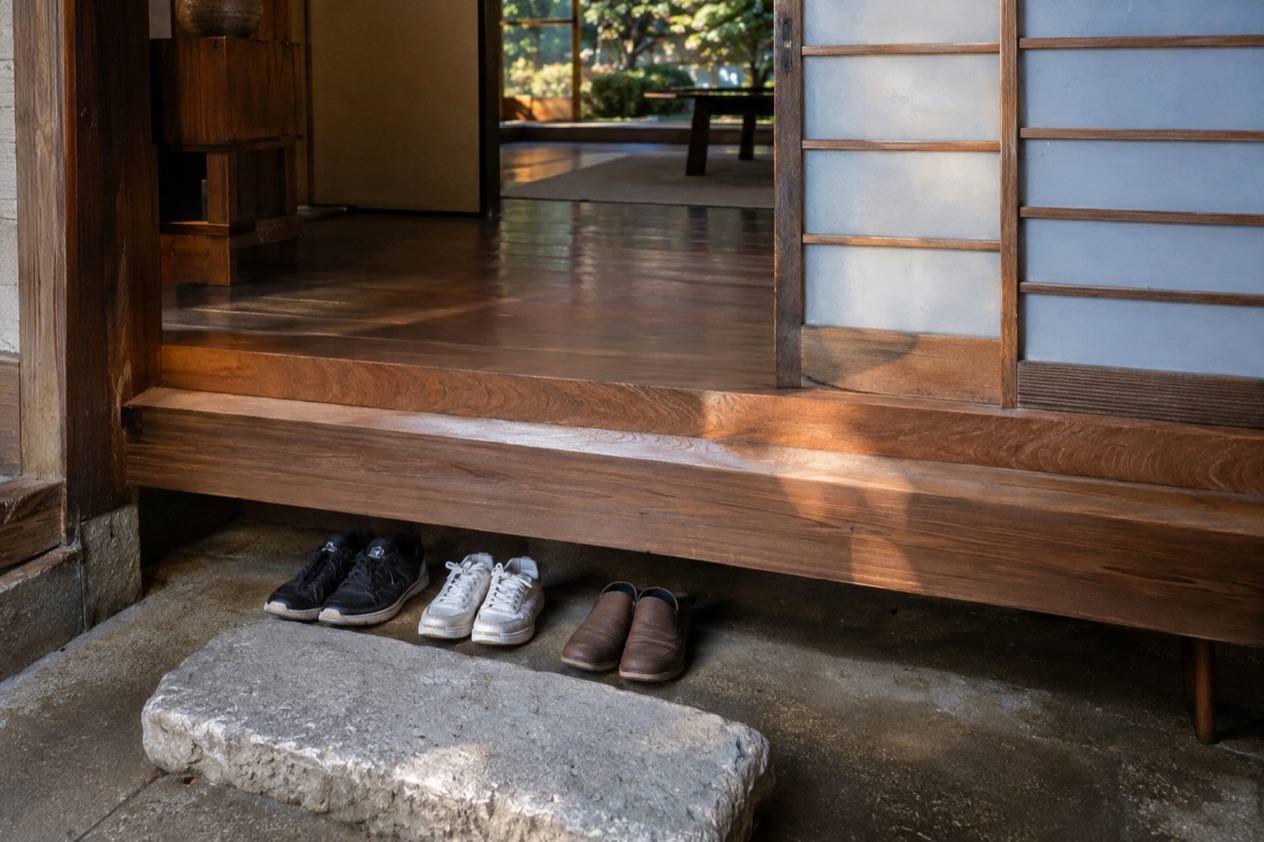
In Japanese homes and inns, shoes are removed in the genkan, the entrance foyer, and often swapped for slippers. The same habit shows how the threshold works: the genkan marks where the outside ends. In the lanes, take the same view of a doorstep as a line you do not cross unless you have been invited.
Ryokan and baths
If you stay at a ryokan in or near a district, other private rules come with it. Slippers come off on tatami mats and are replaced by a separate pair in the bathroom. The bath, the ofuro, is for soaking and not for washing, so you scrub and rinse first, and many ryokan close the bath for several hours each day for cleaning or ask guests to sign up for a soak time.
Many sento and onsen ban customers with tattoos, since tattoos are traditionally taboo and tied in people’s minds to yakuza activity. That is a house rule of the bathhouse, not something you can negotiate at the counter, so plan on that if you have ink.
Where visitors are welcome
The public lanes, the shops and the restaurants that open their doors to travelers are the parts of the districts meant for you. Stage performances and festival appearances are also where geisha perform for a wider audience.
Good to know before you go
Tipping is not part of Japanese custom, so you will not need to add anything on top of a bill, and a small tray at the register is where your payment goes. Carry your trash with you and keep your cigarettes for the designated smoking zones. Autumn evenings can run cool, so a light layer is useful for lantern-lit walks after dark.
Sources
- Japan National Tourism Organization, manners, etiquette, shoes, bowing, chopsticks, public behavior (https://www.japan.travel/en/guide/understanding-and-mastering-japanese-manners-and-etiquette/), checked October 11, 2026
- Wikipedia, Etiquette in Japan (https://en.wikipedia.org/wiki/Etiquette_in_Japan), checked October 11, 2026
- Wikipedia, Geisha (https://en.wikipedia.org/wiki/Geisha), checked October 11, 2026
To plan your stay
- Best Time to Visit Japan: Cherry Blossoms, Autumn Colors, Weather and Festivals
- Where to Stay in Japan: Ryokan, Temple Stays, Capsule Hotels and the Best Cities to Base In
- Sending Luggage from the Airport in Japan: Hands-Free Travel, Hotel Delivery and Coin Lockers
- Know Before You Go to Japan: Entry, Money, Etiquette and Getting Around