
Evening in Fukuoka begins when the yatai, the open-air food stalls, unroll their curtains and the steam from a pot of tonkotsu broth drifts across the sidewalk. By morning the same streets belong to commuters heading into Hakata Station and to joggers circling a park pond. The city rewards whichever neighborhood you choose as a base, but each one feels different, so the real question is whether you want to sleep near the trains, among the shops and stalls, or by the bay.
What is the best area to stay in Fukuoka?
For a first visit, Hakata is the natural answer, because it is where the JR station sits and where the subway line from the airport arrives. Travelers who care most about food and evenings out tend to look at Tenjin and Yakuin, where the yatai stalls and the restaurants gather. Families with children often look at the districts where KidZania and teamLab Forest stand, and anyone who prefers a calmer bayside setting can look at Momochi and Sawara.
Fukuoka is a port city on the north coast of Kyushu, and it spreads out in a way that gives each neighborhood its own character. Hakata is the old merchant town that gave its name to the ramen, the dolls and the great summer festival. Tenjin and Yakuin sit in the part of the city that feels more like a modern downtown. Momochi and Sawara face the water and the newer waterfront development.
Sightseeing travelers will find that the major attractions are spread across these areas rather than packed into one. teamLab Forest Fukuoka is listed in three of them at once, which says something about how the city blends together. KidZania is placed in Hakata and in Tenjin and Yakuin. That overlap means a base in either one keeps the children’s outings close to your door.
Budget travelers have a different kind of advantage here. A bowl of tonkotsu ramen costs no more than 280 yen in some Fukuoka restaurants, and the yatai serve ramen most evenings in Tenjin and Nakasu, so eating well does not depend on a large dining budget. That frees money for the room itself, whether you choose a simple city hotel or save for one night in a ryokan.
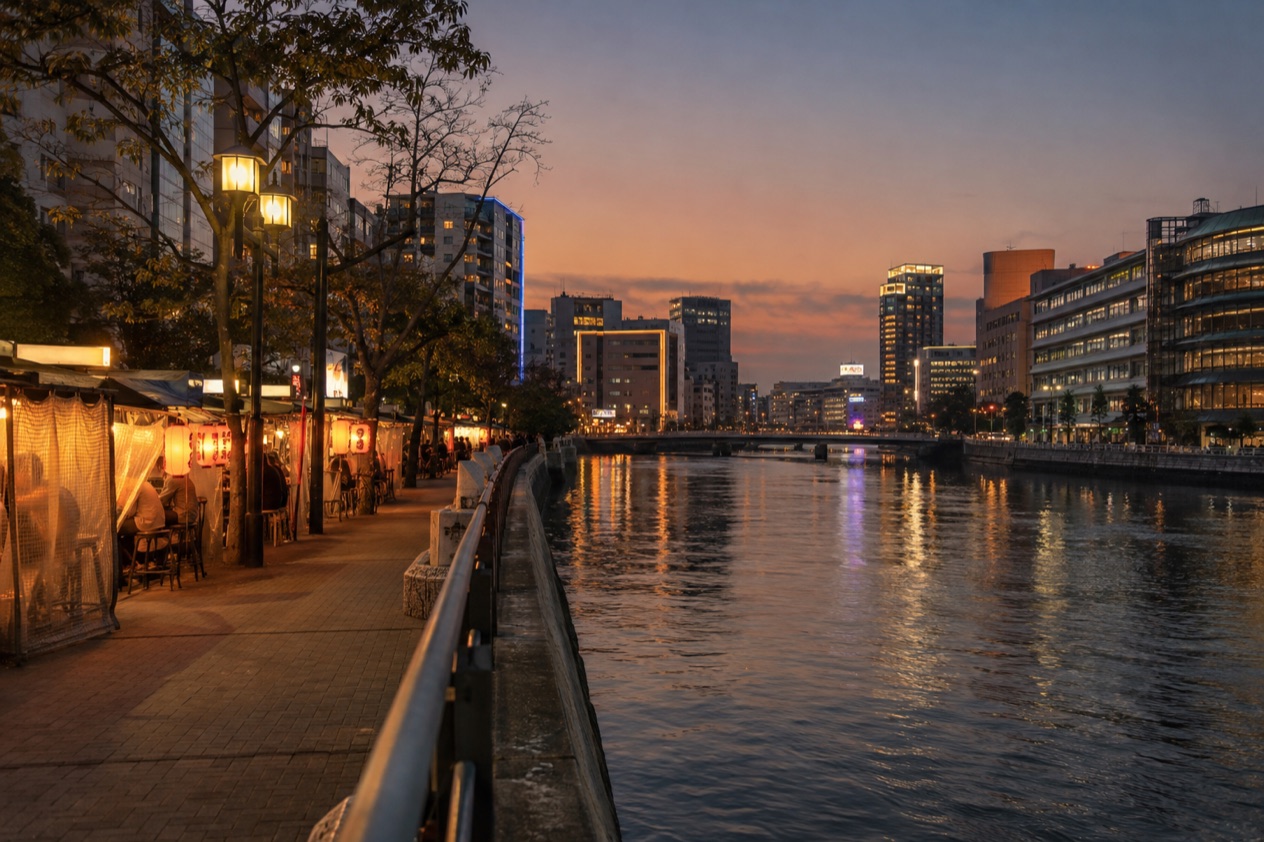
For nightlife, the stalls of Tenjin and Nakasu are the obvious draw. They are a way of spending an evening as much as a way of eating: you sit shoulder to shoulder on a stool, order a bowl or a few skewers, and trade a few words with the neighbor beside you. Staying close enough to walk back afterward is the whole point of choosing that part of town.
Mobility matters too. Fukuoka Airport’s Domestic Terminal is served by the subway, just two stops from Hakata JR station, so a base in Hakata shortens the first and last day of the trip. Elsewhere in the city, the choice depends on what you plan to do each day. Think about where you will spend the evenings, because that is when Fukuoka is at its liveliest.
One more thing shapes the decision: the calendar. Hakata Dontaku takes over the city on May 3 and 4, during Golden Week, and Hakata Gion Yamakasa fills July, with the Oiyama float race on July 15. If your dates match a festival, being in Hakata puts you where the processions and the crowds gather. In the rest of the year, the choice is free to follow your taste for quiet streets or busy ones.
The best areas to stay in Fukuoka
Hakata
Hakata is the area around the JR station, and it is where visitors first arrive. The Domestic Terminal of Fukuoka Airport is served by the subway, two stops from Hakata JR station, so you reach the neighborhood quickly after landing. KidZania and teamLab Forest Fukuoka are both placed in this area, which gives families something to plan around.
The district also carries the weight of the city’s festivals. Hakata Dontaku, held May 3 and 4 during Golden Week, draws 2 to 3 million festival-goers, and the Oiyama float race of Hakata Gion Yamakasa runs on July 15. Staying here during either one means stepping out of the lobby into the celebration, with the sound of drums and the sight of costumed groups in the streets.
Hakata suits first-time visitors, families, and anyone arriving or leaving by train or plane. The lodging is the kind you would expect around a major station in a large Japanese city, and you can also look for a ryokan-style stay if you want a night of tatami and futons. A good tip is to look at the map for the walk from the station exit to your door, since that is the part of the day you will repeat most often.
Tenjin and Yakuin
Tenjin is the part of Fukuoka where the city feels most like a downtown, and Yakuin sits alongside it as a more relaxed neighbor. The yatai serve ramen most evenings in Tenjin, and the stalls were one reason The New York Times included Fukuoka’s Yatai in Hakata in its list of 52 Places to Go in 2023. For anyone who plans to eat out every night, this is a natural base.
KidZania Fukuoka and teamLab Forest Fukuoka are both placed here too, so the area works for families as well as for couples and friends looking for a lively evening. The food that Fukuoka is known for is within reach: motsunabe, the offal hotpot, mentaiko, the spiced pollock roe, and the goma saba, mackerel in a sesame sauce.
The lodging here leans toward city hotels and apartments, as in any dense urban district. This area suits travelers who want restaurants and bars at the doorstep and do not mind that the streets stay active into the evening. A useful tip is to choose a room away from the busiest corner if you are a light sleeper, since the yatai bring a steady flow of people to the sidewalks.
Momochi and Sawara
Momochi and Sawara form the third area where teamLab Forest Fukuoka is placed, and they offer a different mood from the two districts above. This is the bayside part of the city, with a newer feel and wider spaces than the dense blocks around Hakata. Fukuoka is a port city and a short stay here makes that easy to feel.
Staying in Momochi and Sawara suits travelers who prefer a calmer evening, with a meal in the neighborhood and an early night. It also suits those returning for a second visit who already know the center and want a change. Ōhori Park, home to one of the city’s major art galleries, gives another reason to spend a morning outdoors, and the Hakata Port Tower, free to enter, rises next to the international ferry terminal.
The trade-off is distance from the late-night energy of the yatai. If your plan includes ramen at a stall in Tenjin or Nakasu, you will be traveling back at the end of the evening. A good tip is to decide before booking how much of your time you want to spend in this quieter part of town, and how much you want to spend among the stalls.
Fukuoka areas compared
| Area | Best for | Feel | Close at hand |
|---|---|---|---|
| Hakata | First visit, families, festivals | Station district, the old merchant town | JR station, subway to the airport, KidZania, teamLab Forest Fukuoka |
| Tenjin and Yakuin | Food, evenings out, families | Downtown energy | Yatai stalls, KidZania, teamLab Forest Fukuoka |
| Momochi and Sawara | Calmer stays, return visits | Bayside, newer | teamLab Forest Fukuoka |
The main trade-off is between being near the station and having quiet streets. Hakata puts the trains and the airport subway within reach, which suits a traveler who will move on to other parts of Kyushu or Japan.
Tenjin and Yakuin give up none of the city’s appetite and put the stalls at your doorstep, though the evening energy is part of the package. Momochi and Sawara reverse the balance, with more room and a calmer mood but a longer trip back from a night at the yatai.
There is also the question of old town against new. Hakata carries the history of the merchant district and the festivals, with Dontaku in May and Yamakasa in July. Momochi and Sawara, by contrast, are the newer face of a city that has the fastest population growth of any city in Japan. Choosing between them is partly choosing between the Fukuoka that has stood for generations and the one that is still being built.
Two areas share the same two attractions, so a family can pick on mood rather than on access. KidZania appears in both Hakata and Tenjin and Yakuin, and teamLab Forest Fukuoka appears in all three areas. The sights therefore do not force the decision, and the evening you want, a stall dinner or a quiet one, becomes the deciding factor.
How to choose your hotel in Fukuoka
A ryokan, a traditional Japanese inn, offers the most distinctive night of the options. Ryokan typically feature tatami floors, futons, private baths (sometimes outdoor), yukata, a kaiseki dinner, and a traditional Japanese breakfast.
The yukata is a light cotton robe worn around the inn, and kaiseki is a multi-course meal built around seasonal ingredients. Ryokan are believed to have emerged in Japan in the 8th century, so a night in one connects you to a long tradition.
For a deeper step into culture, Heritage Stays let visitors take part in activities such as tea ceremony, calligraphy, and wearing traditional Japanese clothing. Reservations for Heritage Stays are required and can often be made through the property’s website or by phone. This kind of stay suits travelers who want the lodging itself to be part of the day’s plan rather than only a place to sleep.
A standard city hotel is the practical choice when the plan is to explore on foot and by subway. The question to ask is how the room fits the day. If your flight lands at the Domestic Terminal, the subway link to Hakata JR station makes Hakata the simplest anchor for a first and last night. If your evenings revolve around ramen stalls and motsunabe, Tenjin and Yakuin keep dinner close.
Families can weigh the two areas that hold KidZania, Hakata and Tenjin and Yakuin, and the three that hold teamLab Forest Fukuoka. Choosing a base in one of those districts keeps the children’s days in the neighborhood and leaves the evenings for a meal together. Travelers with limited mobility should think about the route from the station to the room, since the station is where most days start and end.
Think too about the season of your visit. In early May, Hakata Dontaku brings the city out in costume during Golden Week, and in July the Yamakasa festival turns Hakata into a stage for racing floats. A room in or near Hakata puts you in the middle of either one. In other months, the choice can follow taste: lively streets in Tenjin, the bayside calm of Momochi, or a night on tatami in a ryokan.
Food shapes the decision more than visitors expect. Fukuoka City was selected in the Food category of Lonely Planet’s Best In Travel 2023, and the local table includes Hakata tonkotsu ramen, mentaiko, motsunabe and goma saba. Because the yatai serve ramen most evenings in Tenjin and Nakasu, a base near those stalls lets you eat late and walk home. A base elsewhere simply trades that for a quieter dinner.
Good to know before you go
Fukuoka Airport’s Domestic Terminal is served by the subway, just two stops from Hakata JR station, which makes the first ride into the city a short one on the map. Money goes a long way at the table, since a bowl of tonkotsu ramen costs no more than 280 yen in some restaurants. Fukuoka is also the capital of Fukuoka prefecture and the largest city on Kyushu, so many other trips begin from here.
Sources
- Japan National Tourism Organization, Fukuoka (https://www.japan.travel/en/destinations/kyushu/fukuoka/fukuoka-city/), checked October 11, 2026
- Fukuoka City official tourist guide (https://yokanavi.com/en/), checked October 11, 2026
- Wikipedia, Fukuoka (https://en.wikipedia.org/wiki/Fukuoka), checked October 11, 2026
- Wikivoyage, Fukuoka (https://en.wikivoyage.org/wiki/Fukuoka), checked October 11, 2026
- Japan National Tourism Organization, ryokan stays, what is included, etiquette (https://www.japan.travel/en/guide/japanese-ryokan/), checked October 11, 2026
- Japan National Tourism Organization, heritage stays (https://www.japan.travel/en/heritage-stays/), checked October 11, 2026