
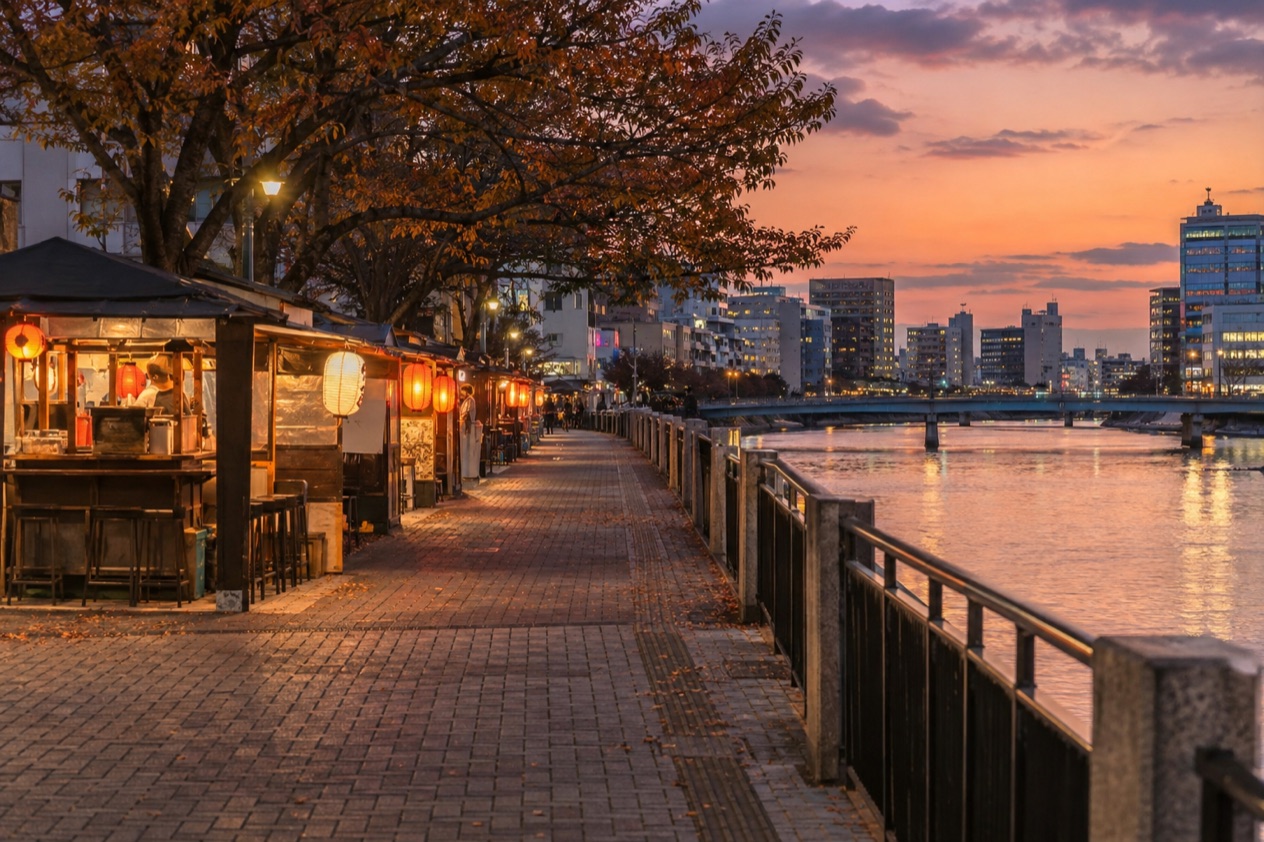
In November, the yatai stalls along the Hakata riverfront trade their summer chatter for steam, and the smell of pork-bone broth drifts between the lanterns as customers squeeze onto stools under plastic curtains. Fukuoka, the port city on the north coast of Kyushu, cools down just enough to make ramen, hot pots and a slow walk through a park feel right. This is a month for eating well, wandering shrine grounds and watching the first reds appear on the maples.
What is the weather like in Fukuoka in November?
November in Fukuoka is cool and mostly comfortable, a clear step down from October’s warmth and not yet the chill of December, with a scattering of rainy days and plenty of gray sky between the sunny ones.
| Month | Average high (°F) | Average low (°F) | Precipitation (in) | Days with 1 mm or more of precipitation | Hours of sunshine | Daylight on the 15th |
|---|---|---|---|---|---|---|
| October | 74.7 | 60.8 | 3.72 | 6.8 | 176 | 11 h 24 min |
| November | 64.8 | 51.1 | 3.60 | 8.5 | 137 | 10 h 27 min |
| December | 54.7 | 42.4 | 2.66 | 8.5 | 112 | 9 h 57 min |
What this means in practice: a sweater or a light jacket is the baseline, and a scarf starts to make sense once you are sitting outside at a yatai stall. The warm, sticky feeling of a Kyushu summer is gone. Walking is pleasant, which fits the way Japan’s tourism board describes autumn, as a season of moderate temperatures that suit walking.
Rain arrives on a handful of days, so a compact umbrella earns its place in the bag. Humidity eases compared with October, and the sunshine hours fall noticeably, which gives the month a softer, grayer light than the clear days of early autumn. Snow is a rarity in November here, and sleet only becomes a real possibility in December.
Daylight is shrinking, and the evenings arrive early enough that the lights of Tenjin and the lanterns of the food stalls are on well before a late dinner. Plan outdoor sights for the daylight hours and keep the evening for eating, which is what this city does best anyway.
What to do in Fukuoka in November
Start with the food, because that is what Fukuoka is known for and what the cooler weather rewards. The city was selected in the Food category of Lonely Planet’s Best In Travel 2023, and its yatai in Hakata were chosen for The New York Times’ list of 52 Places to Go in 2023. A yatai is a small mobile food stall, and in Fukuoka the stalls line up along the river and in the Nakasu and Tenjin areas, each seating a few people elbow to elbow.
November is not a festival month here. The big dates, Hakata Dontaku in early May and the Hakata Gion Yamakasa in July, belong to other seasons. What November offers instead is the pace of an ordinary city in good weather, with open-air time, shrine visits and long meals filling the days.
Yatai stalls and the bowl of Hakata ramen
Tonkotsu ramen, the milky pork-bone broth ladled over thin noodles, traces its origin to Kurume, also in Fukuoka Prefecture, and it is the dish the city built its name on. At a yatai you order from a short menu, eat shoulder to shoulder with strangers and watch the cook work in a space barely larger than a counter. The steam and the heat of the broth are exactly what a cool November evening asks for.
Beyond ramen, stalls and small restaurants serve grilled skewers, gyoza, oden (fish cakes and vegetables simmered in a light broth) and a good deal of local seafood. Look for mentaiko, the spicy cod roe that Fukuoka has made its own, spooned onto rice or folded into omelets.
Dazaifu Tenmangu in the turning season
Dazaifu Tenmangu is a shrine to Sugawara no Michizane, the scholar honored as a patron of learning, and students come to ask for success in exams. You walk under a stone torii and across a curved bridge over a pond before reaching the halls, with camphor trees and plum trees around the grounds. The renovation of the honden, the main hall, is expected to take about three years, so parts of the shrine may look different from the photographs.
The approach street outside is lined with shops selling umegae mochi, a grilled rice cake stuffed with sweet red bean paste and associated with the shrine. Maple leaves in Fukuoka usually change color around the start of December, just after the month ends, so in November the colors are building rather than at full strength. The tourism board describes brilliant reds, yellows and oranges from mid-November to early December across Japan, and a first hint may show on the trees.
Ohori Park and the waterfront
Ohori Park is built around a large pond with islands and bridges, and a loop path circles the water. It is also the location of one of Fukuoka City’s major art galleries, which makes it a natural plan for a gray or showery day when you want to drift between indoors and out. The cooler air suits walking the loop at an unhurried pace, with ducks and herons on the water.
Fukuoka also faces the sea, and the Momochi waterfront with Fukuoka Tower gives you a view of the bay. In November this is a place to stroll in a jacket and look out at the water rather than to swim. Back in the center, Kushida Shrine near the Hakata canal area and the temple district around Tochoji add quieter shrine and temple stops between meals.
Between sights, the covered shopping arcades and department stores of Tenjin and the station buildings at Hakata give you somewhere dry when a shower passes. Izakaya, the casual pubs where food comes in small plates, fill the evenings, and Kyushu dishes such as motsunabe, a hot pot of beef offal and cabbage, and mizutaki, a chicken hot pot, suit the cooler nights.
A two-day itinerary for Fukuoka in November
Day 1 belongs to the city center and the water. Begin at Ohori Park with a loop around the pond while the air is cool, then step into the park’s art gallery if clouds gather. For lunch, pick a small ramen shop or a set-meal restaurant near Tenjin and try a bowl of Hakata tonkotsu if you have not already.
In the afternoon head to the Momochi waterfront and Fukuoka Tower for a view of the bay, then walk back toward the center through the arcades. The shortening November days mean you should keep outdoor sights for before dusk. Evening is for the yatai along the river in Nakasu and Tenjin, with grilled skewers, mentaiko and a final bowl of noodles. If rain sets in, the shopping arcades and station buildings keep you dry.
Day 2 is for Dazaifu. Spend the morning at Dazaifu Tenmangu, walking beneath the torii, over the bridge and past the camphor trees, then browse the approach street and try umegae mochi fresh off the grill. Look at the maples with the expectation that November shows only the beginning of the color.
Return to the city for the afternoon and visit Kushida Shrine and the temple area around Tochoji, both easy to fit between meals. For dinner, choose an izakaya or a hot pot restaurant, where motsunabe or mizutaki turns a cool evening into a long, warm table. On a wet day, swap the shrine walks for the art gallery and a long lunch, and leave the stalls for the evening.
Is Fukuoka busy in November?
November in Fukuoka feels like a city going about its business in pleasant weather rather than one hosting a big seasonal event.
Japan’s tourism board points to the stretch from mid-November to early December as the time when trees across the country show their colors, and Fukuoka’s own maples usually turn right around the start of December. That means the leaf season in the city sits at the edge of the month, so a trip at the end of November lines up better with it than one at the start.
The food scene keeps the city lively at night, with the yatai drawing crowds of diners on the riverfront and in the entertainment districts. Fukuoka is also described as the fastest-growing city in Japan, so the streets around Hakata and Tenjin have the busy feeling of a place with many residents, not just visitors. Nothing here closes down for a holiday in November, since the closures tied to the New Year holidays come later, in winter.
What to pack for Fukuoka in November
Pack for cool, changeable days that mix walking, outdoor eating and a few showers.
- A light jacket or a mid-weight sweater, for the cool air at the shrines and by the water.
- A compact umbrella or a light rain shell, for the scattered showery days.
- A scarf, which is welcome on a stool at an open-air yatai stall.
- Comfortable walking shoes, for the loop around Ohori Park and the paths at Dazaifu.
- A long-sleeved shirt to layer under the jacket, for days that start cool and turn mild.
Good to know before you go
November in Fukuoka is a calm month on the calendar. Hakata Dontaku, held on May 3 and 4, and the Hakata Gion Yamakasa in July both fall outside it, so you will not find those festival crowds or closures. The closures that Japan’s tourism board mentions for the New Year holidays, when many restaurants and attractions shut, come later in the winter.
The renovation of Dazaifu Tenmangu’s honden is expected to take about three years, so it is worth keeping that in mind when picturing the shrine. Rain showers come in the month, so a day of indoor stops, such as the art gallery at Ohori Park or the shopping arcades, is a useful fallback.
Fukuoka in November vs October and December
Moving the trip four weeks earlier brings warmer, sunnier days, with more hours of light for walking the park and the waterfront and fewer rainy days. The trade is that the autumn mood has not arrived, the maples are still green and the bowl of hot ramen feels less necessary. Choose October if you want long outdoor days and do not mind a warmer city.
The air is colder, daylight is shorter, and sleet becomes possible. The rain days stay at about the same count as November, and the New Year closures come closer at the end of the month.
Stay in November if you want cool weather made for food, a first taste of the leaf season and a city without a big festival. Shift to October for sunshine, or to early December for the maples and the warming hot pots. Anyone who wants a festival should look to May or July instead.
Is November a good time to visit Fukuoka?
Yes, November suits travelers who come for food, shrines and walks, and who are happy with cool air and an umbrella in the bag.
People who love eating will get the most from it, because a ramen counter, a hot pot or a stool at a yatai is exactly right in the cooler weather. Walkers will like the park loops and the shrine grounds, and anyone curious about the first signs of autumn color will find it building toward the start of December. Those who want warm sun, beach time or a big festival are better off in another month.
On arrival, go straight to the food: find a yatai along the river, order a bowl of tonkotsu ramen and look at the lanterns. What sets November apart in Fukuoka is that moment, a cool evening, steam rising from the broth and a city that eats outdoors anyway.
Sources
- Japan Meteorological Agency (JMA), Normal values 1991-2020, monthly (https://www.data.jma.go.jp/stats/etrn/view/nml_sfc_ym.php?prec_no=82&block_no=47807), station Fukuoka, elevation 2 m, checked October 11, 2026
- Computed from the date and the latitude of the place (sunrise equation, solar elevation -0.833 degrees), October 11, 2026
- Japan Meteorological Agency, maple color-change dates 2025-2026 with difference from the 1991-2020 normal (https://www.data.jma.go.jp/sakura/data/phn_014.html), checked October 11, 2026
- Japan Meteorological Agency, kaede2020.pdf (https://www.data.jma.go.jp/sakura/data/kaede2020.pdf), checked October 11, 2026
- Japan National Tourism Organization, winter in Japan (https://www.japan.travel/en/guide/winter-guide/), checked October 11, 2026
- Japan National Tourism Organization, autumn in Japan (https://www.japan.travel/en/guide/autumn-guide/), checked October 11, 2026
- Japan National Tourism Organization, spring in Japan (https://www.japan.travel/en/guide/spring-guide/), checked October 11, 2026
- Japan National Tourism Organization, summer in Japan (https://www.japan.travel/en/guide/summer-guide/), checked October 11, 2026
- Wikipedia, Fukuoka (https://en.wikipedia.org/wiki/Fukuoka), checked October 11, 2026
- Wikivoyage, Fukuoka (https://en.wikivoyage.org/wiki/Fukuoka), checked October 11, 2026
- Japan National Tourism Organization, Fukuoka (https://www.japan.travel/en/destinations/kyushu/fukuoka/fukuoka-city/), checked October 11, 2026
- Fukuoka City official tourist guide (https://yokanavi.com/en/), checked October 11, 2026
- Wikipedia, Dazaifu Tenmangū (https://en.wikipedia.org/wiki/Dazaifu_Tenmang%C5%AB), checked October 11, 2026
- Wikipedia, Yatai (food cart) (https://en.wikipedia.org/wiki/Yatai_(food_cart)), checked October 11, 2026
- Wikipedia, Hakata ramen (https://en.wikipedia.org/wiki/Hakata_ramen), checked October 11, 2026
- Wikipedia, Ramen (https://en.wikipedia.org/wiki/Ramen), checked October 11, 2026