
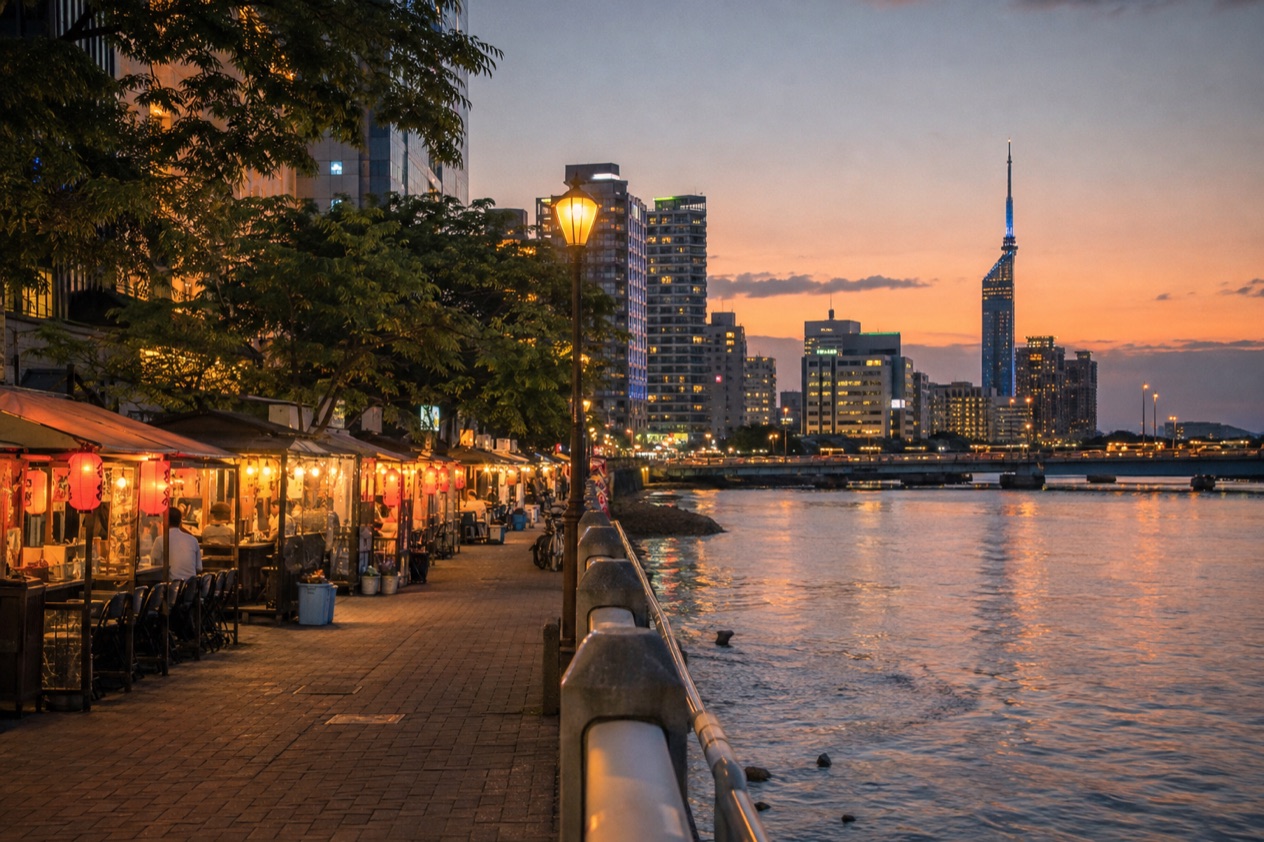
You step out of Fukuoka Airport and the city is already close: a subway ride takes you straight toward Hakata station, and by evening the food stalls along the river are lit and steaming. It is a port city on the north coast of Kyushu, with ramen shops, festivals and a gaze that has long turned toward the Asian mainland. A few things about papers, payment, getting around and manners make the first days run smoothly.
What should you know before visiting Fukuoka?
Four things matter most: a valid U.S. passport that you keep on you, a mix of cards and yen, the habits of shoes and manners, and a climate that changes sharply from a damp, hot July to a crisp January. Everything else is a pleasure rather than a worry, and much of the pleasure is edible.
Fukuoka is the capital of Fukuoka prefecture and the largest city on Kyushu, the third largest island of Japan. It sits on the north coast, and its harbor has looked across the water to Korea for centuries. That closeness to the Asian mainland shaped its trade, its temples and its taste for noodles and broth, and it is why the city often feels like a gateway rather than an endpoint.
What surprises first-time visitors is how much of the city’s life happens outdoors and after dark. The yatai, the open-air food stalls of Hakata, were chosen for The New York Times’ 52 Places to Go in 2023, and Lonely Planet named Fukuoka City in the Food category of its Best In Travel 2023.
You sit shoulder to shoulder on a stool, order a few small plates and a bowl of tonkotsu ramen, and chat with whoever is next to you. In some restaurants, that bowl costs no more than 280 yen.
The other surprise is the pace. Fukuoka has the fastest population growth of any city in Japan, yet its center is organized around the airport, Hakata station and the riverside districts. You can go from plane to noodles with very little fuss.
Entry, customs and paperwork
For tourist or business visa-free stays, the U.S. State Department says U.S. citizens must have a valid passport and should have proof of a return or onward ticket. The stay can run up to 90 days. The passport must be valid for the entire time you are staying in Japan, so it is worth glancing at its expiration date well before you pack.
A visa-free stay is for visiting, not for earning. The State Department notes that you cannot work on the local economy while in Japan on a visa-free stay, which covers everything from a paid job to casual work in a guesthouse.
Once inside the country, the State Department’s page on local laws adds that you must always carry your U.S. passport or a Japanese Residence Card (Zairyu Kado). If you cannot show proof of identity and status, you may be questioned or detained. Travelers keep the passport in a zipped pocket of their day bag, and the habit costs nothing.
The same source flags one item that surprises people who use wellness products: CBD may be illegal in Japan, depending on the amount of THC it contains. It is a good reason to leave such products at home rather than to test the border with them.
Money, cards and tipping
Japan’s national tourism organization says international credit, debit and prepaid cards are generally accepted throughout Japan, and that covers Fukuoka’s hotels, department stores and larger restaurants. The currency is the yen, and you will still want some of it in your pocket for the smaller places.
The same source adds a small caution. In some cases, stores do not display the symbols of the cards they accept, so you should ask the seller if your card will work. A simple, smiling gesture with the card in your hand usually does the job, and it is worth doing at a counter-only noodle shop or a stall in the evening, where a sign may say nothing at all.
The yatai are a good example of why a few coins and bills are useful. These are tiny places, and the whole experience is built around quick orders, small plates and a bowl of ramen at the end. A ramen bowl in some restaurants costs no more than the price quoted above, which shows how modest an everyday meal can be in this city.
Tipping is not part of Japanese dining or taxi habits. People say thank you at the register, and a hand-written note or a polite word to the cook is the closest equivalent. Leaving money on the table can even leave the staff chasing you down the street to return it.
Getting around and staying connected
Fukuoka’s airport is unusually close to the center. The Domestic Terminal is served by the subway, just 2 stops from Hakata JR station.
Hakata station is where Fukuoka meets the rest of the country. The city lies 684 miles from Tokyo, and the rail lines running through the station are what connect it to the capital and the rest of Kyushu. Because Fukuoka is the largest city on its island, it works as a base for those who want to see more of Kyushu.
Ohori Park, home to one of Fukuoka City’s major art galleries, lies on the same map and gives you a green pause between stops.
Staying connected is a matter of preference rather than necessity, and the choices are the usual ones: a SIM card, an eSIM or a pocket Wi-Fi unit. Whichever you pick, it helps to set it up before you leave home or in the airport, so that your maps and translation apps are ready when you reach Hakata.
Beyond the city, the Nanzoin temple lies east of Fukuoka. Founded in 1899, it claims to have the largest statue of a reclining Buddha in the world, and it makes an outing for a day when you want a change from the city streets.
Health, water and the weather
The weather is the part of health that you can plan for. Fukuoka swings from a cold, gray winter, with the occasional dusting of snow, to a heavy, humid summer. Spring and autumn sit in between, and they are the seasons when a day of wandering between temples, parks and food stalls feels most natural.
| Month | Avg high (°F) | Avg low (°F) | Precipitation (in) | Rain days | Sunshine (hours) |
|---|---|---|---|---|---|
| January | 50.4 | 39.0 | 2.93 | 9.3 | 104 |
| April | 67.8 | 52.7 | 4.65 | 9.7 | 188 |
| July | 88.2 | 76.3 | 11.78 | 11.0 | 172 |
| October | 74.7 | 60.8 | 3.72 | 6.8 | 176 |
January is cold enough for a proper coat, and a few snowy or sleety days are possible. Snow is a light dusting at most, so the main effect is on how long you want to stay outside at the evening stalls. April brings mild afternoons and cool evenings, with a light jacket doing most of the work.
July is the month to prepare for. Hot afternoons, warm nights, humid air and heavy rain make it the wettest of the four, and the days feel sticky even when the sun comes out. The Hakata Gion Yamakasa festival falls in this month, so visitors accept the weather for the sake of the crowds and the floats. October has the fewest rain days of the group, with warm afternoons and cooler evenings.
What you can plan for is clothing: layers for the shoulder seasons, a light, breathable outfit and an umbrella for summer, and a warm coat for winter.
Local customs and etiquette
Shoes are the first habit you meet. In Japan it is customary to remove your shoes at the entrance of a building, put on indoor slippers, and leave your shoes in a shoe box or to the side.
Inside a Japanese home or ryokan, the habit goes one step further. Slippers come off before you step on tatami mats, and a separate pair of toilet slippers is often provided at the bathroom door. It sounds fussy until you do it, and then it becomes a small, pleasant routine of the day.
On trains and subways, people tend to keep their voices low, set their phones to silent and take calls outside the car. Lines form at platform markings, and people wait for others to get off before they step on. The same patience shows up at the yatai, where strangers sit close and order quietly, passing dishes along the counter.
Trash cans are not always where you expect them, so people carry a small bag for wrappers and bottles and take them back to the hotel. A slight bow, a quiet thank you and a word like arigato are a graceful way to start or end an exchange, and nobody expects perfect pronunciation.
Festivals have their own rhythm. Hakata Dontaku is held on May 3 and 4, with parades through the streets, and the Oiyama float race of Hakata Gion Yamakasa takes place on July 15.
Good to know before you go
The U.S. State Department rates Japan Level 1: Exercise Normal Precautions.
Weather is the part of the year that most changes a trip. July is humid and heavy with rain, while winter brings cold air and the odd sleety day, and the seasons in between are milder. Keep your passport on you, since the rule on carrying it applies throughout your stay, and have a card and some yen ready for the day.
Finally, bring an appetite for the local cooking. Fukuoka is famous for motsunabe, a hotpot of offal, and for gomasaba, mackerel coated in sesame sauce, and both are worth ordering at a counter once you are settled in.
Sources
- Japan National Tourism Organization, Fukuoka (https://www.japan.travel/en/destinations/kyushu/fukuoka/fukuoka-city/), checked October 11, 2026
- Fukuoka City official tourist guide (https://yokanavi.com/en/), checked October 11, 2026
- Wikipedia, Fukuoka (https://en.wikipedia.org/wiki/Fukuoka), checked October 11, 2026
- Wikivoyage, Fukuoka (https://en.wikivoyage.org/wiki/Fukuoka), checked October 11, 2026
- U.S. Department of State, Japan travel information, local laws and special circumstances (https://travel.state.gov/content/travel/en/international-travel/International-Travel-Country-Information-Pages/Japan.html), checked October 11, 2026
- Japan National Tourism Organization, manners, etiquette, shoes, bowing, chopsticks, public behavior (https://www.japan.travel/en/guide/understanding-and-mastering-japanese-manners-and-etiquette/), checked October 11, 2026
- Japan National Tourism Organization, credit cards and cash, where cards are accepted (https://www.japan.travel/en/plan/credit-cards/), checked October 11, 2026
- U.S. Department of State, Japan travel advisory (https://travel.state.gov/content/travel/en/international-travel/International-Travel-Country-Information-Pages/Japan.html), checked October 11, 2026
- U.S. Department of State, Japan travel information, entry and exit requirements (https://travel.state.gov/content/travel/en/international-travel/International-Travel-Country-Information-Pages/Japan.html), checked October 11, 2026
- Japan Meteorological Agency (JMA), Normal values 1991-2020, monthly (https://www.data.jma.go.jp/stats/etrn/view/nml_sfc_ym.php?prec_no=82&block_no=47807), station Fukuoka, elevation 2 m, checked October 11, 2026