
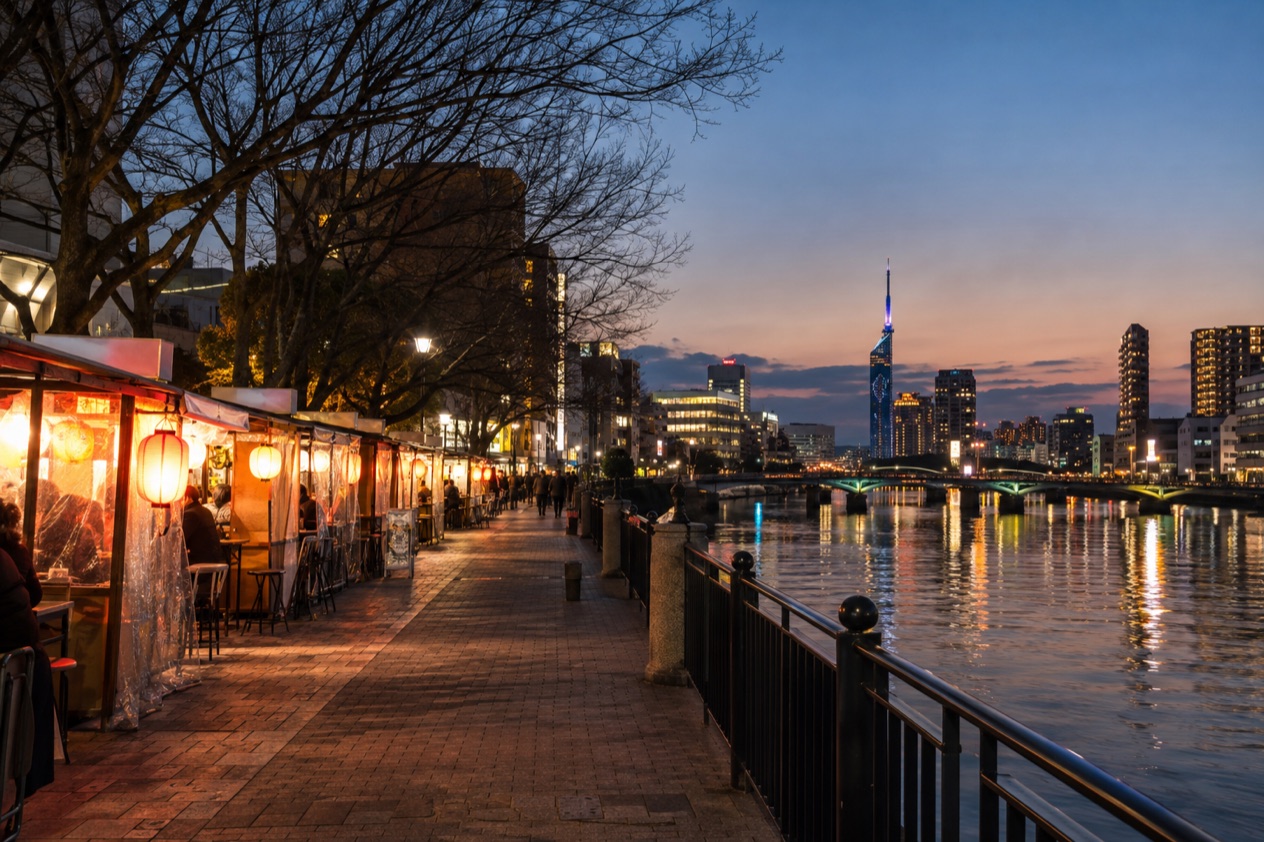
On the first days of January, Fukuoka’s shrines fill with people in winter coats who ring the bell, toss a coin and tie a fortune to a rack of pine branches. By night, the steam from ramen stalls drifts out under strings of lanterns along the river.
January in Fukuoka is a cold-weather month of New Year customs, bowls of pork-bone broth and the first plum buds. It suits travelers who want a lived-in port city on Kyushu, not a month of festivals and blossoms.
What is the weather like in Fukuoka in January?
January in Fukuoka is cold and often gray, but it is not a harsh winter: the city sits at the mild end of the range for the month, with damp days and a low sun. Here are the three winter months side by side.
| Month | Average high (°F) | Average low (°F) | Precipitation (in) | Days with 1 mm or more of precipitation | Hours of sunshine | Daylight on the 15th |
|---|---|---|---|---|---|---|
| December | 54.7 | 42.4 | 2.66 | 8.5 | 112 | 9 h 57 min |
| January | 50.4 | 39.0 | 2.93 | 9.3 | 104 | 10 h 09 min |
| February | 52.9 | 39.9 | 2.75 | 8.8 | 124 | 10 h 58 min |
Highs stay around 50°F, so a coat is part of every outing, and lows hover just above freezing, enough that you want gloves and a scarf once you are out walking after dinner. Rain falls on roughly one day in three. It comes as ordinary winter showers, and sleet or light snow also turns up on about nine days of the month, though almost nothing settles on the ground.
Humidity stays moderate, so the cold feels dry on a bright day and raw on a gray one. Sunshine is at its lowest of the three months, and the sun sets early, which pushes dinner and the evening lights into the middle of the afternoon plan.
Layers do the work: a warm inner layer, a coat you can zip to the chin and a compact umbrella or rain shell for the gray spells. Indoor stops such as covered shopping streets, department stores, shrine halls and noodle counters turn a wet afternoon into part of the plan instead of a loss.
What to do in Fukuoka in January
The month opens with New Year, and the first days of January belong to the shrines. The Japanese New Year is celebrated on January 1, and the custom of hatsumode, the first shrine visit of the year, brings families out to bow, make a wish and buy a charm for the months ahead.
Fukuoka’s shrines, large and small, are the natural place to watch it. Around the shrine gates you see people in their best winter clothes, children with sweets and stalls steaming in the cold.
Two local events fall early in the month. Tamaseseri, at Hakozaki Shrine, is usually held on January 3, when teams of men in loincloths scramble for a wooden ball in a lively scrum. Around the tenth, the Toka Ebisu festival honors Ebisu, the god of business and good fortune, and merchants come to pray for a prosperous year. Both are about neighborhood tradition, not about a show for visitors.
At home, New Year is marked by osechi, a selection of dishes packed in tiered boxes, but during the holidays many restaurants and attractions are closed. The first days are therefore best for shrines, walks and whatever happens to be open. After the holiday, the city’s tables and shops return to their normal rhythm and the real winter eating begins.
January is also hot-pot season. Motsunabe, a pot of beef or pork offal with cabbage and garlic chives, and mizutaki, a clear chicken broth, fit the cold well, and mentaiko, the spicy pollock roe the city is known for, shows up on rice, in omelets and next to the pots. Shops in urban areas are generally open from 10:00 a.m. to 8:00 p.m., so there is plenty of time to browse between meals.
Yatai and ramen on a cold night
A yatai is a small, mobile food stall, and Fukuoka’s are chosen for the New York Times list of 52 Places to Go in 2023. They sell ramen and other dishes, and the city was also picked in the food category of Lonely Planet’s Best in Travel 2023. In January the appeal is simple: a few stools under a canvas, a pot of broth and the steam rising into cold air.
Tonkotsu ramen, the milky pork-bone style, originated in Kurume, in Fukuoka Prefecture, and Hakata’s version has thin noodles and a rich broth. Order a bowl, then add a few skewers or an order of dumplings between conversations with the neighbors on either side. In winter you will eat with your coat on, so bring a scarf, and expect to leave smelling of broth.
Dazaifu Tenmangu and the plum season
Dazaifu Tenmangu is a shrine to the scholar-god of learning, where students come to pray before exams, and its grounds are known for plum trees. Prunus mume typically flowers from January until late February in East Asia, so you may catch the first buds or early blossoms, though the timing shifts from one winter to the next and a cold spell can hold the flowers back.
The renovations of the honden, the main hall, are expected to take about three years, so the shrine is a place to walk the approach, the pond and the trees, not to count on seeing the hall itself. Along the approach, shops sell umemochi, rice cakes with a plum motif, and you can warm up with tea and a sweet before heading back to the city.
Ohori Park on a winter day
Ohori Park is a large park built around a pond, and it is a place for a long walk in cold, clear weather. Bare winter trees open up the views across the water, and you will often see joggers, walkers and people feeding the birds. It is one of the places in town where the pace slows after the holiday rush.
The park is also the location of one of Fukuoka City’s major art galleries, which makes it a good rain plan: walk the pond when the sky is dry, then step indoors if sleet starts. A hot drink at a café near the water makes a natural stop between the two.
A two-day itinerary for Fukuoka in January
Day 1 stays in the city center, where January’s short daylight is easy to manage. Begin at Hakata Station with a late breakfast and a look at the shops, then spend the late morning in a neighborhood shrine, where New Year decorations may still be up. Lunch can be a noodle counter or a set meal, and the afternoon goes to Canal City and the department stores around Tenjin, which are as useful on a wet day as on a dry one.
As the light fades early, move to the river and the Nakasu area, where the lanterns come on and the yatai begin to open. Eat a bowl of ramen at one stall and, if you have room, a few skewers at another. In sleet or rain, the covered arcades of Tenjin and the underground shopping streets keep the afternoon intact, and the evening plan hardly changes.
Day 2 goes out to Dazaifu for the morning, with a stroll along the approach, the pond and the plum trees, and a snack of umemochi with tea. Coming back to the city, head to Ohori Park for a loop of the pond, and if the clouds come in, step into the art gallery for the rest of the afternoon. Finish with a hot pot of motsunabe or mizutaki, a good last meal in cold weather.
Is Fukuoka busy in January?
January in Fukuoka is not a bloom or leaf-color season, so the pace is set by the New Year holidays and the weather, not by a rush of sightseers. The first days are dominated by shrine visits and family gatherings, and the city moves more slowly while many restaurants and attractions are closed.
Once the holiday ends, shops in urban areas return to their usual hours, and the places that make Fukuoka a food city are back in business. The yatai that earned the city a place on the New York Times list in 2023, and the ramen counters and hot-pot restaurants behind its Lonely Planet food selection that year, are a main reason to come in winter.
Fukuoka is not a ski destination. Japan’s snow resorts are in the mountains and in Hokkaido, where the season is at its height in January and February, and most major cities rarely see snow. Fukuoka stays a city of coats and umbrellas, and the month’s visitors are mostly there for the food, the shrines and the early plum blossoms.
What to pack for Fukuoka in January
Pack for cold, damp days of walking, with plenty of room for layers you can add or remove as you move between the street and heated interiors.
- A warm coat that closes at the neck, for evenings at the yatai and the shrine grounds.
- Thin layers such as a fleece or sweater, for overheated trains and shops.
- A compact umbrella or rain shell, since showers and sleet come on many days.
- Gloves, a hat and a scarf, for lows just above freezing.
- Comfortable shoes with grip, for shrine paths and damp pavement at Dazaifu and Ohori Park.
Good to know before you go
The first days of January are the New Year holidays, when many restaurants and attractions are closed, so build the early part of a trip around shrines and walks. When a national holiday falls on a Sunday, the next working day becomes a public holiday, and a day sandwiched between two holidays also becomes one, so a long weekend can change what is open.
Coming of Age Day falls on the second Monday of the month. In urban areas, shops are generally open from 10:00 a.m. to 8:00 p.m. every day.
Fukuoka in January vs December and February
Moving the trip four weeks earlier brings you to December, which is a few degrees milder with a bit more sunshine and a little less rain, though the days are the shortest of the year. You miss the New Year shrine visits and the early-January festivals, but the hot-pot season is already under way, and the city is in its pre-holiday rhythm.
Four weeks later, February has the brightest skies of the three months and noticeably longer days, which helps a day of sightseeing. The plum trees keep flowering until late February in East Asia, so Dazaifu has a better chance of showing blossoms, and the New Year closures are well behind you. It is a little warmer than January, but still a coat month.
Choose January if you want New Year customs, Tamaseseri and Toka Ebisu, and the coldest, most atmospheric nights at the yatai. Choose December for the milder weather and the lead-up to the holidays, and February for more light and a better chance at plum blossoms.
Is January a good time to visit Fukuoka?
Yes, for travelers who come for food, shrines and city walks and who do not mind cold, gray days. January suits people who like steam rising off a bowl of ramen, who want to see New Year customs at the shrines and who are happy to treat a shower as a reason to step into a gallery, a department store or a noodle counter.
It is less suited to those who want clear skies and long outdoor days, or who are looking for blossoms in full flower or snow sports. Such travelers will be happier in another month, or in the mountains and Hokkaido, where the ski season peaks in January and February.
On arrival, spend the first evening at a yatai or a hot-pot restaurant, since a meal does more than anything to take the edge off the cold. After that, let the days fall into a rhythm of shrine, park and noodles. What is special about January here is the contrast: a port city of winter coats, lantern light and broth, with the first plum buds just beginning to open.
Sources
- Japan Meteorological Agency (JMA), Normal values 1991-2020, monthly (https://www.data.jma.go.jp/stats/etrn/view/nml_sfc_ym.php?prec_no=82&block_no=47807), station Fukuoka, elevation 2 m, checked October 11, 2026
- Computed from the date and the latitude of the place (sunrise equation, solar elevation -0.833 degrees), October 11, 2026
- Japan National Tourism Organization, shop and attraction hours, national holidays (https://www.japan.travel/en/plan/business-hours-and-holidays/), checked October 11, 2026
- Wikipedia, Japanese New Year (https://en.wikipedia.org/wiki/Japanese_New_Year), checked October 11, 2026
- Wikipedia, Public holidays in Japan (https://en.wikipedia.org/wiki/Public_holidays_in_Japan), checked October 11, 2026
- Japan National Tourism Organization, winter in Japan (https://www.japan.travel/en/guide/winter-guide/), checked October 11, 2026
- Japan National Tourism Organization, skiing and snowboarding in Japan: regions, resorts, seasons (https://www.japan.travel/en/sports/snow/), checked October 11, 2026
- Wikipedia, Climate of Japan (https://en.wikipedia.org/wiki/Climate_of_Japan), checked October 11, 2026
- Japan National Tourism Organization, weather and seasons in Japan (https://www.japan.travel/en/plan/weather/), checked October 11, 2026
- Japan National Tourism Organization, skiing guide (https://www.japan.travel/en/guide/skiing/), checked October 11, 2026
- Wikipedia, List of ski areas and resorts in Japan (https://en.wikipedia.org/wiki/List_of_ski_areas_and_resorts_in_Japan), checked October 11, 2026
- Japan National Tourism Organization, flowers by season: cherry blossom, plum, wisteria, hydrangea, where and when (https://www.japan.travel/en/see-and-do/flowers/), checked October 11, 2026
- Wikipedia, Prunus mume (https://en.wikipedia.org/wiki/Prunus_mume), checked October 11, 2026
- Japan National Tourism Organization, Fukuoka (https://www.japan.travel/en/destinations/kyushu/fukuoka/fukuoka-city/), checked October 11, 2026
- Fukuoka City official tourist guide (https://yokanavi.com/en/), checked October 11, 2026
- Wikipedia, Fukuoka (https://en.wikipedia.org/wiki/Fukuoka), checked October 11, 2026
- Wikivoyage, Fukuoka (https://en.wikivoyage.org/wiki/Fukuoka), checked October 11, 2026
- Wikipedia, Dazaifu Tenmangū (https://en.wikipedia.org/wiki/Dazaifu_Tenmang%C5%AB), checked October 11, 2026
- Wikipedia, Yatai (food cart) (https://en.wikipedia.org/wiki/Yatai_(food_cart)), checked October 11, 2026
- Wikipedia, Hakata ramen (https://en.wikipedia.org/wiki/Hakata_ramen), checked October 11, 2026
- Wikipedia, Ramen (https://en.wikipedia.org/wiki/Ramen), checked October 11, 2026