
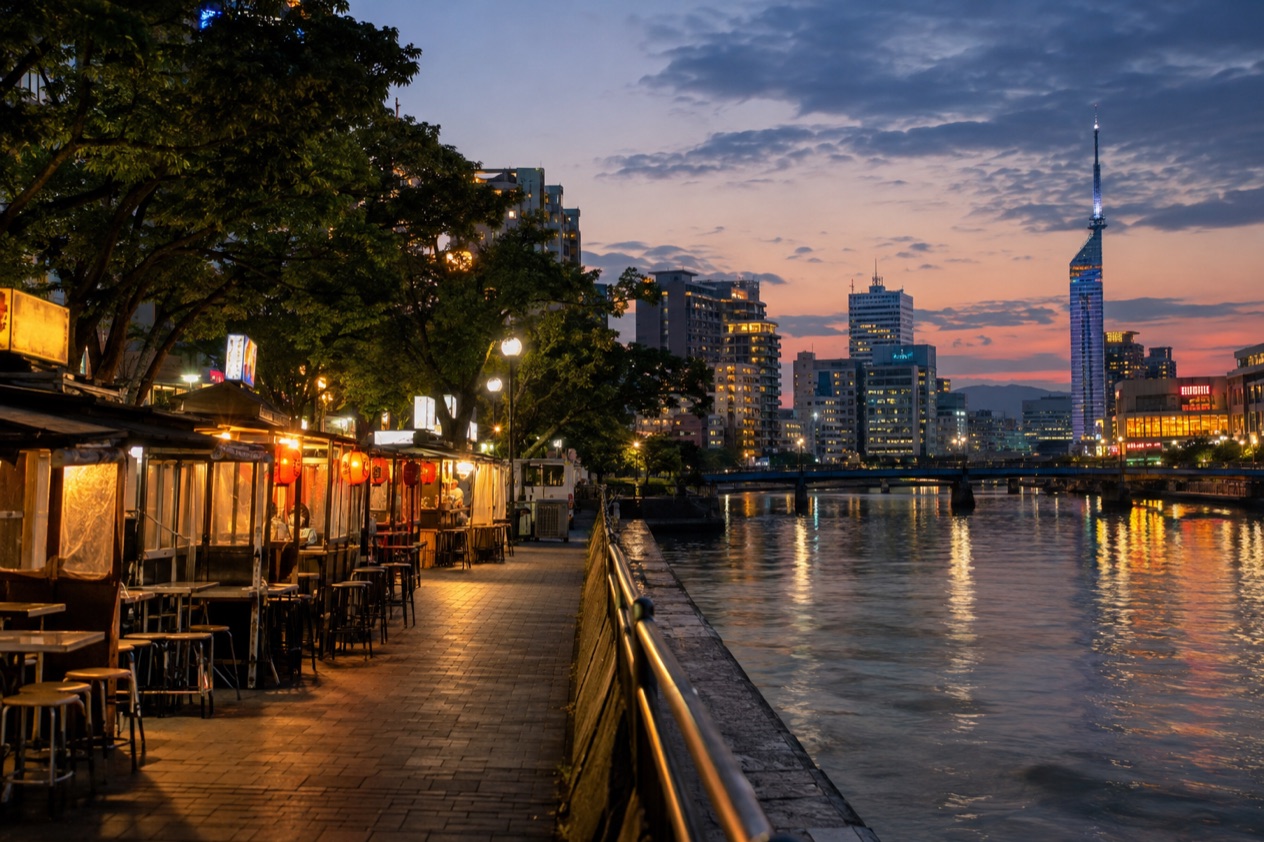
Leaving Tokyo for Fukuoka means trading the commuter crush of the capital for a port city on the north coast of Kyushu, where food stalls light up along the river at dusk and a bowl of tonkotsu ramen is the unofficial welcome. The journey crosses most of Honshu before it reaches the island at the end of the line.
How do you get to Fukuoka from Tokyo?
Fukuoka sits 684 miles from Tokyo, far enough that the trip is a real crossing of the country, and the options are the shinkansen (bullet train) to Hakata Station, conventional trains, a long-distance bus or a flight into Fukuoka Airport. Each of them ends close to the center of the city, which is the quiet advantage of Fukuoka over many Japanese destinations.
What decides the choice is mostly how you like to travel. The train puts you down at Hakata Station, the largest and busiest railway terminal in Kyushu, where JR Kyushu, JR West and the Fukuoka City Subway all meet under one roof.
The San’yo Shinkansen from Osaka ends there, so the rail route is a long ribbon of track with a clear final stop. Flying lands you at the Domestic Terminal of Fukuoka Airport, which has its own subway station, just two stops from Hakata JR station. Either way you arrive in the middle of the city rather than on its outskirts.
Think about what you want from the day. Rail gives you windows, a station full of shops at the other end and a chance to break the trip at another city. A flight turns the crossing into an airport-to-airport hop with a subway ride at the finish.
A bus, the third way, suits someone who prefers a slow overland journey. Japanese trains have a reputation for being on time, which lets you plan arrival plans, such as a dinner at the yatai stalls, to the minute.
Ways to get to Fukuoka from Tokyo
By shinkansen
The bullet train is the way most travelers picture the journey. The San’yo Shinkansen ends at Hakata Station, and from 12 March 2011 the Kyushu Shinkansen also began service from the same station, so Hakata is the point where Honshu’s bullet train meets the lines of Kyushu. The ride is a long one, and you spend it watching Japan go by, from city sprawl to inland valleys to the coast.
It suits travelers who like to arrive downtown, with no airport transfer, and who want to stretch their legs, buy a bento at a station shop and read or watch the scenery. Because Hakata is a terminus, you do not have to watch for your stop. A good habit is to pick your luggage up from the rack well before the end of the line, since the station is large and busy.
By limited express and local train
Conventional trains also run across Japan, and they work as a way to travel in stages rather than in one go. Local trains stop at every station, which makes them ideal for short distances, while rapid trains skip the smaller stations and do not require a supplement. Reaching Fukuoka this way means changing between several lines and operators, so it becomes a slow journey of its own.
This route suits someone with plenty of time who wants to see small towns from the window and does not mind transfers. In Fukuoka the last leg ends at Hakata, where JR Kyushu and JR West both operate, so a conventional train coming in from the Honshu side delivers you to the same big terminal as the shinkansen.
By bus
A long-distance bus is the overland alternative for travelers who want to cover the distance without a train ticket. It is the slowest of the ways to reach Fukuoka, and it has a different feel, with highway rest stops, reclining seats and a morning arrival into a city that is only just waking up.
It suits people who treat the journey as part of the trip and who are comfortable with a long sit. Expect to step off in the Hakata area, then walk or ride the subway to your hotel. Bring a light layer, a book and something to drink, since you are on the road for a good part of the day or night.
By plane
Flying covers the 684 miles above the clouds and lands at the Domestic Terminal of Fukuoka Airport. From there the subway runs to Hakata JR station in just two stops, so the airport is practically part of the city. That link is what makes flying here feel so direct, since you go from the arrival hall to a subway platform and then into the center.
A flight suits travelers who are short on time or who want to keep the Kyushu stay as long as possible. It also pairs well with a one-way plan, for example the train out of Tokyo and a flight back, or the reverse, so you see both modes of travel without doubling back over the same ground.
Options compared
| Option | Best for | What to know |
|---|---|---|
| Shinkansen | Arriving downtown with a window seat | Ends at Hakata Station, where the San’yo Shinkansen from Osaka terminates |
| Limited express and local train | Travelers who want to go in stages | Local trains stop at every station, rapid trains skip smaller stops with no supplement |
| Bus | Overland travel without a train | Arrives in the Hakata area of the city |
| Plane | Saving time for the stay | Domestic Terminal is two subway stops from Hakata JR station |
Seen side by side, the options differ less in where they end than in how you spend the hours before. Three of the four deliver you to the Hakata area, the fourth to an airport with a subway on its doorstep, and in every case you reach a city center rather than a remote station.
Pick the train if you like the journey to be part of the vacation, the plane if you want to land and head straight to the stalls, and the bus or local trains if the road itself interests you. A mixed trip also works well, going one way by rail and returning another way, which lets you compare the crossing without repeating it.
One thing the options share is the arrival. Whether you step out of a train carriage or up from the airport subway, you reach Hakata, and the city’s sights, food and festivals start almost at once. That makes the hours of travel feel like a lead-in rather than a lost day.
Making a day of it
A trip this long is rarely a day trip, so think of it as a day of arriving. If you come by train, Hakata Station is the first stop worth lingering at.
JR Hakata City, the complex that opened there on 3 March 2011, wraps the station in shops and places to eat, and the terminal has served the city since 11 December 1889. Drop your bags, walk around, and you are already in the Fukuoka rhythm.
Break the trip at Osaka
Because the San’yo Shinkansen runs from Osaka to Hakata, a night in Osaka splits the crossing into two pieces. You can spend an evening among its food streets and leave for Kyushu the next morning, rather than doing the whole distance in one stretch. It suits travelers who want to see another city on the way and not just the inside of a train carriage.
If you break the trip like this, carry only what you need for the night and keep your larger bags for the final leg. Fukuoka rewards a fresh arrival, since the best of the city, its stalls and its late dinners, comes after dark.
First evening in Fukuoka
Fukuoka’s yatai, the open-air food stalls of Hakata, were chosen for The New York Times’ 52 Places to Go in 2023, and the city was picked for the Food category of Lonely Planet’s Best In Travel 2023. Both are good reasons to save an appetite. The local dishes to look for are motsunabe, a hotpot of offal, and gomasaba, mackerel coated in sesame sauce, along with tonkotsu ramen.
Sit at a stall counter, order a bowl and watch the cooks work. After a long day of travel, a hot dish at the end of the road is as good a welcome as the city can give.
If you stay longer
With another day, Ohori Park holds one of the city’s major art galleries and gives you a green place to walk off the journey. East of the city, the Nanzoin temple, founded in 1899, claims to have the largest statue of a reclining Buddha in the world. Timing a stay with a festival adds another layer, since Hakata Dontaku is held on May 3 and 4, and the Hakata Gion Yamakasa festival takes over in July, with its Oiyama float race on July 15.
Fukuoka has long traded with continental Asia because it sits close to the Asian mainland, and the nearest overseas region, Busan in South Korea, is about 112 miles away. That history shows in the city’s food, its port and its outward-looking feel.
Good to know before you go
Keep some yen in your pocket for the stalls and the small restaurants, where a bowl of tonkotsu ramen costs no more than 280 yen in some places. Tokyo’s mix of JR trains, Tokyo Metro and Toei Subway lines is the starting point for most journeys, so know which station you leave from before the day begins. Fukuoka sits in a region with a rainy season and typhoons in the summer and autumn months, so keep a rain layer handy if you travel then.
Sources
- Wikipedia, Hakata Station (https://en.wikipedia.org/wiki/Hakata_Station), checked October 11, 2026
- Japan National Tourism Organization, Fukuoka (https://www.japan.travel/en/destinations/kyushu/fukuoka/fukuoka-city/), checked October 11, 2026
- Fukuoka City official tourist guide (https://yokanavi.com/en/), checked October 11, 2026
- Wikipedia, Fukuoka (https://en.wikipedia.org/wiki/Fukuoka), checked October 11, 2026
- Wikivoyage, Fukuoka (https://en.wikivoyage.org/wiki/Fukuoka), checked October 11, 2026
- Japan National Tourism Organization, trains and buses (https://www.japan.travel/en/guide/how-to-travel-by-train-and-bus-in-japan/), checked October 11, 2026
- Japan National Tourism Organization, traveling by rail (https://www.japan.travel/en/guide/traveling-by-rail/), checked October 11, 2026
- Japan National Tourism Organization, getting around Japan: trains, subways, buses, taxis (https://www.japan.travel/en/plan/getting-around/), checked October 11, 2026