
Somewhere between a rainy afternoon in Tokyo and a map full of tiny islands, a traveler decides that the trip needs a stretch of warm southern sea. Okinawa is reached by air, and nearly everyone lands at Naha Airport on the main island. From there the monorail and the buses take you onward.
How do you fly to Okinawa?
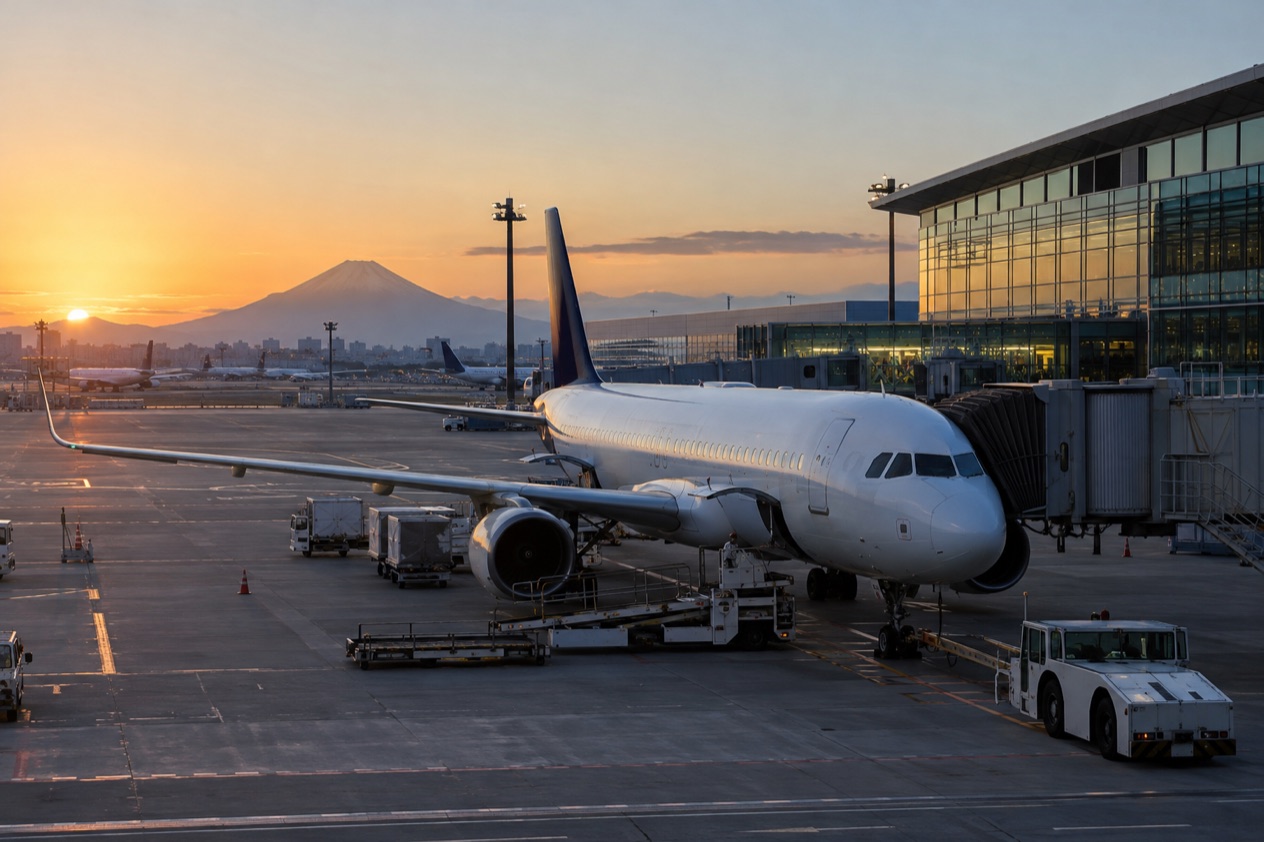
You fly into Naha Airport, either on a domestic flight from another Japanese city or on an international flight from a handful of neighboring countries. Naha is a public and military airport run by Japan’s Ministry of Land, Infrastructure, Transport and Tourism, and it is the sixth busiest airport in the country. That tells you the island is well connected, with several airlines competing for the same route.
Domestic flights from the Japanese mainland
Two big carriers cover the main trunk routes. Japan Airlines flies nonstop from Naha to Osaka-Itami and Tokyo-Haneda. All Nippon Airways flies those same two cities and adds Fukuoka, Hiroshima, Iwakuni, Matsuyama, Sendai and Miyako, so the choice widens if you are starting somewhere other than Tokyo or Osaka.
ANA Wings fills in more of the map with nonstop flights to Fukuoka, Kumamoto, Nagoya-Centrair, Iwakuni, Matsuyama and Miyako. For travelers coming from Hokkaido, the daily Peach Aviation route between New Chitose and Naha is the longest domestic scheduled flight in Japan, taking 4 hours. It is a long haul by Japanese standards, so it suits someone who wants a single flight over a connection.
International flights
Naha handles scheduled international traffic to Taiwan, Hong Kong, South Korea, Thailand, Malaysia, Singapore and mainland China. One route named in the schedule is EVA Air’s nonstop between Naha and Taipei-Taoyuan. If your trip combines Okinawa with another part of Asia, the island works as a stop on a loop as well as a final destination.
A traveler from the United States will usually reach Naha by first arriving elsewhere in Japan or in Asia, then continuing on one of the routes above. The airport does not appear in the schedule with a direct link to a U.S. city, so plan the trip as two legs.
Flights to the other Okinawan islands
Naha is also the jumping-off point for the smaller islands. Ryukyu Air Commuter, which uses Naha as its hub, flies nonstop to Ishigaki, Kitadaito, Kumejima, Minamidaito, Yonaguni and Yoron. Japan Air Commuter links Naha with Amami Ōshima and Okinoerabu, and Japan Transocean Air is the other airline based at the airport.
Ishigaki and Miyako also show up on the ANA and ANA Wings lists, so some routes can be flown on a larger airline.
| Airline | Nonstop from Naha to |
|---|---|
| Japan Airlines | Osaka-Itami, Tokyo-Haneda |
| All Nippon Airways | Fukuoka, Hiroshima, Iwakuni, Matsuyama, Miyako, Osaka-Itami, Sendai, Tokyo-Haneda |
| ANA Wings | Fukuoka, Ishigaki, Iwakuni, Kumamoto, Matsuyama, Miyako, Nagoya-Centrair |
| Japan Air Commuter | Amami Ōshima, Okinoerabu |
| Ryukyu Air Commuter | Ishigaki, Kitadaito, Kumejima, Minamidaito, Yonaguni, Yoron |
| EVA Air | Taipei-Taoyuan |
| Peach Aviation | New Chitose |
Which airport serves Okinawa?
Naha Airport is the airport for Okinawa Island, and it is the one almost every visitor uses. It is a public and military airport, and it ranked 91st in the world in Skytrax’s World Top Airports 100 in 2024. A second runway began operating on March 26, 2020.
The airport runs 24 hours a day, 7 days a week. That matters on a late arrival, since a flight that lands after dark does not land at a closed terminal. Overnight there is also freight activity, as All Nippon Airways runs a cargo hub here that receives freighters between 1 and 4 a.m. and sends them out between 4 and 6 a.m.
Inside the terminal
Check-in for flights takes place in the 3rd floor lobby. After the security checkpoint, the departure concourse holds the DFS duty-free stores, a pleasant place to spend leftover time before boarding with a bag of Okinawan sweets or a bottle of awamori, the local distilled spirit.
ATMs sit in two spots: the domestic area 2nd floor departure lobby and the international area 1st floor arrivals lobby. If you need to copy a document or send a fax, the FamilyMart on the 2nd floor of the domestic area offers both services.
Traveling with children
Strollers and car chairs are available free of charge through each airline at the 3rd floor check-in lobby. For a longer stay on the island, strollers and car chairs for multi-day use can be rented, with a surcharge, at the 1st floor barrier-free tour center.
That second option is handy for families who plan to rent a car and want a child seat for the whole trip. Passengers who want to leave a comment or request can use the suggestion boxes, installed at seven places in the terminal.
Who flies from here
Naha is the hub for Japan Transocean Air and Ryukyu Air Commuter, which is why so many small-island routes start here. The mix of big domestic carriers, island commuter airlines and international flights gives the terminal a busy, slightly mixed feel, with beach-bound families, island workers and business travelers all moving through the same lobbies.
How do you get from Naha Airport to your hotel?
From Naha Airport you reach your hotel by monorail or by bus, depending on where on the island you are staying. The two options cover different ground, so it helps to know where your hotel sits before you walk out of the arrivals hall.
The Okinawa Urban Monorail (Yui Rail)
The Okinawa Urban Monorail, known as Yui Rail, runs from Naha Airport Station to the center of Naha and on to Tedako-Uranishi Station in Urasoe. If your hotel is in the city of Naha, this is the line that serves you, and the ride gives a look at the rooftops of the city rather than a view of the tunnel walls.
Inside the airport, Naha Airport Station is reached by the communication passage from the domestic area 2nd floor. Arriving international passengers can use the 1st floor arrivals lobby, where an ATM is available, and then make their way up toward the domestic area to find the passage.
Buses to other parts of the island
Bus service from Naha Airport is available to many parts of Okinawa Island. That is the option when your hotel is outside the city, in one of the resort areas along the coast, where the monorail does not go.
Bus routes, stops and fares are not set out here, so look at the signs in the arrivals area for the service that matches your destination.
Choosing between the two
A simple rule of thumb: staying in Naha, think monorail. Staying farther along the island, think bus. A traveler heading to Urasoe is also on the monorail, since the line ends at Tedako-Uranishi Station there.
If you arrive late at night, remember that the airport itself never closes, but timetables for the monorail and the buses are their own matter. Have a plan for the first night in case your arrival lands outside the hours of the service you hoped to use.
Good to know before you go
The U.S. State Department rates Japan Level 1: Exercise Normal Precautions.
Cash is within reach at the airport, with ATMs in both the domestic departure lobby and the international arrivals lobby, so you can pick up yen on arrival. Okinawa lies in the part of Japan where the typhoon season is a real part of the calendar, so travelers flying in during the late summer and autumn months should keep an eye on forecasts and on their airline’s notices. Naha runs around the clock, which makes late arrivals and early departures straightforward at the terminal itself.
Sources
- Wikipedia, Naha Airport (https://en.wikipedia.org/wiki/Naha_Airport), checked October 11, 2026
- Naha Airport Passenger Terminal (https://www.naha-airport.co.jp/en/), checked October 11, 2026
- U.S. Department of State, Japan travel advisory (https://travel.state.gov/content/travel/en/traveladvisories/traveladvisories/japan-travel-advisory.html)
To plan your stay
- Best Time to Visit Japan: Cherry Blossoms, Autumn Colors, Weather and Festivals
- Things to Do in Japan: Kyoto Temples, Onsen, Street Food and Day Trips
- Where to Stay in Japan: Ryokan, Temple Stays, Capsule Hotels and the Best Cities to Base In
- Know Before You Go to Japan: Entry, Money, Etiquette and Getting Around