
You come out of customs with a suitcase, a rail map on your phone, and a sudden doubt about which airport your flight actually lands at, because central Japan is not served by the names everyone knows. Chubu Centrair International Airport, code NGO, is the gateway for Nagoya and the middle of Honshu. It sits on an island in the water, with its own shopping, its own terminals and a handful of ways to reach the city.
What is Chubu Centrair Airport?
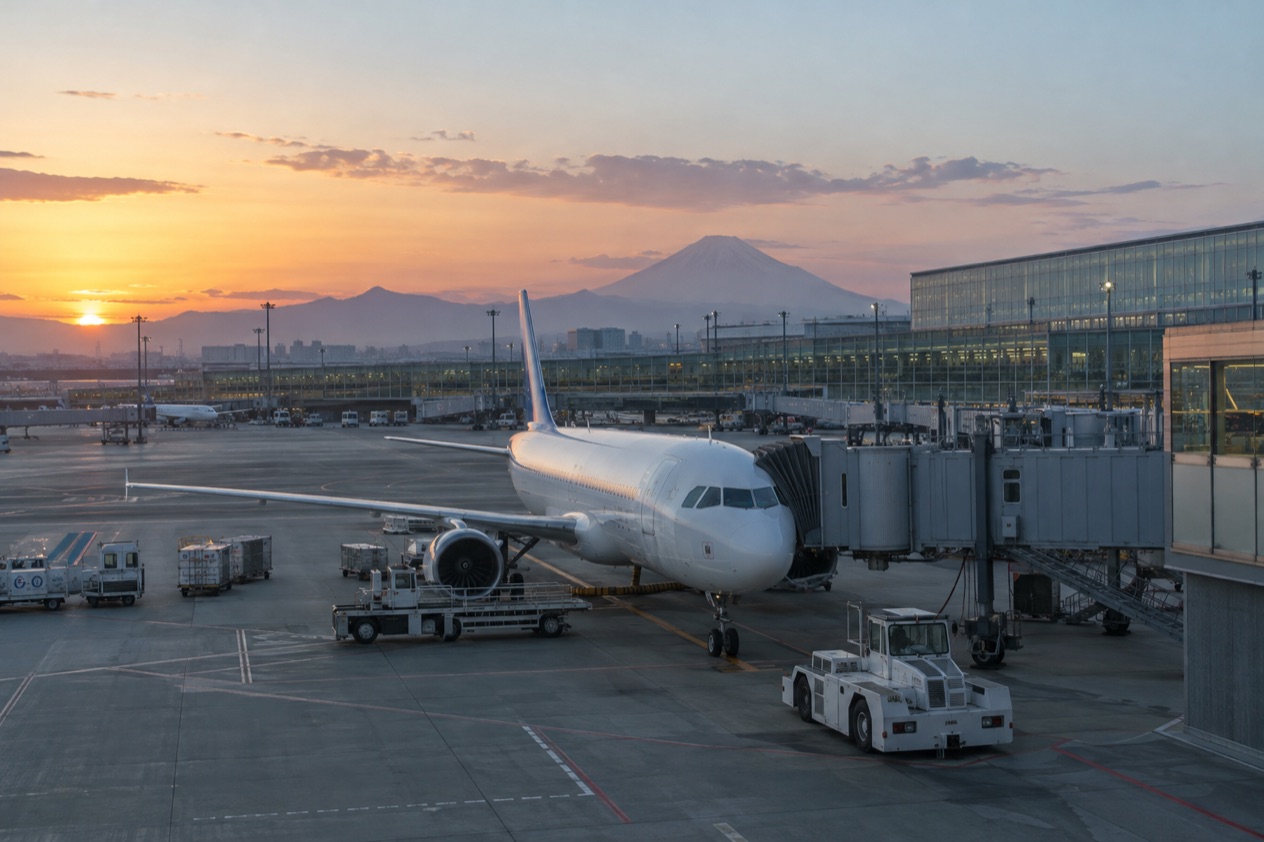
Chubu Centrair International Airport, usually just called Centrair, is the main airport for Nagoya and central Japan, built on an artificial island in Ise Bay about 22 miles south of the city. It is the airport hub for flights to and from cities in Asia and Japan, and it took over almost all commercial flights from the old Nagoya Airport when it opened on 17 February 2005.
The island setting shapes the whole visit. You arrive over water, land on a single long runway, and the airport, its shops, an exhibition center and a hotel-style cluster of buildings all share one patch of reclaimed land. Everything connects to the mainland by a toll bridge, a ferry or a train.
Terminal 1
Terminal 1 is the main building, with 13 gates for domestic flights and 14 for international ones. Most full-service carriers use it, and it is where the Japan Airlines flights described below depart.
On the fourth floor sits Sky Town, a shopping center open to the general public, with 61 shops and restaurants. You do not need a boarding pass to walk in, so it works as a place for a meal of Nagoya-style dishes, a souvenir run or a wait for a friend before you leave the island.
Terminal 2
Terminal 2 opened on 20 September 2019 and serves budget airlines, with 11 international gates and 9 domestic ones. If you booked a ticket with a low-cost carrier such as Peach or Jetstar Japan, look at your confirmation for the terminal before you set out for the airport.
Having two buildings for two kinds of airline is a small detail that saves confusion on departure day. It also explains why the airport feels like two airports in one: one for the full-service flights, the other for the low-fare routes to Sapporo, Naha and Sendai.
Flight of Dreams and Aichi Sky Expo
Flight of Dreams, a Seattle-themed retail complex that opened in 2018, features a prototype Boeing 787 Dreamliner as a display. It is the kind of stop that suits anyone who likes aircraft, or who has a few spare hours between flights and wants something to look at besides the departure board.
Aichi Sky Expo, an exposition center on the same island, opened on 30 August 2019 and has six exhibition halls, each 10,000 square meters in size. Trade fairs and large events take place here, so on some days the airport hosts people who have come for a convention rather than a flight.
Other airports in the picture
Centrair is one of several gateways. Haneda is the airport of Tokyo city, Narita serves international and domestic destinations as one of the two airports of the capital, and Kansai International Airport makes it possible to visit Japan without going through Tokyo. Centrair gives travelers a way in that starts in the middle of Honshu.
Airports in major Japanese cities are served by express trains, buses and taxis, and generally have car rental services. Centrair follows that pattern, with a bus, a ferry, trains and taxis, all of them described in the section on getting to Nagoya.
Which airlines fly there?
Japan Airlines, ANA Wings, All Nippon Airways, Air Do, Peach, Skymark Airlines and Jetstar Japan all serve Centrair on domestic routes, while Japan Airlines and United Airlines operate the nonstop flights toward the United States and its territories.
Flights to Honolulu and Guam
Japan Airlines operates nonstop flights from Centrair to Honolulu, the route that matters most to an American heading home or starting a trip from the Pacific side. United Airlines operates nonstop flights to Guam, a U.S. territory.
These are the two links to U.S. soil that start from the island airport. A traveler who ends a trip in central Japan can leave from Centrair without going back through Tokyo or Osaka first.
Japan Airlines and ANA on domestic routes
Japan Airlines serves Kushiro, Obihiro, Sapporo-Chitose, Tokyo-Haneda and Tokyo-Narita. Hokkaido destinations in that list make Centrair a starting point for a trip to the northern island, since most domestic flights from the main island land at Chitose Airport in southern Hokkaido.
ANA Wings has the longest list: Fukuoka, Ishigaki, Kagoshima, Miyako, Nagasaki, Naha, Sapporo-Chitose, Sendai, Tokyo-Haneda and Tokyo-Narita. All Nippon Airways itself serves Naha and Sapporo-Chitose. Naha, Ishigaki and Miyako are the way to the subtropical islands, and for Okinawa the airplane is the only option from major Japanese cities.
Low-cost and regional carriers
Peach flies to Naha, Sapporo-Chitose and Sendai. Skymark Airlines flies to Kagoshima, Naha and Sapporo-Chitose, and Jetstar Japan flies to Fukuoka and Naha. Air Do adds Hakodate and Sapporo-Chitose.
Low-cost carriers make it possible to reach almost anywhere in Japan at a reasonable price, and Centrair shows how that works in practice. Fukuoka Airport, one of those destinations, is central enough that after you collect your baggage you can reach Hakata, in the heart of Fukuoka, by train in five minutes.
| Airline | Destinations from Centrair |
|---|---|
| Japan Airlines | Honolulu, Kushiro, Obihiro, Sapporo-Chitose, Tokyo-Haneda, Tokyo-Narita |
| United Airlines | Guam |
| ANA Wings | Fukuoka, Ishigaki, Kagoshima, Miyako, Nagasaki, Naha, Sapporo-Chitose, Sendai, Tokyo-Haneda, Tokyo-Narita |
| All Nippon Airways | Naha, Sapporo-Chitose |
| Air Do | Hakodate, Sapporo-Chitose |
| Peach | Naha, Sapporo-Chitose, Sendai |
| Skymark Airlines | Kagoshima, Naha, Sapporo-Chitose |
| Jetstar Japan | Fukuoka, Naha |
How do you get to Nagoya?
You cross the bridge from the island by bus, train or taxi, or you take the ferry to Tsu, since Centrair lies 22 miles south of Nagoya and is joined to the mainland by the Centrair Bridge toll road. Each option leads somewhere a little different.
The Centrair Limousine bus
Centrair Limousine provides direct bus service to and from central Nagoya, Sakae and major hotels. Sakae is the downtown district of department stores and nightlife, so a bus that stops there and at hotels can put you close to where you are sleeping without a change of vehicle.
A direct bus suits a traveler with heavy luggage who does not want to think about platforms. You step off the terminal, find the stop, and ride across the bridge with the bay on both sides.
Trains and taxis
A Meitetsu local train runs one stop from the airport to Rinku Tokoname Station, which is what cyclists are told to do, since a taxi across the bridge is the other choice for them. That detail also tells you the airport is wired into the rail network, and like other major Japanese airports, Centrair is served by express trains, buses and taxis.
A taxi crosses the same bridge by road. It is a way to reach an address that no bus stop or station serves, or to travel with a group that fills a car.
The ferry to Tsu
A ferry connects the airport to the passenger terminal in Tsu, with a 40-minute trip. It is a different way to leave the island, on the water instead of over it, and it points toward Tsu on the opposite shore of Ise Bay rather than toward Nagoya.
Take it if Tsu is your destination, or if you simply like arriving by boat. For Nagoya itself, the bus and the train are the links that the airport lists.
Arriving by bicycle
Bicycles are not allowed on the Centrair Bridge toll road to the mainland. A cyclist leaving the airport has to take a Meitetsu local train one stop to Rinku Tokoname Station, or a taxi across the bridge, and ride from there.
If you travel with a bike box, plan for that first stop on the mainland before you pedal toward Nagoya. Cars, buses and taxis use the bridge, and the train runs alongside it.
Good to know before you go
Centrair is a place where a connection can turn into an outing. Sky Town is open to the public, Flight of Dreams has its Dreamliner on display, and the exposition center on the island means that some visitors are there for a trade fair.
Airports in major Japanese cities generally have car rental services, which matters if your plan leaves the rail network. For flights to other cities in Japan, remember that most Japanese prefectures have at least one airport, so a route from Nagoya may end closer to your goal than you expect.
Sources
- Japan National Tourism Organization, how to reach the city from each international airport (https://www.japan.travel/en/plan/airport-access/), checked October 11, 2026
- Wikipedia, Chubu Centrair International Airport, airlines and destinations (https://en.wikipedia.org/wiki/Chubu_Centrair_International_Airport#Airlines_and_destinations), checked October 11, 2026
To plan your stay
- Best Time to Visit Japan: Cherry Blossoms, Autumn Colors, Weather and Festivals
- Things to Do in Japan: Kyoto Temples, Onsen, Street Food and Day Trips
- Where to Stay in Japan: Ryokan, Temple Stays, Capsule Hotels and the Best Cities to Base In
- Know Before You Go to Japan: Entry, Money, Etiquette and Getting Around