
You step out of the arrivals hall with a suitcase the size of a small refrigerator, and ahead of you lie ticket gates, platform stairs and a train full of commuters. Travelers in Japan decide at that moment that the bag should go to the hotel on its own. It can: Japan runs a luggage delivery service called Hands-Free Travel, and the main airports have counters that will send your bags to your hotel while you carry only a daypack.
Can you send your luggage ahead in Japan?
Yes, you can. Japan’s Hands-Free Travel service lets visitors have their luggage transported and stored securely, so you can sightsee without heavy bags.
The service covers three situations: from an airport to your hotel, from one hotel to the next, and from a convenience store when you are not staying at a major hotel. Each has its own habits, and the limits on what you can send apply to all of them.
From the airport to your hotel
Seven airports offer luggage delivery to your hotel: Narita, Haneda, Kansai International, Chubu Centrair, Shin Chitose, Fukuoka and Naha. That covers the gateways for Tokyo, Osaka and Kyoto, Nagoya, Sapporo, Fukuoka and Okinawa, so most first and last stops on a Japan trip are included.
The picture is simple. You land, collect your bags, hand them over at the airport counter and walk out with a small bag holding what you need for the day. The suitcase meets you at the hotel. It works the other way too, and the same airports are the place to look when you leave, with your stay’s last night still ahead of you.
From hotel to hotel
Most major hotels in Japan can arrange luggage delivery between hotels, and the place to ask is the front desk. This fits a trip that moves from Tokyo to Kyoto to Osaka, where each change of city would otherwise mean dragging the same bags through a station at checkout time.
Travelers send the large suitcase ahead and keep one small bag for a night or two in a ryokan, the traditional inn where space for bulky luggage is limited. The suitcase waits at the next hotel while you travel light.
From a convenience store
A major hotel is not required. Even if you are staying somewhere smaller, you can drop off luggage at a designated convenience store for shipping. Those stores are part of daily life across the country, which is why this option reaches travelers in guesthouses and small inns.
Only designated stores take part, so the counter is where you find out whether yours does. The convenience store route and the hotel route lead to the same result: a bag that travels without you.
What you can send
Delivery and storage services restrict items by size and weight, and both limits matter when you pack for a long trip. A hard-shell suitcase for a two-week stay is often close to the line, so it helps to know the ceiling before you fill it.
| Limit | Maximum |
|---|---|
| Size of the item | 160 linear centimeters |
| Weight of the item | 25 to 30 kg |
How does the service work?
You hand your bags to a certified counter, tell the staff where and when they should arrive, and collect them at the other end. The counters that do this display the Hands-Free Travel logo, which is the sign that they are certified to provide luggage delivery and storage.
What the service offers is clear. Delivery can arrive the same day or at a date and time you specify. Access is multilingual, so you do not need Japanese to explain where the bag is going. And if an item is lost or damaged, the service includes compensation. For a traveler worried about handing a suitcase to a stranger, that last point is the one that matters.
Choosing the date and time of arrival
Delivery on a date and time you set is what turns the service into a tool for planning. If you check out in the morning and check in somewhere else in the evening, the suitcase can be timed to be waiting when you arrive, so there is no hour with a bag in hand and nowhere to put it.
Same-day delivery is also part of the service. It suits a day when you arrive at an airport, want to drop your luggage and go straight to sightsee, and meet the bag at the hotel later.
The black cat behind the name
If you look at Japanese parcel delivery, you will meet Yamato Transport, whose head office is in Ginza, Tokyo. Its trademarked name for express door-to-door delivery is TA-Q-BIN, written takkyubin in Japanese. In everyday speech takkyubin is sometimes used as a generic word for any express home delivery service, but Yamato defends the trademark so the name does not become generic.
The company’s logo is a yellow oval with a black cat carrying her kitten in her mouth. It stands for the promise to take care of what is entrusted to it as though it were family, and it explains the nickname Kuroneko, which means black cat. You will hear the word in conversation, and now you know where it comes from.
Hotels and stores as drop-off points
In practice the service meets you where you already are. At a hotel, you mention the delivery at the front desk. At a convenience store, you hand the bag over where you would buy a snack. At an airport, the counter is in the terminal where you arrive.
Because the same service reaches across airports, hotels and stores, you can chain the pieces together on one trip. The bag can leave the airport with you in Tokyo, move to a hotel in a later city, and reach the departure airport at the end, with you carrying very little in between.
What does it cost and how long does it take?
That is the way to think about timing: with delivery you decide when the bag arrives, and with a locker you decide how long it stays.
Delivery: you set the clock
With Hands-Free Travel, timing is a choice you make rather than a duration you wait out. Same-day delivery is available, and so is delivery at a specified date and time. Keep in mind the limits on size and weight, because an item that goes over them is not covered by the service.
The cost of delivery depends on the counter and the route, so the staff at the certified counter are the people to ask before you hand the bag over. Counters with the Hands-Free logo handle the paperwork and answer in several languages.
Coin lockers: the do-it-yourself option
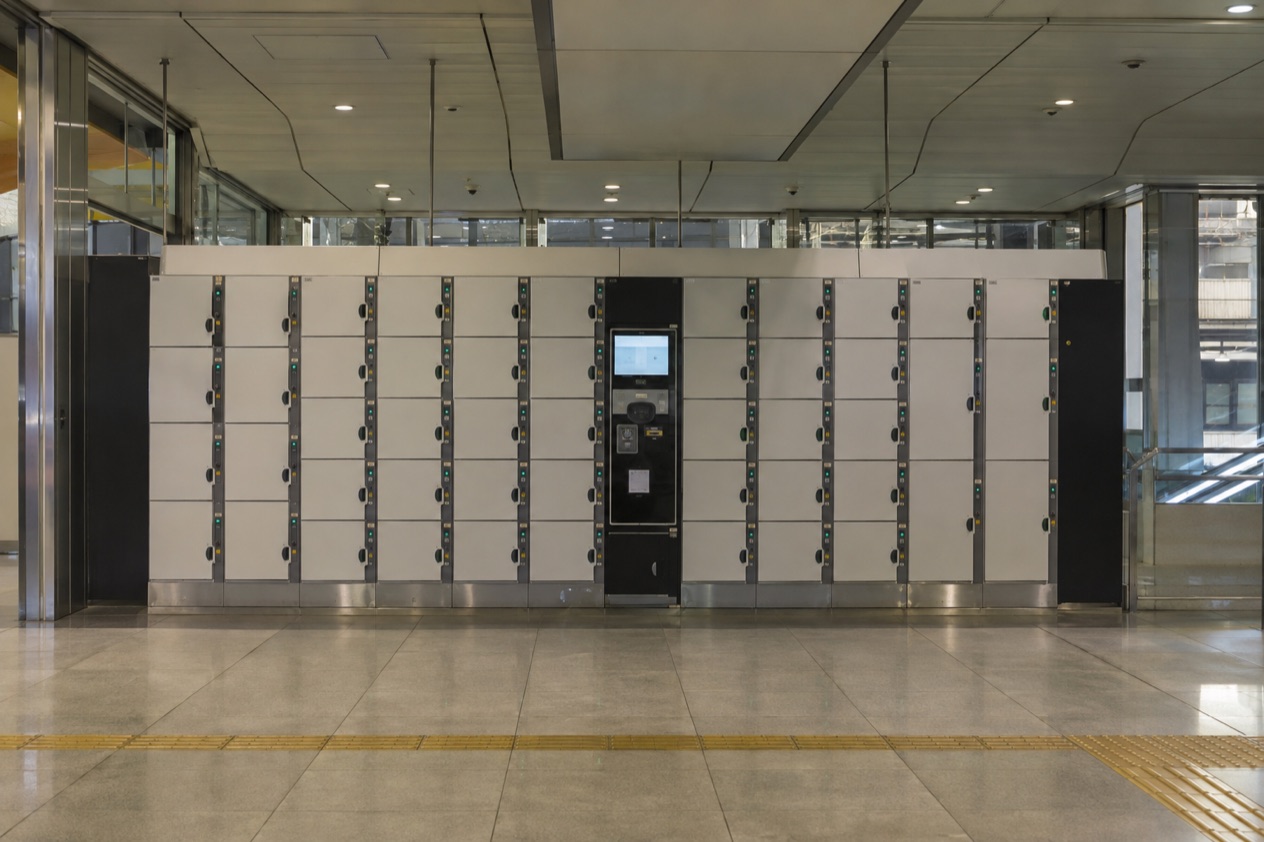
Coin lockers of various sizes are available at most train stations and tourist sites in Japan. They suit a stop of a few hours, such as a morning at a temple before the train to your next city, when sending the bag ahead would be more than you need.
Many modern coin lockers accept payment by IC transportation cards, the rechargeable cards used on trains and subways. A larger bag needs a larger locker, and the larger sizes sit toward the higher end of the range.
Choosing between the two
Think about the length of the gap. For a night or more, sending the suitcase to your next hotel means you never carry it.
A coin locker also suits an item that falls outside the service’s limits, or a day when your plans change. A delivery is set for a place and a time, so it fits an itinerary that is already fixed.
Good to know before you go
In busy locations, coin lockers fill up very quickly, so a station full of travelers is a place to expect that every locker is taken, and a hotel or airport delivery counter is the other way to get rid of the bag. Amounts are in yen, and the counters with the Hands-Free logo are the ones certified for delivery and storage, which makes the logo the thing to look for when you are standing in a terminal with a suitcase and a plan.
Sources
- Japan National Tourism Organization, coin lockers, luggage storage, forwarding (https://www.japan.travel/en/plan/getting-around/luggage-storage/), checked October 11, 2026
- Wikipedia, Yamato Transport (https://en.wikipedia.org/wiki/Yamato_Transport), checked October 11, 2026
To plan your stay
- Best Time to Visit Japan: Cherry Blossoms, Autumn Colors, Weather and Festivals
- Things to Do in Japan: Kyoto Temples, Onsen, Street Food and Day Trips
- Where to Stay in Japan: Ryokan, Temple Stays, Capsule Hotels and the Best Cities to Base In
- Know Before You Go to Japan: Entry, Money, Etiquette and Getting Around