
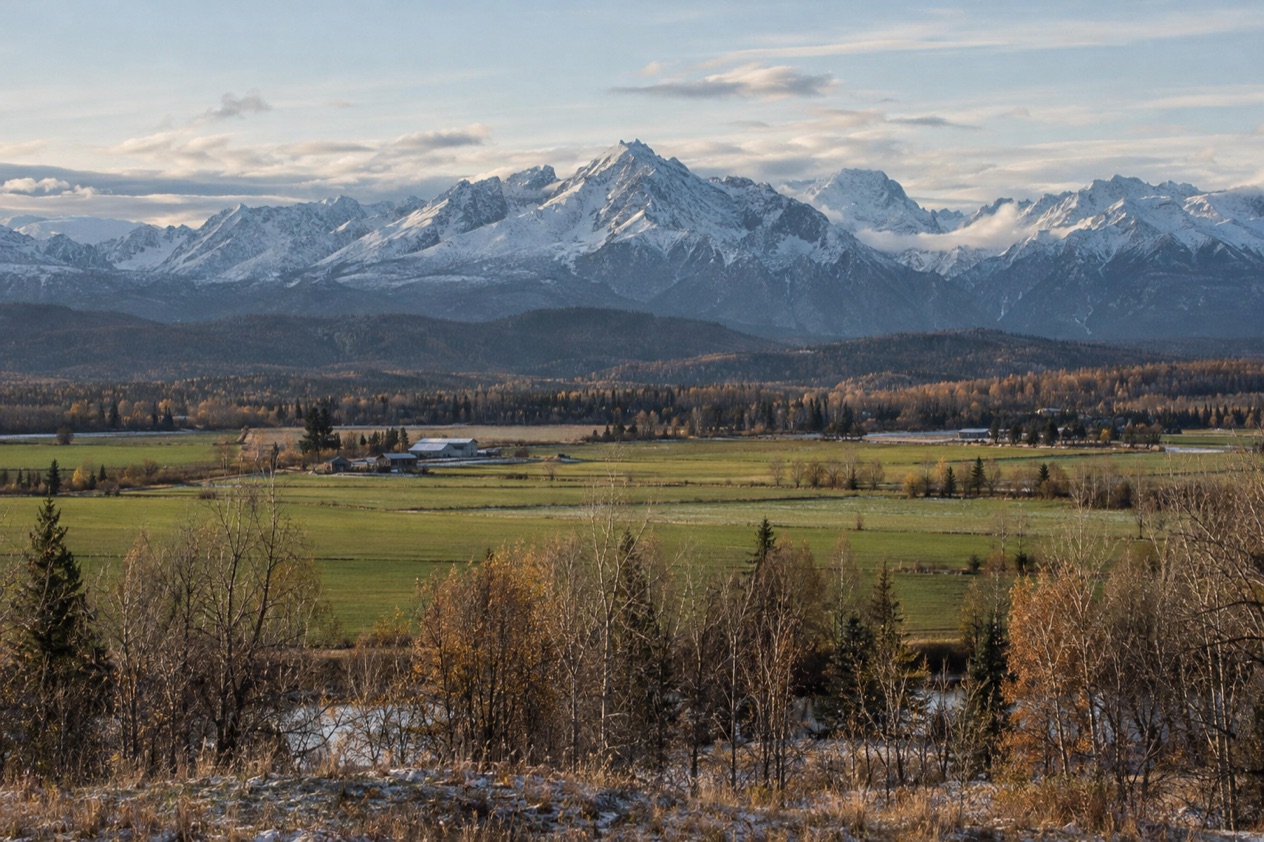
In October, the Matanuska Valley smells of cold earth and woodsmoke. Frost whitens the hay fields at breakfast, new snow dusts the Chugach peaks above Palmer, and the last yellow clings to the birches along Lake Lucille.
The summer fair crowds are long gone, the dark evenings are back, and the valley belongs to the people who live in it. For a traveler, that means a quiet, moody month in Wasilla and Palmer, built around mountain views, small-town stops and a real chance at the northern lights.
What is the weather like in Wasilla and Palmer in October?
October is cold, bright on its good days and quietly damp on its bad ones, with winter clearly on its way. Mornings start below freezing, afternoons stay chilly, and the month is much drier than September.
| Month | Average high (°F) | Average low (°F) | Precipitation (in) | Days with precipitation | Daylight on the 15th |
|---|---|---|---|---|---|
| September | 55.8 | 40.8 | 2.08 | 6.0 | 13 h 04 min |
| October | 42.3 | 28.6 | 1.25 | 3.4 | 10 h 11 min |
| November | 28.9 | 15.6 | 0.66 | 1.8 | 7 h 17 min |
Most October days are dry, and the precipitation that does come falls as rain and melted snow, so a gray morning can turn to wet flakes by afternoon. Puddles skin over with ice at dawn, and the car windshield needs a scrape before you go anywhere. By midday the sun, when it shows, takes the edge off, though the air stays cold in the shade.
Layers matter more than any single heavy coat. A warm base layer, a fleece, and a windproof shell cover the morning chill and the afternoon, and a hat and gloves earn their place from the first hour. Waterproof boots with a good grip are the smart footwear, since wet leaves and frosty boardwalks get slick.
The light is the real change. Days are short enough that sunset comes in the late afternoon, and the low sun gives the mountains a long, warm glow in the hours when it is out. Evenings are fully dark, which is what opens the door to aurora watching.
What to do in Wasilla and Palmer in October
October here is about quiet landscapes, farm-country stops and long dark evenings. The Alaska State Fair, held in Palmer at the foot of the Chugach Mountains, runs for about 12 days in late August and early September, so it is over by now. What remains is the valley itself, the harvest mood on the farms, and the mountains turning white.
The Mat-Su region holds 24 parks, and in October they are yours to wander without the summer traffic. The leaves have mostly dropped, so the views open up, and the trails feel bare and wide. Snow may already lie on higher ground, so the choice of outing depends on the day.
Hatcher Pass and Independence Mine
Hatcher Pass runs through the southwest part of the Talkeetna Mountains, about 12 miles from Palmer and Wasilla. The pass sits at 3,886 feet, far higher than the valley floor, so expect colder air and an earlier winter than in town. The road over the top is unpaved and minimally maintained for about 20 miles, a good reason to look at the sky before you set out.
Independence Mine State Historical Park sits in the pass, surrounded by rugged peaks. The weathered buildings of the old gold mine cling to the slope, and in October, with snow dusting the ridges and few other visitors, the place feels very quiet. It suits people who like photography, history and empty mountain scenery, and less so anyone who wants a warm, sheltered afternoon.
Dress as if it were a month colder than in town, with a windproof layer and warm hands. The wind in the open basin can feel sharper than the thermometer suggests.
Palmer, farmland and Pioneer Peak
Palmer is the valley’s farm town, set among fields, barns and rows of spruce, with the long wall of the Chugach behind it. The Matanuska Valley is known for its giant vegetables, which draw crowds at the fair in late summer. By October the harvest is in, the fields are bare or frosted, and the town has a settled, end-of-season calm.
Walk the small downtown, look into local shops and cafés, and let the mountains do the rest. Pioneer Peak dominates the view and often wears a fresh white cap this month, which makes the farm fields in front of it look even more like a painting. A small local museum is a good way to learn how settlers built this farming community.
Wasilla, Lake Lucille and Iditarod country
Wasilla is more spread out and busier, with shops, diners and lakeside views. Lake Lucille can freeze at its edges this month, and the birches around it show what is left of the fall color. The town is also tied to sled dog culture, and the Iditarod Trail itself runs from Willow through Rainy Pass to Nome.
The race is still far off, but October is a season of training, and you may see teams of dogs on wheeled rigs or hear them yipping at kennels, a sound that goes with the cold. The Iditarod’s official restart is in Willow, 80 miles north of Anchorage. A museum devoted to Alaska’s transportation history is a good option for a gray afternoon.
Knik Glacier and the river valley
Knik Glacier lies to the east of Anchorage, on the northern end of the Chugach Mountains. It averages over 25 miles long and over 5 miles across, one of the largest glaciers in southcentral Alaska, and it feeds the Knik River, which empties into the Knik Arm of Cook Inlet. In October the river corridor has a stark look, with gray gravel bars, pale light and snow on the peaks around it.
It is a place to admire its scale from a distance more than to treat as a short stop. Bring warm layers, and plan the outing around the weather rather than the clock.
Northern lights in the Mat-Su evenings
The Northern Lights oval covers most of Alaska, and the aurora is active over Anchorage from late September through the middle of April. October is therefore inside the viewing season, and the long dark evenings make it practical to stay out. Activity also tends to be stronger around the equinox than around the solstices, and that equinox has just passed.
It remains a chance, never a promise, and clouds can hide even a strong display. Wasilla and Palmer have the advantage of open fields and mountain horizons away from the city lights. Dress warmly, because standing still in a frosty field after dark is far colder than the daytime high suggests.
A two-day itinerary for Wasilla and Palmer in October
Day 1 belongs to Wasilla and the lake country. Start with a late, hot breakfast at a local diner while the frost melts off the car windows, then walk the edge of Lake Lucille once the air has warmed a bit. The light is softest in the mid-morning, and the birches show what color they have left.
After lunch, head indoors to a transportation museum or an Iditarod-themed stop to learn about sled dog culture. This is also your rain card, since the same stops work well if the weather turns. Late afternoon is the hour for a coffee shop with a view, before dark settles in early.
In the evening, have a hearty dinner at a local restaurant, then step out to a dark spot on the edge of town to look for the aurora, with warm layers and patience. Day 2 moves to Palmer and the pass. Begin with a bakery or café breakfast in downtown Palmer, then take a slow look at the farm fields and Pioneer Peak while the morning light is lowest and the air is clearest. A small museum of local history fills the late morning, especially if clouds are rolling in.
Spend the afternoon at Hatcher Pass and Independence Mine State Historical Park, where the mine buildings sit in a ring of rugged peaks. Go in the middle of the day, when the air is warmest and the light is best, and leave before dusk. If the pass looks stormy or snowed in, stay in the valley instead and linger over a late lunch in Palmer.
Is Wasilla and Palmer busy in October?
No, October is a quiet month here, a clear step down from late summer. The Alaska State Fair finished in early September at the latest, and the biggest crowd draw of the valley’s year is over.
What you find instead is a town running at its own pace. Trails and viewpoints feel empty, and the mood in Palmer and Wasilla is of locals getting ready for winter, stacking firewood and tuning up for the snow season. Hatcher Pass and the glacier country around the valley are wide, open places with little company. The aurora is the one attraction that can bring people out in the evenings, since the dark hours are long and the season is under way.
What to pack for Wasilla and Palmer in October
Pack for freezing mornings, chilly afternoons and long, cold evenings, with layers that you can add and remove through the day.
- A warm insulated jacket and a windproof shell, for Hatcher Pass and for aurora nights.
- Fleece and thermal base layers, since mornings start below freezing.
- Waterproof boots with grip, for wet leaves, frost and snow on higher ground.
- A hat, gloves and a scarf, which you will use every day.
- A camera and a spare battery, because cold drains them fast.
- A small flashlight or headlamp for dark evenings.
Good to know before you go
October is a month for short days and a flexible plan. Daylight shrinks quickly and the weather can change on high ground, so schedule the outdoor highlight of each day for midday. The road over Hatcher Pass is unpaved and minimally maintained for about 20 miles, so look at conditions before you commit to the drive. Keep the evenings free for the northern lights, which are best on clear nights.
Wasilla and Palmer in October vs September and November
Moving four weeks earlier gives you September, with far more daylight, warmer afternoons and the Alaska State Fair running into its first days. The valley is greener and busier, and the evenings are not yet dark enough to make aurora watching easy. Choose September if you want long outings, fair crowds and the fall color at its peak.
Moving four weeks later gives you November, with a much colder valley, only a brief window of daylight and snow settling in. The scenery is quiet and wintry, and the aurora season is in full swing, but outdoor outings are shorter and need more care. It suits travelers who want deep quiet and cold, dark skies.
October sits in between. It keeps enough light for a proper day outdoors, brings the first real chance of northern lights evenings, and still feels like autumn rather than deep winter. Choose it if you want that balance, and shift only if the fair or the full winter mood is the point of your trip.
Is October a good time to visit Wasilla and Palmer?
Yes, for travelers who like quiet mountain scenery, crisp air and dark evenings, and no for anyone who wants long warm days or a lively summer program. The valley is calm, and the main draws are the land itself, the old mine in Hatcher Pass and the sky at night.
It will suit photographers, hikers who dress well, history lovers and aurora seekers. It will suit less well anyone counting on warm weather or the fair atmosphere, who would be happier a month earlier.
On arrival, look at the sky and the forecast for Hatcher Pass first, then plan the rest around it. October in Wasilla and Palmer is the valley between seasons, with frost on the fields, snow on Pioneer Peak and a dark sky that sometimes fills with light.
Sources
- NOAA NCEI, U.S. Climate Normals 1991-2020, monthly (https://www.ncei.noaa.gov/access/services/data/v1?dataset=normals-monthly-1991-2020&stations=USW00025331), station Palmer Muni Ap, elevation 230 feet, checked October 11, 2026
- Computed from the date and the latitude of the place (sunrise equation, solar elevation -0.833 degrees), October 11, 2026
- University of Alaska Fairbanks Geophysical Institute, Aurora forecast (https://www.gi.alaska.edu/monitors/aurora-forecast), checked October 11, 2026
- Wikivoyage, Northern lights (https://en.wikivoyage.org/wiki/Northern_lights), checked October 11, 2026
- Wikipedia, Aurora (https://en.wikipedia.org/wiki/Aurora), checked October 11, 2026
- Visit Anchorage, northern lights viewing (https://www.anchorage.net/winter/things-to-do/northern-lights-viewing/), checked October 11, 2026
- Wikipedia, Hatcher Pass (https://en.wikipedia.org/wiki/Hatcher_Pass), checked October 11, 2026
- Alaska State Parks, Mat-Su region (https://dnr.alaska.gov/parks/aspunits/matsu/matsuindex.htm), checked October 11, 2026
- Wikipedia, Alaska State Fair (https://en.wikipedia.org/wiki/Alaska_State_Fair), checked October 11, 2026
- Wikipedia, Knik Glacier (https://en.wikipedia.org/wiki/Knik_Glacier), checked October 11, 2026
- Wikipedia, Iditarod Trail Sled Dog Race (https://en.wikipedia.org/wiki/Iditarod_Trail_Sled_Dog_Race), checked October 11, 2026
- Wikipedia, Climate of Alaska (https://en.wikipedia.org/wiki/Climate_of_Alaska), checked October 11, 2026
To plan your stay
- Things to Do in Wasilla and Palmer: Iditarod Country, Hatcher Pass, Glaciers and the Alaska State Fair
- Where to Stay in Wasilla and Palmer: Parks Highway Base, Farm Country and Valley Towns
- Best Time to Visit Wasilla and Palmer: Summer Daylight, the State Fair, Weather and Seasons
- Wasilla and Palmer in September: State Fair Season, Weather and What to Do