
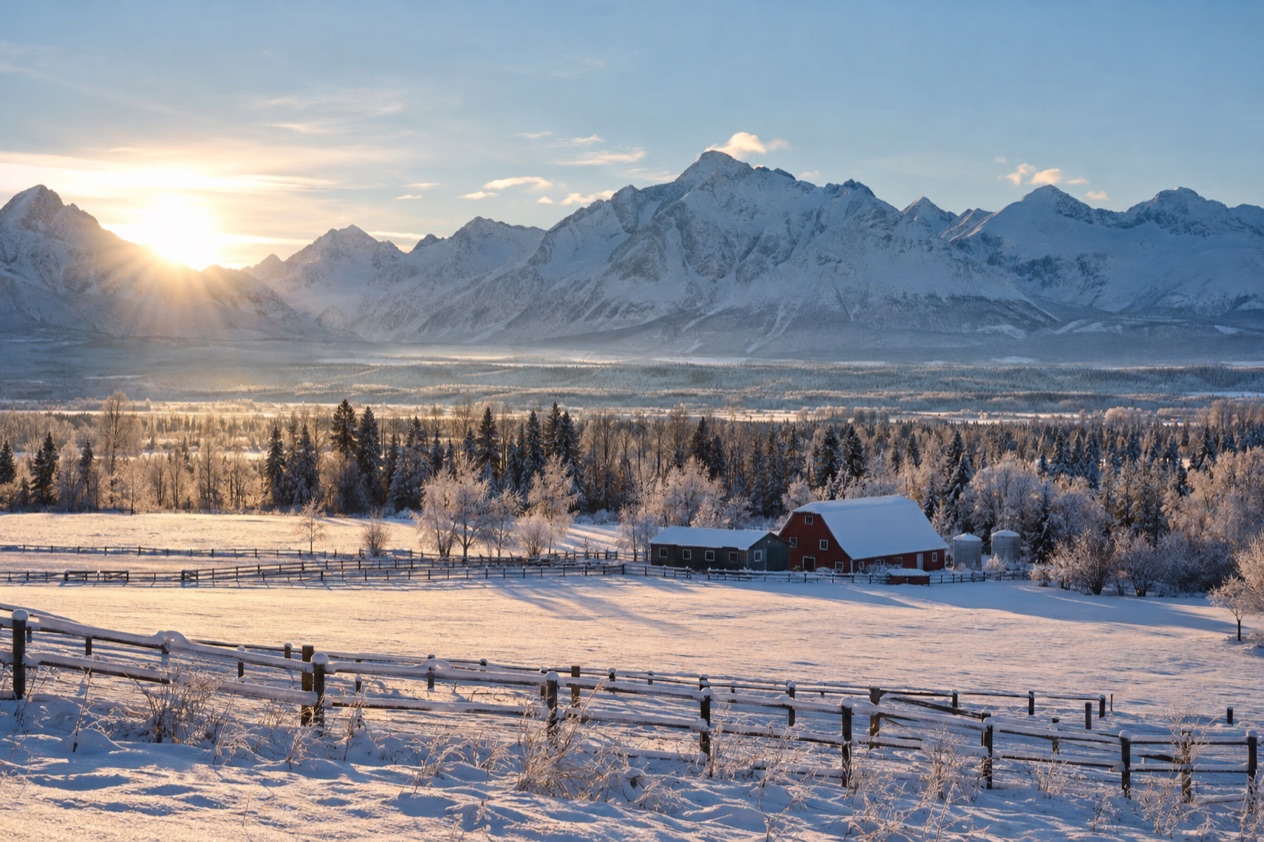
On an April afternoon in the Matanuska Valley, meltwater runs along the road shoulders, the fields turn patchy and brown, and the peaks above Palmer still wear their full white. Lake ice goes gray and starts to let go, and the evening light hangs on well past dinner. Wasilla and Palmer sit in the gap between winter and the green rush of summer, a month for mountain views, farm-country wandering and a quiet pace.
What is the weather like in Wasilla and Palmer in April?
April is cool and mostly dry in Wasilla and Palmer, with afternoons that finally climb above freezing and nights that still drop back into frost.
| Month | Average high (°F) | Average low (°F) | Precipitation (in) | Days with precipitation | Daylight on the 15th |
|---|---|---|---|---|---|
| March | 33.9 | 17.2 | 0.47 | 1.8 | 11 h 38 min |
| April | 47.8 | 29.8 | 0.30 | 1.2 | 14 h 39 min |
| May | 59.1 | 38.8 | 0.62 | 1.8 | 17 h 29 min |
The pattern of the day matters more than the afternoon high. Mornings start hard and cold, with frozen puddles and stiff ground, and by midday the sun softens everything into mud. That daily thaw is the heart of what Alaskans call breakup, and it explains the wet boots, the muddy trailheads and the shine on the pavement.
Rain and snow are both scarce. This is one of the drier months of the year, and a day with any precipitation at all is the exception, so a shower is more likely to be a brief flurry or a passing spatter than a gray, drizzly spell. Wind and cloud can still make a mild afternoon feel raw, which is why layers beat one heavy coat.
The light is the real news. Compared with March, the days have grown by about three hours, so you can start late, linger over lunch and still have daylight for a walk after dinner. Evenings are cool enough for a warm jacket and a hat, and you will want them again once the sun drops behind the mountains.
What to do in Wasilla and Palmer in April
April here is not a festival month, and that is part of its charm. The big events of the valley belong to other seasons: the Iditarod’s official restart in Willow comes the day after the ceremonial start in Anchorage, usually in early March, and the Alaska State Fair in Palmer runs for about twelve days in late August and early September. What April offers instead is the valley between seasons, with its farm roads, its lakes shedding their ice and its mountains close at hand.
Wasilla is the town most people know through the Iditarod. The race’s headquarters are here, and sled dog culture runs deep in the surrounding country, so in the weeks after the race you still see dog yards, sleds propped against sheds and mushers training or resting their teams. Lake Lucille and Knik Lake, both ringed by houses and trees, are good places to watch the ice go gray and break up.
Palmer has the look of a farm town set against a wall of mountains. Pioneer Peak and the Chugach rise behind the fields, and the Knik River drains the great Knik Glacier, one of the largest glaciers in southcentral Alaska, before it empties into Knik Arm. In April the fields are still bare, so the show is the mountains themselves, crisp and white against a long blue sky.
Hatcher Pass and Independence Mine
Hatcher Pass is a mountain pass through the southwest part of the Talkeetna Mountains, and the nearest towns are Palmer and Wasilla, about 12 miles to the south. It tops out at 3,886 feet, a very different world from the valley floor. The road over it is unpaved and minimally maintained for about 20 miles, which is worth remembering in a month of mud and melt.
Independence Mine State Historical Park sits in the pass near Palmer, surrounded by rugged peaks. It preserves the buildings of an old gold mining operation, and the weathered timbers against the mountains make it a photographer’s place. At that elevation, winter often lingers long after the valley has thawed, so the scene may be more snow than meadow, and the high country may feel like a different month from the farm fields below.
It suits travelers who like mountain scenery and mining history more than a checklist of attractions. Allow it a whole outing, bring a camera, and treat the mud and snow as part of the picture rather than a problem.
The northern lights at the end of their season
The aurora oval covers most of Alaska, and the northern lights are active over Anchorage from late September through the middle of April. April therefore sits at the tail end of the season in this part of the state. With the days so long, true darkness comes late and leaves early, so any chance of a show is a late-night one.
Activity tends to be stronger around the spring and fall equinoxes than at midsummer or midwinter, which is a point in April’s favor early in the month. Treat it as a chance, never a promise. Clear skies matter as much as solar activity, and a cloudy night means nothing to see.
Farm country, lakes and local tables
The valley’s agricultural heritage shows in its roadside stands, feed stores and greenhouses, and even in April you can feel the farms waking up. Garden centers fill with seedlings, and seed racks go up as locals plan their short, intense growing season. Wandering the back roads between the two towns is a pleasure in itself, with mountains framing every turn.
For meals, think of what suits a cool spring day: soups and chowders, sourdough, reindeer sausage, salmon and halibut, strong coffee and local beer. Cafés and brewpubs in both towns are warm, unfussy places to wait out a cold morning, and the pace is slow enough that a long lunch feels like the right plan.
Many of the valley’s parks are outdoor places, and the Mat-Su region holds 24 parks and more than 650,000 acres of land. April is a month to scout them rather than to count on full summer conditions, with mud, snow patches and thawing ground shaping what you can do from one day to the next.
A two-day itinerary for Wasilla and Palmer in April
Day 1 belongs to Wasilla and the lakes. Start late, since mornings are frosty and the day warms best from midmorning. Begin with coffee and a hearty breakfast in town, then walk the shore of one of the lakes to watch the ice and the meltwater, with a jacket and boots that can take mud.
Spend the middle of the day on Wasilla’s sled dog side: the Iditarod headquarters, local dog yards and the stories of the race. Take lunch at a café, and keep the afternoon loose for a drive among the farm and lake country around town. Evenings are long, so dinner at a brewpub or a quiet restaurant leaves daylight for one more stroll.
Day 2 goes to Palmer and the mountains. Spend the morning in town and on the back roads, with the Chugach and Pioneer Peak as your backdrop, and stop for lunch at a local café. In the afternoon, when the sun is warmest, head for Hatcher Pass and Independence Mine State Historical Park, remembering that the road over the pass is unpaved and that winter may still hold the high ground.
If the weather turns, stay in the valley: linger in cafés, browse the shops and greenhouses in Palmer, and save the pass for a clearer day. Late in the evening, if the sky is clear, you can step outside for a look at the northern lights, a chance and nothing more, since the season is winding down.
Is Wasilla and Palmer busy in April?
No, April is a quiet month in the valley, a pause between the winter season and the summer rush.
The events that draw crowds to this area fall in other months: the Iditarod restart in Willow comes in early March, and the Alaska State Fair arrives in late summer. In April the towns go about ordinary business, with locals filling the cafés and the roads at their own steady pace. Without a major event on the calendar, the atmosphere is local and unhurried.
That quiet suits travelers who prefer to see a place as residents do, with space to stop at a viewpoint or linger at a lake. It also means April is a month for wandering, not for a packed schedule.
What to pack for Wasilla and Palmer in April
April mixes frosty mornings with afternoons above freezing, and the thaw turns many paths to mud, so pack for a wide swing across one day.
- A warm insulated jacket, because nights still fall below freezing and the evenings turn cold.
- Waterproof boots with good tread for mud, meltwater and any snow left on the trails.
- Layers such as a fleece and a base layer, to peel off as the afternoon warms.
- A hat and gloves for chilly mornings and for any late-night aurora watching.
- Sunglasses, since the sun is strong on bright snow and long days.
- A light rain shell for the occasional spatter or flurry.
Good to know before you go
April is the thaw, so plan around mud, changing conditions and daylight that grows fast. The road over Hatcher Pass is unpaved and minimally maintained for about 20 miles, and the pass sits high enough that winter may still hold it, so the valley floor and the mountains can feel like two different seasons. Long evenings help, because there is light left for a stroll after dinner, and the daily routine can start a little later while the morning frost lifts.
Wasilla and Palmer in April vs March and May
Moving the trip four weeks earlier brings a colder, darker, snowier valley. March is the month of the Iditarod, with the race’s restart in Willow, and winter is still firmly in charge, with cold nights and much shorter days. If you come for the race, for snow and for the cold, March is your month, though April offers longer light and far gentler afternoons.
Moving four weeks later brings real warmth and much longer days. May is greener, afternoons are comfortable and the nights are much milder, though it also brings a bit more precipitation than April. The thaw is more advanced, which opens the high country for those who want to explore beyond the valley, while the northern lights are no longer in play because the nights are too bright.
Choose March for the race and for deep winter, May for a greener valley with long evenings, and April if you prefer the in-between, with quiet towns, lingering snow on the peaks and a last chance at the aurora season.
Is April a good time to visit Wasilla and Palmer?
Yes, April is a good time for travelers who like quiet places, mountain views and the changing mood of a spring thaw, and less so for anyone who wants summer conditions.
You will love it if you enjoy photographing mountains and weathered mining buildings, wandering farm roads and lakes, and watching a landscape wake up. It is a month for slow days, long dinners and late light. It suits those who can take mud and cold in stride and who are happy to let each day follow the weather.
Choose another month if you want green meadows, warm afternoons, full access to the high country or the big events of the valley. On arrival, start with the lakes and the farm roads around town, and keep Hatcher Pass for a day when the sky is clear. What is special about April here is the in-between feeling: peaks still white above thawing fields, lakes letting go of their ice and an evening light that finally lasts.
Sources
- NOAA NCEI, U.S. Climate Normals 1991-2020, monthly (https://www.ncei.noaa.gov/access/services/data/v1?dataset=normals-monthly-1991-2020&stations=USW00025331), station Palmer Muni Ap, elevation 230 feet, checked October 11, 2026
- Computed from the date and the latitude of the place (sunrise equation, solar elevation -0.833 degrees), October 11, 2026
- University of Alaska Fairbanks Geophysical Institute, Aurora forecast (https://www.gi.alaska.edu/monitors/aurora-forecast), checked October 11, 2026
- Wikivoyage, Northern lights (https://en.wikivoyage.org/wiki/Northern_lights), checked October 11, 2026
- Wikipedia, Aurora (https://en.wikipedia.org/wiki/Aurora), checked October 11, 2026
- Visit Anchorage, northern lights viewing (https://www.anchorage.net/winter/things-to-do/northern-lights-viewing/), checked October 11, 2026
- Wikipedia, Hatcher Pass (https://en.wikipedia.org/wiki/Hatcher_Pass), checked October 11, 2026
- Alaska State Parks, Mat-Su region (https://dnr.alaska.gov/parks/aspunits/matsu/matsuindex.htm), checked October 11, 2026
- Wikipedia, Alaska State Fair (https://en.wikipedia.org/wiki/Alaska_State_Fair), checked October 11, 2026
- Wikipedia, Knik Glacier (https://en.wikipedia.org/wiki/Knik_Glacier), checked October 11, 2026
- Wikipedia, Iditarod Trail Sled Dog Race (https://en.wikipedia.org/wiki/Iditarod_Trail_Sled_Dog_Race), checked October 11, 2026
- Wikipedia, Climate of Alaska (https://en.wikipedia.org/wiki/Climate_of_Alaska), checked October 11, 2026
To plan your stay
- Things to Do in Wasilla and Palmer: Iditarod Country, Hatcher Pass, Glaciers and the Alaska State Fair
- Where to Stay in Wasilla and Palmer: Parks Highway Base, Farm Country and Valley Towns
- Best Time to Visit Wasilla and Palmer: Summer Daylight, the State Fair, Weather and Seasons
- Wasilla and Palmer in March: Iditarod Restart, Weather and Northern Lights Chances