
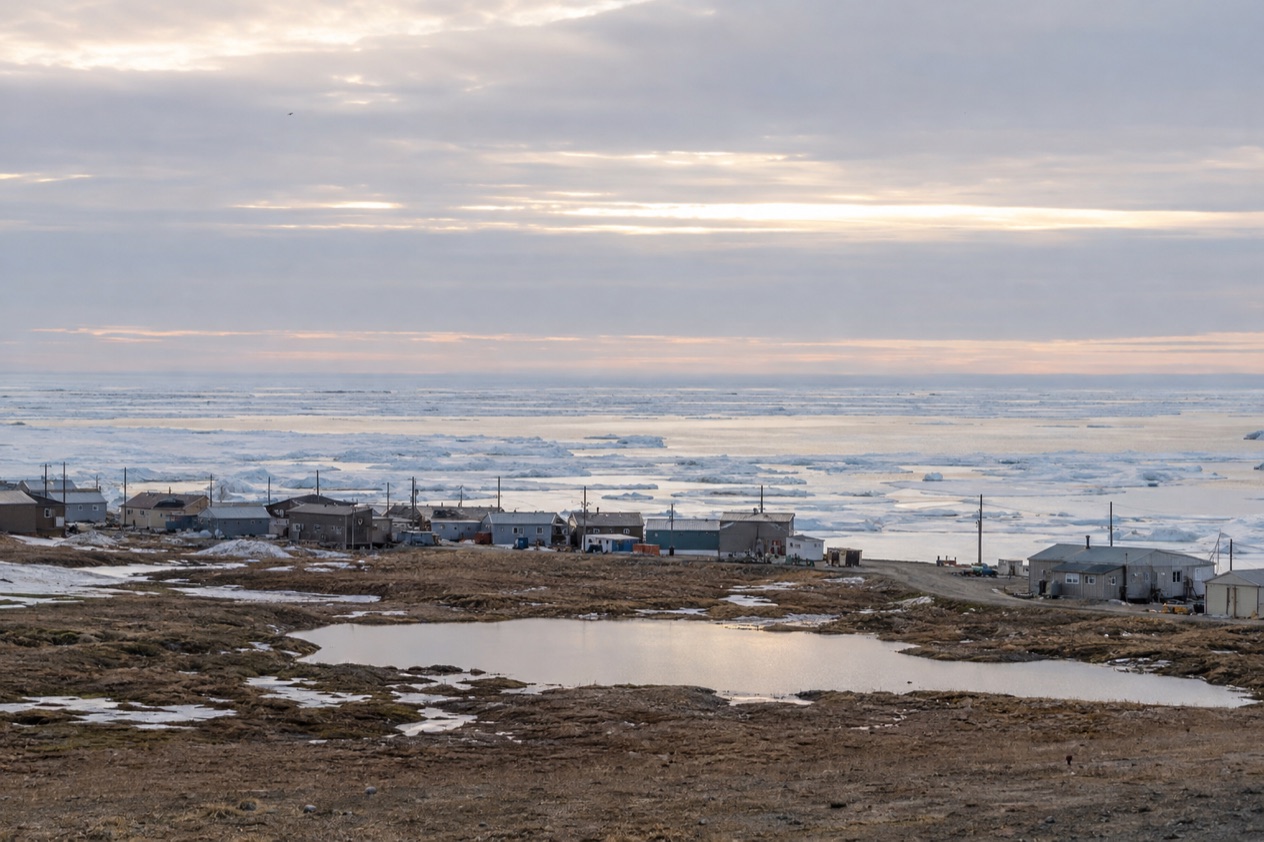
In May, Utqiagvik stays bright through what would be the night anywhere else. Kids are still out on bikes and four-wheelers long after bedtime, snow is going gray along the gravel streets, and the sea ice creaks and shifts out beyond the last houses.
This is the northernmost city in the United States, and May is the month when winter loosens its grip but the Arctic Ocean has not yet let go. It suits travelers who want light, space and a town that lives by the rhythm of the ice.
What is the weather like in Utqiagvik in May?
May in Utqiagvik is still a cold month, with afternoons that reach just a little below freezing weather and nights that stay well under it, but it is far milder than April and almost completely dry.
| Month | Average high (°F) | Average low (°F) | Precipitation (in) | Days with precipitation | Daylight on the 15th |
|---|---|---|---|---|---|
| April | 10.6 | -2.5 | 0.18 | 0.4 | 16 h 21 min |
| May | 26.9 | 18.5 | 0.28 | 0.8 | 24 hours (midnight sun) |
| June | 40.9 | 31.1 | 0.43 | 1.4 | 24 hours (midnight sun) |
The coldest hours come when the sun sits lowest in the north, and even then the lows hover in the high teens. Wind off the ice can make a calm-looking day feel much colder than the thermometer says, so layers matter more than any single heavy coat.
Rain is hardly the issue. Precipitation falls on less than one day in an average May, and some of it arrives as snow, a few inches over the month. Expect a light dusting or a flurry, not a storm, and ground that alternates between crusted snow, slush and mud as the thaw begins.
The light is the real weather story. By the middle of the month the sun does not set at all, so there is no dusk to plan around and no race to get back before dark. Dinner can be at ten, and a walk along the shore at midnight happens in flat, pale daylight, with the sea ice glowing white. A sleep mask is worth having for the same reason.
What to do in Utqiagvik in May
May here is about the edge of the ice. The Chukchi and Beaufort seas meet along this coast, and in spring the shoreline is a landscape of pressure ridges, drifted snow and open leads of dark water, a scene no southern month can match. Everything you do in town is shaped by that view and by the endless daylight.
Utqiagvik is on the North Slope, a region cut off from the rest of the Alaska road system except for the highway between Fairbanks and Prudhoe Bay. Waterways and small airports tie it to the world, which gives the town the feel of an island. Distances are short in town itself, and most of what you do is simply walking its streets and the shoreline, talking with people and watching the ice.
Spring whaling and Iñupiat life
Utqiagvik is an Iñupiat community, and spring is the season when the town’s oldest tradition comes to life: the bowhead whale hunt, carried out by crews who camp on the ice and wait at the open leads. Even if you never see a crew, you feel it in town. Skin boats sit ready on racks, snow machines come and go with gear, and conversations turn to the ice conditions.
This is the life of a community, not a show. Treat the hunt and the camps with the respect you would give someone’s home, and take your cues from the people you meet. The whaling season is usually followed in June by Nalukataq, the community celebration of the blanket toss and shared whale meat, so May is the quiet, focused chapter before the feast.
The Iñupiaq language is still heard here, though across the Iñupiat people only a small number of speakers remain, most of them elderly. Listen for it on the radio, in greetings and in place names, and notice the name Utqiaġvik itself, which carries the local language into the way the city is written today.
The shore, the whale-bone arch and the ice
A walk along the beach road is the plainest and best way to spend a May afternoon, if you can call it afternoon. The beach is not for swimming.
It is a shelf of ice and gravel where the sea meets the land, and in May the ice is usually still there, stacked in ridges and broken slabs with a long white horizon behind it. Bring a camera and keep a respectful distance from the edge, because ice is never as solid as it looks.
The whale-bone arches that stand near the shore are among the most photographed spots in town, made from the jawbones of bowhead whales and standing as a quiet reminder of what the community lives on. In the light of a May evening, with the sun low but never gone, they cast long shadows over the snow. It is a good spot to simply stand and look at the Arctic Ocean.
That sense of being at the edge, with nothing but ice between you and the pole, is what travelers come for. In May it has the added drama of a frozen sea that slowly breaks apart as the month turns to June.
Town streets, wildlife chances and the midnight sun
The center of Utqiagvik is compact, a grid of gravel roads, wooden houses on pilings, a grocery store, a few restaurants and community buildings that all sit within reach of one another. May means a town waking up from a long winter, with people outdoors and work on boats and houses underway. Stop at a café or restaurant when the cold gets to you, and let the day set its own pace.
Birds arrive in spring, and you may see geese, ducks and other migrants over the tundra and along the shore as the snow melts, with the chance of an animal or two on the ice. These are chances, not promises.
Polar day in Utqiagvik runs for most of the summer, and the midnight sun of May is its opening act. The sun stops setting sometime in the first half of the month, and from then on there is no night until the sun begins to dip again in the summer. Walk out at what the clock calls midnight and enjoy the odd, quiet brightness that gives May here its character.
A two-day itinerary for Utqiagvik in May
Day 1 is about the town and the shore. Start in the morning with a slow walk through the center, letting yourself see the houses, the boats on their racks and the daily errands of a community on the edge of the ice. Have a late breakfast at a local café or restaurant, then head out to the beach road for the first look at the sea ice.
Spend the afternoon along the shore and by the whale-bone arches, taking your time with the pressure ridges and the open water. Wind is the main reason to keep moving and to stop in somewhere warm for a hot drink. In the evening, eat dinner at one of the town’s restaurants and then go out again, because the light in the late hours is soft and long and the shore is quiet.
Day 2 widens the view. Begin with a walk toward the edge of town where the streets give way to tundra, binoculars in hand for birds, and see how the thaw is turning the ground. Midday suits a long lunch and a visit indoors, such as the Iñupiat Heritage Center, to learn more about the culture of the people who live here.
If the weather turns, with a wind-driven flurry or a gray, cold afternoon, spend it indoors with museums, a long meal and conversation. Late in the day, return to the shore for a last look at the ice under the never-setting sun, which makes this a day you can end whenever you choose.
Is Utqiagvik busy in May?
May is a quiet month in Utqiagvik, a town of local routines and spring work rather than a place of crowds.
The calm comes from the setting. The town is far from the rest of Alaska’s road system and reached by small airports and waterways, so visitors are never a flood. What fills May instead is the season itself, with the whaling crews, the thaw and the first migrating birds, and a rhythm set by the ice instead of by tourism.
For a traveler, this means a slower, more personal visit, with room to talk to people and to see the place as it really is. The main summer season belongs to June and later, when the sea opens and the weather warms, and May sits just before that, in the quieter chapter when the town is still turning toward the light.
What to pack for Utqiagvik in May
Pack for cold, wind and bright light, not for rain, since highs stay below freezing for most of the month and the ground is a mix of snow and mud.
- A warm insulated jacket, because the wind off the ice makes the afternoons feel colder than they read.
- Thermal layers under your clothes, for the nights that dip into the teens.
- Waterproof, insulated boots, for slush, melting snow and gravel streets on your shore walks.
- A warm hat, gloves and a scarf, since hands and ears are the first to feel the wind.
- Sunglasses, because sunlight on snow and ice is intense when the sun never leaves the sky.
- A sleep mask, to get real rest in the nonstop daylight.
- Binoculars, for birds and distant shapes on the ice.
Good to know before you go
The town sits on the North Slope, and the region is joined to the rest of Alaska’s roads only by the highway between Fairbanks and Prudhoe Bay, with waterways and small airports doing most of the work of moving people and goods.
Spring is also the whaling season, so some of the community’s energy goes to the ice. Be considerate with photography around people and camps, and let the locals guide what is welcome. Beyond that, plan loosely and leave room for weather and the ice to shape your days.
Utqiagvik in May vs April and June
Moving the trip to April means a much colder, darker-ended town. The sun still sets, the ice is deep and solid, and the average high stays near ten degrees. It is the winter version of the Arctic, with fewer thaw signs and a shorter day, though the days are already long. Choose April for the harshest cold and the starkest ice, and May if you want the midnight sun.
Moving to June brings a warmer and a wetter feel. Highs climb to the low forties, rain and snow both become more likely, and the sea ice starts to break up and retreat. The community celebration of Nalukataq usually falls in June, after the whaling season, which gives the month a strong cultural draw.
Stay with May if you want the frozen sea at its most dramatic, a quiet town and the new midnight sun. Shift to June for a gentler temperature, open water and the festival. Shift to April only if the deep-winter Arctic is your goal and you can handle the cold.
Is May a good time to visit Utqiagvik?
Yes, May is a good time to visit Utqiagvik for travelers who want to see the Arctic Ocean still wearing its ice, in endless daylight and with few other visitors around.
It will suit people who love stark landscapes, birdwatchers who like to wait and watch, and anyone interested in Iñupiat culture and the traditions of the spring whale hunt. It is a poor match for travelers who want warm weather, green tundra or open water, who will be happier in June or later. If cold and wind are a problem, choose a milder month.
On arrival, start with a slow walk to the shore and let your body adjust to the light, because the first hours set the tone for the whole stay. What makes May special in Utqiagvik is the sense of timing: the ice is still here, the sun no longer leaves, and the town is turning from winter toward summer.
Sources
- NOAA NCEI, U.S. Climate Normals 1991-2020, monthly (https://www.ncei.noaa.gov/access/services/data/v1?dataset=normals-monthly-1991-2020&stations=USW00027502), station Barrow Post Rogers Ap, elevation 31 feet, checked October 11, 2026
- Computed from the date and the latitude of the place (sunrise equation, solar elevation -0.833 degrees), October 11, 2026
- Wikipedia, Polar bear (https://en.wikipedia.org/wiki/Polar_bear), checked October 11, 2026
- Wikipedia, Polar night (https://en.wikipedia.org/wiki/Polar_night), checked October 11, 2026
- Wikipedia, Midnight sun (https://en.wikipedia.org/wiki/Midnight_sun), checked October 11, 2026
- Wikipedia, Alaska North Slope (https://en.wikipedia.org/wiki/Alaska_North_Slope), checked October 11, 2026
- Wikipedia, Inupiat (https://en.wikipedia.org/wiki/Inupiat), checked October 11, 2026
- Wikipedia, Climate of Alaska (https://en.wikipedia.org/wiki/Climate_of_Alaska), checked October 11, 2026