
PORTUGAL · GETTING AROUND · TRAINS, WHEELS AND WHEN TO USE WHICH
Portugal is a small country that travels big: 350 miles top to bottom, with a fast train down the spine, coaches into every town the rails skip, two proper metro systems, and country roads that turn driving back into a pleasure. The question is never whether you can get there. It’s which tool fits which leg. Get that right and the moving parts of your trip become some of its best hours.
THE NETWORK AT A GLANCE · PORTUGAL
Rails own the coast spine, wheels own the interior: train between the cities, coach where the rails thin out, feet and metro inside town, and a car only for the countryside days that earn it.
SPINE TRAIN: 2H50 · COACHES FROM ~€5 · CAR = INTERIOR ONLY · NO TRAIN TO THE ISLANDS
The golden rule: book the fast train at 60 days (~€16 instead of €35.70) and never bring a car into a city — Portugal punishes urban parking and rewards early rail bookings with almost comic generosity.
Think twice before: renting a car “for the whole trip out of convenience”: the first two-thirds of a classic route needs no wheels at all, as our 10-day plan demonstrates.
Fares: CP & operators, dynamic pricing flagged · full sources at the end of this guide
On this page
- City to city, the big hopsThe three trains, one logo
- Where the rails don’t reachCoaches, the quiet workhorse
- Inside Lisbon and PortoMetro, trams and the €7.25 day
- The countryside chaptersWhen the car earns its keep
- Madeira or the AzoresThe islands rule
- Just landed, now what?Airport to city, fast
From Lisbon airport to the city center (Porto and Faro too)
Lisbon (LIS) is the rare capital whose airport sits inside the city: the metro’s Red line runs from the terminal to the center in about 25 minutes, and a taxi or Bolt to most central quarters is a short, fairly priced ride: no train-to-town saga, no €60 transfer.
Porto (OPO) plays the same trick with the violet E line, about 30 minutes to the middle of things. Faro (FAO) is the Algarve’s front door: city buses and taxis into Faro itself, the rental-car desks for everyone else. Most arrivals are collecting keys anyway, and the coast spreads out 30–60 minutes in either direction.
All three sell the local transit card in the arrivals hall. Buying it before you leave the airport is the first smart move of the trip.
Trains in Portugal: which service to book
Portugal’s railway is really three services wearing one logo. The Alfa Pendular is the flagship: Lisbon to Porto in 2h50, center to center, €35.70 in second class or from about €16 if you book up to 60 days ahead, with 15-plus departures a day. Seats are reserved, so the August walk-up traveler pays double for the worst car.
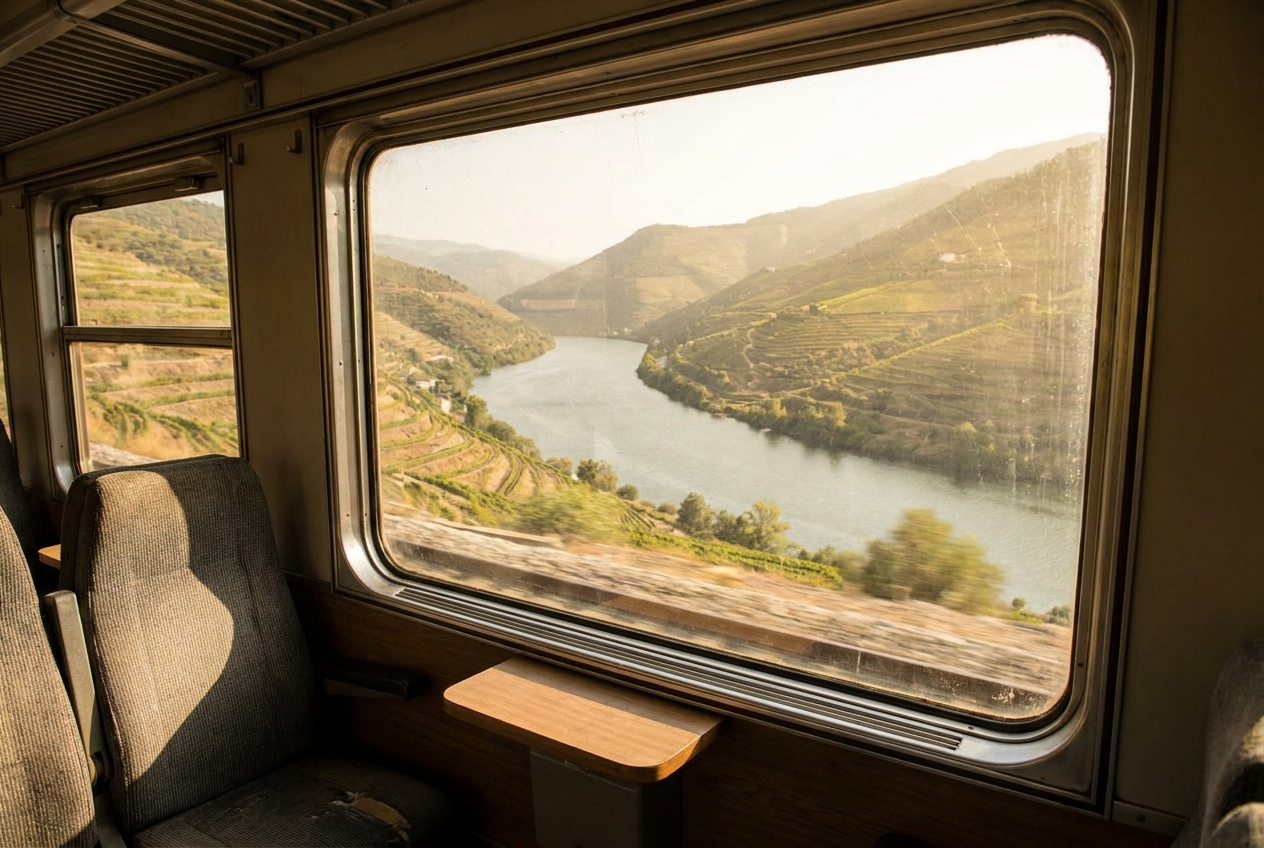
The Intercidades is its honest cousin: a little slower, a little cheaper, same reservation logic, and the way south to the Algarve (about three hours from Lisbon). The regionals are the unreserved, show-up-and-ride locals: slow, cheap, and occasionally spectacular. The Douro line from Porto to Pinhão spends its final hour glued to the riverbank, and no ticket in the country buys better scenery per euro.
One habit covers all three: cp.pt sells every ticket, and the promo fares evaporate weeks out.
Buses and coaches in Portugal: routes, fares and when to use them
Where the map goes rail-thin (Évora and the deep Alentejo, the Algarve’s smaller towns, the crossings the train does slowly), the Rede Expressos network (plus FlixBus on the big corridors) does unglamorous, excellent work: modern coaches, direct routes, and dynamic fares that start absurdly low: Lisbon to Évora from about €3–5 booked a week out, Lisbon to Faro from about €5, climbing as seats fill.
The catch is the same as the airlines’: book late in high season and the bargain becomes a normal European price. For city pairs the train skips, check the coach before assuming you need a car for the day.
Getting around Lisbon and Porto: the €7.25 day
Lisbon and Porto both run clean, simple metros (Lisbon’s Red line meets the airport, Porto’s violet E line does the same), and both cities hide their transport inside their attractions: the trams and funiculars are sightseeing that happens to have rails. The practical kit is one reusable Navegante card (€0.50 once) loaded with either single fares or the €7.25 24-hour pass: trams, metro, buses, funiculars and Lisbon’s Santa Justa lift, one swipe each.
For the gaps, Uber and Bolt work everywhere, arrive fast and cost a fraction of their US prices. The classic beige taxis are fine too, metered, and best hailed at ranks. What you won’t need inside either city, ever: a car. Lisbon’s own guide is blunt about the low-emission zone and the parking.
Driving in Portugal: when to rent a car
Three chapters justify wheels, and they’re all rural: the Alentejo (the region is the road between its towns), the Douro’s quinta lanes beyond the train’s reach, and the Algarve’s cove-hopping west of the rail line.
The playbook: rent for those days only, pick the car up at an airport (city-center garages are a hazing ritual), and read the full briefing before you drive: Portugal’s electronic tolls have a genuine tourist trap in them, and the license rules for Americans matter. Everything else in that guide, from the transponder to the IDP question, stays out of this page on purpose: one topic, one place.
Getting to Madeira and the Azores
Madeira and the Azores are flights, full stop: around two hours from Lisbon (TAP, SATA/Azores Airlines, easyJet on some routes), no ferries worth a traveler’s time from the mainland. Treat them as separate trips grafted onto Portugal rather than legs of the same journey. When their cocoons open here, they’ll get the full treatment.
Getting around Portugal: five classic legs
| Leg | Best tool | Time | Money | The note |
|---|---|---|---|---|
| Lisbon → Porto | Alfa Pendular | 2h50 | €35.70 · ~€16 early | Book at 60 days, always |
| Lisbon → Algarve | Train or coach | ~3h / 3h30 | Varies · coach from ~€5 | Tavira side has rail, west wants wheels |
| Lisbon → Évora | Coach (or your rental) | 1h30 | From ~€3–5 early | Train exists but dawdles |
| Porto → the Douro | Regional train | ~2h to Pinhão | Cheap, unreserved | The scenic hour is the point |
| Lisbon → Sintra | Suburban train | 40 min | Under €3 | From Rossio, before 8:30 |
Portugal transport worth riding for itself
Four legs in Portugal are attractions wearing a fare. The Douro line’s final hour into Pinhão, glued to the riverbank — the country’s best scenery per euro. Tram 28 before 9am, a rolling museum of Lisbon’s best streets. The Cacilhas ferry, ten minutes of full-frontal skyline for pocket change. And the Cascais line, which hugs the Tagus and the sea half the way to the easiest sea day in Europe. Plan them as transport; enjoy them as the itinerary.
Portugal travel apps: download before you fly
Five apps carry the whole country: CP (tickets and live times for every train, including the promo fares), Bolt and Uber (both work; Bolt often arrives first), Rede Expressos or FlixBus (the coach seats at their cheapest), and an offline map of your bases (the Douro’s river bends and Alfama’s alleys both eat phone signal for sport). Everything sells to US cards without drama.
Three classic mistakes moving around Portugal
Renting the car on day one. It then sits in a €25-a-night garage while you ride trams past it. The car joins the trip when the countryside does.
Buying the fast train at the station, in summer, same day. That’s the €35.70-for-the-middle-seat experience. The ~€16 version was sitting on cp.pt for weeks. Assuming the coach is the sad option. On the Évora and Faro runs it’s frequent, comfortable and often faster door to door than the rail detour — the locals aren’t settling, they’re choosing.
The last word
Portugal rewards travelers who match the tool to the terrain: rails where the country is a corridor, wheels where it’s a canvas, feet where it’s a staircase. Plan the moves once, book the two that need booking, and the geography does something rare: it gets out of the way.
See the tools in action in the 10-day route, price them in the honest cost guide, and settle the car question once with the rental briefing.
Sources & data for this guide
- Alfa Pendular · 2h50, €35.70 2nd class, promo from ~€16 up to 60 days ahead, 15+ daily departures · CP official · checked Sep 1, 2026
- Lisbon–Algarve rail ~3h · Sintra line under €3, ~40 min · CP (cp.pt) · checked Sep 1, 2026
- Coach fares · Lisbon–Évora from ~€3–5 and Lisbon–Faro from ~€5 booked ahead, dynamic pricing · Rede Expressos via booking platforms · checked Sep 1, 2026
- Urban transit · Navegante card €0.50, 24h pass €7.25, on-board tram €3.30 · Carris/Metropolitano fare tables · checked Sep 1, 2026
- Island flights ~2h from Lisbon · TAP / SATA schedules, frequencies vary by season
- Ride-hailing availability and taxi practice are editorial observations, not regulated facts