
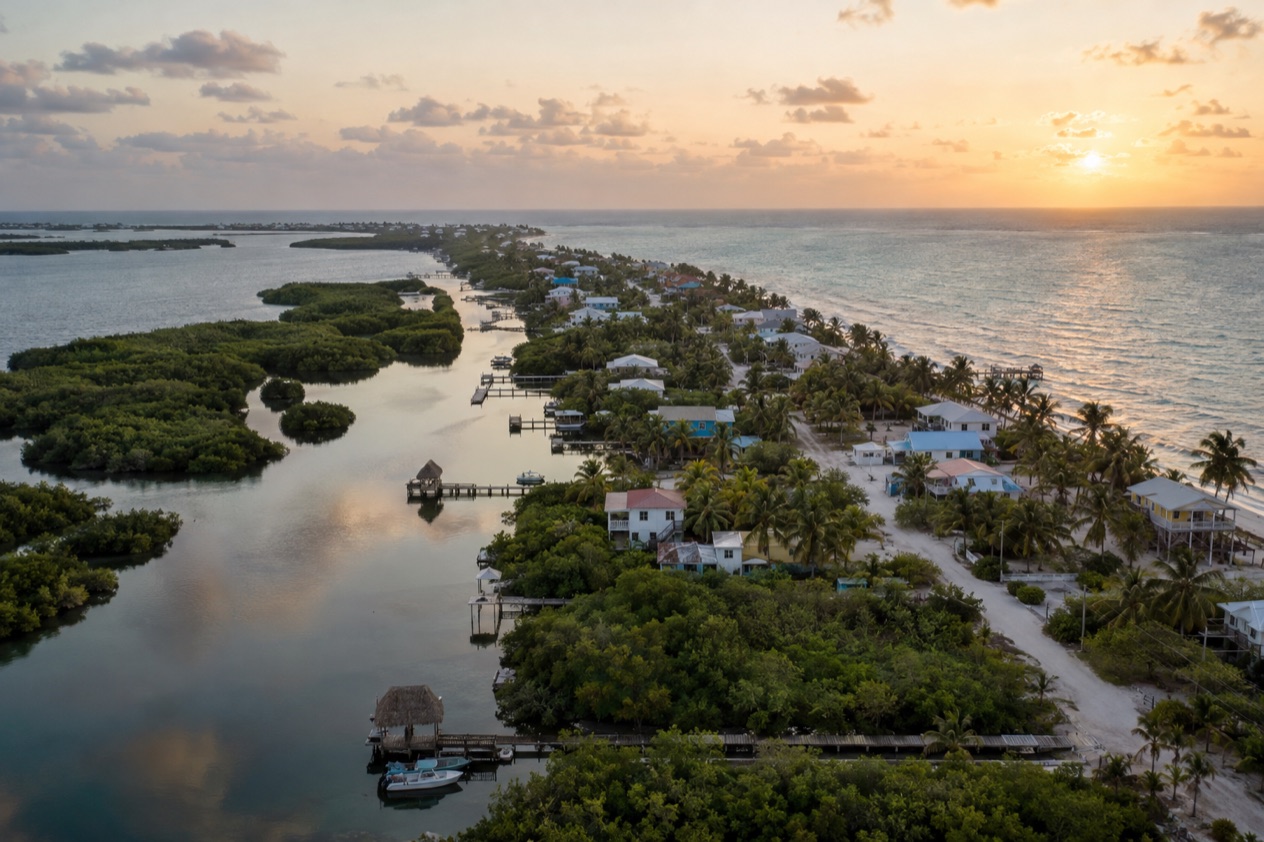
At Gales Point the day ends on the water. Boats slide back across the lagoon, the mangroves go dark against a pink sky, and from somewhere in the village comes the low thump of a drum. This is a small Creole community on a narrow peninsula, wrapped by a manatee reserve, and it suits travelers who would rather watch a lagoon than a dance floor.
Where is Gales Point and what is it like?
Gales Point, officially Gales Point Manatee, is a village in Belize District, on the central coast of Belize, with the Caribbean Sea to its east. Most of its people live on a peninsula that pushes into the Southern Lagoon, a manatee reserve whose water is brackish, a blend of fresh and salt. Five neighboring communities ring the village: Mullins River, St. Margaret, La Democracia, Gracie Rock and Freetown Sibun.
The village is tiny. Its population was 296 in 2010, which tells you most of what you need to know about the pace. People know each other, boats are tied up along the shore, and the main events of the day are the weather, the fishing and the light on the lagoon. Nothing here resembles a resort town, and that is exactly the point for the people who come.
Belize District is better known for its barrier islands. Ambergris Caye with San Pedro Town, and Caye Caulker, are counted among the country’s primary tourism areas, and Belize City is the district capital. Gales Point sits on the mainland side of that picture, among lagoons, wildlife sanctuaries and river country, and it offers a different Belize from the reef towns: still water instead of surf, mangrove edges instead of a beach strip, and a Creole village instead of a row of dive shops.
Who will love it? Birdwatchers, paddlers, travelers curious about Creole culture and anyone who finds a quiet shoreline more interesting than a busy one. Who may not? Those who want a long beach to lie on, a lively bar scene or a long list of restaurants to compare. Gales Point rewards patience. You sit, you watch, you talk with people, and the place slowly opens up.
Think of it as a base for noticing things: a heron standing motionless in the shallows, the V of a ripple where something large has just gone under, the smell of woodsmoke and frying fish in the evening. It is a place to slow down, not to tick items off a list.
What is there to do in Gales Point?
The main reason to come is the Southern Lagoon itself, a manatee reserve that surrounds the village on most sides. Everything else, from the birds to the evening drumming, grows out of that setting. What sets Gales Point apart from its neighbors is how little stands between you and the water.
The lagoon and its manatees
Time on the water is the heart of a stay. The lagoon is a protected manatee reserve, and manatees are the animal people hope to see. They are shy and surface only briefly, so a sighting is a chance, never a promise. You may see only a nostril breaking the surface, a swirl or a trail of bubbles, and that is often enough to make the trip feel worthwhile.
Because the water is brackish, the lagoon supports a mix of life that neither a freshwater lake nor open sea would. Mangrove roots crowd the edges, fish gather in the shallows, and the whole shoreline is a nursery for creatures large and small. Go slowly, keep quiet and look at the edges as much as the open water.
Under Belize law, wildlife means any undomesticated mammal, reptile, bird or amphibian, along with its eggs, nests, parts and products. The Forest Department enforces the Wildlife Protection Act, so the right approach to any animal here is to watch and leave everything where it is.
Birds and quiet shorelines
Lagoon country is bird country. Herons, egrets and kingfishers work the shallows, and the mangrove fringe hides more than it shows. The keel-billed toucan, Belize’s national bird, is a species travelers hope to spot somewhere in the country, and a patient morning with binoculars along the water’s edge is how birdwatchers go about it.
You do not need a specialist’s knowledge. Sit near the shore at the beginning or end of the day when the light is soft and the water is still, and let the birds come to you. A small notebook and a pair of binoculars do more here than any itinerary.
Belize District also holds sanctuaries that bird and wildlife enthusiasts often pair with a lagoon stay, among them Crooked Tree Wildlife Sanctuary and the Community Baboon Wildlife Sanctuary, both listed in the district. They give you other kinds of habitat to compare with the Southern Lagoon.
Village life and Creole culture
Gales Point is a Creole village, and part of the pleasure is simply being among its people. Creole Belize is known for its cooking, its storytelling and its music, and drumming has long been associated with this community. Ask about local traditions with respect and curiosity, and let conversations lead you rather than trying to schedule culture like an attraction.
Walk the village lanes in the evening, when people sit outside and the air cools. You will see how the peninsula works as a community: boats pulled up, nets and gear laid out, neighbors calling across fences. Eat what is cooked locally when you have the chance, and take your time over it. A village of this size sets its own rhythm, and the best thing a visitor can do is fit into it.
How many days do you need in Gales Point?
A night or two is enough to feel the place, and a few days lets you slow down to its speed. Gales Point is not a destination of sights to be collected, so extra days add depth rather than new checklist items.
With a short stay, give your time to the lagoon and the village. Spend an outing on the water looking for manatees and birds, then use the evening to walk the peninsula, eat locally and listen. That alone gives you a real sense of the village and the reserve around it, and it will not feel rushed if you resist the urge to add more.
A longer stay changes the experience. You can return to the water at different times of day and notice how the light, the birds and the mood of the lagoon shift. You can sit on the shore without a plan, get to know people in the village and let one slow morning follow another. Travelers who like to read, paint, photograph or simply sit tend to find the extra days rewarding.
Gales Point also fits into a wider trip across Belize District. Belize City is the district capital, and from the mainland you can go on to the barrier islands the district includes, such as Ambergris Caye with San Pedro Town, and Caye Caulker, both counted among the country’s primary tourism areas. Inland, Crooked Tree Wildlife Sanctuary and the Community Baboon Wildlife Sanctuary are other nature stops in the same district.
A sensible shape for a longer Belize trip is to pair a quiet lagoon village like this one with a reef island, so you get both sides of the country: still brackish water and wildlife on one side, the barrier reef and its cayes on the other. Gales Point is the calm half of that pairing.
Where to stay in Gales Point
The place to stay is the village on the peninsula. Most of Gales Point’s people live there, on a strip of land with the Southern Lagoon around it, so staying in the village puts you within sight of the water and in the middle of daily life. It suits travelers who want to meet the community, wake to the lagoon and see the evening light on the mangroves.
Lodging in a village of a few hundred people is small in scale, and that shapes the stay. You are a guest in a community rather than a customer of a resort, so expect a quiet, personal setting. It will appeal to people who value simplicity and local company, and may disappoint those who want a large property with a long list of services on site.
The surrounding communities, Mullins River, St. Margaret, La Democracia, Gracie Rock and Freetown Sibun, are the neighbors on the map, and they show the countryside setting you are in: small settlements, water and green rather than a town center. They are context for your trip, a sense of the landscape you move through, rather than separate resort areas.
If you want a more typical tourist scene, Belize District’s reef islands are the alternative. Ambergris Caye, where San Pedro Town sits, and Caye Caulker are considered two of Belize’s primary tourism areas, and Belize City is the district capital and a base for the mainland. Many travelers split a trip between a lagoon village and an island, using each for what it does best.
Whatever you choose, think about what you want from your evenings. In Gales Point they are quiet, with the lagoon, the village and the sky as the entertainment. Pack accordingly, with a book, binoculars and patience, and you will be well matched to the place.
How do you get to Gales Point and get around?
Gales Point lies on the central coast of Belize, in Belize District, so you reach it through the district whose capital is Belize City. The village sits on a peninsula in the Southern Lagoon, with the Caribbean Sea to the east and five neighboring communities around it, so it is a place you travel to on purpose rather than pass through.
Belize City is the natural reference point on the map. It is the capital of the district and the place most routes across the central coast are measured from. The district also takes in offshore islands, including Ambergris Caye, Caye Caulker, St. George’s Caye and Caye Chapel, so many trips through this part of Belize combine the mainland with a stay on the water.
Once you are in the village, the setting does much of the work for you. The peninsula is where most people live, and the community is small, so you move around on foot and by boat on the lagoon. The water is the main avenue here, and the reserve that surrounds the village is best known from the surface.
Within Belize District, the Belize River, the longest river in the country, passes through and reaches the Caribbean along the district’s coast. It is part of the same watery geography that shapes this region, and a reminder that travel here is as much about rivers, lagoons and coast as it is about roads.
The U.S. State Department rates Belize at Level 2 and says the south side of Belize City has historically had the highest concentration of violent crime. That is worth knowing when you plan how you pass through the district’s largest city on your way to a quiet village.
When is the best time to visit Gales Point?
There is no single perfect month for a lagoon village, and what you want from the stay matters more than the calendar. The air figures that exist for this coast come from Belize City, and they show a warm place all year. In Belize City, January highs average about 83°F, with lows near 68°F, and July highs climb to about 89°F, with lows near 77°F.
Rain falls in both seasons. In Belize City, January brings around five inches of rain and about ten rainy days, while July brings nearly six inches and about twelve. So a winter trip is a little cooler and slightly less wet, and a summer trip is hotter and slightly wetter, but neither is a dry month. Pack for showers whenever you come.
The Atlantic hurricane season runs from June 1 to November 30, and it covers the summer and fall months in Belize. A trip in those months falls inside the official season, while December through May falls outside it. A quiet, remote village in lagoon country is a place where it helps to follow forecasts and stay flexible if you travel during the season.
If you want the coolest conditions for walking the village and sitting outside in the evening, the early months of the year are the natural choice, with January as the example. If you do not mind the heat and want long, warm days, July shows the other end of the range. Either way, the lagoon is the draw, and it is there every month.
Good to know before you go
The U.S. State Department rates Belize Level 2, “Exercise increased caution”, because of crime, and says the south side of Belize City has historically had the highest concentration of violent crime.
Gales Point is a small community in a protected wildlife area, and good manners go a long way. Wildlife in Belize is protected by law, and the Forest Department enforces the Wildlife Protection Act, so watch animals and leave eggs, nests and parts of wildlife alone. Since 2016, newly captured baby parrots cannot be owned under the National Captive Wildlife permit program, a reminder that wildlife is not for taking home.
A village of a few hundred people is a place to arrive with respect, patience and curiosity. Greet people, ask before photographing, and let the pace of the peninsula set the pace of your stay. Bring binoculars, a hat and clothing for warm, damp weather, and expect the lagoon to be the star of the visit.
Sources
- Wikipedia, Gales Point (https://en.wikipedia.org/wiki/Gales_Point), checked October 11, 2026
- Wikipedia, Belize District (https://en.wikipedia.org/wiki/Belize_District), checked October 11, 2026
- Wikipedia, Wildlife of Belize (https://en.wikipedia.org/wiki/Wildlife_of_Belize), checked October 11, 2026
- Wikivoyage, Belize District (https://en.wikivoyage.org/wiki/Belize_District), checked October 11, 2026
- Wikipedia, Climate of Belize (https://en.wikipedia.org/wiki/Climate_of_Belize), checked October 11, 2026
- NOAA NCEI, GHCN-Daily station BHM00078583 (Philip S. W. Goldson International Airport, Belize City), normals 1991-2020 computed from the daily record (https://www.ncei.noaa.gov/access/services/data/v1?dataset=daily-summaries&stations=BHM00078583), checked October 11, 2026
- U.S. Department of State, Belize Travel Advisory, Level 2, March 11, 2026 (https://travel.state.gov/), checked October 11, 2026
- NOAA National Hurricane Center, Climatology (https://www.nhc.noaa.gov/climo/), checked October 11, 2026