
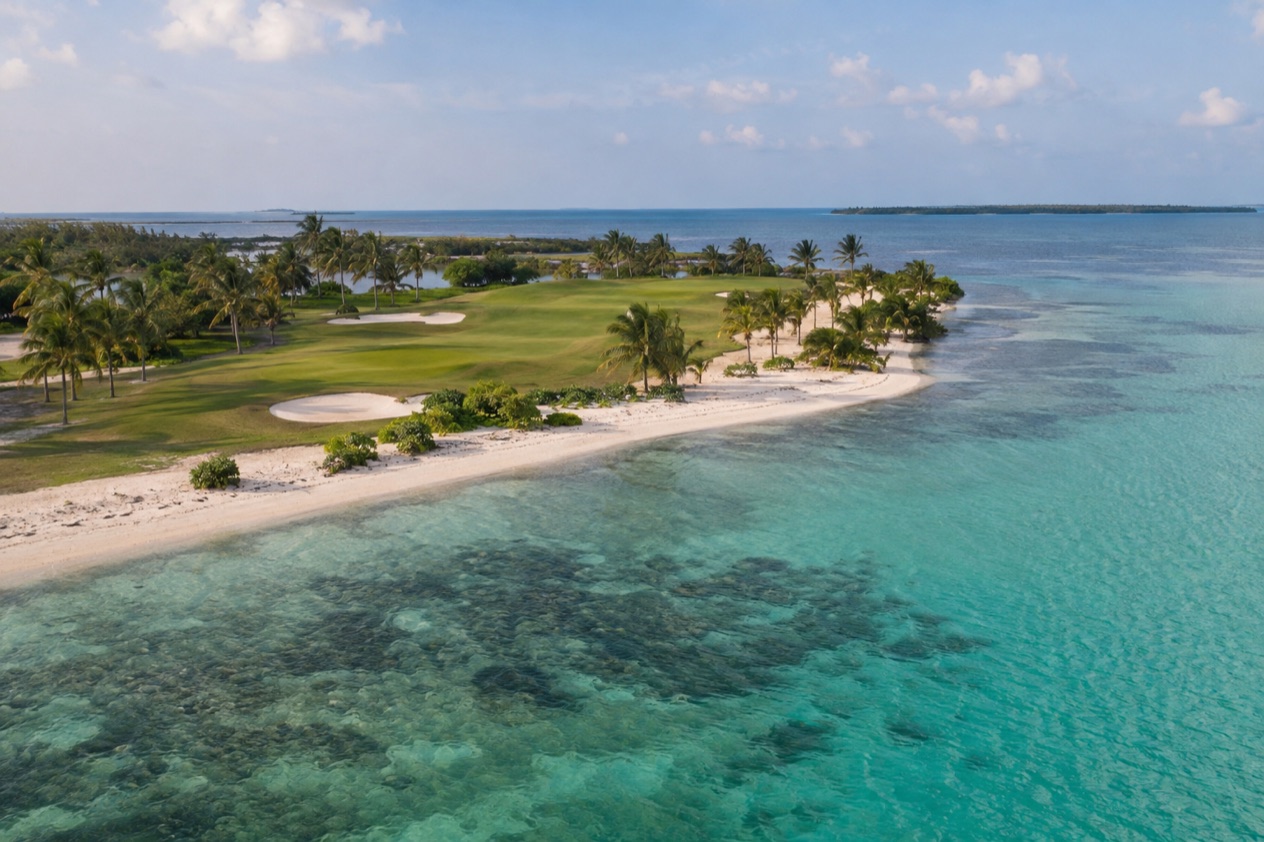
Out on the shallow green water between Belize City and the northern cayes, a low line of palms appears and a small plane lines up with a grass-edged strip. This is Caye Chapel, a private island where the sea fills almost every view. It suits travelers who want a quiet stretch of the Belize coast, with the livelier cayes close enough to visit.
Where is Caye Chapel and what is it like?
Caye Chapel is a small, private island off the coast of Belize, 16 miles north-northeast of Belize City and 3 miles south of Caye Caulker. It sits in the Caribbean waters inside the barrier reef, in the stretch of cayes that leads north toward Ambergris Caye. Belize City is the country’s largest city and principal port, and it is the mainland gateway to this part of the coast.
The word private sets the tone. There is no village here with a main street, no row of guesthouses and no dock lined with tour boards. The island is a single-purpose place, built around an airstrip, a shoreline and the water on every side. Mornings are about light on the flats, a breeze through the palms and the sound of small engines in the distance.
That quiet is the appeal for some and the limit for others. If you picture an evening of wandering from a taco stand to a beach bar, Caye Chapel is not that kind of place, and the neighboring cayes serve that picture better. Caye Caulker Village, with a population of roughly 4,000, is the nearest town and has the shops, restaurants and hotels that a private island does not offer.
Ambergris Caye lies farther north and is a very different island. It is long and narrow, about 25 miles from end to end and a mile across, and its main attractions are the Belize Barrier Reef and its beaches. Seen together, the three cayes form a ladder: Caye Chapel for seclusion, Caye Caulker for a small-town pace, Ambergris for the widest range of things to do.
The setting is the Mesoamerican Barrier Reef System, the world’s second longest barrier reef. Its presence shapes everything about this coast, from the color of the water to the fishing traditions of the Creole and Garifuna communities along the shore. Even on a private island, you are living inside that landscape, with the reef offshore and the open Caribbean beyond it.
What is there to do in Caye Chapel?
The main reason to come is the island itself: its shoreline, its stillness and its position among the cayes. Caye Chapel is a place to slow down, and the things to do fall into a few simple categories, with the more active outings found on the islands nearby.
Time on the island
Days here are built around the sea view. You watch the color of the water shift from pale turquoise in the shallows to deeper blue toward the reef line, you read in the shade of a palm, and you follow the movement of pelicans and frigatebirds over the flats. Sunrise comes over the reef side and sunsets fall across the lagoon toward the mainland.
This is the right choice for couples, for anyone recovering from a busy itinerary and for travelers who prefer a calm base to a lively one. It is less suited to people who like to wander on foot into a town for dinner, because the island is private and does not have a public village. Bring a book and let the days run long.
The reef and the lagoon
The Belize Barrier Reef is the draw of the whole coast, and Caye Chapel sits within reach of it. Off Caye Caulker, a shallow lagoon, between 6 inches and 14 feet deep, meets the reef to the east, where the reef is a dry reef exposed at the surface. That gives you a sense of the landscape here: broad, bright shallows with the reef as a long white line of breaking water on the horizon.
Many travelers connect their stay with a boat outing to the reef, but the details of those trips (operators, routes and timing) vary, so arrange them through the place where you stay. What you can count on is the scenery: flats, mangrove edges and open water that look different at every hour of the day.
Neighboring cayes
Caye Caulker, 3 miles to the north, is the nearest place to feel a Belizean island community. The town is known for its relaxed pace, its backpacker roots and its restaurants and shops, and it has become a popular destination with more than 50 hotels. Its sandy streets, colorful wooden houses and seafood stands give a very different mood from a private island.
Ambergris Caye, with San Pedro as its town, gives a larger menu of beaches, restaurants and reef-focused activities. Pairing a quiet base with a visit to one of these cayes is the natural way to balance seclusion with variety. It is what sets Caye Chapel apart from its neighbors: the others are places you go out to enjoy, while this is a place you retreat to.
How many days do you need in Caye Chapel?
A long weekend is enough to feel the island, and a week lets you pair it with the surrounding cayes. Caye Chapel does not have a checklist of sights, so the length of your stay depends on how much you want to do beyond resting by the sea.
In a short stay, the pleasure is in the rhythm: a slow breakfast, a long look at the water, an afternoon with nothing to do and an evening under a wide sky with few lights around. A few nights are long enough to settle into that rhythm without feeling you have missed something. Travelers who arrive on a tight schedule often find that two or three nights is what the place asks for.
With more time, the neighboring cayes become part of the trip. Caye Caulker is the closest, and a day in its village gives a glimpse of everyday island life, with its sandy lanes, its small restaurants and its view of the lagoon. Ambergris Caye, reached by plane or by one of the fast sea ferries from Belize City, adds a longer coastline and the town of San Pedro.
A week also leaves room for a day or two in Belize City, the old capital of British Honduras until the government moved to Belmopan in 1970. Its Swing Bridge, the only functioning, manually operated swing bridge in the world, is a curiosity, and the city is the port and financial center of the country. Many travelers pass through it on the way to the cayes, so building in a little time there costs little.
If you want to combine the island with the mainland, a longer trip can extend beyond the coast to the rainforest and the Maya sites inland. That is a different kind of travel from a stay on a small cay, and it deserves its own days rather than a rushed add-on.
Where to stay in Caye Chapel
The main choice is between staying on Caye Chapel itself, a private island without a public village, and basing yourself on a neighboring caye. Because the island is private, it works as a self-contained retreat, where your stay, your meals and your time by the water are all arranged in one place. It suits couples and travelers who put privacy and quiet first.
If you prefer variety, Caye Caulker is the closest alternative. The island has more than 50 hotels, along with restaurants and shops, and the village is compact enough that your whole stay stays within one small area. It draws backpackers and other travelers who want a laid-back, small-town atmosphere with the lagoon at the doorstep.
Ambergris Caye offers the broadest range. Its length, about 25 miles north to south, means there are different stretches to choose from, from the town of San Pedro with its restaurants and activity centers to quieter beaches along the coast. Resorts and hotels are found along the shoreline, and the island has its own small airstrip served by Tropic Air and Maya Island Air.
Choosing among them comes down to the kind of evening you want. A private island gives you stillness and a view. Caye Caulker gives you a walk to dinner on sandy streets. Ambergris gives you the widest choice of places to eat and things to do. Many travelers split a trip between two of them, spending the quiet nights on one island and the livelier ones on another.
How do you get to Caye Chapel and get around?
You reach Caye Chapel from the mainland through the Belize City area, and the island has an airstrip. Belize City, 16 miles to the south-southwest, is the country’s principal port and the usual starting point for the cayes, so most journeys to this stretch of coast begin there.
For the neighboring islands, the options are clearer. Caye Caulker is accessible by high-speed water taxi or by small plane via Caye Caulker Airport, and it lies about 20 miles north-northeast of Belize City.
Ambergris Caye can be reached by plane or helicopter from Belize City and by numerous fast sea ferries, and its small airstrip is served by Tropic Air and Maya Island Air. Astrum Helicopters serves the local airstrip and various resorts.
Ambergris Caye can also be reached by ferry from Chetumal in Mexico, which matters if your trip includes the northern border. That route links the island to a different gateway, so it is a way to arrive from the north rather than through Belize City.
Getting around once you are there depends on the island. On a private island, movement is limited to the grounds and the shoreline, and your arrangements for the island are handled by where you stay.
Between the cayes, the sea is the road. The water taxis and small planes that link the islands to Belize City are part of daily life on this coast, and watching the planes lift off from the short strips is one of the small pleasures of the region. Plan the legs of your trip around where you want to sleep each night, and let the water do the connecting.
When is the best time to visit Caye Chapel?
The cooler, winter months are the pleasant ones for time outdoors by the sea, and January is a good example. In Belize City, January highs average in the low 80s, with 10.3 rainy days and nights cool enough to sit outside comfortably. It is a month of soft light and easy days, and the air has none of the weight of summer.
July is the hot end of the year. In Belize City, highs average near 90 and lows stay in the upper 70s, and rain falls on about 12 days of the month. Expect a warm, humid stay, with the sea at its warmest and the sky changing quickly. The air is thick enough that shade and breezes matter more than anything else on the island.
The Atlantic hurricane season runs from June 1 to November 30, which covers the summer, the fall and the start of winter. Travelers who come during those months should plan with that in mind and stay flexible, because a tropical system can disrupt flights and boats along the coast. The months from December to May fall outside the official season.
For a quiet island, the choice of month shapes the mood more than the activities. Winter gives you the milder air and the long evenings outside. Summer gives you the heat, the greener land and the quiet of a slower season. Each suits a different traveler, and the island itself, with its sea and its stillness, is there in both.
Good to know before you go
The U.S. State Department rates Belize Level 2, “Exercise increased caution”, because of crime, and says the south side of Belize City has historically had the highest concentration of violent crime.
Caye Chapel is private, so plan your stay and your arrival around the place where you will be staying rather than expecting to wander in. The neighboring cayes are where you will find shops, restaurants and public docks, so it helps to think of the region as a small group of islands with different characters.
The hurricane season runs from June 1 to November 30, so a trip in those months benefits from flexible plans. Belize City is the gateway to the cayes and the largest city in the country, with a population of 63,999 in the 2022 census. Bring what you need for the sun and the sea, and leave room in the schedule for the slow pace that makes the cayes worth the trip.
Sources
- Wikipedia, Caye Chapel (https://en.wikipedia.org/wiki/Caye_Chapel), checked October 11, 2026
- Wikipedia, Ambergris Caye (https://en.wikipedia.org/wiki/Ambergris_Caye), checked October 11, 2026
- Wikipedia, Caye Caulker (https://en.wikipedia.org/wiki/Caye_Caulker), checked October 11, 2026
- Wikipedia, Belize City (https://en.wikipedia.org/wiki/Belize_City), checked October 11, 2026
- Wikipedia, Climate of Belize (https://en.wikipedia.org/wiki/Climate_of_Belize), checked October 11, 2026
- NOAA NCEI, GHCN-Daily station BHM00078583 (Philip S. W. Goldson International Airport, Belize City), normals 1991-2020 computed from the daily record (https://www.ncei.noaa.gov/access/services/data/v1?dataset=daily-summaries&stations=BHM00078583), checked October 11, 2026
- U.S. Department of State, Belize Travel Advisory, Level 2, March 11, 2026 (https://travel.state.gov/), checked October 11, 2026
- NOAA National Hurricane Center, Climatology (https://www.nhc.noaa.gov/climo/), checked October 11, 2026