
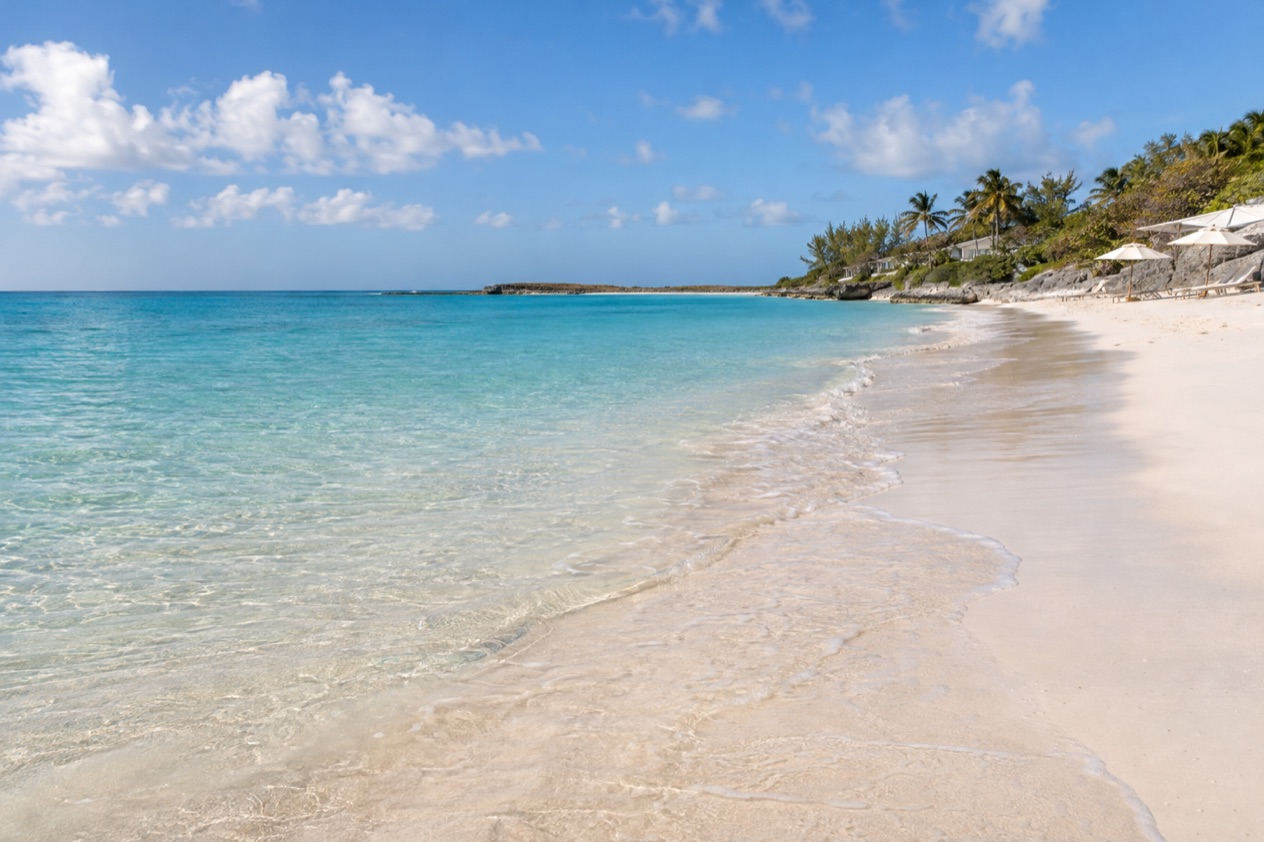
Sugar Beach opens as a string of pale sandy coves tucked between rocky cliffs, with thatchberry trees leaning over the edge of the sand and the ruins of an old resort standing back from the water. It is a beach to wander rather than to settle on, where each headland hides another cove. The beach belongs to the Berry Islands, a different island group from pink-sand Harbour Island, and it suits travelers who like their coastline wild, quiet and a little mysterious.
Is visiting Sugar Beach worth it?
Yes, if you are the kind of traveler who would rather explore a coast than lie on a lounger, and especially if you like shelling, ruins and a walk with a view at the end of it. Sugar Beach is considered one of the prettiest places in the Bahamas, with sandy coves among cliffs that resemble great Mediterranean beaches. That description is the heart of the appeal: this is a beach with architecture of its own, made of rock, trees and hollows.
What sets it apart from the beaches people usually pair with it is the lack of polish. Harbour Island, off the northeast coast of Eleuthera, is known for pink sand along its east side and for the colonial houses of Dunmore Town, and it is a popular vacation spot for Americans.
Sugar Beach offers something else: a shoreline of coves and caves, the shell of a vanished resort and creeks full of wildlife. Visitors who want a bar on the sand will not find that story here. Visitors who want a place that feels discovered will.
It also rewards curiosity more than schedules. You arrive, you pick a cove, you follow the sand to the next one, and the day arranges itself around what you find. Those who enjoy a slow, observant kind of vacation, with a pocket full of shells and a camera, will get the most out of it.
What to see at Sugar Beach
The beach reads best as a sequence, from the sand and cliffs at the water’s edge to the ruins behind them and the trail at the far end. Each part has its own character and its own pace.
The sandy coves and cliffs
Sugar Beach is not one long strip but numerous sandy coves set among cliffs. Walking it means rounding a rocky point, stepping into a small curve of pale sand, and then finding that another point and another cove follow. The cliffs frame the water and give each pocket of beach a private feel, which is the reason the place is compared with the great Mediterranean coves.
Thatchberry trees grow in abundance here, and their feathery crowns soften the edge between sand and scrub. They give the beach its look: pale sand, gray rock and a fringe of green. Photographers tend to love the contrast, especially when the light is low and the cliffs turn warm.
The ruins of the Sugar Beach Resort & Golf Club
Behind the sand stand the ruins of the Sugar Beach Resort & Golf Club, the original resort of the Berry Islands. An abandoned hotel on a remote beach has a pull of its own: walls that once held guests, now open to the weather, and a setting that tells you the island once had bigger plans for its coastline.
The ruins are best taken as a place to look and to imagine, a few quiet minutes of storytelling between the beach and the trees. They make a good landmark too, since the stretch of beach to the north is measured from them.
Shelling and the beach north of the ruins
Shelling is excellent at Sugar Beach, and other sea treasures can be found when strolling along the beach north of the ruins. This is the kind of walk that goes slowly: eyes on the waterline, a stop every few steps, a small collection building in your hand or pocket.
Children and adults take to it equally. The reward is not just the shells themselves but the unhurried rhythm it gives the morning, with the cliffs on one side and open water on the other.
The trail and the viewpoint at the northern end
At the northern end of the beach, a trail runs through the woods. Visitors can ask locals how to find it, then carefully climb up the rocks to enjoy a spectacular view. The payoff is a high look back over the coves and the water, the best way to understand how the cliffs and sand fit together.
The route depends on local knowledge, which is part of the experience. Go with sturdy shoes in mind and take the rocks slowly, since the reward is the view and not the speed of the climb.
Caves and creeks
Sugar Beach also has caves to explore, and its creeks are filled with many species of wildlife for the more adventurous. These are the corners that turn a beach visit into a small expedition: a dark opening in the rock, a tidal channel winding back into the trees, birds and creatures going about their business.
They suit people who like to poke around and who are happy to look closely rather than cover ground. Bring patience and curiosity, and let the creeks set the pace.
Hours, tickets and rules
Sugar Beach is a natural shoreline of coves, cliffs, caves and creeks, with the ruins of an old resort behind the sand, and it is visited as a place to walk rather than a ticketed attraction with a gate and a turnstile. The experience is shaped by the land itself: the cliffs, the trees, the creeks and the beach.
The one clear instruction for visitors concerns the viewpoint at the northern end. Visitors can ask locals how to find the trail through the woods, then carefully climb up the rocks to enjoy the view. That is the extent of the guidance, and it asks for two things: local knowledge to find the path, and care on the rocks.
For questions about the beach, the Berry Islands Tourism Representative is the contact to use, and you can reach that office by phone or email. Everything else about a visit here comes down to common sense: look, walk, collect shells gently and leave the coves as you found them.
How to get to Sugar Beach
Sugar Beach is on the Berry Islands, and that is the starting point for any plan. It is not on Harbour Island, which lies off the northeast coast of Eleuthera and has its own arrival story: by airplane to North Eleuthera Airport, followed by a short water taxi ride from neighboring North Eleuthera. That route takes you to Harbour Island, home to Dunmore Town, the island’s only town, and its pink sand beaches, not to Sugar Beach.
For the Berry Islands, the local source is the Berry Islands Tourism Representative, who can be reached at (242) 451-0404 or by email at [email protected]. They are the people to ask about Sugar Beach itself, and a short message before you travel is a sensible way to sort out how you will reach the coast.
Once you are at the beach, the final piece of navigation is local. The trail at the northern end is found by asking locals, and the same habit of asking works for the rest of your visit. People who live near a place like this know its paths and its corners better than any map.
If you are building a longer trip that includes Harbour Island, think of the two as separate chapters: Harbour Island for its pink sand and colonial streets, the Berry Islands for the wilder coves of Sugar Beach. Each has its own island and its own way in, and each deserves its own plan.
When to visit Sugar Beach
Go when you can give the beach unhurried daylight, because the walk from cove to cove, the shelling and the climb to the viewpoint all reward time. Morning light tends to be soft on the cliffs and the sand, and late afternoon turns the rock warm, so those are the hours photographers enjoy. Midday sun is bright on pale sand, so a hat and a pause in the shade of the thatchberry trees make sense.
The trail up to the viewpoint is the part of the day to plan around. Climbing the rocks is best done with good light and a clear head, so many walkers do it in the first part of the visit, then return to the coves at a lower pace. If you want the view in warm, low light, plan the climb for later in the day and leave enough daylight for the way back down.
As for the months, the beach itself is a coast of sand and rock that can be explored in any season, and shelling often improves after rough weather has stirred the sea and left things on the sand. The time of year mostly changes the feel of the walk, with brighter, drier-looking light on some days and heavier skies on others.
There is no festival or fixed date tied to Sugar Beach, which is part of its charm. It is a place for an ordinary good day, one with no schedule other than the light and your own curiosity.
Tips for your visit
Bring what a day of exploring asks for: shoes with a grip for the rocks and the trail, a hat, water, and a small bag or pouch for shells. A camera is worth the space, since the coves, the ruins and the view from the northern trail are all made for it. Binoculars or a patient eye are useful at the creeks, where many species of wildlife live.
Plan the day around three kinds of walking. The first is along the sand through the coves, which is gentle and open. The second is north of the ruins, where the shelling and the sea treasures are.
The third is the trail through the woods and up the rocks, which asks for care and is the most demanding part of the visit. Anyone with limited mobility will enjoy the sand and the ruins most, and can leave the climb to others in the group.
Families with children will find plenty to keep them busy: shells to collect, caves to look into, creeks to watch and ruins to wonder about. Keep a close eye on young ones near the cliffs, the caves and the rocks of the trail.
If you are combining Sugar Beach with a stay elsewhere, think of it as its own outing on the Berry Islands. Harbour Island offers a very different day, with the pink sand along its east side, the English Colonial-style architecture of Dunmore Town and an island nickname, Briland, that locals use with affection. Together they make a good contrast between the polished and the wild.
For questions before you go, the Berry Islands Tourism Representative is the person to contact. Asking locals is also the way to find the trail, so keep the conversation friendly and open.
Good to know before you go
The U.S. State Department rates the Bahamas Level 2, “Exercise increased caution”, and says most crime occurs in Nassau on New Providence and in Freeport on Grand Bahama.
The Atlantic hurricane season runs from June 1 to November 30, so those are the months when a tropical system can reshape travel plans on any island of the Bahamas. Sugar Beach is a natural shoreline with ruins, caves and creeks, and it is best enjoyed with a little local advice and a relaxed schedule.
Take your time on the rocks and the trail, carry out what you carry in and leave the shells that still hold a living creature. The beauty of the place is in how little has been done to it, and a light touch keeps it that way.
Sources
- Bahamas Ministry of Tourism, Investments & Aviation (bahamas.com), Sugar Beach (https://www.bahamas.com/natural-wonders/sugar-beach), checked October 10, 2026
- Wikipedia, Harbour Island, Bahamas (https://en.wikipedia.org/wiki/Harbour_Island,_Bahamas), checked October 10, 2026
- U.S. Department of State, The Bahamas Travel Advisory, Level 2 (https://travel.state.gov/), checked October 10, 2026
- NOAA National Hurricane Center, Climatology (https://www.nhc.noaa.gov/climo/), checked October 10, 2026
To plan your stay
- Best Time to Visit the Bahamas: Weather, Hurricane Season, Sea Temperatures and Junkanoo
- Where to Stay in the Bahamas: Best Islands, Resorts, Boutique Stays and How to Choose
- Getting Around the Bahamas: Flights, Ferries, Mailboats and Taxis in Nassau
- Know Before You Go to the Bahamas: Entry Rules, Money, Getting Around and Local Customs