
The boat idles over a patch of pale sand, someone checks a regulator one last time, and the whole group tips backward into water so clear that the reef seems to rise to meet you. A gray shape slides in from the blue, a school of grunts parts around it, and the surface slips away overhead.
That is the Bahamas underwater: an Atlantic archipelago of sharks, shipwrecks, blue holes and a very long barrier reef. Divers go down off New Providence, Grand Bahama, Andros, Bimini, the Exumas and Eleuthera.
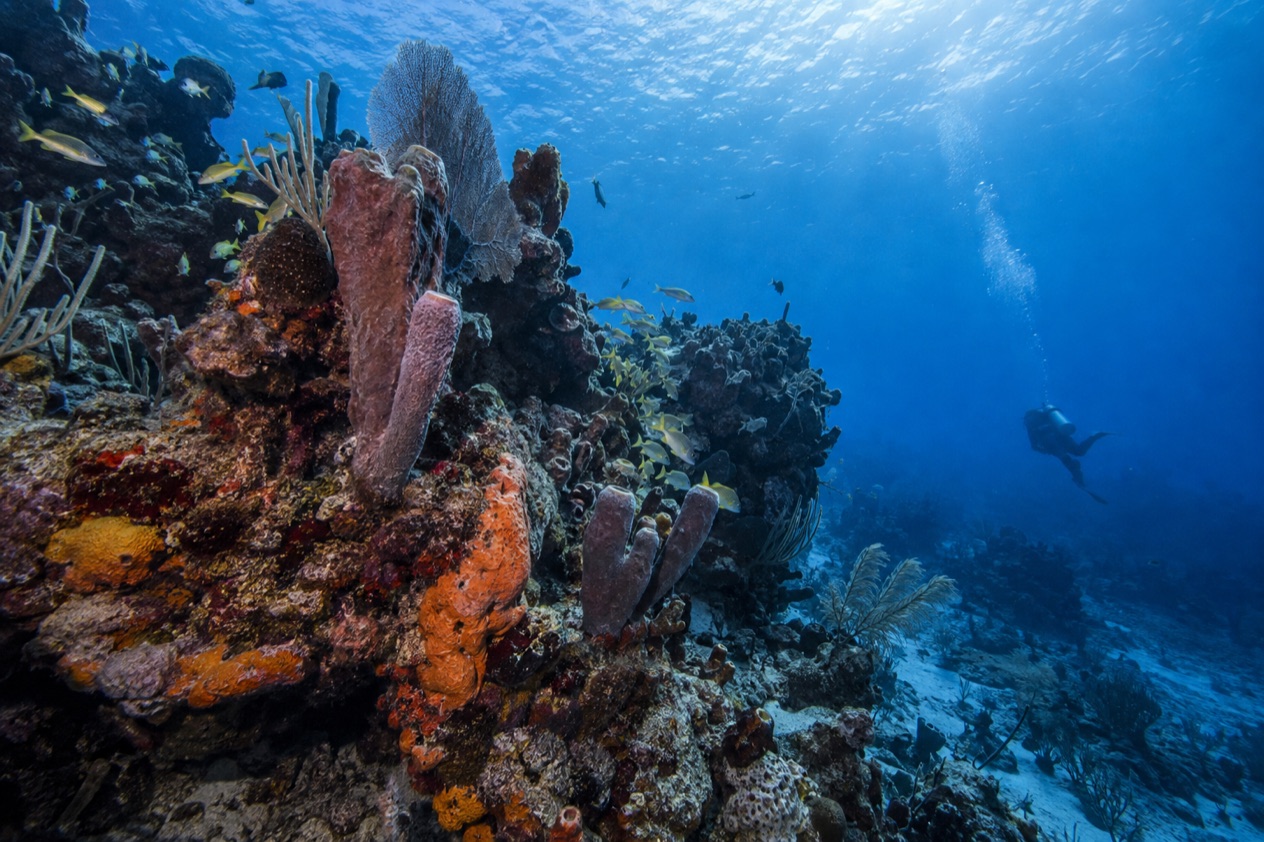
Where can you dive in the Bahamas?
Named dive sites and dive operators are spread across several island groups, from the shore bases of New Providence to the blue holes of Andros. The Bahamas is an archipelago, so each island has its own character underwater, and a good day on one says little about the next. Underwater visibility can reach 150 to 200 feet, which is a large part of the draw.
The practical way to plan is by island. Decide what you want to see, whether sharks, a wreck, a wall or a cave, and then choose the island that has it. The sections that follow go island by island.
New Providence and Nassau
Stuart Cove’s Dive Bahamas sits on the southwest side of New Providence, the island that holds Nassau. It is a PADI 5-Star Dive Center with daily dive trips, and it has run shark dives since 1985. It keeps a fleet of seven dive vessels and offers sites for every level of experience, from beginners to experts.
Dive sites lie on two sides of the island, so when the wind blows hard from one direction the boat simply goes out on the other. Resorts add their own programs: Sandals on New Providence works through a mix of 10 different sites, enough that most guests staying a week never see the same one twice.
Grand Bahama: Freeport, Lucaya and West End
Diving off Freeport means sharks, shipwrecks and reef in the same short list. Reef sharks, wrecks hung with sea fans and the coral heads of Picasso’s Gallery all lie off this coast, and the dive shops of Freeport and Lucaya run boats to them.
West End, at the island’s western tip, is the oldest and westernmost settlement on Grand Bahama and the first Port of Entry for boaters coming over from Florida, only 55 nautical miles away. Operators such as Reef Oasis Dive Club pick up divers from Freeport or West End for the day trip to Tiger Beach. On days out of the water, East Grand Bahama has Lucayan National Park and Gold Rock Beach, and Peterson Cay, a protected national park managed by the Bahamas National Trust, lies just off the coast.
Andros and the Tongue of the Ocean
Andros is the island for people who like their diving on a grand scale. Its barrier reef runs for 190 miles and is the third-largest in the world. On the island side the reef drops to only about eight feet, and on the ocean side it falls away toward the Tongue of the Ocean, the deep canyon between Andros and Nassau.
Scuba diving and snorkeling are both part of a visit to the barrier reef. First-time divers can take a Resort Course on Andros to learn the basics. Andros also holds some of the Bahamas’ best-known blue holes, described in the section on what to see.
Bimini
Bimini is a small island with a big reputation for animal encounters. Hammerhead shark dives are offered here, and visitors can also swim with a pod of wild dolphins in the warm waters where the animals live, as a one-of-a-kind outing.
The island also has a wreck with a strange history, the S.S. Sapona off South Bimini. Neal Watson’s Bimini Scuba Center is among the operators in the area. Between dives, the island’s marinas and fishing-village feel give the trip a slower rhythm than the big resort islands.
The Exumas and Eleuthera
In the Exumas, a long chain of cays strung out south of Nassau, Amberjack Reef is listed as a top reef dive site. The sea around George Town warms through the summer and stays pleasant into autumn, so the reefs here suit divers who like to linger in the water.
Eleuthera, a long, thin island with an Atlantic coast on one side and calmer bays on the other, has Devil’s Backbone, a top reef dive site. Both islands are quieter diving bases than Nassau or Freeport, with fewer resorts and a good deal of open water around them.
What is there to see?
Underwater, the Bahamas offers sharks, wrecks, coral reef, blue holes and caves, and sometimes dolphins. The islands are known for countless blue holes, caves and caverns, alongside the third-largest barrier reef on earth, so a single trip can mix open-water drama with something much quieter.
Sharks off Grand Bahama and Bimini
At Shark Junction off Grand Bahama, Caribbean reef sharks likely appear on most dives, and encounters are nearly guaranteed.
Tiger Beach lies 26 nautical miles off the west end of Grand Bahama, in water only 20 feet deep. Operators run it as a day trip with pickups from Freeport or West End. Bimini adds hammerhead dives, and New Providence has shark dives through Stuart Cove’s. Each place has its own species, its own operator and its own rules.
Shipwrecks and the Sapona
Off Freeport, sunken wrecks bloom with gorgonian sea fans and swarms of fish. Wrecks around Grand Bahama sit in depths from 25 to 105 feet, so there is a wide spread of dives, with the shallower ones easier on air and time.
The S.S. Sapona off South Bimini has the best story. It was one of a fleet of concrete ships ordered by President Woodrow Wilson during World War I, when steel was scarce, and is said to have been designed by Henry Ford. After the war it became a casino and oil storage, and then a floating liquor warehouse during Prohibition.
A hurricane drove it aground in 1926, and later U.S. fighter planes used it for bombing practice.
Coral gardens and the barrier reef
Picasso’s Gallery off Freeport is famous for coral heads shaped like a painter’s palette, and the name suits the colors. Near New Providence, Goulding Cay has corals that start in 25 feet of water and come all the way up toward the surface, a bright, shallow garden.
Amberjack Reef in the Exumas and Devil’s Backbone off Eleuthera are named among the top reef sites of their islands. The Andros barrier reef, the long wall that drops into the Tongue of the Ocean, is the largest reef setting of all. Expect fish in schools, sea fans swaying with the surge and long views along the edge of the drop.
Blue holes and caves
Dean’s Blue Hole on Long Island is the third-deepest blue hole in the world. The Guardian Blue Hole on Andros has a maximum explored depth of 436 feet, which makes it said to be the second-deepest cave in the islands of the Bahamas.
The surface pond of the Guardian Blue Hole holds fresh water, and a layer of hydrogen sulfide is sometimes present at the halocline, the boundary between fresh and salt water. The Andros Tourist Office, at (242) 368-2286, answers questions about the Guardian Blue Hole.
Dolphin encounters
Two very different dolphin experiences exist in the Bahamas. In Bimini, visitors can swim with a pod of wild dolphins in the waters where they live, which means the animals set the terms of the meeting.
The UNEXSO dolphin dive on Grand Bahama begins with a brief training session, so divers learn the hand-signal commands the dolphins respond to. It suits people who want a structured, in-the-water encounter rather than a chance meeting.
What should divers know?
Divers should know that certification, depth limits and the season decide which dives are open to them. The islands cover a wide range, from a first-day shallow reef to cave and shark dives that ask for a card and some experience.
First dives and learning
Anyone trying scuba for the first time or learning to dive must stay at 40 feet or shallower, in line with PADI standards. Goulding Cay off New Providence is recommended for first-time divers, since its reef begins close to the surface. On Andros, a Resort Course introduces beginners to the equipment and the basics.
Stuart Cove’s on New Providence offers sites for all levels, so a group with a mix of beginners and experienced divers can stay on the same island. Beginners who want to see what the islands offer can start with the shallow reefs and build toward the dramatic dives later.
Shark dives and requirements
Shark dives are an organized activity with rules of their own. UNEXSO requires that any diver joining its active shark feeding dive hold an Open Water Diver certification and have done one dive with UNEXSO beforehand.
The requirement shows how these dives work. They are run by operators with set routines, and the operator’s conditions apply to everyone on the boat. Divers who want a shark day should hold their certification card ready and choose the operator and site that match their experience.
Seasons and sea temperature
The sea around George Town in the Exumas and around Freeport and Lucaya on Grand Bahama follows the same pattern. It is coolest in winter and early spring and warmest in midsummer, with October still very warm. In January and April, divers on either island may want more exposure protection than in July or October.
| Month | Sea near George Town, Exuma (°F) | Sea near Freeport and Lucaya, Grand Bahama (°F) |
|---|---|---|
| January | 78.3 | 77.1 |
| April | 80.0 | 78.2 |
| July | 87.3 | 87.2 |
| October | 85.5 | 84.3 |
Wind and where the boat goes
Wind decides which side of an island the boat works. On New Providence, dive sites lie on two sides of the island, so a boat can leave from the sheltered side when conditions turn. Other islands have their own patterns, so the operator on the dock is the person who knows where the water is best that day.
Good to know before you go
The U.S. State Department rates the Bahamas Level 2, “Exercise increased caution”, and says most crime occurs in Nassau on New Providence and in Freeport on Grand Bahama.
After several days of diving, avoid being underwater for at least 12 hours before a flight home. New Providence, home to Nassau, has nonstop flights from Atlanta, Baltimore-Washington, Boston, Dallas, Denver, Miami, New York City and other major cities, which makes it a natural first stop on a diving trip.
The Atlantic hurricane season runs from June 1 to November 30, so the warm-water months of summer and autumn fall inside it. Plan around that season when choosing dates, and keep the diving days at the front of the trip so the flight home comes after the 12-hour wait.
Sources
- Bahamas Ministry of Tourism, Investments & Aviation (bahamas.com), Diving (https://www.bahamas.com/plan-your-trip/diving), checked October 10, 2026
- Bahamas Ministry of Tourism, Investments & Aviation (bahamas.com), Dive Freeport (https://www.bahamas.com/experiences/dive-freeport), checked October 10, 2026
- Bahamas Ministry of Tourism, Investments & Aviation (bahamas.com), travel blog, Grand Bahama diving (https://www.bahamas.com/blog/dive-it-all-on-grand-bahama), checked October 10, 2026
- Bahamas Ministry of Tourism, Investments & Aviation (bahamas.com), travel blog, diving and culture Long Island or Grand Bahama (https://www.bahamas.com/blog/the-diving-and-cultural-capital-of-the-bahamas), checked October 10, 2026
- Bahamas Ministry of Tourism, Investments & Aviation (bahamas.com), Stuart Coves Dive (https://www.bahamas.com/natural-wonders/stuart-coves-dive), checked October 10, 2026
- Bahamas Ministry of Tourism, Investments & Aviation (bahamas.com), Andros Barrier Reef (https://www.bahamas.com/natural-wonders/andros-barrier-reef), checked October 10, 2026
- Bahamas Ministry of Tourism, Investments & Aviation (bahamas.com), Sapona Shipwreck (https://www.bahamas.com/natural-wonders/sapona-shipwreck), checked October 10, 2026
- Bahamas Ministry of Tourism, Investments & Aviation (bahamas.com), Guardian Blue Hole (https://www.bahamas.com/natural-wonders/guardian-blue-hole), checked October 10, 2026
- Open-Meteo Marine API, average 2015-2024, checked October 10, 2026
- U.S. Department of State, The Bahamas Travel Advisory, Level 2 (https://travel.state.gov/), checked October 10, 2026
- NOAA National Hurricane Center, Climatology (https://www.nhc.noaa.gov/climo/), checked October 10, 2026
To plan your stay
- Best Time to Visit the Bahamas: Weather, Hurricane Season, Sea Temperatures and Junkanoo
- Where to Stay in the Bahamas: Best Islands, Resorts, Boutique Stays and How to Choose
- Getting Around the Bahamas: Flights, Ferries, Mailboats and Taxis in Nassau
- Know Before You Go to the Bahamas: Entry Rules, Money, Getting Around and Local Customs