
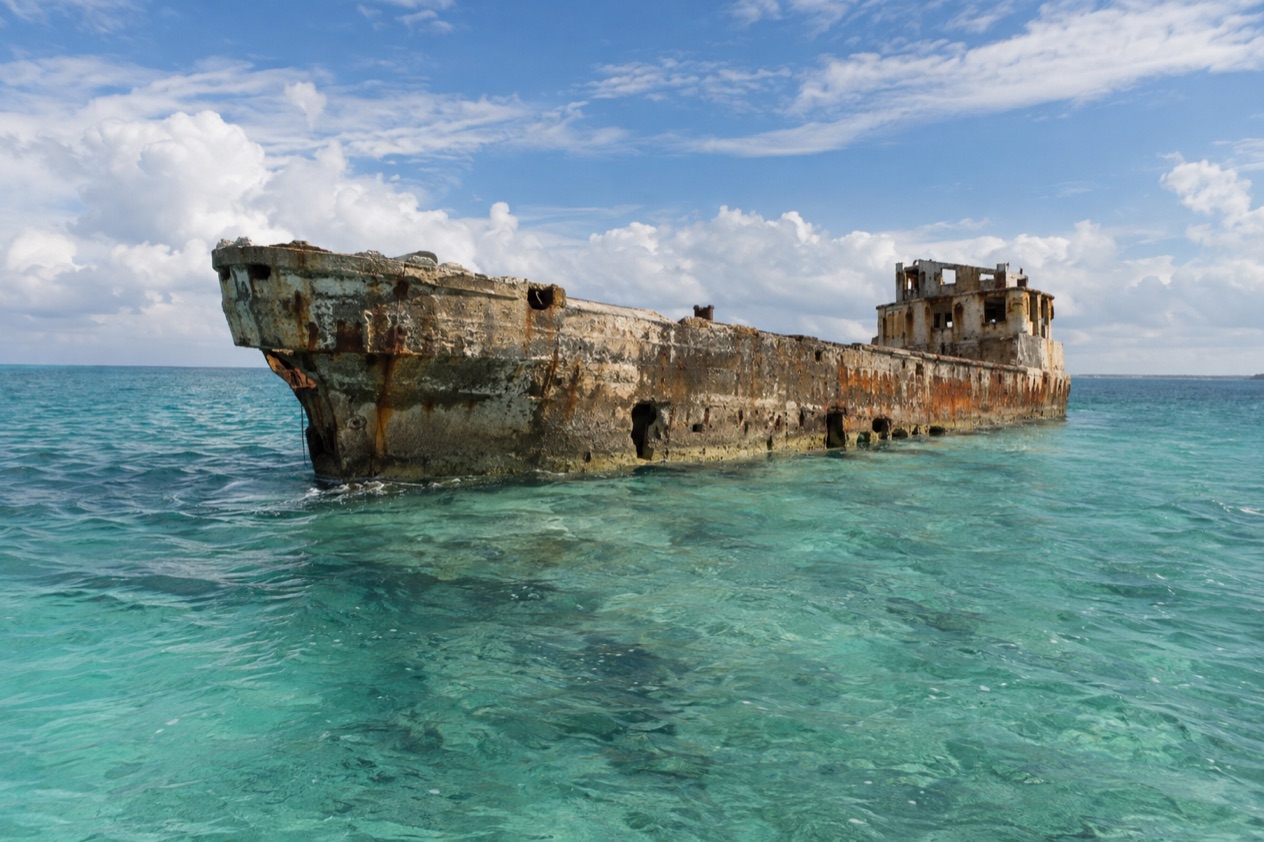
A concrete hull lies tilted in shallow water off South Bimini, its upper deck pale against the sky and the lower half sunk in clear sea. Gulls rest on the broken ribs of the ship while boats idle nearby. The S.S. Sapona is a wreck you see from the water, a history stop and a snorkeling or diving site for anyone who comes to Bimini.
Is visiting the Sapona shipwreck worth it?
Yes, if you like a wreck with a story and you are happy to reach it by boat: it suits history buffs, snorkelers and divers most of all. The Sapona is described as an underwater museum on Bimini’s powdery ocean floor, one that holds many secrets, and the description fits a ship that has been a casino, a liquor warehouse and a bombing target.
What sets it apart from other wrecks is that half of it stays in the air. The top of the ship is exposed while the bottom half is submerged, so you can look at the structure from a boat and then slip into the water to see the rest. It is also built of concrete, an unusual material for a ship, and one of a fleet planned during World War I when steel was in short supply.
Around it, the sea is also known as a prime fishing drop. Bimini itself is a district of the Bahamas, 50 miles east of Florida, and the wreck sits off its quiet southern island, far from the bars and shops of Alice Town. Come for the history and the water, not for facilities.
What to see at the Sapona shipwreck
The concrete hull and its origins
The Sapona was one of a fleet of concrete ships commissioned by former President Woodrow Wilson to carry troops in World War I, when steel was scarce. It is said to have been designed by Henry Ford and was built by the Liberty Ship Building Company in Wilmington, North Carolina.
Most of the concrete on the hull has now been worn away by bombing and weathering. Look for the places where the skin has fallen off and some of the ship’s inner workings show, rusted ribs and rough, crumbling edges that make the ship look more like a skeleton than a vessel.
The Prohibition years
After the war the ship was sold for scrap to Carl Fisher, one of the developers of Miami Beach, who used it briefly as a casino and then for oil storage. In 1924 it was bought by Bruce Bethell, a former British war captain and liquor merchant out of Nassau, who turned it into a floating warehouse to store and distribute liquor during Prohibition.
Picture that as you drift beside it: a hull stacked with crates, small boats coming and going. A hurricane in 1926 ended that chapter, driving the ship aground and damaging it substantially. It has sat in the shallows ever since.
Target practice and the lost bombers
During World War II, U.S. fighter planes used the wreck as a bombing target for training, which explains much of the damage you see. The practice stopped abruptly after December 5, 1945, when a group of five torpedo bombers mysteriously disappeared while returning from a run to the Sapona.
That disappearance is part of the Bermuda Triangle lore that boat captains in Bimini love to tell. Whatever you make of the legend, it gives the scarred hull a darker mood.
In the water around the wreck
The wreck sits in 15 feet of water, a few miles off Bennett’s Harbour in South Bimini, and it is a popular scuba diving and snorkeling site. Below the surface the lower half of the ship is part of an underwater museum, with the sandy bottom spreading around it.
Some brave souls dive 40 feet into the ocean from atop the wreck. That is a choice some visitors make, not a recommendation, and it is the sort of thing you watch from the boat if you prefer.
Hours, tickets and rules
The Sapona is an open-water wreck, not a ticketed site with a gate, so there are no posted visiting hours or admission fee to give. You see it from the sea, and the experience is yours whenever you reach it.
The one rule that bears on a visit to Bimini’s waters is a ban on swimming at Big Game Marina, because it is home to a large group of hungry bull sharks that have bitten people. That is a different spot from the wreck, but it is a reminder of where not to get in the water on the island.
Diving from the top of the wreck is something some visitors dare to do, and the wreck is a popular spot for diving and snorkeling. Beyond those points, nothing further is stated here about climbing, drones, tripods or sunscreen, so the section stays with what is known.
How to get to the Sapona shipwreck
You reach the Sapona by sea. It lies a few miles off Bennett’s Harbour in South Bimini, so the trip starts from the island and goes out over open water to the wreck.
Bimini itself is 50 miles east of Florida. Baleària runs an international passenger ferry between Bimini and Port Everglades in Fort Lauderdale, using the high-speed catamaran HSC Jaume II. South Bimini has a population of 182 and houses South Bimini Airport.
For many years South Bimini tourists were mostly boaters, since there was little lodging other than private homes. That history still shapes the south: it is quiet, and the wreck belongs to a stretch of coast best known to people on the water. North Bimini, with Alice Town and its King’s Highway of shops, restaurants and bars, is the busier base from which the island’s boats set out.
When to visit the Sapona shipwreck
The tourist season in Bimini runs from April to July, when calm seas allow for fishing and diving. That is the stretch to aim for if you want conditions suited to a wreck you reach by sea and explore from the surface or just below.
The rainy season, from July to October, brings occasional rainfall and rare hurricanes. The Atlantic hurricane season runs from June 1 to November 30, so the months from June on fall inside it, and it is a point to weigh when you plan a boat trip.
As for the time of day, the wreck keeps no schedule, so choose by your own light and comfort. A mid-morning visit usually means the pale concrete is bright against the water, and the top of the ship is easy to photograph from the boat.
Tips for your visit
Bring a mask and snorkel if you plan to look at the submerged half, and a camera for the exposed deck and the broken hull. The wreck is a popular scuba diving and snorkeling site, and the surrounding area is a prime fishing drop, so you may share the water with anglers.
Combine the wreck with other places on South Bimini. The Bimini Nature Trail is a protected dry forest with an interpretive trail and signs about local plants and animals, and it connects to Shell Beach. A small freshwater well with a plaque for the Fountain of Youth stands on the road leading to the South Bimini Airport.
On North Bimini, Alice Town is where Ernest Hemingway stayed at the Compleat Angler Hotel from 1935 to 1937 and fished from his boat Pilar. The Healing Hole, a pool at the end of winding tunnels in the mangrove swamp, is another stop for curious travelers. History buffs will find the wreck, Hemingway and the Prohibition story fit together well.
Good to know before you go
The U.S. State Department rates the Bahamas Level 2, “Exercise increased caution”, and says most crime occurs in Nassau on New Providence and in Freeport on Grand Bahama.
Plan around the Atlantic hurricane season, which runs from June 1 to November 30, and remember that the island’s rainy season overlaps it. Keep to the rule at Big Game Marina, where swimming is strictly banned because of bull sharks. The Sapona is a place for a boat trip and a story, and its battered concrete is best taken in slowly.
Sources
- Bahamas Ministry of Tourism, Investments & Aviation (bahamas.com), Sapona Shipwreck (https://www.bahamas.com/natural-wonders/sapona-shipwreck), checked October 10, 2026
- Wikipedia, Bimini (https://en.wikipedia.org/wiki/Bimini), checked October 10, 2026
- Wikivoyage, Bimini travel guide (https://en.wikivoyage.org/wiki/Bimini), checked October 10, 2026
- U.S. Department of State, The Bahamas Travel Advisory, Level 2 (https://travel.state.gov/), checked October 10, 2026
- NOAA National Hurricane Center, Climatology (https://www.nhc.noaa.gov/climo/), checked October 10, 2026
To plan your stay
- Best Time to Visit the Bahamas: Weather, Hurricane Season, Sea Temperatures and Junkanoo
- Where to Stay in the Bahamas: Best Islands, Resorts, Boutique Stays and How to Choose
- Getting Around the Bahamas: Flights, Ferries, Mailboats and Taxis in Nassau
- Know Before You Go to the Bahamas: Entry Rules, Money, Getting Around and Local Customs