
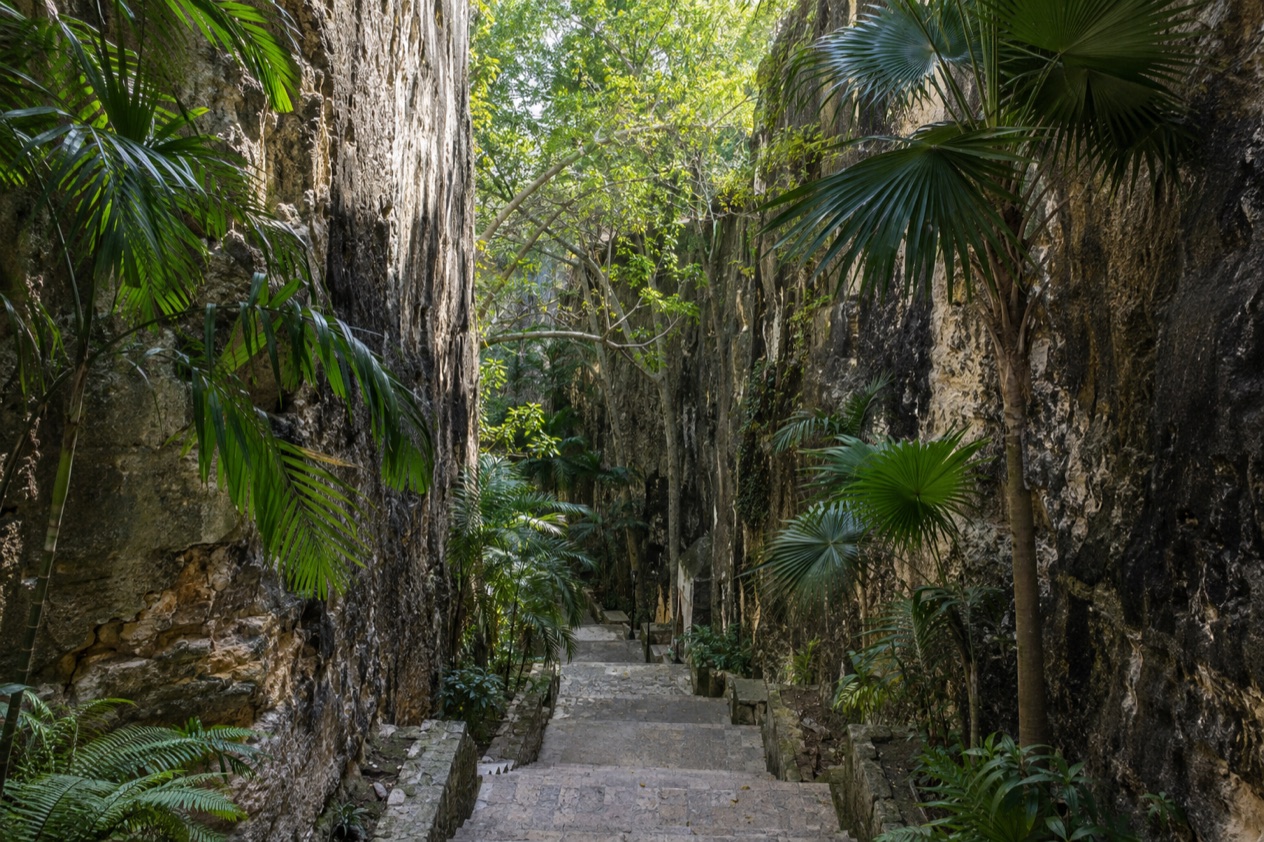
Water trickles down beside the old limestone steps, and the air under the tall walls smells of damp stone and green leaves. You come into the Queen’s Staircase from a shaded walkway lined with tropical plants and trees, and the steps rise ahead of you toward the fort on the hill. It is a short, atmospheric stop in the middle of Nassau, built around a piece of history that deserves a slow look.
Is visiting the Queen’s Staircase worth it?
Yes, if you like places where a story is carved into the landscape, and it suits history lovers, photographers and anyone who wants a quiet green pause between Nassau’s downtown streets and the fort above. The staircase was hewn out of solid limestone by slaves between 1793 and 1794, and standing among those walls you can see how much labor went into every step.
What sets it apart from other sights in town is the setting. Many historic stops are a building to look at from outside. Here you walk through a narrow cut in the rock, with high stone walls on both sides, ferns and trees leaning over the path, and water cascading alongside the steps to a pool below. The staircase leads straight to Fort Fincastle, so the visit has a natural second act at the top.
It is also a place with a moving history rather than a grand one. The steps were a working route between the fort and the town, and the name came later, in honor of Queen Victoria. That mix of hard labor and a royal name gives the stop more depth than its modest size suggests, and it rewards people who read the stone as well as photograph it.
What to see at the Queen’s Staircase
The limestone steps
The staircase is the heart of the visit. It was carved out of solid limestone by 600 slaves working with limited tools, and the rock walls beside you still show the scale of the cut. The steps climb a total of 102 feet, which is why the view back down the passage feels so tall and narrow.
Count them if you like. Sixty-five steps are visible today, though the staircase originally had 66. The bottom step is buried under the asphalt of the paved pathway that leads to it. It is a small detail, but it makes the staircase feel like something that has been absorbed into the modern city around it.
The waterfall and the walkway
Water cascades alongside the steps and ends in a pool below, adding the sound of running water to the stillness of the passage. It is the feature that makes the place feel cool and almost secret, especially when you look up the stone corridor with leaves hanging over the edge.
At the base, a walkway runs between high stone walls, tropical plants and tropical trees. This is the best stretch for photographs, with green framed by pale rock, and it is also a pleasant place to slow down and listen before you start up the steps.
Fort Fincastle at the top
The steps were said to provide a direct route from Fort Fincastle down to Nassau, and the fort is the natural end of the climb. It sits on Bennet’s Hill, the highest point of Nassau, built of cut limestone around 1793 to protect the town and its harbor.
Look at the shape of the fort itself. It was built to resemble a paddle-wheel steamer, and it went up under the governorship of John Murray, also known as Viscount Fincastle. The hill is in downtown Nassau, next to Princess Margaret Hospital and the Grosvenor campus of the University of The Bahamas, so you are never far from the city even while you feel above it.
Hours, tickets and rules
The staircase sits inside the Fort Fincastle Historic Complex, and the hours that are published belong to the daily guided tours at the fort. Entry to Fort Fincastle is by donation rather than a fixed fee.
| Site | Open | Admission |
|---|---|---|
| Fort Fincastle and the Queen’s Staircase (daily guided tours) | 8:00 a.m. to 4:00 p.m. | Donations appreciated, no fixed entry fee |
For questions about the Queen’s Staircase, the listed contact is Christine Rolle, at (242) 356-9085 or [email protected].
How to get to the Queen’s Staircase
The Queen’s Staircase is in Nassau, the capital of the Bahamas, on New Providence Island, inside the Fort Fincastle Historic Complex. You do not need to leave the city to reach it, because it lies in downtown Nassau on Bennet’s Hill.
The Queen’s Staircase is in downtown Nassau, beside Princess Margaret Hospital and the Grosvenor campus of the University of The Bahamas. Those two landmarks place you in the right part of downtown, and the staircase and the fort stand together on the rise above them. The staircase itself leads up to Fort Fincastle, so you can arrive at the base and climb, or reach the fort and come down the steps.
Because the steps were built as a direct route between the fort and the town, they still do that job today. Starting at the bottom gives you the walkway between the stone walls and the pool first, then the climb, then the fort at the top.
When to visit the Queen’s Staircase
If you plan to pair the staircase with a guided tour of Fort Fincastle, those tours run daily from 8:00 a.m. to 4:00 p.m. Within that window, the early part of the day is the natural choice for a climb outdoors in a tropical city, and the light slanting into the stone passage then makes for softer photographs.
The Bahamas has no single cold season to avoid, and the staircase is an outdoor stop, so a dry spell is the best companion. Under the trees and between the walls the passage stays shaded and green, which gives the place a cool feeling even when the town is bright.
Keep in mind that the Atlantic hurricane season runs from June 1 to November 30, which includes early October. Weather can change your plans for an open-air stop like this one, so leave room in your schedule if you are visiting in those months.
Tips for your visit
Bring a camera and something to carry water, since the visit combines a climb with an outdoor fort. The stone steps are the main event, so wear shoes you are comfortable climbing in, and give yourself time to stop at the pool and the walkway rather than rushing to the top.
The natural combination is the staircase and Fort Fincastle together. Climb the steps, then explore the fort, whose paddle-wheel steamer shape is easier to appreciate once you are standing in it. Daily guided tours run at the fort, and since entry is by donation, it is a pleasant way to learn the stories behind the stone.
Because the route is a stepped climb of 102 feet, travelers with limited mobility may prefer to enjoy the base, with its walkway, plants and pool, and skip the full ascent. Families will find the cascading water and the counting of steps a good way to keep a visit lively, and the history of the place gives older children something real to think about.
Good to know before you go
The U.S. State Department rates the Bahamas Level 2, “Exercise increased caution”, and says most crime occurs in Nassau on New Providence and in Freeport on Grand Bahama.
Fort Fincastle asks only for donations, so a little cash in your pocket is worth having ready. Nassau is a city, so use the same everyday habits you would anywhere in a busy downtown, and keep your belongings close while you climb and take photographs.
Sources
- Bahamas Ministry of Tourism, Investments & Aviation (bahamas.com), Queens Staircase (https://www.bahamas.com/natural-wonders/queens-staircase), checked October 10, 2026
- Wikipedia, Queen%27s Staircase (https://en.wikipedia.org/wiki/Queen%27s_Staircase), checked October 10, 2026
- Bahamas Ministry of Tourism, Investments & Aviation (bahamas.com), Fort Fincastle (https://www.bahamas.com/natural-wonders/fort-fincastle), checked October 10, 2026
- U.S. Department of State, The Bahamas Travel Advisory, Level 2 (https://travel.state.gov/), checked October 10, 2026
- NOAA National Hurricane Center, Climatology (https://www.nhc.noaa.gov/climo/), checked October 10, 2026
To plan your stay
- Best Time to Visit the Bahamas: Weather, Hurricane Season, Sea Temperatures and Junkanoo
- Where to Stay in the Bahamas: Best Islands, Resorts, Boutique Stays and How to Choose
- Getting Around the Bahamas: Flights, Ferries, Mailboats and Taxis in Nassau
- Know Before You Go to the Bahamas: Entry Rules, Money, Getting Around and Local Customs