
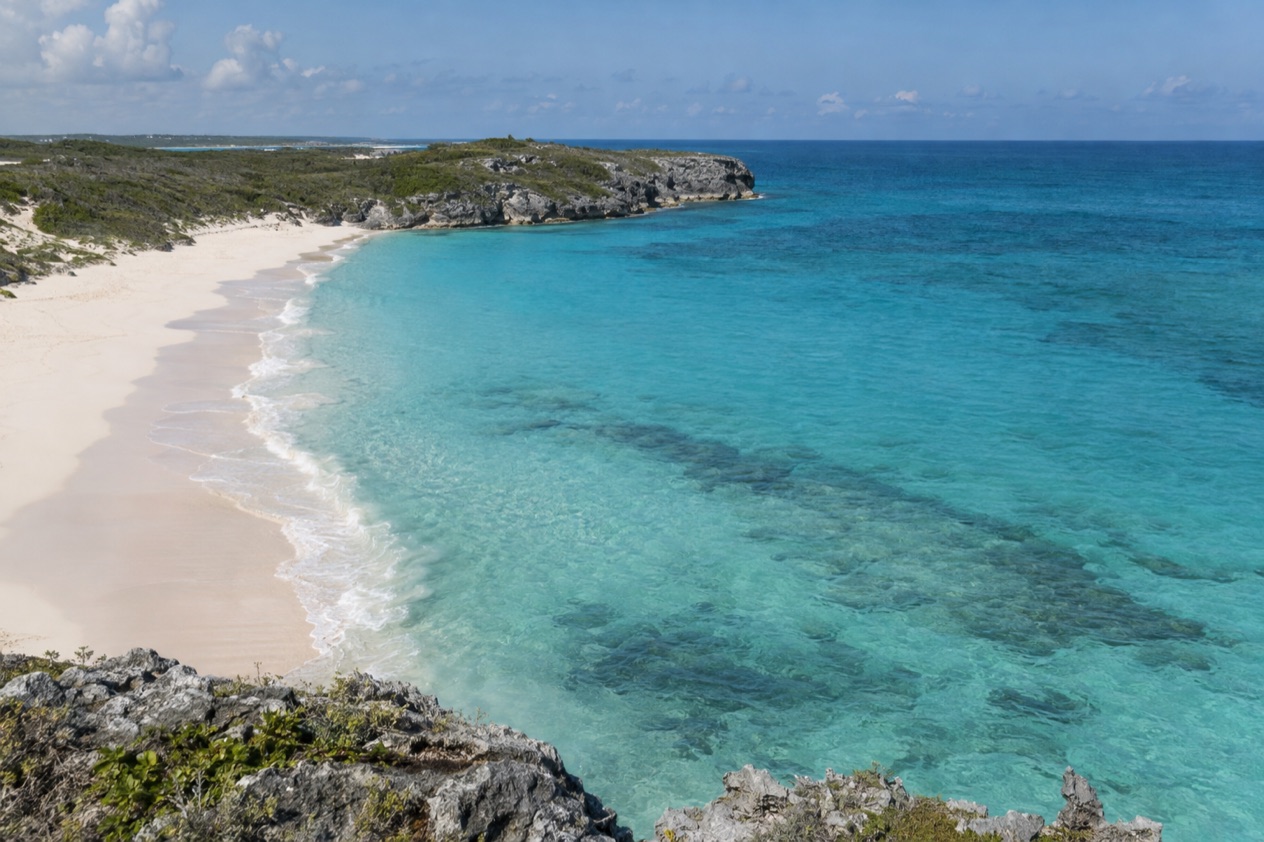
Late in the afternoon on Long Island, the light turns gold over a long white beach and the only sound is water moving over sand. A little later the sky goes orange, then pink, and nobody is in a hurry to go anywhere. This is a thin, quiet island of the Bahamas, made for people who want a deep blue hole, empty shorelines and the slow rhythm of small settlements.
Where is Long Island and what is it like?
Long Island is one of the islands of the Bahamas, in the southern half of the archipelago, about 165 miles southeast of Nassau, the city on New Providence. The island is a narrow ribbon of land, around 80 miles from end to end and only about 4 miles across at its widest. It is stretched along the Atlantic side, and the Tropic of Cancer crosses its northern quarter, which gives you a small bit of trivia to enjoy while you walk a beach.
The character of the island follows from that shape. Long Island has settlements strung out along its length rather than one town that gathers everything, and the names come up again and again in conversation: Clarence Town, Deadman’s Cay, Salt Pond, Simms, Stella Maris, Cape Santa Maria.
Each has its own small harbor or dock, a church or two, and a handful of homes close to the water. The island feels lived in rather than staged for visitors, and days here run on boat schedules, fishing and the weather.
The coastline mixes two moods. In places there are long, soft beaches with sand that feels like silk underfoot. Elsewhere the land breaks into rock, bays and cliffs that frame deep water, and the most dramatic example is the blue hole west of Clarence Town. The history also runs deep: Columbus Point, on the northern tip, marks the shore where Christopher Columbus made his landfall on the island.
Long Island suits divers, free divers, beach walkers, boaters and anyone who likes to unplug. It will feel too quiet for travelers who want nightlife, shopping streets or a long list of ready-made attractions. Come with a book, a snorkel mask and a sense of curiosity, and the island rewards you with its stillness.
What is there to do in Long Island?
The reasons to come are few but strong: a blue hole that draws athletes from around the world, a four-mile beach, walls for scuba diving, and the quiet pleasure of exploring a long island settlement by settlement. Few other islands in the Bahamas combine all of these in a single shape.
Dean’s Blue Hole
Dean’s Blue Hole sits in a bay west of Clarence Town, and it is the third deepest blue hole in the world, plunging to 663 feet. From above, the water goes from pale turquoise at the edges to an inky navy at the center. Rock encloses it on three sides in a natural amphitheater, while the fourth side opens onto a turquoise lagoon and a powdery white beach, so the setting looks almost designed.
Visitors can climb up the rocky pathway and plunge into the clear blue water, and there is a beach for those who prefer to stay at the edge and watch. The hole is also the stage for the annual Vertical Blue free diving competition, which has run in July.
Competitors, film crews and spectators come from all over the world to see who can dive the deepest, and the site has seen a number of free diving world records. It is a place to arrive at with time to spare, simply to watch the color of the water change as the sun moves.
Cape Santa Maria beach
Cape Santa Maria is the island’s best-known stretch for beach time, with a four-mile white sand beach made for walking. The sand is fine and soft, and the water offshore shades through several blues. Sunsets here are the kind you see on postcards, and you can enjoy them from nearly any point on the shore in the evening.
Scuba diving is available at Cape Santa Maria, so the beach is not only for sunbathing. A typical day might start with a long barefoot walk at the water’s edge, a quiet midday in the shade, and a return to the sand when the light softens. If you are traveling with a partner, a book or both, this is where the island’s calm is easiest to feel.
Diving the Conception Island walls
For serious divers, Conception Island is a day-trip destination 16 miles from Long Island, reached by an hour-long boat ride. Its dive walls lie amid a 30,000-acre national park, start at 55 feet deep and then drop straight down to 3,000 feet. That kind of vertical drama is why divers bring their gear all the way out here.
The outing fits well into a stay built around diving, paired with a quieter day on a beach afterward. Even travelers who do not dive can take in the idea of the place: a protected park, deep water just offshore, and a boat ride across open sea to reach it.
Settlements, churches and the history of the island
A day spent driving or traveling between settlements shows another side of Long Island. St. Mary’s Roman Catholic Church is the oldest church in the country, a reminder that this island has been settled for generations. Clarence Town, with its public dock and marina, is a good place to see how the island’s life still centers on the water.
At Columbus Point on the northern tip, you stand on the shore where Columbus is said to have made landfall. The place has no crowds and no commentary, just wind, rock and the horizon, and it works best as a pause in a day of exploring.
How many days do you need in Long Island?
A long weekend gives you a taste of Long Island, but a week suits it better, because the island is long and its pleasures are spread out and slow. Rushing through defeats the purpose.
With a short stay, choose two anchors and let the rest of the time be loose. Spend one day at Dean’s Blue Hole, watching the water and perhaps taking the plunge from the rocky path, and give another to Cape Santa Maria for a long beach walk and a sunset. That alone fills a weekend with the island’s two most striking scenes, and leaves room for a meal in a settlement and an evening with nothing planned.
With a week, the island opens up. You can add a dive day, with scuba from Cape Santa Maria or the boat trip out to the Conception Island walls, which are an outing in themselves.
You can spend a morning among the settlements, seeing Clarence Town, Salt Pond, Simms and Deadman’s Cay, and looking at the churches and the harbors. You can also leave a day open for the weather, for a quiet beach, or for simply sitting on a dock.
Longer stays suit travelers who like to settle in and find a rhythm, such as divers working through several sites, free divers following the competition, or boaters moving between ports of entry. If a rainy day comes, it becomes a good excuse for a slow lunch, a drive through the settlements or a long conversation with whoever is behind the counter.
The island does not reward a checklist. It rewards staying put long enough to notice the light.
Another way to extend a trip is to pair Long Island with the Exumas. The Sheep Runner ferry runs between Long Island and Exuma on Monday, Wednesday and Friday during peak season, leaving Long Island early in the morning and returning from Exuma late in the afternoon, which makes a round trip between the two a real possibility for a stay that wants a change of scenery.
Where to stay in Long Island
Because Long Island is so long, the best place to stay depends on what you came for, and it helps to think in terms of areas rather than one central base. Each of the main settlements has its own character and its own reason to be chosen.
Cape Santa Maria suits beach lovers above all. The four-mile white sand beach is the draw, along with the sunsets and the scuba diving, and the area suits couples, walkers and anyone who wants the water at the doorstep. Stella Maris is the area with a marina and its own airport, a good fit for boaters and for travelers who like having a harbor close by.
Clarence Town is the choice for divers and free divers, since Dean’s Blue Hole lies in a bay to the west of the town, and the settlement also holds a public dock and a marina. It is a base for early mornings at the water and for travelers who care more about the sea than about amenities.
Deadman’s Cay, home to the island’s other airport, works for anyone who wants to arrive and be among the settlements right away, and Salt Pond and Simms, each with a public dock, suit travelers who want to feel the working life of the island. Whichever area you choose, expect quiet evenings, the sound of the sea and a sky full of stars rather than a busy scene.
A useful way to decide is to start with the main reason for the trip. For a dive trip or a free diving event, stay near Clarence Town. For a beach vacation, stay near Cape Santa Maria.
For a boat trip or a stay that begins and ends in a harbor, look to Stella Maris or Clarence Town. For a first visit that mixes a bit of everything, plan to spend some nights in two areas rather than force one to do everything.
How do you get to Long Island and get around?
Most visitors arrive by air from Nassau, a 45-minute flight, landing at Deadman’s Cay Airport or Stella Maris Airport. BahamasAir has daily scheduled flights from Nassau to Deadman’s Cay, and Southern Air Charter has daily scheduled flights from Nassau to both Deadman’s Cay and Stella Maris. Choosing your airport depends on where you plan to stay, since the island is so long.
By sea, the Sheep Runner ferry links Long Island and Exuma on Monday, Wednesday and Friday during peak season, leaving Long Island early in the morning and returning from Exuma late in the afternoon. Travelers arriving by private boat can clear customs at official ports of entry on the island, including the Clarence Town Public Dock, Flying Fish Marina at Clarence Town, Salt Pond Public Dock, Simms Public Dock, Stella Maris Marina and Stella Maris Airport, some of them upon request.
Getting around is shaped by the geography. The island is a ribbon of land, and the settlements, beaches and the blue hole are spread along it, so a day on Long Island usually means choosing one area and enjoying it fully rather than trying to cover everything. Travelers who arrive by boat have their own harbor to anchor the day, and those who fly in will want to think about where they sleep so that the main sights lie close to their base.
A boat is also the way to reach Conception Island, an hour-long ride across open water from Long Island. That outing is the one real journey beyond the island, and it is worth keeping a day free for it if diving is part of your plans.
When is the best time to visit Long Island?
The best months for Long Island are the cooler, drier ones from December through April, when beach days feel comfortable and the island is most relaxed. In Nassau, January afternoons reach the high 70s with very little rain, and the same pattern of mild days and cool evenings suits time on the sand, walks along the shore and long dinners outdoors.
Summer is a different island. In Nassau, July highs climb to about 90 degrees, and rain falls on a good share of the days, often as short, heavy showers that clear and leave the sky bright. The heat suits travelers who want to spend the day in and on the water, and it is also the season when the Vertical Blue free diving competition has taken place at Dean’s Blue Hole, bringing divers, film crews and spectators from around the world.
The Atlantic hurricane season runs from June 1 to November 30, so the late summer and autumn months fall within it, while December through May lie outside the official season. If your dates fall in those months, it is wise to keep plans flexible, especially for boat trips and the ferry to Exuma, which runs on its peak-season schedule.
Diving and boating suit the calmer part of the year, but the island’s real appeal is its quiet in any month. Spring brings long days and warm water, and winter brings pleasant air for walking Cape Santa Maria. Choose the season by what you want from the days: cool beach walks in winter, hot swims and diving in summer, and the buzz of a world-class competition if your plans line up with it.
Good to know before you go
The U.S. State Department rates the Bahamas Level 2, “Exercise increased caution”, and says most crime occurs in Nassau on New Providence and in Freeport on Grand Bahama.
Long Island is a small-island destination, so plan as you would for any quiet corner of the Bahamas. The country uses the Bahamian dollar, and the island’s settlements are small and spread out, so it helps to think ahead about meals and moving between places. Keep in mind that Dean’s Blue Hole is a deep, open body of water, so treat the climb to the water with care.
The Atlantic hurricane season runs from June 1 to November 30, and a tropical system can reach any island in the archipelago, so travelers in those months should follow the forecast as their dates approach. Outside those months, the island’s calm is easier to rely on, and the sun-filled days make for easy, unhurried vacations.
Sources
- Bahamas Ministry of Tourism, Investments & Aviation (bahamas.com), Long Island (https://www.bahamas.com/islands/long-island), checked October 10, 2026
- Wikipedia, Long Island, Bahamas (https://en.wikipedia.org/wiki/Long_Island,_Bahamas), checked October 10, 2026
- Wikivoyage, Long Island (Bahamas) travel guide (https://en.wikivoyage.org/wiki/Long_Island_(Bahamas)), checked October 10, 2026
- Bahamas Ministry of Tourism, Investments & Aviation (bahamas.com), travel blog, Long Island diving (https://www.bahamas.com/blog/the-underwater-thrill-of-long-island), checked October 10, 2026
- Bahamas Ministry of Tourism, Investments & Aviation (bahamas.com), Deans Blue Hole (https://www.bahamas.com/natural-wonders/deans-blue-hole), checked October 10, 2026
- Wikipedia, Dean%27s Blue Hole (https://en.wikipedia.org/wiki/Dean%27s_Blue_Hole), checked October 10, 2026
- Bahamas Ministry of Tourism, Investments & Aviation (bahamas.com), Cape Santa Maria (https://www.bahamas.com/natural-wonders/cape-santa-maria), checked October 10, 2026
- Wikipedia, Geography of the Bahamas (https://en.wikipedia.org/wiki/Geography_of_the_Bahamas), checked October 10, 2026
- NOAA NCEI, GHCN-Daily station BF000078073 (Nassau Airport), normals 1991-2020 computed from the daily record (https://www.ncei.noaa.gov/access/services/data/v1?dataset=daily-summaries&stations=BF000078073), checked October 10, 2026
- Open-Meteo Marine API, average 2015-2024, checked October 10, 2026
- U.S. Department of State, The Bahamas Travel Advisory, Level 2 (https://travel.state.gov/), checked October 10, 2026
- NOAA National Hurricane Center, Climatology (https://www.nhc.noaa.gov/climo/), checked October 10, 2026
To plan your stay
- Best Time to Visit the Bahamas: Weather, Hurricane Season, Sea Temperatures and Junkanoo
- Where to Stay in the Bahamas: Best Islands, Resorts, Boutique Stays and How to Choose
- Getting Around the Bahamas: Flights, Ferries, Mailboats and Taxis in Nassau
- Know Before You Go to the Bahamas: Entry Rules, Money, Getting Around and Local Customs