
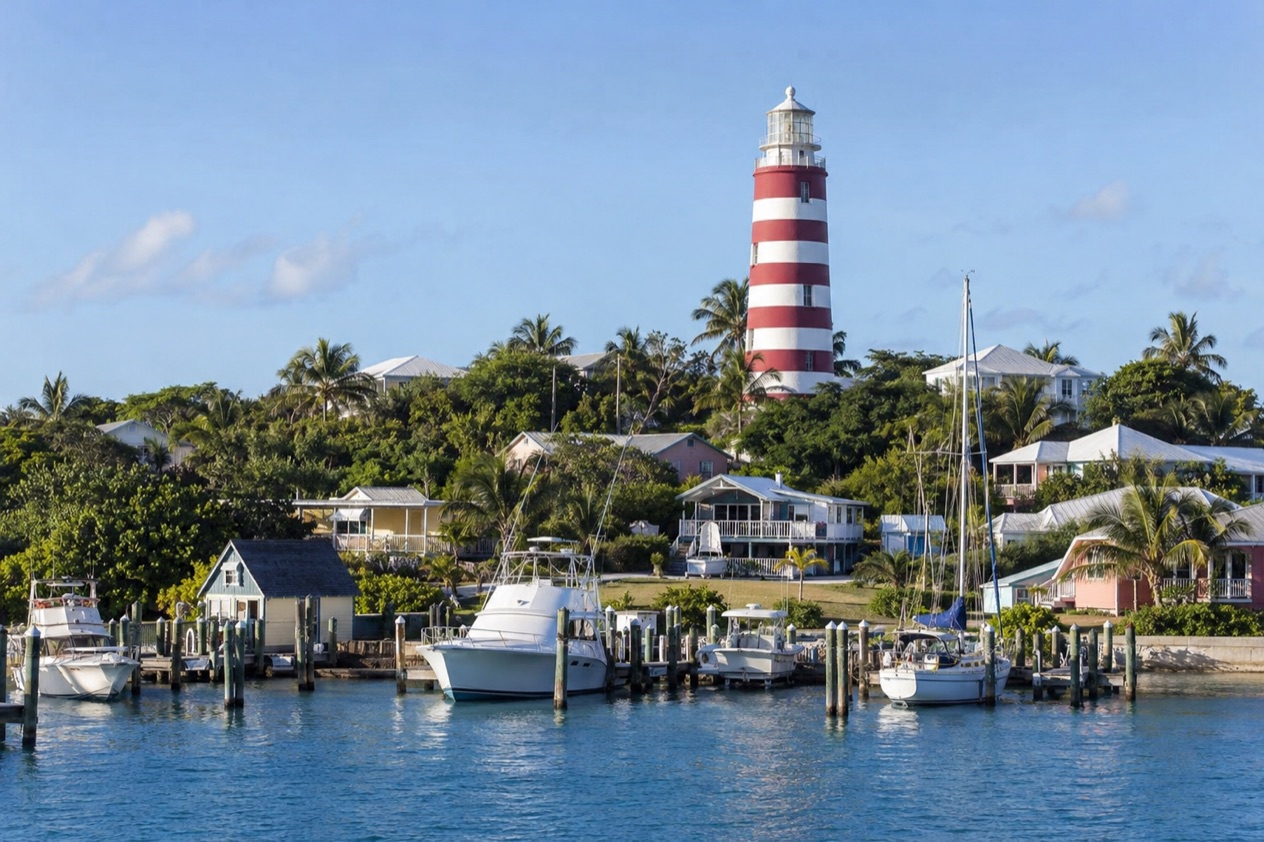
At dusk in Hope Town, the harbor turns the color of the cottages, pink and pale yellow and mint, and the red and white stripes of the lighthouse catch the last light above the rooftops. Dinghies knock gently at the docks, bikes and golf carts roll along narrow lanes, and somewhere a screen door slaps shut. This is the only village on Elbow Cay, a small island in the Abacos, and it suits travelers who want a walkable harbor town, a lighthouse, a quiet beach and slow evenings over fresh seafood.
Where is Hope Town and Elbow Cay and what is it like?
Hope Town is a village on Elbow Cay, a narrow island in the Abaco chain of the Bahamas, and it is the only settlement on the island. The Abacos lie about 193 miles east of Miami and stretch in a long arc of large islands and small cays, with Marsh Harbour on Great Abaco as the largest town. Elbow Cay sits just offshore from that town, across a stretch of water you cross by boat.
The place feels like a village that has decided to stay small. Pastel-hued cottages crowd the lanes around a sheltered harbor, local shops and art galleries sit between them, and beachside cafés open onto the shore.
Hope Town counted 458 residents in 2010, so you recognize faces within a day or two, and the pace follows suit. Mornings begin with coffee on a dock, afternoons drift between the beach and the water, and evenings are for dinner by the harbor.
The history is part of the scenery. The village was co-founded in 1785 by Wyannie Malone, a widow from South Carolina who arrived with her four children after the American Revolution. For generations the island lived from fishing and shipwreck salvage, and the settlement still builds Abaco dinghies, the wooden boats you see at regattas throughout the Bahamas. That boatbuilding heritage gives the harbor a working, lived-in character rather than a resort polish.
Who loves it: couples, families who like beaches and bikes, sailors, and anyone who enjoys wandering a place on foot with no schedule. Who may not: travelers looking for nightlife, big resorts or a long list of attractions. Hope Town is about atmosphere, water and small pleasures, and you get the most out of it by slowing down to its rhythm.
What is there to do in Hope Town and Elbow Cay?
The big reasons to come are a lighthouse, a beach, a harbor to explore by bike or on foot, and dinner by the water. Nothing here requires a plan, and that is the difference from the larger, busier islands of the Bahamas. Hope Town is a place to do a few things well and spend the rest of the day just being on a cay.
The Elbow Reef Lighthouse
The candy-striped tower rises above the village and is the image everyone brings home. It was built in 1862 and is one of the last kerosene-fueled lighthouses in the world, still run by hand, and the last of its kind in the Bahamas. Seen from the harbor, with the pastel cottages in front of it and the water behind, it is the most photographed sight on the island.
Walk up the lanes toward it in the late afternoon, when the light softens and the heat eases. The surrounding streets are worth drifting through on the way, past wooden fences, flowering bushes and small porches. Stay until dusk if you can, because this is a lighthouse that still works the old way, and the evening is when it feels most alive.
Tahiti Beach
At the southern tip of Elbow Cay, Tahiti Beach is a curve of soft white sand lined with coconut trees, opening onto clear water. It is secluded, and you reach it only on foot, by bike or by boat, which keeps it feeling like a destination rather than a roadside stop. It is a good place for a picnic, for beach games, and for collecting shells, starfish and sand dollars along the shore.
The beach is known for a long sand bar that stretches out especially at low tide, so you can wander far into shallow water and look down at the bottom. Pack what you need for the day, since this is a beach for settling in. The ride or walk down the island is part of the pleasure, and it suits families and couples alike.
The village by bike and on foot
Couples and families can rent bikes to explore, passing colorful cottages, local shops, art galleries and beachside cafés. Cars and golf carts are permitted on the outskirts of the village, but within the settlement the scale is made for walking. Go slowly, stop at the galleries, and let the lanes lead you back down to the harbor.
The Wyannie Malone Museum is the place to put the village in context. It preserves the settlement’s history through memorabilia, artifacts, old photos and documents, and it tells the story of the families who built this community. Hope Town has also kept up its cholera graveyard, a quiet reminder of earlier days.
Harbor dining and sunset walks
Waterfront restaurants serve fresh local seafood, and a candlelit table beside the harbor is one of the island’s defining evenings. Conch, fish and lobster are the kind of dishes to look for on a Bahamian menu, and here they come with a view of masts and dock lights.
Before dinner, a sunset walk along the shore gives you the sound of the waves and a sky that changes color by the minute. It costs nothing, it takes no planning, and it is the way many days on Elbow Cay naturally end.
How many days do you need in Hope Town and Elbow Cay?
A long weekend is enough to see Hope Town properly, and a week lets you settle into the island’s pace. Because the cay is small and everything revolves around the harbor, the beach and the lighthouse, you are not racing a checklist. The question is how much slowness you want.
With two or three days, you can see the lighthouse and the lanes around it, spend a full day at Tahiti Beach, visit the Wyannie Malone Museum, and have a couple of dinners by the water. Start the first morning on foot in the village while it is quiet, take the beach on the second day with a picnic and a bike, and keep an evening for the sunset walk. That sequence covers what the island is known for without feeling rushed.
With four or five days, you can add the slower things: a second visit to the beach at a different tide so the sand bar looks different, a long browse through the art galleries and shops, and an afternoon on the water in a boat. Hope Town rewards repeat habits, like the same café at the same hour or a favorite dock for watching dinghies come in.
A week gives you room to explore beyond Elbow Cay. The Abacos are a chain of islands and cays, and Marsh Harbour on Great Abaco is the nearest town of any size, reached by boat.
Treasure Cay, on Great Abaco, has its own airport and is another point on the map for those who want to see more of the chain. Even so, many visitors find that Hope Town alone is enough for a full stay.
Where to stay in Hope Town and Elbow Cay
The natural place to stay is in or near the village of Hope Town, around the harbor. From there the lighthouse, the museum, the galleries, the cafés and the waterfront restaurants are all close, and you can leave the bike or golf cart for the beach. It suits first-time visitors, couples, and anyone who wants to walk to dinner and back in the evening.
The island is narrow, so every spot on Elbow Cay is close to the water, but the character changes as you move away from the harbor. Toward the outskirts, where cars and golf carts are permitted, the setting is quieter and more spread out, and the village feels like a short trip back into town. Toward the southern tip, you are nearer Tahiti Beach, which is reached on foot, bike or boat and keeps its secluded feel.
If you want a base with more services and a larger choice of shops, Marsh Harbour on Great Abaco is the largest settlement in the Abacos, with a population of 5,314, and it has the main airport. Staying there, however, means crossing to Elbow Cay by boat or ferry whenever you want the village and the beach. For a trip built around Hope Town itself, sleeping on the cay is the better fit, because the evenings are the best part of the day.
Think about what kind of stay you want. A harborside setting means evenings of boat lights and dock chatter. A spot near the beach means mornings on the sand. Either way, the pastel cottages and the lanes between them are the backdrop, and none of it is far from the water.
How do you get to Hope Town and Elbow Cay and get around?
You reach Hope Town by air to Great Abaco and then by water to Elbow Cay. Great Abaco is the main and largest island of the Abacos, and Leonard M. Thompson International Airport is in Marsh Harbour. Treasure Cay Airport, also an international airport, sits in the settlement of Treasure Cay on the same island.
From Marsh Harbour, Elbow Cay is accessible by private boat or by a regularly scheduled ferry. That crossing is part of the arrival, with the cay appearing low on the water and the lighthouse coming into view as you approach the harbor. It sets the mood for the stay, and it is a good reminder that this is an island trip, not a road trip.
Once on Elbow Cay, you get around the way the village was made for. In Hope Town you walk, and couples and families can rent bikes to pass the cottages, shops, galleries and cafés. Cars and golf carts are permitted on the outskirts of the village, so the roads beyond the settlement are shared with them. Tahiti Beach, at the southern tip, is accessible only on foot, by bike or by boat.
Boats are also part of daily life. Abaco dinghies and other small craft move between docks and cays, and the harbor is full of them. Whether you arrive by ferry or watch the boats from the dock, the water is the real road network here.
When is the best time to visit Hope Town and Elbow Cay?
Winter and early spring, from roughly December through April, are the months that sit outside the official hurricane season and bring the mildest air. In Nassau, January highs average around 79°F with only a few rainy days, and the sea is cooler than in summer. For a harbor village built around outdoor life, walking, biking, beach picnics and dinner on a dock, that is a comfortable time to be outside.
Summer is hot and wetter. In Nassau, July highs reach about 91°F and around twelve days record rain, and the sea warms to bathwater levels. Days on Elbow Cay are for the water and for shade, with the beach as the main attraction. The Atlantic hurricane season runs from June 1 to November 30, so those months deserve attention when you plan.
The weather in the Abacos can matter more than elsewhere, as the island’s history shows. Hurricane Dorian made landfall on Elbow Cay on September 1, 2019, and the storm left a mark on the Abacos.
Late summer and early fall are the months when storms are most on the radar. Spring, after the cool season but before the heat peaks, offers a middle ground, and Hope Town is the kind of place where a quiet week at any time of year still has its pleasures.
Good to know before you go
The U.S. State Department rates the Bahamas Level 2, “Exercise increased caution”, and says most crime occurs in Nassau on New Providence and in Freeport on Grand Bahama.
Elbow Cay is small and everything is close, so a light bag, sun protection and comfortable shoes for lanes and sand go a long way. The Atlantic hurricane season runs from June 1 to November 30, and a trip in those months is worth planning with the weather in mind. Hope Town is a settlement of just a few hundred people, so the pace is gentle and evenings tend to be calm, with dinner by the harbor as the main event.
Sources
- Wikipedia, Hope Town (https://en.wikipedia.org/wiki/Hope_Town), checked October 10, 2026
- Bahamas Ministry of Tourism, Investments & Aviation (bahamas.com), Hope Town (https://www.bahamas.com/natural-wonders/hope-town), checked October 10, 2026
- Bahamas Ministry of Tourism, Investments & Aviation (bahamas.com), travel blog, Hope Town (https://www.bahamas.com/blog/the-top-5-most-romantic-things-to-do-in-hope-town-abaco), checked October 10, 2026
- Bahamas Ministry of Tourism, Investments & Aviation (bahamas.com), Tahiti Beach (https://www.bahamas.com/natural-wonders/tahiti-beach), checked October 10, 2026
- Wikipedia, Abaco Islands (https://en.wikipedia.org/wiki/Abaco_Islands), checked October 10, 2026
- Bahamas Ministry of Tourism, Investments & Aviation (bahamas.com), The Abacos (https://www.bahamas.com/islands/abacos), checked October 10, 2026
- Wikipedia, Marsh Harbour Airport (https://en.wikipedia.org/wiki/Leonard_M._Thompson_International_Airport), checked October 10, 2026
- Wikipedia, Hurricane Dorian (https://en.wikipedia.org/wiki/Hurricane_Dorian), checked October 10, 2026
- Wikipedia, Geography of the Bahamas (https://en.wikipedia.org/wiki/Geography_of_the_Bahamas), checked October 10, 2026
- NOAA NCEI, GHCN-Daily station BF000078073 (Nassau Airport), normals 1991-2020 computed from the daily record (https://www.ncei.noaa.gov/access/services/data/v1?dataset=daily-summaries&stations=BF000078073), checked October 10, 2026
- Open-Meteo Marine API, average 2015-2024, checked October 10, 2026
- U.S. Department of State, The Bahamas Travel Advisory, Level 2 (https://travel.state.gov/), checked October 10, 2026
- NOAA National Hurricane Center, Climatology (https://www.nhc.noaa.gov/climo/), checked October 10, 2026
To plan your stay
- Best Time to Visit the Bahamas: Weather, Hurricane Season, Sea Temperatures and Junkanoo
- Where to Stay in the Bahamas: Best Islands, Resorts, Boutique Stays and How to Choose
- Getting Around the Bahamas: Flights, Ferries, Mailboats and Taxis in Nassau
- Know Before You Go to the Bahamas: Entry Rules, Money, Getting Around and Local Customs