
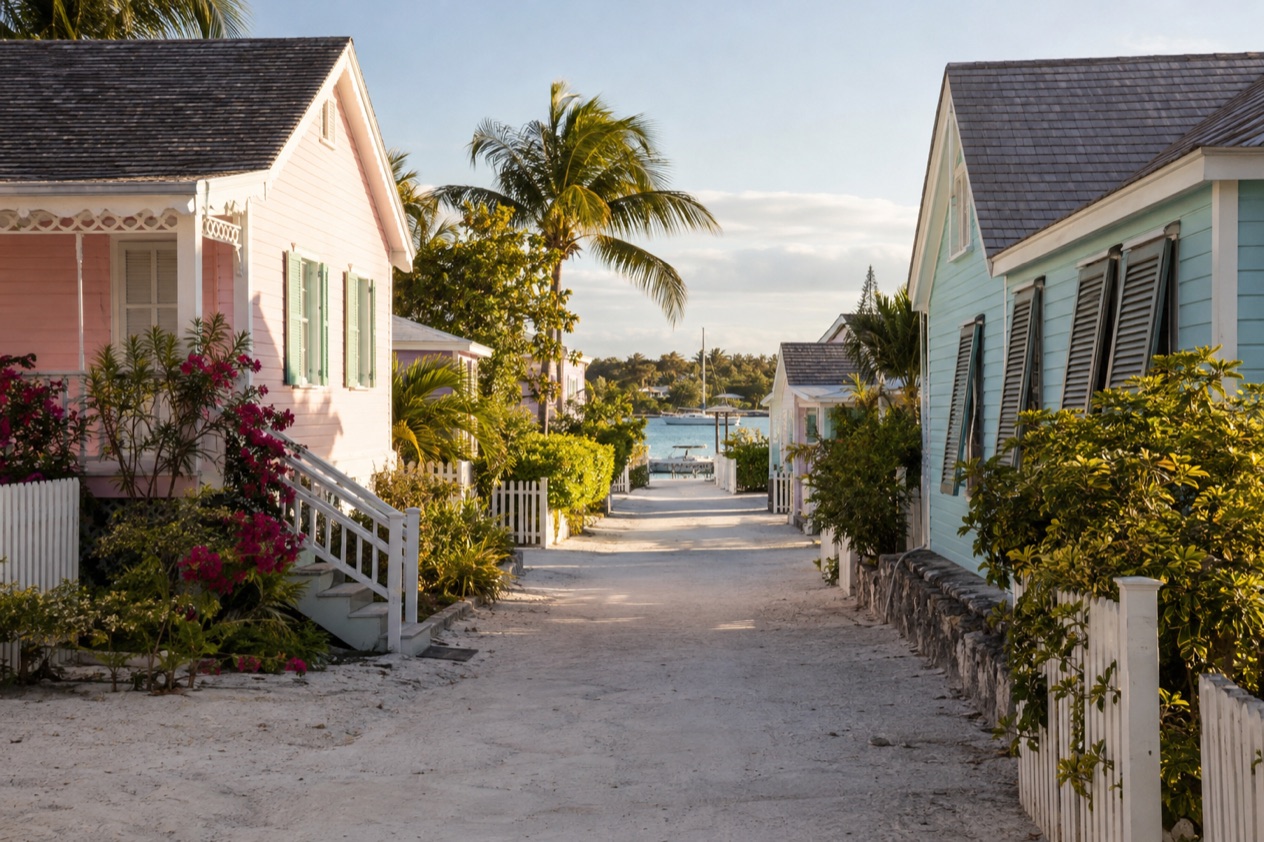
Late in the afternoon on Green Turtle Cay, the only traffic on the narrow lanes of New Plymouth is a golf cart or two rolling past white picket fences and pastel cottages. Somewhere a screen door slaps shut, and the harbor water turns the color of old brass.
This is a small Abaco island with a slow pulse, a Loyalist past you can read in the rooflines and a shoreline made for wandering. It suits travelers who want a village to settle into rather than a resort to check into.
Where is Green Turtle Cay and what is it like?
Green Turtle Cay is one of the barrier islands lying off mainland Great Abaco, in the Abacos chain of the Bahamas, and it is a quiet, walkable village island rather than a resort strip. The cay stretches about 3 miles from end to end and is only half a mile wide, so the Atlantic side and the sheltered harbor side are never far apart. The island takes its name from the green turtles once found in the surrounding waters.
About 450 people live here, and nearly all of them are in New Plymouth, a settlement founded in the 18th century. Many residents trace their ancestry to the Loyalists who left the American colonies after the Revolution, and that heritage shapes the town.
The older houses have steep-pitched roofs, a style found nowhere else in the Bahamas and brought by settlers from New England. Clapboard walls, shutters, tidy gardens and narrow lanes give the place the look of a Maine fishing village that drifted south into warm water.
The pace is the point. Days here run on breakfast at a local bakery counter, a long wander through town, an afternoon on a beach and a dinner of conch in some form, perhaps cracked, fried into fritters or tucked into a salad.
The island has shops, restaurants and a boat repair yard, so it is a working community and not a stage set. You hear boat engines starting at dawn and the murmur of porch conversations at dusk.
Green Turtle Cay is for couples, families who like to roam, sailors and anyone who enjoys small places where people nod hello. It is less suited to travelers who want a big nightlife scene, casinos or a long list of organized attractions. Because the island has no airport, arriving takes a few steps, and the effort filters out much of the hurry you find elsewhere.
What is there to do in Green Turtle Cay?
The best things to do here are walking New Plymouth, finding a beach, getting out on the water and eating and drinking well in the harbor bars. What sets the cay apart from its Abaco neighbors is that it combines all of these in one small village, with a Loyalist feel that Hope Town on Elbow Cay and the boat-building community of Man-O-War Cay each express differently.
Walking New Plymouth
Begin with no plan. The lanes of New Plymouth curve between old homes with steep roofs, small gardens and bright paint, and every few steps there is a view down to the water.
A small museum devoted to the island’s history and a sculpture garden honoring the Loyalist settlers are the kind of stops that give the architecture a story. Go in the morning, when the light is soft on the clapboard and the village is just waking.
Allow time for the little shops and galleries, where local crafts, books and island clothing share the shelves. It suits nearly everyone, including travelers who prefer a gentle day, and it pairs well with a lunch stop at a harbor-side restaurant. A hat and a bottle of water travel well in your hand.
Beaches and the Atlantic side
The island offers outstanding beaches, mostly along the Atlantic shore, where long stretches of pale sand are backed by sea grape and casuarina. Coco Bay and Gillam Bay are names you will hear from locals, and the fun is in walking or riding out to see which suits your mood. Some stretches feel nearly private, with little more than shells, driftwood and the sound of surf.
The open ocean side can have real waves, so treat it as a place to stroll, read and watch the horizon unless a local tells you otherwise. Bring your own shade and snacks, since the farther beaches are not lined with services. Late afternoon is lovely for the light on the sand.
On the water
A cay in the Abacos is a boating place, and Green Turtle Cay is no exception. The harbor holds sailboats and fishing skiffs, and the surrounding islands and sandbars invite exploring by boat. Boat rental operators work in the Abacos, and day trips run out of Marsh Harbour, so a day on the water is easy to build into a stay.
Even without a boat, you can sit on a dock at sunset and watch the traffic of dinghies heading home. Fishing, snorkeling and sightseeing by boat are the classic pursuits, and they suit visitors who like their vacation to have a rhythm of mornings out and afternoons in the shade.
Harbor bars, conch and island drinks
Evenings are for the waterfront. Casual restaurants serve conch fritters, grilled fish, peas and rice and Key lime pie, and the island’s bars are tied to the story of the Goombay Smash, a fruity rum cocktail that visitors often try at least once. Sit outside when you can, because the breeze and the harbor lights are half the meal.
Most of the social life here happens at the tables and bar stools of these places, where sailors, residents and visitors end up chatting. It is a friendly scene that rewards lingering, and it asks for nothing more elaborate than a clean shirt and an appetite.
How many days do you need in Green Turtle Cay?
A long weekend is enough to enjoy Green Turtle Cay, and four or five nights lets the island settle into your bones. The cay is small, so you will not run out of reasons to stay but you may run out of things you feel you must do, which is a good sign.
With two or three days, spend one morning on New Plymouth, an afternoon on a beach and an evening at the harbor. The second day can go to a boat outing or a golf cart tour of the whole island, stopping where a view or a beach beckons. A third day lets you do a bit of nothing, which is the best use of a cay like this one.
With a week, the island becomes a base for the Abacos. Marsh Harbour, the largest settlement in the chain, is the hub for shopping, restaurants and boat trips. Elbow Cay, reached from Marsh Harbour by private boat or regularly scheduled ferry, has the candy-striped Elbow Reef Lighthouse, built in 1862 and the last manually operated lighthouse of its kind in the Bahamas.
Man-O-War Cay, a neighboring cay, is known as the boat-building capital of the Bahamas, with family businesses run by the descendants of the Albury family. It is also the only dry island in the Bahamas, with no public sale or consumption of alcohol, a useful thing to know if you plan lunch there. Treasure Cay, on Great Abaco, adds another beach to the list and has its own airport.
Rainy days are best spent in the museum, the shops and a long lunch, with a book on a covered porch afterward. A change of weather rarely wrecks a stay here, since much of what the island offers is indoors or under a roof.
Where to stay in Green Turtle Cay
Lodging on Green Turtle Cay is small in scale and spread across a few distinct areas: the village of New Plymouth, the harbor shores and the quieter ends of the island. Expect cottages, guesthouses, small inns and vacation rentals rather than large resorts, which keeps the whole island feeling intimate.
New Plymouth suits travelers who want to step out the door into the lanes, shops and restaurants. You will hear the village morning and evening, and everything you need is nearby. It is a good choice for first-timers, couples and anyone who likes to wander at odd hours.
The harbor sides, along the sheltered waters where boats anchor, appeal to sailors and to people who like to wake up looking at masts. The scene changes with the tide and the weather, and a dock or porch usually sits just steps away. These areas feel a little removed from the village center while remaining close enough for a walk or a golf cart ride.
The island’s quieter stretches, toward the northern end and along the Atlantic shore, suit travelers who want sand and silence more than a street scene. Families with a taste for beach days and readers who like a long afternoon on a veranda will find them restful. Visitors can rent a golf cart or a bicycle to get between these areas and the village.
When choosing, think about the kind of evening you want. Staying in the village means music, voices and lights nearby, while staying out toward the ends of the island means stars and surf. Either way, the whole cay is small enough that no stay is far from the center of things.
How do you get to Green Turtle Cay and get around?
You reach Green Turtle Cay by ferry from the mainland or by private boat, because the island has no airport. The first leg is a flight into the Abacos, where two airports take commercial travelers: Leonard M. Thompson International Airport in Marsh Harbour and Treasure Cay International Airport in the settlement of Treasure Cay, both on Great Abaco.
From the mainland, the crossing to the cay is made by water. The step from airport to ferry gives the trip a sense of passage, as pavement gives way to a dock and a short stretch of open water. Travelers coming from Grand Bahama can also reach the Abacos by Pinder’s Ferry, which operates twice a day from McLean’s Town.
Once on the cay, the main ways to get around are on foot, by golf cart or by bicycle. Visitors can rent a golf cart or a bicycle to tour the island’s attractions, and the narrow lanes and low speeds suit both. Walking works well in New Plymouth itself, where everything is clustered around the harbor.
To go farther, you take to the water. Boat rentals operate in the Abacos for those who want to hop between cays, and day trips by boat run from Marsh Harbour for travelers who prefer to be taken. Elbow Cay is reached from Marsh Harbour by private boat or regularly scheduled ferry, so Hope Town and its lighthouse can be added to a stay.
When is the best time to visit Green Turtle Cay?
The most comfortable months for Green Turtle Cay are generally the winter and early spring, from roughly December through April, when the heat eases and the island is most pleasant for walking, beach days and long lunches. In Nassau, a useful reference for the Bahamas, January highs average in the upper 70s and lows in the mid-60s, with only a few rainy days.
Summer is hot and wetter. In Nassau, July highs reach the low 90s, with lows in the mid-70s and rain on a dozen days, often as brief downpours or stormy afternoons rather than all-day gray. Summer suits those who plan around the water, because boats, shade and the sea carry the day.
The Atlantic hurricane season runs from June 1 to November 30, so a trip between those dates falls within it, and the Abacos know the stakes well since Hurricane Dorian made landfall on Elbow Cay in 2019. Travelers who go in autumn should plan with that season in mind and keep their plans flexible.
The shoulder seasons of late spring and the beginning of the summer offer a middle path, with warming seas and a quieter village. Because the island is small, the feel of any month depends on how many boats are in the harbor, so a week in the high season will feel livelier than one in the off-season.
Good to know before you go
The U.S. State Department rates the Bahamas Level 2, “Exercise increased caution”, and says most crime occurs in Nassau on New Providence and in Freeport on Grand Bahama.
The Bahamas uses the Bahamian dollar, and Green Turtle Cay is a small island with a small number of shops and restaurants, so it helps to travel with what you need for the day. The hurricane season, which runs from June 1 to November 30, is worth weighing when you choose your dates, and the same goes for a stay in the late summer and autumn months.
Pack light clothing, a hat, sun protection and comfortable walking shoes for the lanes and beaches, and bring a light layer for breezy evenings on the water. The island rewards a slow approach, a friendly greeting to whoever you pass and a willingness to follow the rhythm of the village.
Sources
- Wikipedia, Green Turtle Cay (https://en.wikipedia.org/wiki/Green_Turtle_Cay), checked October 10, 2026
- Bahamas Ministry of Tourism, Investments & Aviation (bahamas.com), Green Turtle Cay (https://www.bahamas.com/natural-wonders/green-turtle-cay), checked October 10, 2026
- Bahamas Ministry of Tourism, Investments & Aviation (bahamas.com), Man O War Cay (https://www.bahamas.com/natural-wonders/man-o-war-cay), checked October 10, 2026
- Wikipedia, Abaco Islands (https://en.wikipedia.org/wiki/Abaco_Islands), checked October 10, 2026
- Bahamas Ministry of Tourism, Investments & Aviation (bahamas.com), The Abacos (https://www.bahamas.com/islands/abacos), checked October 10, 2026
- Bahamas Ministry of Tourism, Investments & Aviation (bahamas.com), travel blog, island hopping in the Abacos (https://www.bahamas.com/blog/the-ultimate-guide-to-island-hopping-in-the-abacos-without-breaking-the-bank), checked October 10, 2026
- Bahamas Ministry of Tourism, Investments & Aviation (bahamas.com), travel blog, Abacos and Grand Bahama after Hurricane Dorian (https://www.bahamas.com/blog/things-to-know-when-visiting-the-bahamas-after-dorian), checked October 10, 2026
- Wikipedia, Geography of the Bahamas (https://en.wikipedia.org/wiki/Geography_of_the_Bahamas), checked October 10, 2026
- NOAA NCEI, GHCN-Daily station BF000078073 (Nassau Airport), normals 1991-2020 computed from the daily record (https://www.ncei.noaa.gov/access/services/data/v1?dataset=daily-summaries&stations=BF000078073), checked October 10, 2026
- Open-Meteo Marine API, average 2015-2024, checked October 10, 2026
- U.S. Department of State, The Bahamas Travel Advisory, Level 2 (https://travel.state.gov/), checked October 10, 2026
- NOAA National Hurricane Center, Climatology (https://www.nhc.noaa.gov/climo/), checked October 10, 2026
To plan your stay
- Best Time to Visit the Bahamas: Weather, Hurricane Season, Sea Temperatures and Junkanoo
- Where to Stay in the Bahamas: Best Islands, Resorts, Boutique Stays and How to Choose
- Getting Around the Bahamas: Flights, Ferries, Mailboats and Taxis in Nassau
- Know Before You Go to the Bahamas: Entry Rules, Money, Getting Around and Local Customs