
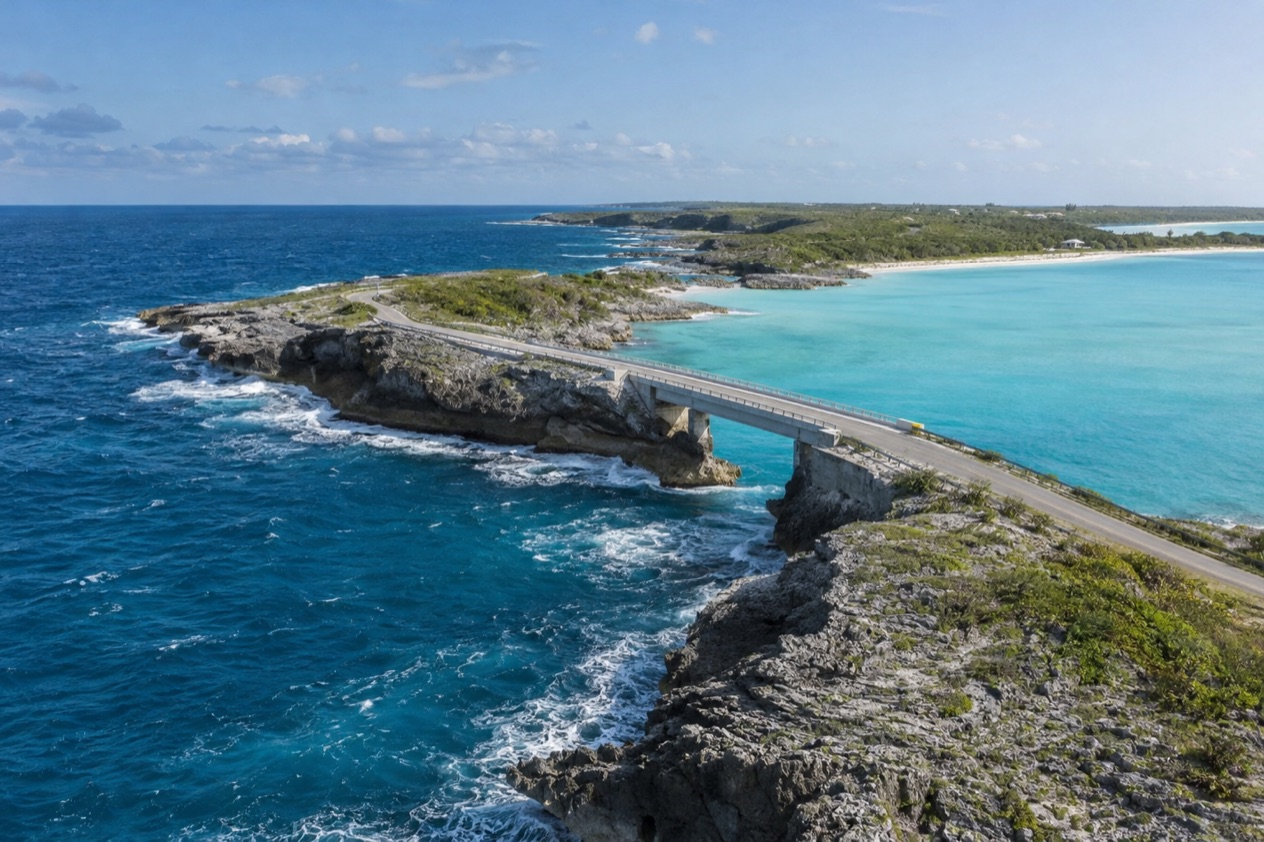
The road narrows, the land drops away on both sides, and suddenly the color changes. To the east the Atlantic rolls in a deep, dark indigo, and to the west the Bight of Eleuthera lies pale and glassy turquoise.
This is Glass Window Bridge in North Eleuthera, the spot where an island that stretches for miles is pinched almost to nothing. It is a short stop with a big view, and it suits anyone driving the length of the island.
Is visiting Glass Window Bridge worth it?
Yes, if you like places where geography does the talking, and it suits photographers, road-trippers and anyone curious about how an island is actually put together. Only a strip of rock about 30 feet wide separates the open Atlantic from the sheltered Bight, and standing on it you can watch two different seas at once. Few places in the Bahamas let you see that so plainly from a single spot.
What sets it apart from the pink beaches and harbor towns elsewhere on Eleuthera is that nothing here asks for a plan. There is no resort, no boat to catch, no beach day to organize.
You come for the panorama, the sound of the Atlantic working against the rocks, and the odd sense of standing on a thread between two bodies of water. Some visitors linger for a quarter of the afternoon, others stop for a photo and carry on. Either way, it fits easily into a day of exploring the north of the island.
It also gives the drive up the island a punctuation mark. Eleuthera is long and thin, and this is the place where that shape becomes obvious. If you only have time for a few stops, this is the one that explains the island at a glance.
What to see at Glass Window Bridge
The two seas side by side
The main event is the contrast. On the Atlantic side the water is dark and restless, and swells arrive from far out and break against the rock below the bridge. On the Bight side the water is calmer in color and tone, a pale shelf of turquoise that seems to belong to another place altogether.
Stand in the middle of the bridge and look from one side to the other, then back again. The difference in color, texture and sound is the whole point of the visit, and it shifts with the light. Morning and late afternoon give the Atlantic its deepest blue, while midday sun brings out the glow of the Bight.
The bridge and its story
The name comes from a natural stone arch that once framed the view like a window, and the Atlantic has long been working at this narrow neck of land. Over the years the crossing has been rebuilt, and storm waves have repeatedly tested whatever spans the gap. A major upgrade of the bridge was announced in 2021 with a price of $30 million, a sign of how much the island depends on this single link.
For a visitor, the story adds weight to the scene. When the ocean is running high, you can see why the crossing is so hard to hold. Look at the rock and the water line and you get a quick lesson in how the sea shapes the Bahamas.
The panoramic view along the cliffs
The view here is magnificent and wide, with the coast running away in both directions. Look north and south along the ridge and you see how little land there is between the water on the two sides. Low scrub clings to the rock, and the horizon on the Atlantic side is an unbroken line.
Bring your camera, but also take a minute without it. The sound of the surf, the wind coming over the narrow strip and the shifting colors of the water are what most people remember. Sunrise and sunset light can turn the whole scene gold and rose, so plan your visit around one of them.
Queen’s Bath, a mile or so south
A mile or so south of the bridge lies Queen’s Bath, a stop many visitors pair with the bridge. It is a spot on the rugged Atlantic side where the sea works against the rock, and visitors are told to watch out for big waves there. That warning is the thing to carry with you, because the ocean on this coast is powerful and can surprise.
Treat Queen’s Bath as a place to look and take in the force of the Atlantic, keeping a respectful distance from the edge and keeping an eye on the water. Together with the bridge, it gives you two very different views of the same rugged shore.
Hours, tickets and rules
Glass Window Bridge is a stretch of road and a viewpoint on the island, not a museum or a gated park, and the visit is about standing there and looking. For questions about the site, the Eleuthera Tourist Office can be reached at (242) 332-2142 or at [email protected].
The one rule to carry is about the water. At Queen’s Bath, a mile or so south of the bridge, visitors should watch out for big waves. The Atlantic side of Eleuthera can be forceful, and the same attitude of respect applies anywhere along this rocky coast. Since the road itself carries traffic, remember that driving on Eleuthera is on the left-hand side.
Beyond that, treat the place as you would any natural landmark. Take your photos, enjoy the view and leave the rock and the shoreline as you found them. The surrounding island has plenty of other stops, from Gregory Town to Hatchet Bay, if you want more to fill the day.
How to get to Glass Window Bridge
Glass Window Bridge is in North Eleuthera, on an island that lies 50 miles east of Nassau. Most visitors reach Eleuthera from Nassau and then travel along the island to the bridge. Eleuthera is long and narrow, so the bridge sits along the main route that runs through it, the Queens Highway, which covers 110 miles end to end.
Once on Eleuthera, you will need your own wheels. The island has no public transport system, so visitors generally rent a car to explore. That is the mode to plan around, and it also gives you the freedom to stop wherever the view tempts you on the way.
Remember that driving on Eleuthera is on the left-hand side of the road. If you are staying around Gregory Town, Hatchet Bay or Harbour Island, the bridge fits naturally into a drive along the island. Approaching, you will notice the land pinching in and the sea appearing on both sides well before you reach the crossing itself. For any question about reaching the site, the Eleuthera Tourist Office is the contact to use, at (242) 332-2142 or [email protected].
When to visit Glass Window Bridge
The best time of day is when the light is low. Early morning and late afternoon bring a soft glow to the rock and deepen the contrast between the dark Atlantic and the pale Bight. Midday sun is bright and flat, though it makes the turquoise of the Bight glow more than at any other time.
As for the season, the view works in any month, and what changes is the mood of the ocean. When the Atlantic is rolling in strongly, the scene feels dramatic, with spray and sound filling the air. On quieter days the two seas sit more peacefully side by side.
The Atlantic hurricane season runs from June 1 to November 30, so a trip in those months comes with the chance of rough weather and a more powerful sea. Eleuthera was severely damaged in 1992 by category 5 Hurricane Andrew, including an 18-foot tidal surge, a reminder of what this coast can face.
If you want to build the visit around an event, the island has a few. An annual Pineapple Festival is held in Gregory Town, a Junkanoo parade takes place in Tarpum Bay at Christmas time (check with locals for the exact schedule), and the Cancer Society Ride for Hope brings cyclists to the island every April. Governor’s Harbour holds a Friday night fish fry, which draws a crowd for BBQ, drinks and loud music, with a wait of an hour or more for food after ordering.
Tips for your visit
Bring a camera and something to shade you from the sun, since the viewpoint is open and exposed. Wind comes off the Atlantic, so a light layer can be welcome. The stop itself can be brief, and most of the value comes from combining it with other places nearby.
Queen’s Bath, a mile or so south, is the natural pairing, with the reminder to watch out for big waves. North of the bridge, Harbour Island has a 3 mile pink sand beach with clear waters that travel magazines have often cited as one of the most beautiful in the world. Eleuthera as a whole is known for wide rolling pink sand beaches and large outcrops of ancient coral reefs.
For nature, the Leon Levy Native Plant Preserve opened as Eleuthera’s first National Park, a 25-acre sanctuary home to more than 171 species of indigenous plants, and it includes an environmental education centre. South of Gregory Town, Hatchet Bay Cave is for the adventurous: bring a friend and at least one flashlight, because the lowest level is half-filled with water. In North Eleuthera, the tidal current at Current Cut is suitable for swimming, snorkeling or diving.
Families will find the bridge a good quick stop, with wide views to point out and a clear lesson about two seas. Since the bridge carries road traffic and the Atlantic side can be powerful, keep a close eye on children near the edges and the water. Because there is no public transport, plan your day around the car you have.
Good to know before you go
The U.S. State Department rates the Bahamas Level 2, “Exercise increased caution”, and says most crime occurs in Nassau on New Providence and in Freeport on Grand Bahama.
The Bahamas uses its own currency, the Bahamian dollar, and Eleuthera is a quiet island where a day of sightseeing is mostly about the drive and the views. Hurricane season in the Atlantic runs from June 1 to November 30, so a visit between those dates calls for an eye on the forecast before you set out.
Keep in mind that the island is long and spread out, with no public transport, so a car and a full tank give you the freedom to move between stops. Take care at the water’s edge, especially where the Atlantic meets the rock, and leave the shoreline as you found it.
Sources
- Bahamas Ministry of Tourism, Investments & Aviation (bahamas.com), Glass Window Bridge (https://www.bahamas.com/natural-wonders/glass-window-bridge), checked October 10, 2026
- Wikipedia, Eleuthera (https://en.wikipedia.org/wiki/Eleuthera), checked October 10, 2026
- Wikivoyage, Eleuthera travel guide (https://en.wikivoyage.org/wiki/Eleuthera), checked October 10, 2026
- U.S. Department of State, The Bahamas Travel Advisory, Level 2 (https://travel.state.gov/), checked October 10, 2026
- NOAA National Hurricane Center, Climatology (https://www.nhc.noaa.gov/climo/), checked October 10, 2026
To plan your stay
- Best Time to Visit the Bahamas: Weather, Hurricane Season, Sea Temperatures and Junkanoo
- Where to Stay in the Bahamas: Best Islands, Resorts, Boutique Stays and How to Choose
- Getting Around the Bahamas: Flights, Ferries, Mailboats and Taxis in Nassau
- Know Before You Go to the Bahamas: Entry Rules, Money, Getting Around and Local Customs