
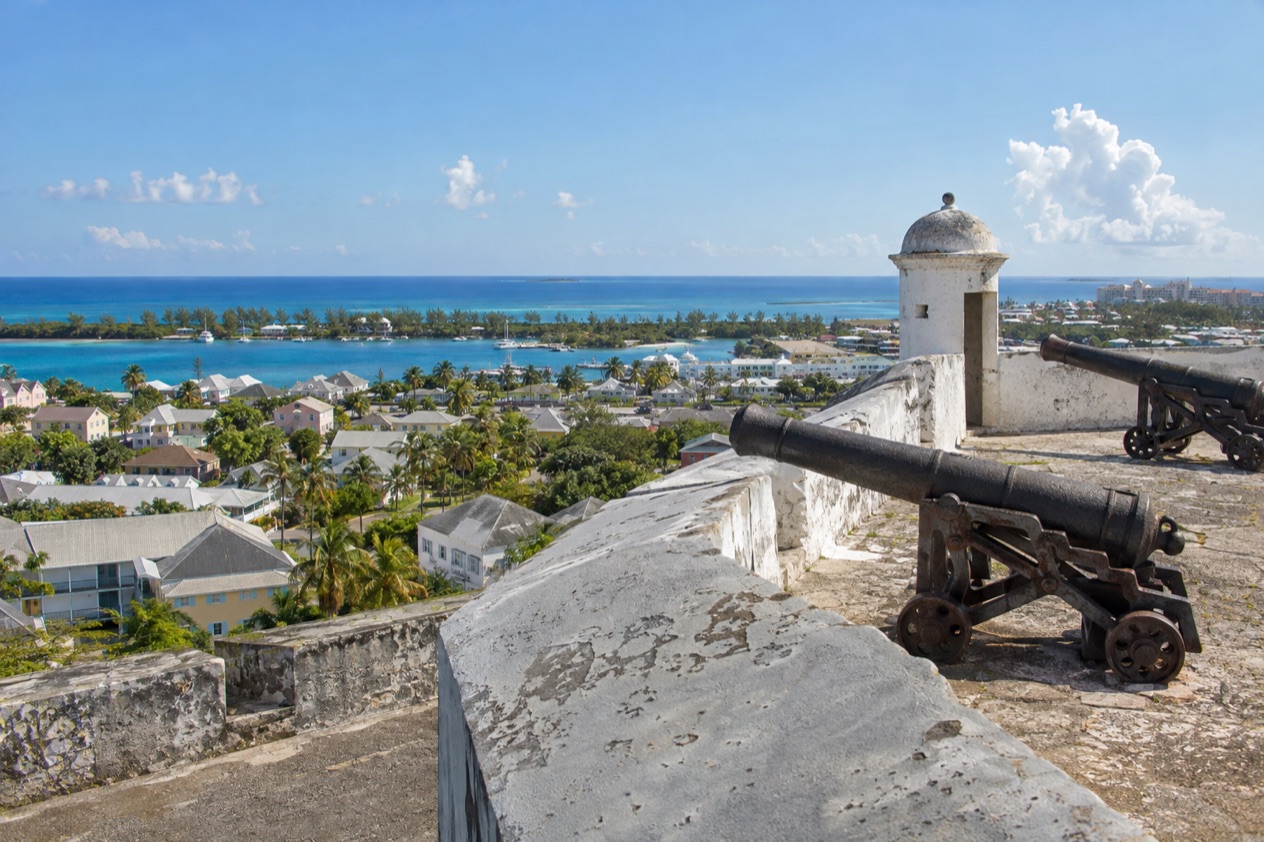
You reach Fort Fincastle by climbing, past the cool, mossy walls of the Queen’s Staircase, with palms leaning over the limestone and the sounds of downtown Nassau falling away behind you. At the top, the stone ramparts open onto the harbour and the rooftops of the old town. This is a short, atmospheric history stop on Bennet’s Hill, built around a fort shaped like a ship.
Is visiting Fort Fincastle worth it?
Yes, for travelers who like their history with a view, and for anyone curious about how Nassau was defended and who built the town’s stonework. It suits cruise visitors on a few free hours, families with children who like climbing steps and peering over walls, and anyone who wants to understand the city before wandering its streets.
What sets it apart from the other fortifications around Nassau is its shape and its setting. Fort Charlotte, west of downtown, is a sprawling complex with a drawbridge, a moat and underground passages, and it sits above the harbour entrance.
Fincastle is smaller and more compact, perched on a hill right above the old town, built of cut limestone in the form of a paddle-wheel steamer. The staircase that leads up to it is a sight in itself, carved by hand from solid rock. Together they make a visit that is more about atmosphere and story than about a long list of rooms to tour.
What to see at Fort Fincastle
The paddle-wheel fort
The fort was built of cut limestone around 1793, during the governorship of John Murray, also known as Viscount Fincastle, the man whose title gave it its name. Its builders gave it the outline of a paddle-wheel steamer, so the walls curve and angle like the bow and sides of a ship that has come to rest on top of the hill.
Walk the ramparts and look for the pale, tightly fitted blocks, the openings where guns once pointed toward the sea, and the way the shape makes more sense the longer you follow the wall. Like the other forts of Nassau, it saw threat on many occasions but never significant battle, so what survives is a well-kept stone vessel rather than a ruin of sieges.
The Queen’s Staircase
The staircase belongs to the Fort Fincastle Historic Complex and was hewn out of solid limestone rock by slaves between 1793 and 1794. It is said to have given a direct route between the fort and the town. Later the steps were named in honor of Queen Victoria, who reigned for 64 years.
Sixty-five steps are visible today. The bottom step is buried beneath the asphalt, because the path leading to the staircase was paved over it. Take your time on the climb: the high stone walls on either side, the ferns and the dappled shade make it one of the most photogenic corners of Nassau, and it is worth remembering whose hands cut every step.
The view over the harbour and old town
The fort stands atop Bennet’s Hill to protect historic Nassau town and its harbour, and that purpose still explains the view. From the walls you look down over the old town, the water and the ships moving in and out. It is the reason the hill was chosen, and it is the best place to get your bearings before heading downhill again.
The harbour view is also where the story of the town’s garrison comes alive. British West India Regiments, whose soldiers were African men under European officers, were sent to garrison the New Providence forts in 1801. Many of them married Bahamian women, and after the British military left in 1891 many stayed and helped shape the Over-the-Hill community just beyond the foot of the hill.
Hours, tickets and rules
Guided tours run every day through the working day, and there is no fixed entry fee. The fort asks instead for donations, which are appreciated.
| Site | Open | Admission |
|---|---|---|
| Fort Fincastle (daily guided tours) | 8:00 a.m. to 4:00 p.m. | Donations appreciated, no fixed fee |
For questions about the fort or the Queen’s Staircase, the contact email is [email protected], and the staircase has a local phone line, (242) 356-9085, answered by Christine Rolle. No rules on climbing the walls, drones, tripods or sunscreen are stated for the fort, so the most useful thing to say is that the visit is a guided one and the guides lead the way.
How to get to Fort Fincastle
The fort stands in Nassau on New Providence Island, atop Bennet’s Hill, above the old town it was built to protect. The Queen’s Staircase is part of the same historic complex, and it is the staircase that links the fort with the town below.
That staircase is how the fort has always been reached from downtown: it is said to have provided a direct route from Fort Fincastle to Nassau. Walking up it is the natural way to arrive, and it makes the stop feel like a small journey rather than just an entrance. Coming up from the harbour side, you rise out of the streets and the noise into the cooler, shaded cut of the stone.
For Fort Charlotte, the other major fort on the island, the direction is west of downtown Nassau, on a hill overlooking the entrance to Nassau Harbour. Fincastle sits on the opposite side of the old town, so the two forts bracket the historic center rather than sitting side by side.
When to visit Fort Fincastle
Go early. Tours begin at 8:00 a.m., and a morning visit means climbing the staircase in the shade of its high walls before the sun is fully overhead. The last tours of the day wind down by 4:00 p.m., so late afternoon is possible but leaves little margin.
The hill and the ramparts are open to the sky, so on a bright midday the stone holds the heat and there is little cover on the walls. Early morning gives softer light on the pale limestone and a clearer look over the harbour. If the weather turns gray or showery, the climb is still worth doing, though the view loses its sparkle.
The Atlantic hurricane season runs from June 1 to November 30, so a visit in those months is a visit during the season. No festival or equinox date is tied to the fort, so there is no special day to plan around. The calendar that matters most is the daily one: morning for comfort, mid-morning for the harbour, and the fort fits naturally into a day in the old town.
Tips for your visit
Bring comfortable shoes with a good grip, because the visit is built around stone steps and uneven ramparts. A hat and water are sensible for the open walls. Carry a few small bills if you plan to leave a donation, since the fort asks for donations rather than a fixed fee.
Plan the visit as a pairing of the staircase and the fort, with time to stop for photographs on the way up and a slow walk along the walls. The stop fits comfortably into a morning in the old town, and the guided tour gives the story of the fort, the staircase and the soldiers who once lived nearby.
Combine it with Fort Charlotte if you want a fuller picture of Nassau’s defenses. Charlotte is the largest of the three remaining forts and offers a very different experience, with a drawbridge, a moat, dungeon-like passages and its three linked parts, Fort Charlotte, Fort Stanley and Fort D’Arcy.
Families will find the steps and the ship-shaped walls easy to enjoy, though the climb is a climb. Details on step-free routes, parking and on-site facilities are not described for the fort, so travelers with mobility needs can write to [email protected] before going.
Good to know before you go
The U.S. State Department rates the Bahamas Level 2, “Exercise increased caution”, and says most crime occurs in Nassau on New Providence and in Freeport on Grand Bahama.
Donations are the way to support the fort, so a little cash in hand is useful. Nassau is the city where most crime in the Bahamas is reported to occur, so the usual habits of a city visit apply: keep your valuables close and your bag zipped on the climb. The Atlantic hurricane season runs from June 1 to November 30, and a visit within those months is best planned with an eye on the forecast.
Sources
- Bahamas Ministry of Tourism, Investments & Aviation (bahamas.com), Fort Fincastle (https://www.bahamas.com/natural-wonders/fort-fincastle), checked October 10, 2026
- Bahamas Ministry of Tourism, Investments & Aviation (bahamas.com), Queens Staircase (https://www.bahamas.com/natural-wonders/queens-staircase), checked October 10, 2026
- Bahamas Ministry of Tourism, Investments & Aviation (bahamas.com), travel blog, Nassau forts (https://www.bahamas.com/blog/historic-forts-of-nassau), checked October 10, 2026
- U.S. Department of State, The Bahamas Travel Advisory, Level 2 (https://travel.state.gov/), checked October 10, 2026
- NOAA National Hurricane Center, Climatology (https://www.nhc.noaa.gov/climo/), checked October 10, 2026
To plan your stay
- Best Time to Visit the Bahamas: Weather, Hurricane Season, Sea Temperatures and Junkanoo
- Where to Stay in the Bahamas: Best Islands, Resorts, Boutique Stays and How to Choose
- Getting Around the Bahamas: Flights, Ferries, Mailboats and Taxis in Nassau
- Know Before You Go to the Bahamas: Entry Rules, Money, Getting Around and Local Customs