
On Great Inagua, a pink line appears at the edge of a salt pan, then lifts, and thousands of flamingos turn the sky the color of a conch shell. Out on the water, dolphins sometimes race a boat’s bow, while on Andros the forest closes in around an inland blue hole. The Bahamas is an archipelago of wild places, and its birds, reefs and protected parks reward travelers who slow down and look.
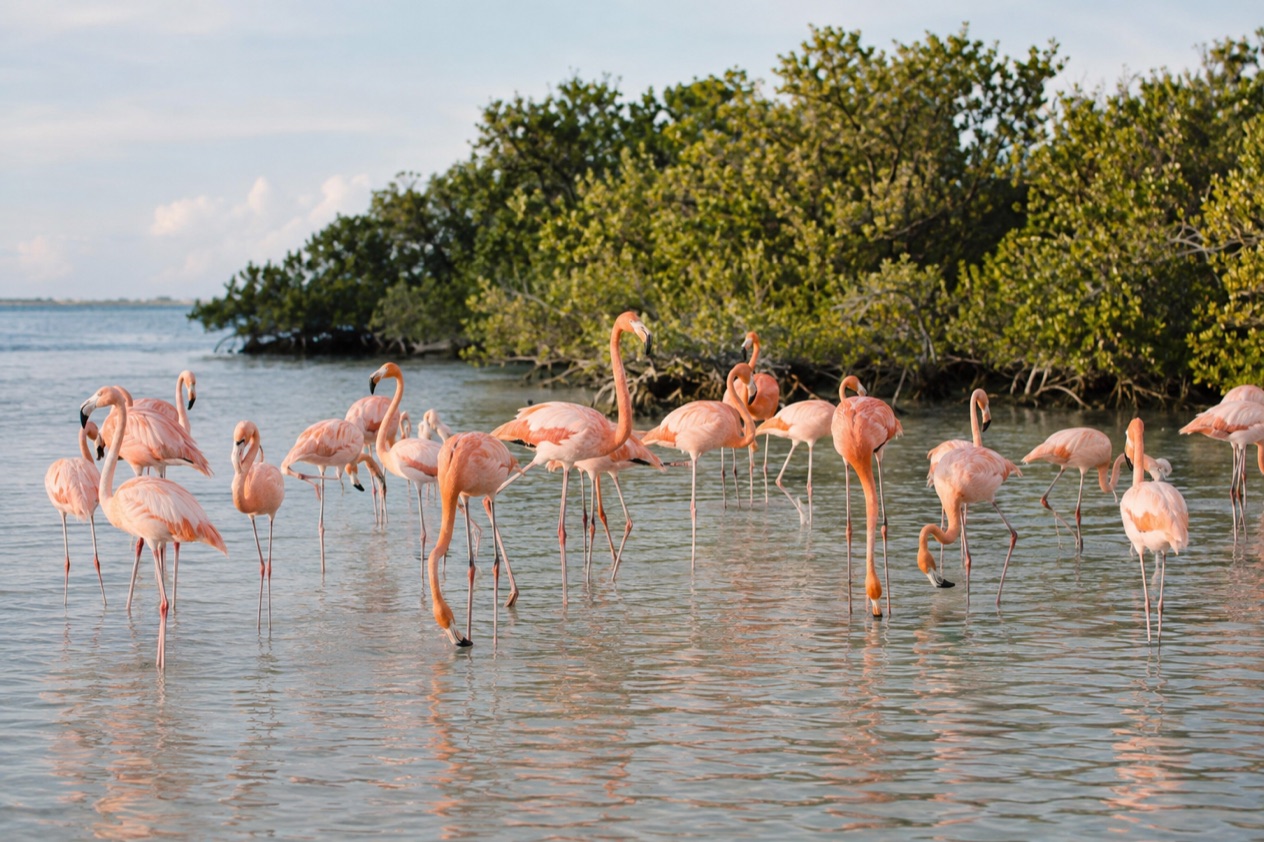
What wildlife can you see in the Bahamas?
Flamingos, sea life and birds are the stars: the islands hold the largest breeding colony of West Indian flamingos, reefs that draw scuba divers, and waters where sharks and dolphins turn up. Because the Bahamas is spread across many islands, each animal belongs to its own place, so it helps to choose the island first and the creature second.
Flamingos on Inagua
Inagua is the flamingo island. Its colony is the largest remaining breeding colony of West Indian flamingos, with about 60,000 birds, and the birds nest at Lake Rosa, the island’s largest salt pan. In years when breeding conditions are favorable the count can swell far higher. The sight is a wall of pink standing in shallow water, with a constant murmur of honking.
The story behind the flock is one of recovery. In the 1950s fewer than 5,000 Caribbean flamingos remained in the whole region, all of them on Inagua, after hunting and disturbance had hammered the population since early in the twentieth century. Over some 40 years the colony came back from near extinction, and it has helped repopulate other Bahamian islands such as Andros and Mayaguana, as well as Cuba and Grand Cayman.
Protection is built into daily life here. Aircraft may not fly below 2,000 feet above ground, and eating flamingos is illegal. Wild pigs once ate eggs and trampled nesting grounds, and since flamingos lay eggs only once a year, every nest counts. Expert guides run half-day and full-day birdwatching tours on Inagua, which suit anyone who wants to see the colony with someone who knows where the birds are feeding.
Birdwatching beyond the flamingos
Inagua is home to over 140 native and migratory species. Keen birders look for the native Bahama parrot, the endemic Bahama woodstar hummingbird, Bahama pintails, roseate spoonbills, reddish egrets, snowy egrets, tri-colored herons, brown pelicans, burrowing owls and American kestrels. Wild donkeys wander the park, freshwater terrapins live in its ponds, and stands of natural bonsai forest give the land a strange, miniature look.
Andros also offers half-day and full-day guided birdwatching, and on Nassau bird watchers can spot rare tropical birds in their natural habitat. At The Island House in western New Providence, birdwatching tours are part of the activities, so you can pair a morning with the birds with a quiet stay by the coast.
Sharks, dolphins and reefs
The water is where many visitors find their most vivid moments. Travelers can swim with sharks, an experience people describe as transformative and even spiritual. Boaters may meet dolphins leaping from the clear blue water and playing alongside the hull, though like all wild encounters it is a chance, never a promise. Scuba divers consider the Bahamas a paradise.
Andros has the world’s third-largest fringing barrier reef, a long line of coral just offshore. The Reef Rescue Network offers five coral reef restoration experiences designed for snorkelers and scuba divers, so you can help repair a reef instead of only looking at it. Many travelers find that kind of hands-on dive the most memorable of the trip.
Reptiles, zoos and bush tours
There are no poisonous snakes in the Bahamas. The Bahamian boa, the pygmy boa and the brown racer are all harmless, which is a relief for anyone heading into the bush. Bush tours and lake tours are available on several of the islands.
On New Providence, Ardastra Gardens offers a controlled setting to see flamingos, monkeys, iguanas, leopards and wild cats. It is a way to meet animals up close if the trip does not reach Inagua.
Where are the national parks?
The Bahamas has 33 national parks, scattered from the Abaco Cays down through the Exumas and Andros to Great Inagua. The Bahamas National Trust looks after them and also does wetland conservation work on Andros, New Providence, Exuma, Freeport and Inagua.
Inagua National Park
Established in 1965, Inagua National Park on Great Inagua covers 183,740 acres, a vast sweep of salt pans, scrub and shallow lakes. It is the home of the flamingo colony, and it is the place to go for birds, wild donkeys and the odd bonsai woodland.
Go with a guide. The half-day and full-day birdwatching tours are built for this landscape, and they turn a flat horizon into a list of species. Bring a hat and patience, because the best viewing comes from waiting quietly at the water’s edge.
Exuma Cays Land and Sea Park
Established in 1958, the Exuma Cays Land and Sea Park is the first marine reserve in the Bahamas and the wider Caribbean. It covers 112,640 acres of land and sea, and its headquarters sit at Warderick Wells, where wardens and Royal Bahamas Defence Force officers keep constant watch.
The rules are strict and clear: within the park no fishing, shelling or conching of any kind is permitted. The idea is that what is here stays here, from the shells on the sand to the fish in the water. The park office keeps set hours.
| Site | Open |
|---|---|
| Exuma Cays Land and Sea Park office | Monday to Friday 9am to 5pm, Sunday 9am to 12pm |
Andros and the Abaco Cays
Andros has four parks, among them Blue Holes National Park, which has hiking trails through the forest around the blue holes. The island is also the setting for the third-largest fringing barrier reef in the world, and the Small Hope Bay Foundation works toward an environmentally and economically sustainable future there.
In the Abaco Cays, the protected areas include Black Sound Cay National Park, Fowl Cays National Park, Pelican Cays Land & Sea Park and Walker’s Cay National Park. In Freeport on Grand Bahama, a five-mile Heritage Trail offers nature walks close to town.
How can you visit responsibly?
Visit responsibly by following each park’s rules, staying with guides who know the wildlife, and choosing lodging and activities that give something back to the island. The Bahamas spans 100,000 square miles of the world’s clearest waters, and a lot of that clarity depends on small habits.
Respect the rules in the parks
Rules are the first layer of protection. In the Exuma park, no fishing, shelling or conching is allowed, and on Inagua, low flights and eating flamingos are against the law. These laws exist because hunting and disturbance once pushed flamingos to the edge of extinction, and they are why the birds are still there.
If you see poaching or something unusual in the Exuma park, you can report it anonymously by calling Exuma Park on VHF Channel 09 and giving your vessel the name Miss Molly or any made-up name. VHF Channel 16 is monitored around the clock for emergencies.
Stay at eco-minded lodgings
Tiamo Resort on South Andros runs on solar energy, serves organically grown produce and seafood bought from local fishermen, and offers snorkeling, kayaking and hiking. It is a good example of how a stay can support the island instead of simply using it.
The Island House in western New Providence uses reclaimed wood and natural stone in its rooms, grows herbs for the restaurant in its own garden, and relies on solar panels, rainwater harvesting and energy-saving appliances. Guests can join beach cleanups as well as birdwatching tours.
Join community and conservation efforts
Local groups are doing steady work. The Andros Community Tourism Cluster brings together 67 enterprises, entrepreneurs and agencies to conserve the island’s natural and cultural heritage. The Bonefish & Tarpon Trust has helped establish six nationally protected bonefish conservation zones.
On Eleuthera, the Eleuthera Sustainability Council Cooperative has installed 32 solar-powered lights, and on Harbour Island the Briland Sustainable Tourism Council removed 16,000 pounds of debris from the coastline in 2022 and 2023. The Sandals Foundation, launched in March 2009, supports environmental work and education in the Bahamas. Joining a reef restoration dive or a cleanup is a direct way to add to these efforts.
Good to know before you go
The U.S. State Department rates the Bahamas Level 2, “Exercise increased caution”, and says most crime occurs in Nassau on New Providence and in Freeport on Grand Bahama.
Wildlife trips here are island-by-island affairs, so plan around the one or two places that matter most to you, whether that is the flamingos of Inagua or the reefs of Andros. The Atlantic hurricane season runs from June 1 to November 30, so a visit in those months calls for flexible plans. Keep a small supply of cash and a sense of patience for the remote parks, where guides and wardens are the best source of local knowledge.
Sources
- Bahamas Ministry of Tourism, Investments & Aviation (bahamas.com), Ecotourism (https://www.bahamas.com/plan-your-trip/ecotourism), checked October 10, 2026
- Bahamas Ministry of Tourism, Investments & Aviation (bahamas.com), travel blog, eco resorts (https://www.bahamas.com/blog/eco-friendly-resorts-in-the-bahamas–the-ultimate-green-escape), checked October 10, 2026
- Bahamas Ministry of Tourism, Investments & Aviation (bahamas.com), travel blog, wildlife by island (https://www.bahamas.com/blog/bahamian-wildlife-and-where-to-find-them), checked October 10, 2026
- Bahamas Ministry of Tourism, Investments & Aviation (bahamas.com), travel blog, flamingos Inagua (https://www.bahamas.com/blog/how-the-bahamas-rescued-the-flamingo), checked October 10, 2026
- Bahamas Ministry of Tourism, Investments & Aviation (bahamas.com), Inagua National Park (https://www.bahamas.com/natural-wonders/inagua-national-park), checked October 10, 2026
- Bahamas National Trust, National park info (https://bnt.bs/national-park-info/), checked October 10, 2026
- Bahamas National Trust, Exuma Cays Land and Sea Park (https://bnt.bs/explore/exuma/exuma-cays-land-sea-park/), checked October 10, 2026
- Bahamas Ministry of Tourism, Investments & Aviation (bahamas.com), Sustainability (https://www.bahamas.com/plan-your-trip/sustainability), checked October 10, 2026
- U.S. Department of State, The Bahamas Travel Advisory, Level 2 (https://travel.state.gov/), checked October 10, 2026
- NOAA National Hurricane Center, Climatology (https://www.nhc.noaa.gov/climo/), checked October 10, 2026
To plan your stay
- Best Time to Visit the Bahamas: Weather, Hurricane Season, Sea Temperatures and Junkanoo
- Where to Stay in the Bahamas: Best Islands, Resorts, Boutique Stays and How to Choose
- Getting Around the Bahamas: Flights, Ferries, Mailboats and Taxis in Nassau
- Know Before You Go to the Bahamas: Entry Rules, Money, Getting Around and Local Customs