
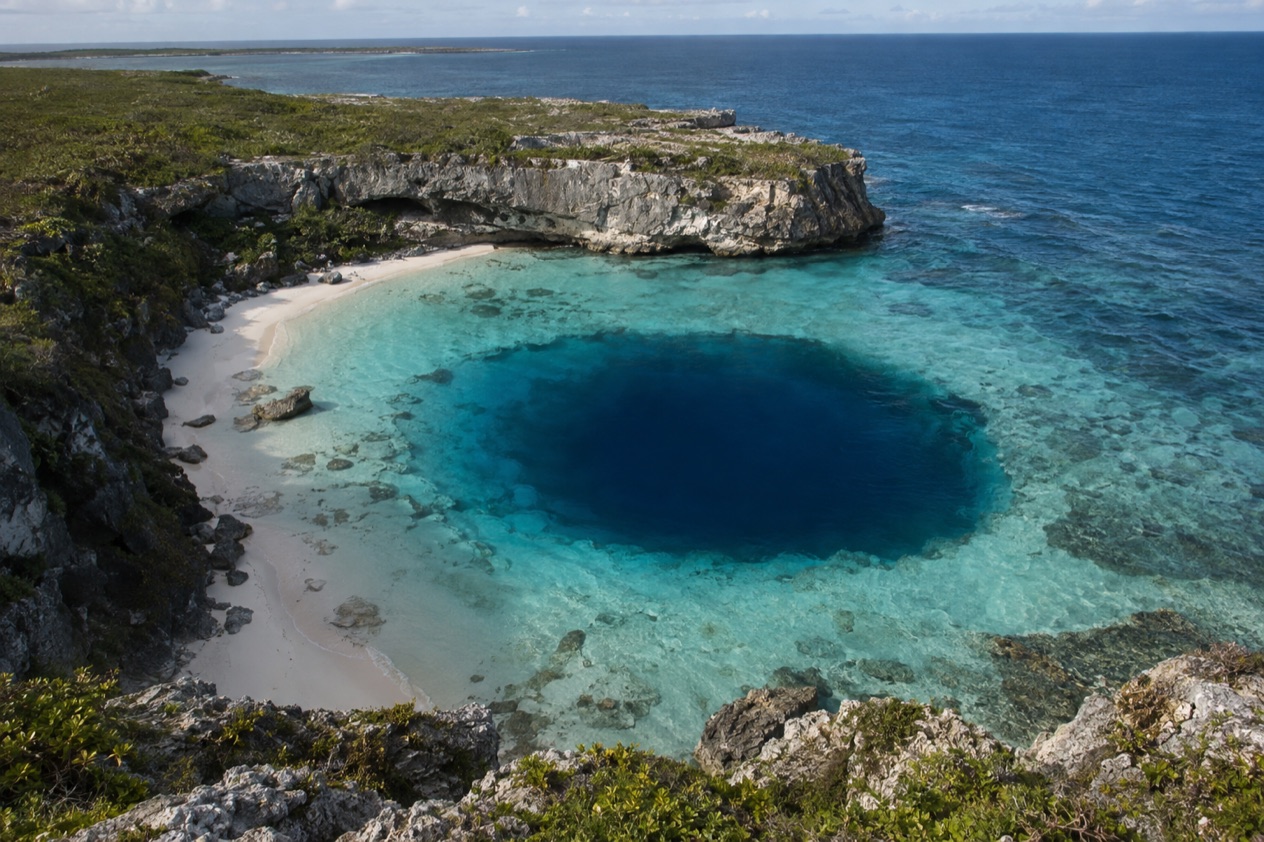
A rim of pale rock curves around a patch of water so dark and deep it looks like ink poured into the shallows, while a few steps away the lagoon glows turquoise over white sand. That contrast is the first thing you see at Dean’s Blue Hole, west of Clarence Town on Long Island. It is a place to stand at the edge, look down into the blue and understand why freedivers travel across the world for it.
Is visiting Dean’s Blue Hole worth it?
Yes, if you like dramatic natural scenery and are happy to make a special trip to a quiet island, and it is a particularly rewarding stop for anyone curious about freediving. The hole plunges to 663 feet, and it is described as the third deepest blue hole in the world (another source ranks it second). Even if you never get in the water, the setting alone repays the journey.
What sets it apart from other blue holes in the islands is the frame around it. The hole is enclosed on three sides by a natural rock amphitheater, and on the fourth side by a turquoise lagoon and a powdery white beach. You get a deep, dark pool, a bright shallow lagoon and a sand beach in one view, which few places can offer.
It also carries a story. Because of its depth, the hole is the site of a number of freediving world records, and every year it hosts the Vertical Blue competition, which draws competitors, film crews and spectators from around the world.
A visit on an ordinary day lets you picture that scene: divers floating on a line above a drop that disappears into the dark. Divers with experience will see it as a day trip, while everyone else can treat it as a scenic stop along the island’s single main road.
What to see at Dean’s Blue Hole
The hole and its rock amphitheater
The opening at the surface is modest, about 100 feet across, but the hole widens below into a cavern roughly three times that width. From the rim you see only the inky center, which is why the water looks almost black in the middle and shifts to bright blue toward the edges where light reaches the white sand and rock.
Look at the walls that enclose it on three sides. This natural amphitheater is what gives the place its sense of a stage, and it explains why spectators gather here for the competition. Take your time at the edge and watch how the color changes as clouds pass.
The rocky pathway and the plunge
Visitors can climb up the rocky pathway and plunge into the clear blue water. That is the classic moment here: a scramble up the stone, a pause at the top, then the drop into water that looks bottomless beneath you. It is the best way to feel the scale of the place, even if you stay near the surface.
Not everyone will want to jump, and watching others do it is entertaining in its own right. The pathway also gives you a higher view over the hole and the lagoon beyond.
The lagoon and white beach
On the fourth side the hole opens onto a turquoise lagoon and a powdery white beach. After the dark drama of the hole, this is the soft part of the visit, a place to sit on the sand and look back at the rim of rock and the deep blue water. The contrast between the pale shallows and the dark center is the best photograph on the site, and it is easiest to appreciate from the beach looking toward the amphitheater.
Vertical Blue and the record dives
Vertical Blue is held here every year, and the roster has included William Trubridge, Alenka Artnik, Alice Modolo, Arnaud Jerald and Filippo Carletti. Trubridge set a world record here in April 2010 with a dive without fins, and in July 2025 Walid Boudhiaf set a Tunisian national record at the event.
The hole also has a sober side. Free diver Nicholas Mevoli died here in November 2013 while attempting to set a new American national record, a reminder that the depth is serious business and not a backdrop for experiments.
Hours, tickets and rules
No opening hours or admission fee are published for the site, so the only thing to tell is how the visit works: you arrive at the rim, walk the rocky pathway and the beach, and take in the hole as it is. For questions, the Long Island Tourist Office is the contact.
| Contact | Details |
|---|---|
| Long Island Tourist Office, phone | (242) 338-8668 |
| Long Island Tourist Office, email | [email protected] |
On safety, many deaths have occurred here among people attempting freediving without proper training or pushing beyond their limits. The body becomes more dense with depth, which makes the ascent more difficult, and divers should always surface with one hand over the head to avoid overhangs. Visitors may climb the rocky pathway and plunge into the water.
How to get to Dean’s Blue Hole
Dean’s Blue Hole is in a bay west of Clarence Town on Long Island, and another source places it just north of the town. Long Island is a 45-minute flight from Nassau, so most visitors begin with a plane.
BahamasAir has daily scheduled flights from Nassau to Deadman’s Cay Airport, and Southern Air Charter has daily scheduled flights from Nassau to both Deadman’s Cay Airport and Stella Maris Airport. Deadman’s Cay is at the southern end of the island, and Stella Maris is in the north.
From Exuma, the Sheep Runner ferry connects with Long Island on Monday, Wednesday and Friday during the peak season, leaving Long Island early in the morning and returning from Exuma late in the afternoon. By private boat, you can clear customs at Clarence Town Public Dock or Flying Fish Marina at Clarence Town, among other official ports of entry.
Once on the island, the Queen’s Highway runs from north to south as the one main road, which makes navigation simple. Car rental companies may provide pickup and drop-off only at the airport in their end of the island: companies in the south only at Deadman’s Cay Airport, and companies in the north only at Stella Maris Airport.
When to visit Dean’s Blue Hole
The most eventful time is when Vertical Blue is held, since competitors, film crews and spectators gather around the amphitheater. The 2025 edition was in July, and the competition takes place every year, so summer is when the hole is at its liveliest.
Vertical Blue, a freediving school on the island, also offers summertime clinics for beginner and experienced freedivers, which adds to the sense that summer is the season of activity here. Mahi-Mahi are more commonly seen in the waters around Long Island in May, June and July, which suits anyone combining the visit with time on the water.
The Atlantic hurricane season runs from June 1 to November 30, so a summer or autumn trip falls within it. For the hole itself, there is no time of day that the sources single out, so plan around the light: the color of the water shifts as the sun moves, and the white sand of the lagoon reflects it.
Tips for your visit
Bring shoes with a real grip for the rocky pathway, and a swimsuit and a towel if you plan to take the plunge, since visitors can climb the path and jump into the clear water. Keep your own limits in mind and do not treat the hole as a place to test how deep you can go.
Pair the visit with the rest of the Clarence Town area. Conception Island is a day-trip diving destination 16 miles from Long Island, reached by an hour-long boat ride. Its walls start at 55 feet deep and drop straight down to 3,000 feet, amid a 30,000-acre national park, and the uninhabited island is home to green sea turtles, sharks and eagle rays.
Divers can also visit the M.V. Comberbach, a 98-foot ship sunk in 1986 to a depth of 90 feet off Long Island. Its interior, including the engine room and captain’s quarters, can be explored because it was made safe before sinking.
On land, the ruins of old stone plantation houses, including Adderley Plantation and Taylor Plantation, require a hike, so proper shoes are needed and long pants can help if paths are overgrown. On Saturday nights there is a cave party at the Stella Maris Resort.
Good to know before you go
The U.S. State Department rates the Bahamas Level 2, “Exercise increased caution”, and says most crime occurs in Nassau on New Providence and in Freeport on Grand Bahama.
Long Island is about 81 miles long and 3.7 miles wide at its widest point, a long, narrow island, and the Queen’s Highway ties it together from end to end. The hurricane season runs through the autumn months, so a trip from June to the end of November falls inside it. The Long Island Tourist Office can answer questions about the hole by phone or email.
Sources
- Bahamas Ministry of Tourism, Investments & Aviation (bahamas.com), Deans Blue Hole (https://www.bahamas.com/natural-wonders/deans-blue-hole), checked October 10, 2026
- Wikipedia, Dean%27s Blue Hole (https://en.wikipedia.org/wiki/Dean%27s_Blue_Hole), checked October 10, 2026
- Wikivoyage, Long Island (Bahamas) travel guide (https://en.wikivoyage.org/wiki/Long_Island_(Bahamas)), checked October 10, 2026
- Bahamas Ministry of Tourism, Investments & Aviation (bahamas.com), travel blog, Long Island diving (https://www.bahamas.com/blog/the-underwater-thrill-of-long-island), checked October 10, 2026
- U.S. Department of State, The Bahamas Travel Advisory, Level 2 (https://travel.state.gov/), checked October 10, 2026
- NOAA National Hurricane Center, Climatology (https://www.nhc.noaa.gov/climo/), checked October 10, 2026
To plan your stay
- Best Time to Visit the Bahamas: Weather, Hurricane Season, Sea Temperatures and Junkanoo
- Where to Stay in the Bahamas: Best Islands, Resorts, Boutique Stays and How to Choose
- Getting Around the Bahamas: Flights, Ferries, Mailboats and Taxis in Nassau
- Know Before You Go to the Bahamas: Entry Rules, Money, Getting Around and Local Customs