
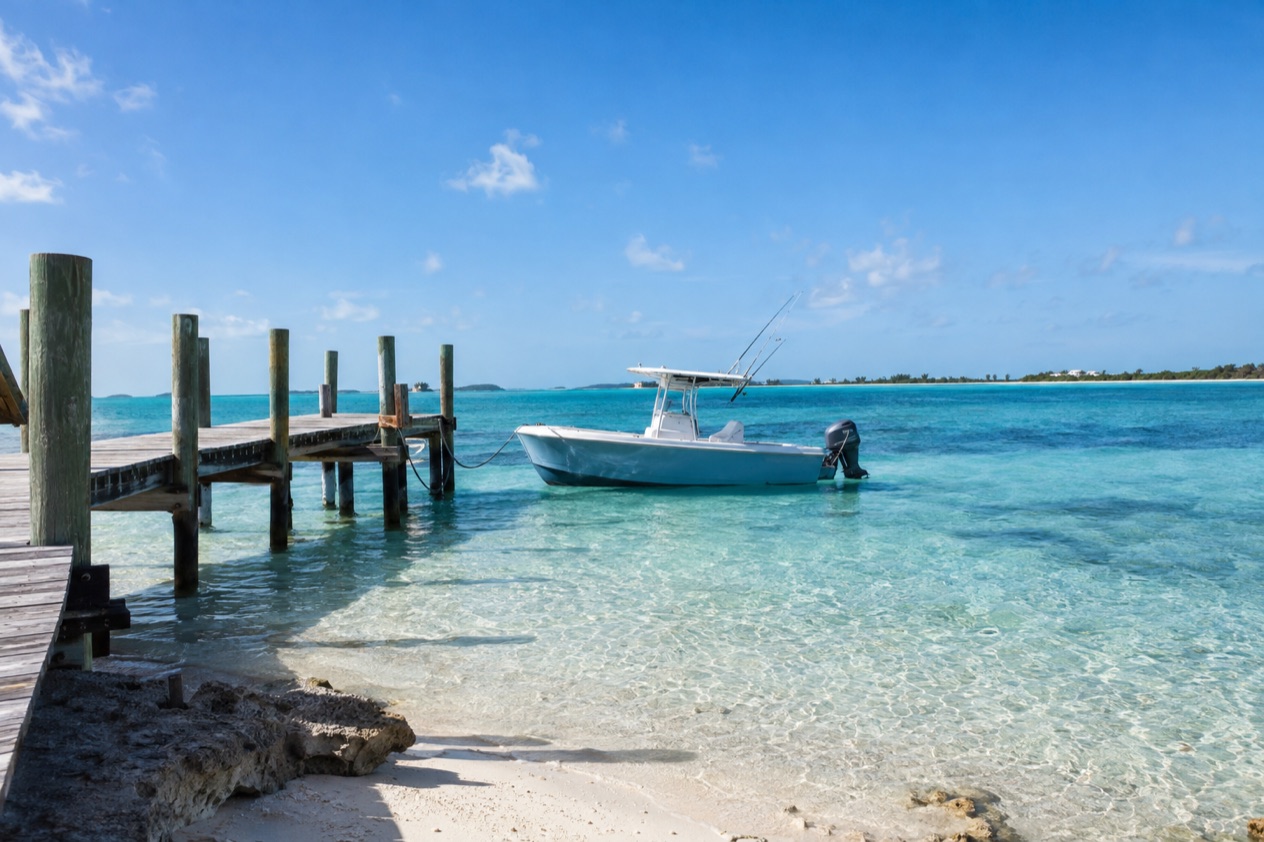
On a January morning in Alice Town, the air smells of fried conch and salt, fishing boats idle at the docks, and the low sun turns the shallow flats the color of pale jade. Nobody hurries along the King’s Highway. Winter in Bimini is a season for wreck snorkeling, bowls of fresh crawfish salad and long evenings in the island’s bars.
What is the weather like in Bimini in January?
January in Bimini is mild and sunny, with sea temperatures still in the mid-70s and days short enough that the evenings arrive early and gold.
| Month | Sea at Bimini (°F) | Daylight on the 15th (hours and minutes) |
|---|---|---|
| December | 75.4 | 10 h 35 min |
| January | 76.3 | 10 h 45 min |
| February | 76.2 | 11 h 20 min |
In Nassau, highs average about 79°F in January, with nights in the mid-60s, and that gives a fair picture of the air around the islands: warm enough for shorts at midday, cool enough for a light layer after dark. Rain is brief when it comes. Nassau sees only a handful of rainy days in the month, so a shower usually means a short pause on a porch rather than a lost day.
Mornings are the softest part of the day, with a low sun across the flats on the lee side and a breeze that keeps the docks comfortable. Afternoons are for the water or a shaded table. Daylight lasts a little under eleven hours, so sunset arrives early and the evening starts sooner than in summer.
The sea is the number to watch. It sits in the mid-70s, which is comfortable once you are in and often a little brisk on the first step. Bring a light jacket or sweatshirt for the boat rides, because wind over open water feels cooler than the air on shore.
Can you swim in Bimini in January?
Yes, the sea is warm enough for a swim, with water in the mid-70s that feels refreshing rather than cold, though a thin rash guard or shorty wetsuit will make a long snorkel more comfortable.
Bimini has the open Atlantic on its western shore and shallow, pale flats on the eastern side. Conditions change from day to day and from one stretch of shore to another, and winter winds can stir up the ocean side. Look at the water yourself before you go in, and ask locals about the spot you have in mind.
Snorkelers have a famous target in the wreck of the SS Sapona, whose top half rises out of the water while the lower half stays submerged. Pack a mask, a snorkel and a sun shirt. Sunscreen still matters in January, because the winter light reflecting off the flats is bright.
What to do in Bimini in January
January in the Bahamas is Junkanoo season at its tail end. The great parades of Boxing Day and New Year’s Day have just passed in Nassau, with their goatskin drums, cowbells, whistles and enormous paper costumes. Junkanoo is celebrated year round, so the music and the rhythms are never far away, and you may catch echoes of it in a bar or at a local gathering.
Crawfish season runs through the end of March, and January sits in the middle of it. Menus use crawfish and lobster interchangeably, so you can order crawfish salad (onions, sweet peppers, lime juice and diced lobster, served on greens or in a sandwich) or a bowl of stew lobster in brown gravy. A table by the water at sunset is the classic way to eat it.
Wreck snorkeling at the SS Sapona
The Sapona is a concrete ship built during the First World War, when steel was scarce, and it ran aground off South Bimini in a hurricane in 1926. Its upper hull still breaks the surface, and the lower half lies under water, which makes it a landmark that boats can find at once and a favorite for both divers and snorkelers.
The ship was once designed, it is said, by a famous American carmaker, and later served as a casino and a storage barge. Today it is a skeleton of rust-streaked concrete with fish swirling around it. Go on a morning with clear light, bring a snorkel and a rash guard, and look at the sea before you commit to the swim.
The Bimini Road
West of the bluff on North Bimini lie squared blocks and straight alignments of stone on the sea floor, stretching along a line about fifteen hundred feet long. Some people believe they are the remains of a road from the lost continent of Atlantis, and others see a natural formation. Either way, the story is half the fun.
It suits travelers who like a mystery and a boat ride more than a checklist. A calm morning gives the best view of the stones through the water. Bring polarized sunglasses and a camera, and keep expectations modest, because the site is a pattern in shallow water rather than a monument.
Alice Town and the King’s Highway
Alice Town is a cluster of shops, restaurants and bars along a road locals call the King’s Highway. North Bimini is only about seven miles long and a couple of hundred feet wide, so you often see the ocean on one side and the flats on the other from the same spot.
In January, the pace is slow. Walk the road in the late afternoon, when the light is long and soft, stop at a bar for a cold drink, and let a conch salad or a crawfish sandwich set the tone for the evening. Most of what is good here happens at street level, between a dock and a doorway.
A two-day itinerary for Bimini in January
Day 1 starts with a slow breakfast in Alice Town and a walk down the King’s Highway while the sun is still low and the air cool. Spend the late morning on the sand or in the shallows on the ocean side, then eat a crawfish salad or a conch sandwich at a casual spot near the docks around midday.
In the afternoon, take a boat out to the SS Sapona for a snorkel while the light is high and the water clearest. Be back before sunset, which comes early in January, and spend the evening at a dockside bar, where the day’s catch usually ends up on a plate.
Day 2 begins with a boat toward the Bimini Road on a morning when the surface is smooth, so the stones show through the water. Afterward, wander the quieter stretches of North Bimini, looking for shell-strewn beaches and the pale flats on the sheltered side.
Lunch is a bowl of stew lobster or a plate of fried fish. If rain moves in, stay in a bar or restaurant with a covered porch and let the shower pass, because the rainy spells are usually short. Finish with a last walk along the King’s Highway and dinner of grilled crawfish as the light fades.
Is Bimini busy in January?
Bimini is fairly quiet in January once the holiday weeks are over, and the island returns to its winter rhythm of fishermen, boaters and a few visitors.
The first days of the month can still feel festive, with visitors lingering after the Junkanoo celebrations of Boxing Day and New Year’s Day. After that, the pace slows. Restaurants and bars along the King’s Highway are easier to settle into, and a table by the water rarely needs much planning.
As a habit, book rooms early if your trip falls in the first days of January, when people are still on holiday, and later for the quiet weeks that follow. Because Bimini is small, with North Bimini only seven miles long, a few rooms and boats can make the difference between a smooth stay and a scramble. Arrange the boat to the Sapona or the Bimini Road once you know your dates.
What to pack for Bimini in January
Pack for warm days, cool boat rides and bright light on the water.
- A light jacket or sweatshirt, because wind over the water feels cooler than the air on shore.
- A rash guard or shorty wetsuit for longer snorkels in water in the mid-70s.
- Mask and snorkel for the SS Sapona.
- Polarized sunglasses to see the stones of the Bimini Road through the water.
- Reef-safe sunscreen, since the winter light off the flats is strong.
- A light rain shell for the short showers.
Good to know before you go
The U.S. State Department rates the Bahamas Level 2, “Exercise increased caution”, and says most crime occurs in Nassau on New Providence and in Freeport on Grand Bahama.
January falls outside the Atlantic hurricane season, which runs from June 1 to November 30. Planes land at South Bimini Airport, North Bimini Airport also receives flights, and the ferry crosses to North Bimini, where Alice Town sits.
U.S. citizens need a passport valid at least six months (passport cards are not accepted by air) and a return or onward ticket. No Bahamian visa is needed for a visit, and the Bahamas Department of Immigration may ask for proof of funds.
Bimini in January vs December and February
Moving the trip four weeks earlier brings you into the holiday season, with the Junkanoo parades fresh in Nassau and the sea a degree cooler. The days are at their shortest, so evenings arrive early, and rooms are busier around Christmas and New Year.
Moving four weeks later, the sea stays nearly the same, but the daylight stretches by half an hour or more and the island feels a little brighter. Crawfish season is still open until the end of March, so the menus hold steady.
Choose December if you want the festive mood, and February if you want longer afternoons on the water. January suits travelers who want the quiet middle, after the parades and before the spring rush.
Is January a good time to visit Bimini?
Yes, January is a good time for travelers who like slow days, warm-enough water and fresh seafood, and less so for anyone who wants a big festival or hot beach weather.
It suits snorkelers, anglers and people who like to wander a small settlement at dusk. It suits less anyone who needs hot, still water to enjoy a swim. On arrival, head to the docks, settle in with a crawfish salad and ask where the boats are going out. What is special about January in Bimini is the light: low, golden and long on the flats, with a sea still warm enough to enter and a street where the loudest sound is a radio on a porch.
Sources
- Open-Meteo Marine API, average 2015-2024, checked October 10, 2026
- sunrise-sunset.org, sunrise and sunset calculated for the 15th of the month, checked October 10, 2026
- NOAA NCEI, GHCN-Daily station BF000078073 (Nassau Airport), normals 1991-2020 computed from the daily record (https://www.ncei.noaa.gov/access/services/data/v1?dataset=daily-summaries&stations=BF000078073), checked October 10, 2026
- Bahamas Ministry of Tourism, Junkanoo (https://www.bahamas.com/events/junkanoo), checked October 10, 2026
- Wikipedia, Junkanoo (https://en.wikipedia.org/wiki/Junkanoo), checked October 10, 2026
- Bahamas Ministry of Tourism, Christmas season (https://www.bahamas.com/blog/christmas-season-officially-launched-in-the-bahamas), checked October 10, 2026
- Bahamas Ministry of Tourism, Investments & Aviation (bahamas.com), Junkanoo (https://www.bahamas.com/events/junkanoo), checked October 10, 2026
- Bahamas Ministry of Tourism, crawfish season (https://www.bahamas.com/blog/its-crawfish-season), checked October 10, 2026
- Bahamas Ministry of Tourism, Investments & Aviation (bahamas.com), Bimini (https://www.bahamas.com/islands/bimini), checked October 10, 2026
- Wikipedia, Bimini (https://en.wikipedia.org/wiki/Bimini), checked October 10, 2026
- Wikivoyage, Bimini travel guide (https://en.wikivoyage.org/wiki/Bimini), checked October 10, 2026
- Bahamas Ministry of Tourism, Investments & Aviation (bahamas.com), Sapona Shipwreck (https://www.bahamas.com/natural-wonders/sapona-shipwreck), checked October 10, 2026
- Wikipedia, Geography of the Bahamas (https://en.wikipedia.org/wiki/Geography_of_the_Bahamas), checked October 10, 2026
- Bahamas Ministry of Tourism, Investments & Aviation (bahamas.com), Island FAQ (https://www.bahamas.com/plan-your-trip/island-faq), checked October 10, 2026
- Bahamas Department of Immigration, Entry requirements (https://www.immigration.gov.bs/entry-requirements/), checked October 10, 2026
- Bahamas Department of Immigration, Before your arrival (https://www.immigration.gov.bs/entry-requirements/before-your-arrival/), checked October 10, 2026
- U.S. Department of State, The Bahamas Travel Advisory, Level 2 (https://travel.state.gov/), checked October 10, 2026
- NOAA National Hurricane Center, Climatology (https://www.nhc.noaa.gov/climo/), checked October 10, 2026
To plan your stay
- Things to Do in Bimini: Diving the SS Sapona, the Bimini Road, Alice Town and Bahamian Food
- Where to Stay in Bimini: Alice Town, the Resorts World Beachfront and South Bimini
- Bimini from Miami: Ferry from Port Everglades, Flights to South Bimini and a Day on North Bimini
- Know Before You Go to Bimini: Entry Rules, Money, Getting Around and Island Etiquette