
You step off the plane onto a flat, bright strip of South Bimini, with the smell of salt and sun-warmed asphalt around you and water showing on almost every side. The town you came for, Alice Town, is not on this island at all. A short stretch of sea lies between the airport and the bars, docks and fishing boats of North Bimini, and crossing it is the first small adventure of the trip.
How do you get from the airport to Bimini?
From the airport to Alice Town, you go by ferry across the water to North Bimini. Commercial and charter airlines land at South Bimini Airport, and visitors then ferry over to the north island, where Alice Town and most of the island’s life are found. There is no road that carries you straight from the runway to the King’s Highway, so the water crossing is simply part of arriving.
What decides how your arrival feels is mostly practical. The size of your group and the amount of luggage you carry shape how you handle the hop between the two islands, and the hour you land shapes how much daylight you have to settle in.
If you land in the afternoon, you can reach the north island with light left for a walk along the main road and a first look at the harbor. If you land later, the crossing becomes a quiet evening transition, and the town’s bars and restaurants are the reward at the other end.
It helps to know the shape of the place. Bimini is two main islands, North Bimini and South Bimini, lying about fifty miles off the Florida coast. South Bimini is a small community with a population of 182 that happens to hold the airport.
North Bimini is a long, thin island, and nearly everything a visitor comes for is strung along it. Keeping that split in mind makes the whole arrival make sense: you land on one island and sleep, eat and drink on the other.
Your options from the airport
The ferry to North Bimini
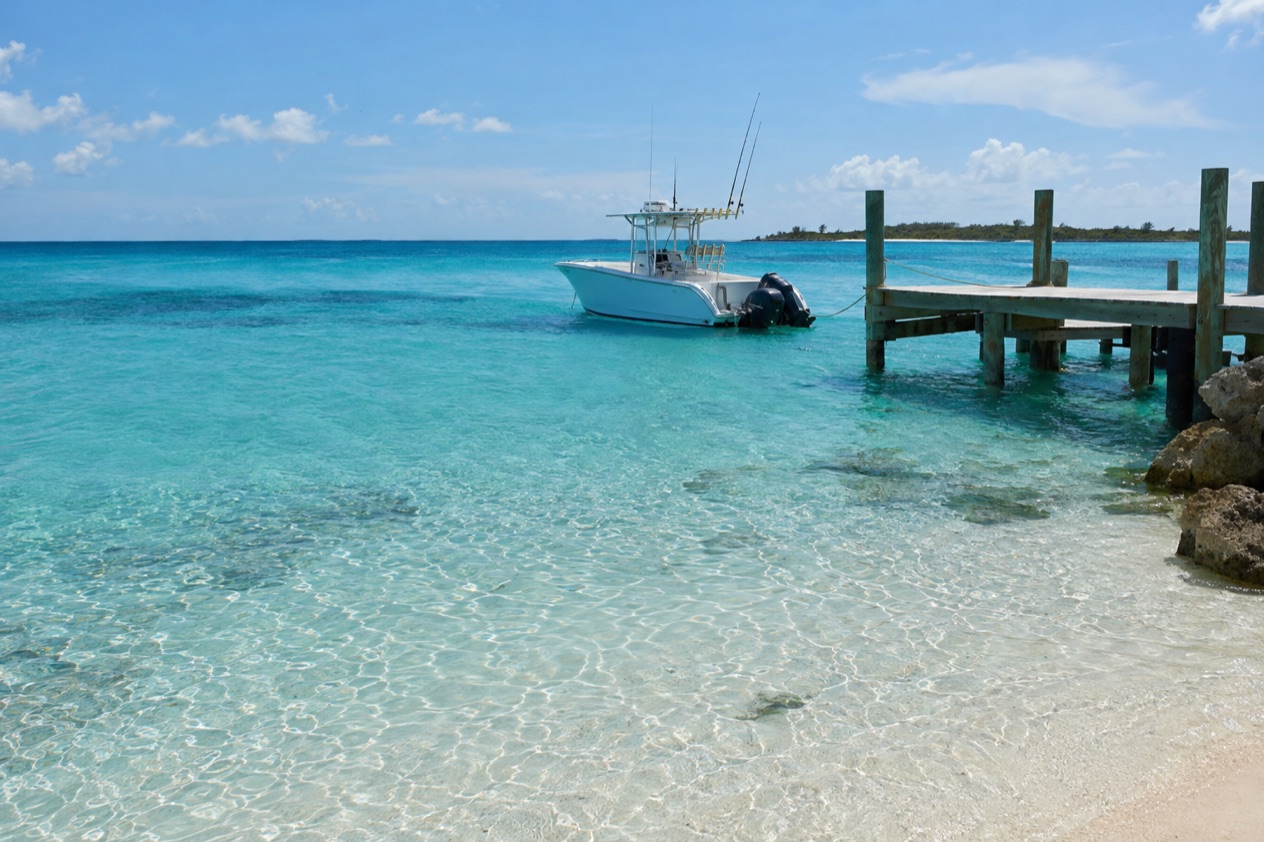
The crossing is the way visitors reach Alice Town after landing at South Bimini Airport. You leave the airport side and travel over the channel to North Bimini, so the first thing you see of the main island is its waterfront, with boats tied up and low buildings behind them. It is a short moment of travel, but it sets the tone: Bimini is a place where boats do the work that roads do elsewhere.
This way suits nearly everyone, from anglers with rod cases to couples carrying a single bag, because it is the route the island itself is built around. Keep your belongings together and close at hand, since you will be stepping on and off a boat. Once you are across, Alice Town is the main settlement on North Bimini, a cluster of shops, restaurants and bars on the road known as the King’s Highway.
Arriving at North Bimini Airport instead
Bimini is served by two airports, North Bimini Airport and South Bimini Airport, and both receive domestic flights from other Bahamian islands as well as international flights from the United States. Which one you use depends on your flight, not on your taste. If your flight lands on the north island, you are already where the town is, and the water crossing described above does not apply to you.
If your itinerary lets you choose between the two, the choice comes down to where you are staying. A stay in Alice Town fits the north island. Anyone heading to Resorts World Bimini, which sits on North Bimini and holds the island’s only casino, is also aiming for the north side, so South Bimini arrivals should plan on the same crossing.
Continuing by air to Freeport
Not every trip ends in Bimini. Flamingo Air operates flights from South Bimini Airport to Freeport, which makes the airport a stepping stone for travelers who are combining islands. If you are coming from Freeport, the same service brings you to the runway on South Bimini, where the ferry to the north island takes over.
This is a link between two islands, not a way into Alice Town, so treat it as the front or back end of a longer plan. A traveler who spends a few days fishing or diving around Bimini and then flies on has the airport at both ends of the stay, with the ferry as the connecting thread in between.
Airport transfer options compared
| Option | Starts at | Ends at | Best for |
|---|---|---|---|
| Ferry across the water | South Bimini Airport | North Bimini and Alice Town | Anyone staying in town or at the resort |
| Flight with Flamingo Air | South Bimini Airport | Freeport | Travelers continuing to another island |
| Landing at North Bimini Airport | North Bimini | Already on the island of Alice Town | Travelers whose flight is booked into the north airport |
The trade-off on Bimini is not between a dozen ways of moving, it is between two islands. Landing on South Bimini means a crossing before you reach town, which adds a step but also gives you an arrival by water that feels exactly like Bimini. Landing on the north island removes that step. Either way, the destination is the same long, narrow strip of land.
That narrowness matters once you are across. North Bimini is about seven miles long and only a couple of hundred yards wide at its narrowest, so the sea is never far from either side of the road.
Alice Town sits along that strip, which means your hotel, a dock and a place for dinner are all close to one another. Planning your arrival around the crossing, and not around a long ride, keeps the first hours simple.
A flight onward to Freeport sits in a separate category. It does not take you into Bimini, it takes you out of it, and it belongs to the end of a stay or the start of a multi-island trip.
Arriving at the airport
South Bimini Airport sits on South Bimini, very close to sea level, with a paved asphalt runway. It is a small island airport in the plainest sense, set among low scrub and water, and a long way from the glass concourses you may know from the mainland. The island that holds it has a population of 182, so the surroundings are quiet.
What happens after you land is the ferry crossing to North Bimini. Commercial and charter airlines fly into this airport, and visitors then make their way across to the north island. Beyond that, the airport is a place to collect your bags and turn toward the water, with the north island visible as the next stage of your trip.
Once you reach North Bimini, the setting changes quickly. Alice Town is the main settlement, with its shops, restaurants and bars along the King’s Highway, and the harbor is the center of daily life. Out on the water near the island lies the wreck of the SS Sapona, which ran aground in 1926 during a hurricane.
The top of the ship is exposed to the air while the lower half is underwater, and it is a popular scuba diving and snorkeling site near Bimini. You will not see it from the airport, but it is one of the reasons the water around the island draws visitors.
The resort side of the island is also on North Bimini. Resorts World Bimini occupies a 750-acre beachfront stretch of the island and has the largest marina in the Bahamas. Cruise lines dock at its pier, so on some days the north end of the island sees ship passengers as well as people who arrived by air.
Good to know before you go
The U.S. State Department rates the Bahamas Level 2, “Exercise increased caution”, and says most crime occurs in Nassau on New Providence and in Freeport on Grand Bahama.
The Atlantic hurricane season runs from June 1 to November 30, so a trip in those months falls inside it, and a flexible plan for the crossing and your days on the water is wise. Bimini is a small, flat island group, and its daily rhythm follows the sea. Plan to travel light, since you will be handling your bags between plane and boat, and keep the first evening open for the walk along the King’s Highway.
Sources
- Wikipedia, South Bimini Airport (https://en.wikipedia.org/wiki/South_Bimini_Airport), checked October 10, 2026
- Wikipedia, Resorts World Bimini (https://en.wikipedia.org/wiki/Resorts_World_Bimini), checked October 10, 2026
- Bahamas Ministry of Tourism, Investments & Aviation (bahamas.com), Bimini (https://www.bahamas.com/islands/bimini), checked October 10, 2026
- Wikipedia, Bimini (https://en.wikipedia.org/wiki/Bimini), checked October 10, 2026
- Wikivoyage, Bimini travel guide (https://en.wikivoyage.org/wiki/Bimini), checked October 10, 2026
- Great-circle distance computed from the GPS coordinates of the two places, October 10, 2026
- U.S. Department of State, The Bahamas Travel Advisory, Level 2 (https://travel.state.gov/), checked October 10, 2026
- NOAA National Hurricane Center, Climatology (https://www.nhc.noaa.gov/climo/), checked October 10, 2026
To plan your stay
- Best Time to Visit Bimini: Weather by Month, Sea Temperatures, Festivals and Crowds
- Things to Do in Bimini: Diving the SS Sapona, the Bimini Road, Alice Town and Bahamian Food
- Where to Stay in Bimini: Alice Town, the Resorts World Beachfront and South Bimini
- Know Before You Go to Bimini: Entry Rules, Money, Getting Around and Island Etiquette