
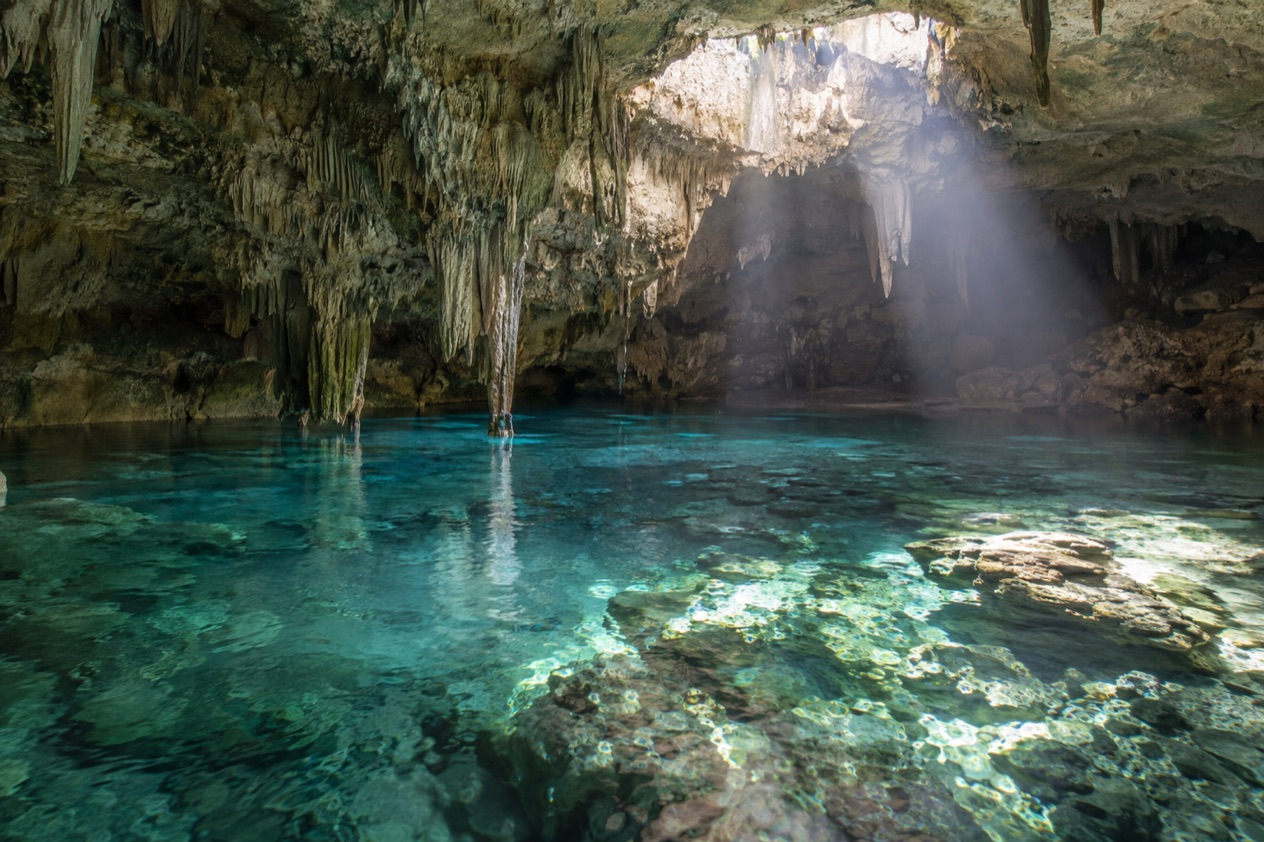
Under the pines of Grand Bahama, the ground simply opens, and a pool of dark, clear water sits in a bowl of pale limestone. Ben’s Cave is one of those places where the island’s surface gives no hint of what lies beneath. It belongs to Lucayan National Park near Freeport, and a visit here is about looking into a flooded cave world and understanding what divers find in it.
Is visiting Ben’s Cave worth it?
Yes, if you are curious about how the Bahamas looks from underneath, and above all if you are a certified diver who wants to enter one of the better-known cave systems of the islands. Non-divers get a quieter reward: a short stop at an inland blue hole, with the park’s trails and boardwalks around it.
What sets it apart from the other sights near Freeport is that it is not a beach, a market or a resort. Ben’s Cave is one of two inland blue holes inside Lucayan National Park, and two caves in the park are open to the public.
The cavern system beneath it is deemed one of the longest surveyed in the world, with passages that run horizontally for thousands of yards. You will not see most of that, but knowing it is down there changes how you look at the water.
The setting adds to the visit. You come on foot through a protected park, among trees and boardwalks, rather than stepping off a tour bus onto a stage. It suits divers, geology fans, birders and families who like a nature stop built around curiosity rather than a swim. It will not suit anyone hoping to get in the water without a dive instructor, because swimming in the caves is prohibited.
What to see at Ben’s Cave
The blue hole and its two layers of water
A blue hole is a sinkhole that formed in limestone when the rock dissolved and the ceiling of a cave gave way. Ben’s Cave is an inland one, so it is a window into a flooded cave rather than a hole in the sea. The first thing to notice is the water itself, which can look still, glassy and very clear.
That clarity has a reason. The clear upper portion is fresh water, and it floats on top of the heavier saltwater below. Where the two meet, divers find a halocline, a shimmering boundary where the water seems to blur and ripple. From the edge you are looking at the top of that arrangement, which is the part of the story anyone can see.
What divers see below
For those who dive with an authorized instructor, the cave is a gallery of stone. Visitors can see stalactites hanging from the ceiling and stalagmites rising from below, left from a time when this cave was dry and dripping before the sea rose and filled it. Fossilized conch shells and bivalves are set in the rock, a reminder that these limestone walls were once seabed.
The halocline is the moment divers talk about most, since passing through it can make your view go soft and wavy for a moment before it clears again. The passages continue for a very long way, which is why the system has the reputation it does. A dive here is a guided, controlled experience, not a freelance one.
Why it carries Ben’s name
The cave is named for Ben Rose, a legend of UNEXSO, the Grand Bahama diving operation whose name is known to divers well beyond the island. Cave names in the Bahamas often honor the people who explored and mapped them, and this one keeps a link to the island’s diving history alive. It gives the stop a human story to go with the geology.
The park around the cave
Ben’s Cave sits in Lucayan National Park, which covers 40 acres and is described as the star of the island’s three parks. Nature trails and boardwalks lead to a variety of ecosystems, so the walk is as much a part of the visit as the cave itself. Picnic tables are set on the beach in the park, a pleasant place to sit after the trails.
The park also incorporates one of the largest underwater cave systems in the world, which explains the attention it gets from divers. Expect pine and coppice, shaded paths and the feel of the island’s quieter interior, a side of Grand Bahama that cruise ports and resort strips do not show.
Hours, tickets and rules
The rules at Ben’s Cave are simple to state, and most of them concern the water. Looking is welcome. Getting into the water is not, unless you are diving under the right conditions. For questions about the cave or the park, the local number is (242) 352-5438, which is also the contact for inquiries about Lucayan National Park, where Mrs. Cecilia Bodie is named as the person to ask.
Swimming in the caves at Lucayan National Park is prohibited, and that applies to Ben’s Cave as well as the other cave open to the public. Diving is a separate matter. To dive at Ben’s Cave you must be accompanied by an authorized dive instructor, and that is arranged before the dive date rather than on the day. A special permit is also required for diving at Lucayan National Park.
In practice this means a dive is something you plan ahead through the contact above, not something you decide at the water’s edge. Anyone who is not diving comes to look at the cave, walk the trails and boardwalks and enjoy the park. The two kinds of visit are quite different, and it helps to know which one you are making before you set out.
How to get to Ben’s Cave
Ben’s Cave is on Grand Bahama Island, near the City of Freeport, inside Lucayan National Park. Freeport is therefore your base for the visit, and the cave is reached through the park rather than from a separate entrance of its own. If you are staying elsewhere on the island, think of Freeport as the reference point when you plan the day.
The park is on the same island as Freeport, so you do not need a boat or a flight to reach it from there. Beyond that, the specific route, the way you travel and how long it takes are best settled when you speak to the park contact. The number to call is (242) 352-5438, and it is the same one given for both the cave and the park.
If you are arriving on Grand Bahama only for the day, a visit to Ben’s Cave is something you build into a plan around Freeport, not a stop you squeeze in without thinking. Because divers must have an instructor arranged ahead, anyone coming for a dive should set that up first and then fit the travel around it. Walkers and families can be more flexible, since looking at the cave and the trails does not involve that arrangement.
When to visit Ben’s Cave
Choose a time of day when you want to be outdoors under the trees. Morning light tends to slant nicely through the pines and onto the pale rock around a blue hole, and it is the kind of hour when a walk on a boardwalk feels pleasant rather than tiring. Midday in the Bahamas can be bright and warm, so a shaded park is welcome then too, but plan to pace yourself.
For the water itself, light matters. A blue hole looks its clearest and most striking when the sun is high enough to reach into it, so a bright day suits a quick look into the cave. If you are diving, the schedule is set by the instructor you arrange ahead of time, so the time of day follows that plan.
On the calendar, the Atlantic hurricane season runs from June 1 to November 30, which covers the early autumn weeks. The rest of the year falls outside the official season, and that is when many travelers prefer to plan an island trip with fewer weather unknowns. Grand Bahama is a place to watch forecasts if you travel in the season, and a day outdoors in a park is always the kind of plan that follows the sky.
There is no festival or special date tied to the cave itself. Its appeal is steady across the year, which makes it an easy addition to almost any stay near Freeport, whether you arrive for diving or simply want a morning among the trees.
Tips for your visit
Think of the visit as a nature walk with a highlight. Wear shoes that suit trails and boardwalks, bring water for yourself, and carry a camera, since the clear surface and the pale rock make a good picture. Because swimming in the caves is prohibited, a swimsuit is not needed for the cave itself, though you may want one for other parts of your day on the island.
Plan the visit around the park rather than the cave alone. The nature trails and boardwalks lead to a variety of ecosystems, and picnic tables on the beach give you somewhere to sit and eat. Packing a lunch turns the stop into a relaxed half day among trees, sand and rock, which is the spirit of the place.
If you want to dive, begin with the phone call. You must be accompanied by an authorized dive instructor arranged prior to the dive date, and a special permit is required at the park. Divers will see stalactites, stalagmites, the halocline and fossilized conch shells and bivalves, so bring the patience to take it slowly and look closely.
Families will find the trails and the beach more approachable than the cave itself, and children can enjoy looking down into the water and hearing how fresh water floats on salt. For mobility, the park’s boardwalks are part of the design, but the contact number is the place to ask about the exact paths before you set out. Combine the visit with the rest of Lucayan National Park, and with Freeport for lunch or a rest afterward.
Good to know before you go
The U.S. State Department rates the Bahamas Level 2, “Exercise increased caution”, and says most crime occurs in Nassau on New Providence and in Freeport on Grand Bahama.
Ben’s Cave is a protected natural site, so the best way to enjoy it is to follow the park’s rules, keep out of the water unless you are diving with an authorized instructor, and leave the rock and plants as you found them. Grand Bahama is a foreign country for American visitors, with its own currency, the Bahamian dollar, so carry a little for small purchases.
During the hurricane season, which runs from June 1 to November 30, keep an eye on the forecast as you would anywhere on the islands. The park contact, (242) 352-5438, is the one to use for any question about the cave.
Sources
- Bahamas Ministry of Tourism, Investments & Aviation (bahamas.com), Bens Cave (https://www.bahamas.com/natural-wonders/bens-cave), checked October 10, 2026
- Bahamas Ministry of Tourism, Investments & Aviation (bahamas.com), Lucayan National Park (https://www.bahamas.com/natural-wonders/lucayan-national-park), checked October 10, 2026
- U.S. Department of State, The Bahamas Travel Advisory, Level 2 (https://travel.state.gov/), checked October 10, 2026
- NOAA National Hurricane Center, Climatology (https://www.nhc.noaa.gov/climo/), checked October 10, 2026
To plan your stay
- Best Time to Visit the Bahamas: Weather, Hurricane Season, Sea Temperatures and Junkanoo
- Where to Stay in the Bahamas: Best Islands, Resorts, Boutique Stays and How to Choose
- Getting Around the Bahamas: Flights, Ferries, Mailboats and Taxis in Nassau
- Know Before You Go to the Bahamas: Entry Rules, Money, Getting Around and Local Customs