
Early in the morning at the dock in Nassau, passengers with duffel bags and coolers line up at a check-in desk while the harbor wakes up around them. The boat they are waiting for is a high-speed passenger ferry bound for two of Eleuthera’s best-loved small islands. Bahamas Ferries runs that passenger service to Spanish Wells and Harbour Island, and the rest of its fleet carries freight.
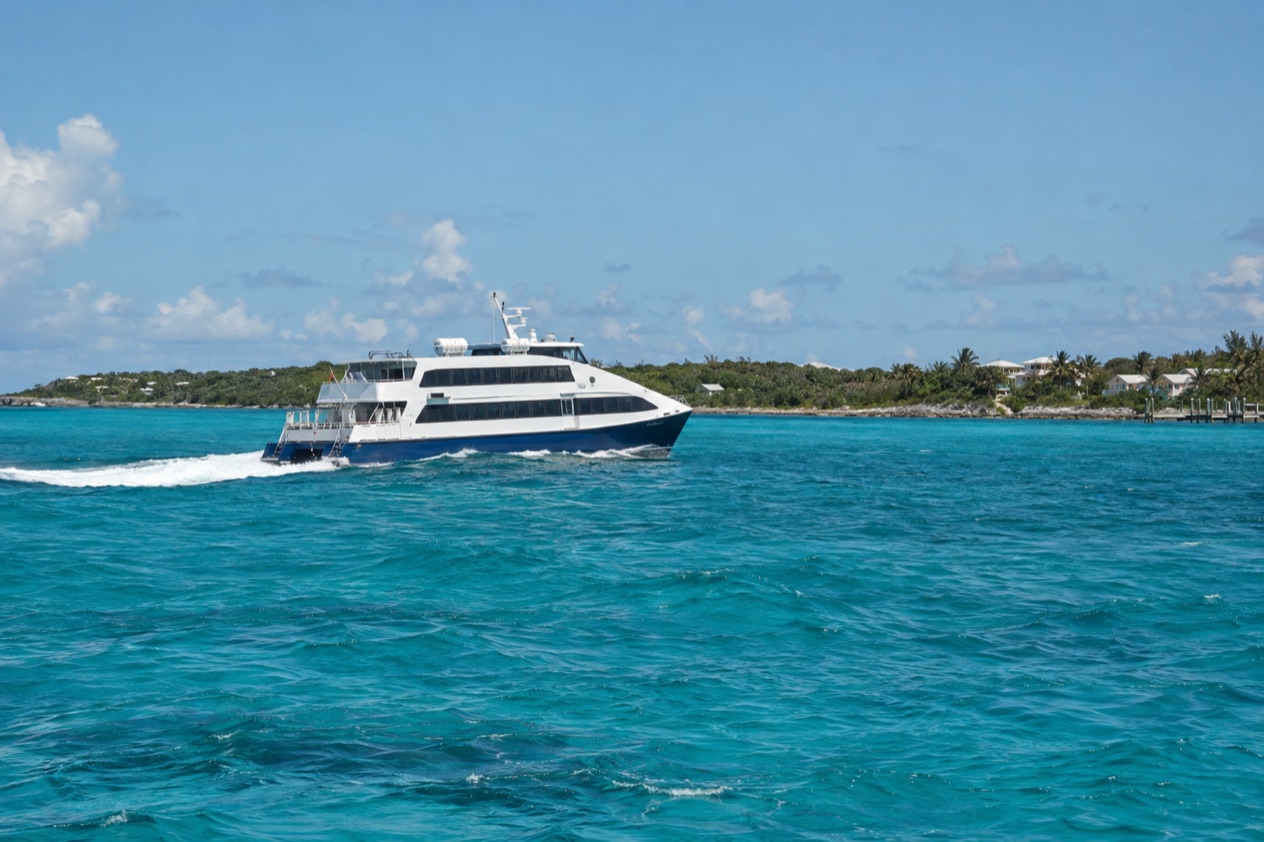
How do the Bahamas ferries work?
The passenger ferries work on a fixed weekly rhythm: one high-speed boat leaves Nassau on three set days, makes two stops, and comes back the same afternoon. The M/V Bo Hengy III sails from Nassau to Spanish Wells and Harbour Island on Wednesdays, Fridays and Saturdays. Check-in opens early on those mornings and the boat leaves Nassau at 8:00 a.m.
Because the service is built around a single morning departure, a trip from Nassau is planned around that boat. You arrive at the dock with your bags, check in, and board. The same boat turns around at Harbour Island in the afternoon, so a day out and back is possible on the days it runs, and an overnight or longer stay simply means returning on a later sailing day.
Tickets, payment and the round-trip fare
An adult round trip between Nassau and either Spanish Wells or Harbour Island costs $257.00, VAT included. Bahamas Ferries accepts same-day ticket purchases if seats are available, with check-in one hour before sailing, though advance bookings are recommended at least two days ahead.
The company is cashless. It takes all forms of credit and debit cards, wire transfers and company checks, and full payment is required to process a booking.
A group of 20 or more traveling round trip together can get a discount with a week’s advance booking, but not during black-out periods (holidays and regattas), and not on vehicles. A party of six heading to Eleuthera can ask about a charter by emailing [email protected].
Luggage, coolers and dogs
Each paying passenger may bring one small carry-on that fits under the seat and two checked pieces free of charge, each up to 45 pounds, with restrictions applied. Extra pieces start at $13 each. Oversize luggage, or luggage paid for at the vessel, starts at $26 per piece, and items must be properly packaged for shipping.
Coolers over 48 quarts count as oversize luggage and must go as freight, which matters for anyone loading up on groceries and drinks for a rental house on the island. Dogs may travel on the outside deck, in a kennel or on a leash, with costs starting at $19.00 depending on the dog’s size. Dogs sent as freight cannot be serviced to Freeport.
| Sailing | Time |
|---|---|
| Check-in, Nassau (departure days) | 6:45 a.m. to 7:45 a.m. |
| Departs Nassau | 8:00 a.m. |
| Arrives Spanish Wells | 10:10 a.m. |
| Arrives Harbour Island | 11:10 a.m. |
| Departs Harbour Island (return) | 3:40 p.m. |
| Arrives Nassau (return) | 6:30 p.m. |
Which routes do the ferries run?
Bahamas Ferries carries passengers on one route, Nassau to Spanish Wells and then Harbour Island, and carries freight to a wider list of ports. That passenger route links New Providence with two of the small, pastel-painted communities off the northern tip of Eleuthera.
Nassau, Spanish Wells and Harbour Island
The boat reaches Spanish Wells at 10:10 a.m. and continues to Harbour Island, where it arrives at 11:10 a.m. Spanish Wells is a fishing community, and Harbour Island is known for Dunmore Town, its lanes of clapboard cottages and its long beach. Both stops come in the late morning, which leaves the middle of the day for a walk, a lunch of fresh conch or grilled fish, and a look around.
On the way back the ferry leaves Harbour Island at 3:40 p.m. and reaches Nassau at 6:30 p.m. A traveler staying only for the day has a few hours ashore before the afternoon sailing, and anyone staying longer builds the stay around the next departure day.
Freight ports and the wider network
Freight services run to eight destinations: Harbour Island, Spanish Wells, Three Island Dock, Rock Sound, Marsh Harbour, Freeport, George Town and Nassau. In all, the company serves the islands of Abaco, Eleuthera, Exuma, Grand Bahama and New Providence. It ships small boxes, pallets, vehicles, containers and heavy equipment, including commercial and industrial freight, and keeps a logistics network in the Family Islands.
Those are cargo routes, so the list reads as the supply lines that keep the islands stocked rather than as passenger sailings. Passenger service is limited to Harbour Island and Spanish Wells.
Other boats around the islands
Ferries and water taxis turn up across the Bahamas, especially between New Providence and the Out Islands. Short hops connect Downtown Nassau to Paradise Island, Great Abaco to its nearby cays, and Acklins, Crooked Island and Long Cay. At Bimini, boats link South Bimini Airport to the resort town of North Bimini, and the Exumas have water taxi services of their own.
Farther afield, Baleària, which operates in the United States as Baleària Caribbean, runs regular international ferry services from Fort Lauderdale, Florida, to Freeport on Grand Bahama and to Bimini. Its ferry Jaume II is operated under Baleària Caribbean.
What does the fleet look like?
The fleet is a mix of fast passenger boats and heavy cargo carriers: Bahamas Ferries Ltd. operates 7 vessels for passengers and cargo. Only some of them carry people, and the passenger boats are built for speed over open water between islands.
The passenger ferries
The Bo Hengy III is the boat on the Nassau to Spanish Wells and Harbour Island run. It makes 23 knots and holds 130 passengers. Two larger fast ferries, the Happy Hour and the Lady Daisy, both make 24 knots, with room for 300 and 290 passengers respectively.
The Sea Link is a ro-ro passenger ferry, meaning vehicles roll on and off. It holds 250 passengers, 14 TEU, and has 6426 square feet of deck area and a draft of 5 feet. That shallow draft suits the small harbors of the islands.
The cargo vessels
The ro-ro cargo ships do the heavy lifting for island supply. The East Wind carries 23 TEU and 11 FEU and 290 long tons of cargo, with 5200 square feet of deck area and a draft of 7 feet. The Grand Master II takes 28 TEU, 13 FEU and 360 long tons, with 6300 square feet of deck and a draft of 7.5 feet.
The Inagua Spray is the odd one out, with room for 24 passengers alongside 17 TEU, 36 FEU and 120 long tons of cargo. Its deck area is 9500 square feet and its draft 9 feet. The company’s own description of its working fleet names the Bo Hengy III for passengers and Eastwind, Inagua Spray and Grand Master for freight.
| Vessel | Type | Passengers | Speed (knots) |
|---|---|---|---|
| Bo Hengy III | Passenger ferry | 130 | 23 |
| Happy Hour | Passenger ferry | 300 | 24 |
| Lady Daisy | Passenger ferry | 290 | 24 |
| Sea Link | Ro-ro/passenger ferry | 250 | Not shown |
| Inagua Spray | Ro-ro vessel | 24 | Not shown |
Good to know before you go
The U.S. State Department rates the Bahamas Level 2, “Exercise increased caution”, and says most crime occurs in Nassau on New Providence and in Freeport on Grand Bahama.
Payment is by card or transfer only, so there is no counter for cash. Drivers in the Bahamas keep to the left, which is worth remembering once you step off the boat onto an island road. Licensed jitneys on New Providence run on posted routes with a number on the vehicle, and rides range from $1 to $3.
Anyone arriving in the Bahamas by private boat must clear customs at a specified port of entry, and Harbour Island and Spanish Wells are both on that list. The Atlantic hurricane season runs from June 1 to November 30, which covers the weeks around this writing.
Sources
- Bahamas Ferries, Your travel (https://bahamasferries.com/your-travel/), checked October 10, 2026
- Bahamas Ferries, FAQ (https://bahamasferries.com/faq/), checked October 10, 2026
- Bahamas Ferries, Our fleet (https://bahamasferries.com/about-us/our-fleet/), checked October 10, 2026
- Bahamas Ferries, Our company (https://bahamasferries.com/about-us/our-company/), checked October 10, 2026
- Wikipedia, Baleària (https://en.wikipedia.org/wiki/Baleària), checked October 10, 2026
- Wikipedia, Transport in the Bahamas (https://en.wikipedia.org/wiki/Transport_in_the_Bahamas), checked October 10, 2026
- U.S. Department of State, The Bahamas Travel Advisory, Level 2 (https://travel.state.gov/), checked October 10, 2026
- NOAA National Hurricane Center, Climatology (https://www.nhc.noaa.gov/climo/), checked October 10, 2026
To plan your stay
- Best Time to Visit the Bahamas: Weather, Hurricane Season, Sea Temperatures and Junkanoo
- Where to Stay in the Bahamas: Best Islands, Resorts, Boutique Stays and How to Choose
- Getting Around the Bahamas: Flights, Ferries, Mailboats and Taxis in Nassau
- Know Before You Go to the Bahamas: Entry Rules, Money, Getting Around and Local Customs