
You land in Aruba, switch your phone off airplane mode, and wonder whether the screen has jumped an hour on you. It depends on the season, and the answer is simple once you know the pattern. The island keeps the same time all year, and that steadiness shapes how you plan flights home, calls to family and the evening at the water’s edge.
What time zone is Aruba in?
Aruba is on Atlantic Standard Time, usually shortened to AST, and it stays there every day of the year. The island sits in the southern Caribbean Sea, well below the main hurricane-minded stretch of the chain and just above South America, so its clocks follow the Atlantic zone rather than the Eastern one you may be used to at home.
For a traveler from the East Coast, the useful part is the comparison with New York. The gap is not fixed, because New York moves its clocks and Aruba does not. That is the whole story, and it means you can just feel the time difference for yourself.
| Season | Aruba compared with New York |
|---|---|
| Summer months | Same time as New York |
| Winter | One hour ahead of New York |
Working out the difference from home
If you live in the Eastern time zone, the arithmetic is easy to hold in your head. In the summer months you do not touch your watch at all, and a text sent at noon from Aruba lands at noon in New York. In winter, add one hour to your home time to get the island’s time, so dinner at seven in Aruba is six at home.
Readers in other parts of the country should remember that the gap shifts with the seasons whenever your own region follows daylight saving time. A traveler from Chicago or Denver will find the difference larger than a New Yorker does, and it will change twice a year even though Aruba itself never does. Count from the Eastern comparison and add the hours between your zone and New York.
Why it matters on a vacation
A fixed island clock makes the practical side calmer. A sunset sail, a dinner reservation or a morning at the beach sits at the same hour on the clock whenever you arrive, and the island does not ask you to adjust mid-trip. The only moving part is your own phone, which usually updates by itself once it finds the local network.
It also helps when you speak with people back home. Sunday evening calls to children or grandparents are easy to schedule when you know whether you are level with New York or an hour ahead. Papiamento and Dutch are the island’s languages, with English and Spanish widely spoken, so the person at the front desk can confirm the local hour in whichever language you prefer.
Does Aruba change its clocks?
No, Aruba does not change its clocks, because there is no daylight saving time on the island. The time stays consistent all year, so there is no spring-forward weekend and no autumn night with an extra hour.
This is the reason the gap with the mainland United States moves around. It is not Aruba that shifts, it is your own region. When the States move their clocks forward in spring, New York catches up with the island. When they fall back in the autumn, Aruba pulls one hour ahead again and stays there through the winter.
What the clock change means for your trip
If your vacation straddles the weekend when the United States changes its clocks, you will notice it at home rather than on the island. Your phone may adjust itself overnight, and your friends at home will suddenly be an hour closer or further away. Aruba itself carries on as if nothing happened, so a tour, a dinner or a sail keeps the same time on the clock.
A good habit is to set a second clock on your phone for your home city before you leave. That way you see both times side by side and never have to do the sum while standing on the sand. It is a small thing, but it saves the odd mistaken call at dawn.
Flights, calls and the morning after you land
Because the offset from the East Coast is at most one hour, jet lag is not a factor. You can fly in, walk to the water and keep your normal sleep rhythm without any adjustment. Travelers from farther west feel more of a difference, but the island is still much closer to American time than a trip across the Atlantic would be.
When you read a flight itinerary, remember that departure and arrival times are given in local time at each end. A return leg that leaves Aruba in the afternoon will show a home arrival time that already accounts for the difference, so you do not need to add or subtract anything yourself. The only thing to keep straight is your own alarm on the morning you leave.
Because the island’s clock never moves, a printed schedule for a tour or a restaurant stays accurate whatever month you visit. The only variable is how many hours of daylight you have, and Aruba stays on the same clock all year.
What time is sunrise and sunset in Aruba?
Sunrise in Aruba usually happens between about 6:30 and 7:00 in the morning, and sunset comes earlier in the winter and later in the summer. Since the island sits at roughly 12.5 degrees north of the equator, the days never swing wildly, but you do feel the difference between a December evening and a July one.
| Moment | What to expect |
|---|---|
| Sunrise | Usually between about 6:30 am and 7:00 am |
| Sunset, December to March | Slightly earlier, with shorter daylight hours |
| Sunset, June to September | Later in the evening, with extended daylight |
Mornings: sunrise and the early hours
The east side of the island is where the day begins. San Nicolas, in the south, is nicknamed the Sunrise City, a fitting name for a town whose streets and murals catch the first light. The windward coast to the east is rougher and wilder than the resort side, so it makes a striking place to watch the sky change color.
Active visitors can head out for an early morning run and enjoy the sunrise while exploring the island. The trade winds keep temperatures comfortable, and the weather is warm and dry year-round, so you rarely need to plan around a downpour. Because the sun is up by seven at the latest, you have a long morning before the heat builds.
Evenings: where to watch the sunset
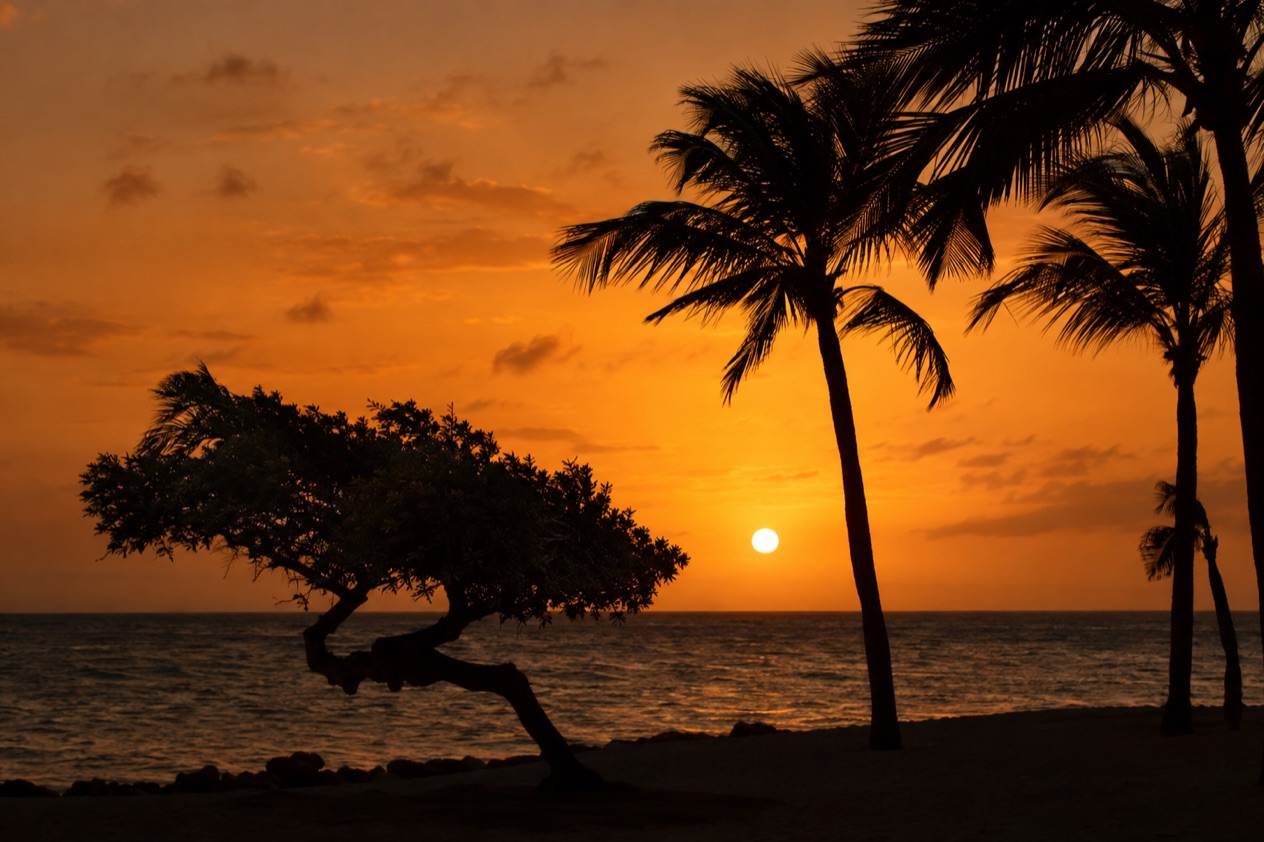
The leeward coast faces west, so the resort beaches are where the sunset belongs. A stroll along Eagle Beach or Palm Beach just before dusk lets you enjoy the last rays on soft, powdery sand, and the light is easy on the eyes for photographs. Walk down a little early so you are settled when the sky starts to turn.
A beachfront dinner at one of the island’s renowned seafood restaurants is another natural way to spend the hour, since the table doubles as a front-row seat. A sunset sail is a fun way to explore the island from the water and enjoy a Caribbean sunset at the same time. Pair either one with a late afternoon swim or a slow walk and the evening plans itself.
Planning a day around the light
In winter, from December to March, plan your outdoor activities a little earlier, because the light fades sooner and the evening comes on faster. Save long walks, drives around the island and photo stops for the morning and early afternoon, and keep the last hour of light for the beach.
From June to September the longer evenings stretch the day. You can fit in a late swim, an unhurried dinner and still catch the sky changing color. Whatever the month, the pattern is gentle: an early sunrise, a warm middle of the day and an evening that invites you to the water.
Good to know before you go
The U.S. State Department rates Aruba Level 1, ‘Exercise normal precautions,’ and says Aruba is generally a safe destination for travelers, with petty crime the main concern in popular tourist areas.
The island’s clock never changes, but the gap with home does, so a second clock on your phone is the simplest way to stay oriented. The island is part of the Kingdom of the Netherlands, with Oranjestad as its capital, and the weather stays warm and dry year-round with steady trade winds. Keep an eye on the usual petty-crime concerns in busy tourist areas, as you would anywhere, and enjoy the long golden evenings.
Sources
- Aruba Tourism Authority, Time zone (https://www.aruba.com/us/our-island/island-facts/aruba-time-zone), checked October 9, 2026
- Aruba Tourism Authority, Sunset and sunrise (https://www.aruba.com/us/our-island/island-facts/aruba-sunset-and-sunrise-time), checked October 9, 2026
- Aruba Tourism Authority, Where is Aruba (https://www.aruba.com/us/our-island/island-facts/where-is-aruba), checked October 9, 2026
- U.S. Department of State, Aruba Travel Advisory, Level 1, issued August 19, 2026 (https://travel.state.gov/content/tsg_aem/us/en/home/international-travel/travel-advisories/destination.abw.html), checked October 9, 2026
To plan your stay
- Best Time to Visit Aruba: Weather by Month, Peak Season and Festivals
- Where to Stay in Aruba: Palm Beach, Eagle Beach, Oranjestad and All-Inclusives
- Aruba Airport (AUA): Arrival, Getting to Your Hotel, U.S. Preclearance and Departure
- Know Before You Go to Aruba: Entry Forms, Money, Water and Local Customs