
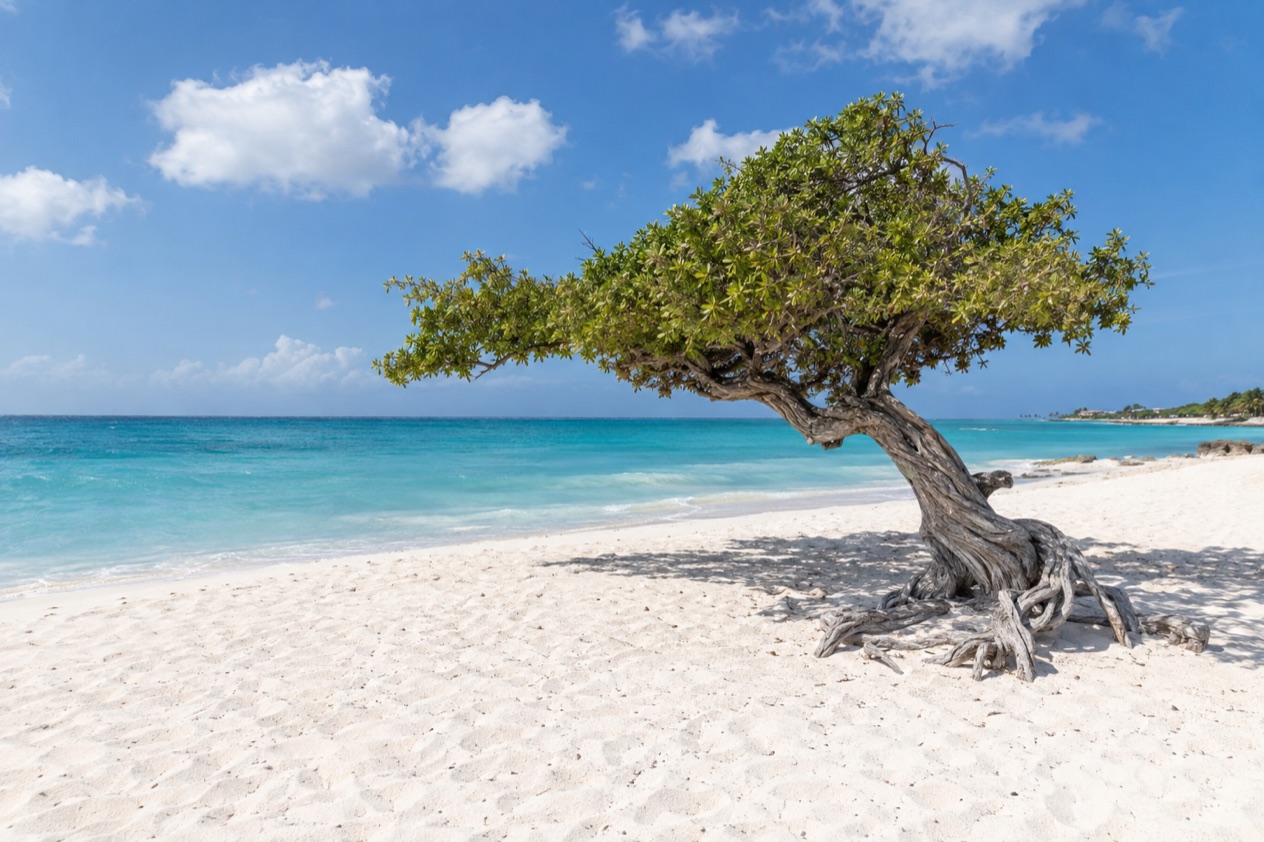
Late in the afternoon in September, the trade wind combs through the leaning fofoti trees on Eagle Beach while the sea glows an almost bathwater green and the last pastechi (a fried turnover, usually stuffed with cheese or meat) come out of the kitchens in Oranjestad. The air is hot, the water is hotter, and the island has the loosened, unhurried feel of a place between its busy seasons. September in Aruba suits beach lovers, snorkelers and anyone who likes a quieter island, with the resort strip, the wild north coast and the southern coves all within reach.
What is the weather like in Aruba in September?
September is hot, sunny and mostly dry on every coast, with the east wind always blowing and the sea warm enough that getting in feels like stepping into a pool. Showers come in short bursts rather than gray days, and the sun is back within the hour.
| Place | Region | Average high (°F) | Average low (°F) | Rain (in) | Rain days | Sea (°F) |
|---|---|---|---|---|---|---|
| Oranjestad (airport station) | Leeward coast, southwest | 91.8 | 81.1 | 1.69 | 3.3 | 85.3 |
September in Aruba feels like one warm, steady embrace from shore to shore. What changes from coast to coast is the wind and the water rather than the temperature.
The leeward side, with Palm Beach in the Noord district, Eagle Beach and Oranjestad, takes the trade wind more gently and holds the resort beaches. Off Palm Beach the sea sits at 85.6°F, and off San Nicolas, at the southern end, it reads 85.4°F. These are daily highs of the water, so a first morning dip can feel a shade cooler.
The windward north and east coasts face the wind head on and are rough and wild, so September there means crashing surf, bare rock and a steady breeze that keeps the heat bearable. The wind averages 15 mph at the airport.
Afternoons are the hottest part of the day, and the breeze is the reason a walk along the shore remains pleasant. Mid-September days last a little over twelve hours, which gives you a full morning at the beach and an evening that stays warm well after sunset.
Where to go in Aruba in September
The leeward coast: Palm Beach, Eagle Beach and Oranjestad
This is where the resort beaches line up, and in September it is the natural base. Palm Beach is the strip of resorts in Noord, with restaurants and beach bars a few steps from the sand.
Eagle Beach, a little south, is wider and more open, with the fofoti trees that lean in the wind and give the island its best-known photograph. Mornings are bright and still, and the breeze picks up through the afternoon.
Oranjestad, the capital, is the place for a change of pace. The harbor front has pastel Dutch colonial facades, shopping streets and cafés, and you can fill a morning wandering between them.
When one of the occasional showers passes, a café or a shop gives you shelter and the sun is usually back by the time you finish your coffee. Mind the afternoon heat on the street and keep the walking for the morning or the evening.
The windward coast and Arikok National Park
The north and east of Aruba are a different island from the beaches: rocky, windswept and wild. Arikok National Park covers a large part of this side, a landscape of cacti, dry scrub and rugged shoreline that looks more like desert than Caribbean postcard. On the north coast, the ruins of the Bushiribana gold smelter stand above the surf, a stop for anyone who likes history with a view.
In the middle of the island, the rounded hill of Hooiberg rises above the flat land and is a landmark you will keep spotting from the road. The windward coast is rough, so September visits here are about looking, photographing and walking along the shore rather than lingering in the water. Heat builds quickly away from the sea, so these outings belong to the early part of the day.
The south: Savaneta, San Nicolas and Baby Beach
The southern end of the island has a quieter, more local rhythm. San Nicolas, the old refinery town, is known today for its murals, and a walk through its streets is a way to see the island’s street art and everyday life far from the resort strip. Savaneta, the fishing village on the way, has a working-harbor feel and plates of fresh fish.
Baby Beach, in the south near San Nicolas, is one of the beaches the island is known for among snorkelers. September’s warm sea suits a long afternoon here, and the beach is a good way to end a day in the south after the murals and a late lunch. At the far northwest tip, the California Lighthouse offers a different sort of outing, with open views at the end of the island.
What to do in Aruba in September
September has no single headline festival to plan around, and that is part of its appeal: the days are for the water, the table and the landscape. The warm sea is the star of the month, and the island’s clear water is made for looking down.
Snorkeling and the Antilla wreck
The clear water lets snorkelers and divers explore reefs and wrecks, and the sea is warm all year, with September among its warmest stretches. Malmok Beach, Boca Catalina, Mangel Halto and Baby Beach are among the best beaches for snorkeling, each with its own character, from sheltered coves to open shoreline.
Snorkel tours stop at the Antilla, the World War II shipwreck that lies off the northwest coast and is one of the island’s famous sites. Boat outings put you on the water in the morning, when the breeze is gentler, and the wreck is the highlight for those who want a story with their swim. Pair it with an afternoon on Palm Beach or Eagle Beach to dry off.
Eating the island’s food
Aruban cooking is a blend of Amerindian, European, African and Asian influences, and September is a good month to taste it. The first people on the island, the Caquetio, ate fresh fish and conch, and both are still on menus today. Look for keshi yena, a baked cheese shell stuffed with spiced meat, and for pastechi at breakfast or as a snack.
Papiamento, the island’s language, gives the menus their names, and servers are happy to explain a dish if you ask. Fish in Savaneta, a long lunch in Oranjestad and a dinner on the Palm Beach strip give three very different tables in a single week. After a hot day, evenings are warm enough to eat outside.
Driving the wild side and the murals
A day on the windward side is the counterpart to the beach days. Arikok National Park, the ruins at Bushiribana and the surf-battered coast give you the island’s dramatic face, and in the middle Hooiberg rises as a landmark. In San Nicolas, the mural tour turns a former refinery town into an open-air gallery.
Plan the outdoor stops for the morning, while the sun is lower, and keep the afternoon for the sea or a shaded table. With only a few rain days in the month, a shower is more a pause than a ruined plan.
Is Aruba busy in September?
No, September falls in the off-season, which on Aruba runs from September to November, so the island is calmer than in its winter peak. The peak season stretches from December to April, and September sits at the opposite end of that rhythm.
That shows up as a more relaxed pace. The beaches of Palm Beach and Eagle Beach have more space, restaurants are easier to settle into, and the harbor front in Oranjestad feels like a town rather than a crowd. Over 20 public beaches and coves, all of them public, share the shoreline, so there is always a place to spread a towel.
The resort strip remains the liveliest corner, with evenings of music and open-air dining. The south, around Savaneta and San Nicolas, keeps its everyday local rhythm in every season, and the windward coast is the quietest of all, mostly wind, rock and sea. If you like the sense of having a place to yourself, September rewards a trip to the less visited corners.
Because the month is quieter, it suits travelers who prefer an unhurried pace over a social buzz. Those looking for the full energy of the high season, with its crowded beach bars and packed calendars, will find September gentler.
What to pack for Aruba in September
Packing for September is about heat and wind more than variety: the days are hot on every coast, so light clothing carries the trip, with a little extra for the windward side, where the breeze is stronger and the coast is rougher. Evenings stay warm, so you rarely need more than a light layer.
- Light, breathable clothes for hot days, in cotton or linen, that dry fast in the wind.
- Swimsuits and a cover-up, since the sea is warm and you will likely spend much of the day near it.
- A mask and snorkel if you like to bring your own, for the reefs and coves the island is known for.
- A light rain jacket or a compact umbrella for the occasional short shower.
- Sun protection: a hat, sunglasses and sunscreen for strong sun and open, windy beaches.
- Sturdy shoes for the rocky windward coast and the trails of Arikok National Park.
Good to know before you go
The U.S. State Department rates Aruba Level 1, ‘Exercise normal precautions,’ and says Aruba is generally a safe destination for travelers, with petty crime the main concern in popular tourist areas.
September falls inside the hurricane season, which runs from June 1 to November 30. Tropical storms passing in the Caribbean can bring more rain, gusty winds, a total lack of wind or a hotter feeling to the air, so keep an eye on the forecast as you plan.
For entry, U.S. citizens do not need a visa. You need a passport valid for the whole of your stay, a completed Aruba ED Card (Embarkation and Disembarkation Card) within 7 days before travel, proof that you can return to your country of departure or continue through another country, and enough money to cover your stay.
Is September a good time to visit Aruba?
Yes, September is a good month for travelers who want warm water, quiet beaches and a relaxed island, with the leeward coast of Palm Beach, Eagle Beach and Oranjestad the best base. It suits snorkelers, beach lovers and anyone who would rather have room on the sand than a full calendar of events.
Compared with August, the days feel much the same, with highs unchanged and the air just as hot, but the sea is a little warmer and the showers are a touch more frequent. August is also drier by a good margin, so if you want the surest sunshine it is the safer pick. September trades a small amount of that certainty for the quieter off-season feel.
October moves further along the same path. The island enters its rainy season, which runs from October to December, and the month brings more than twice the rain days of September, with about 3.01 inches of precipitation.
The sea is warmer still, but the sky is less dependable. September sits just before that turn, so it keeps most of the dry, sunny weather and the warm water while the island is already in its calm stretch.
What stands out about September in Aruba is that mix: the warmest sea of the year within reach, a steady trade wind, and beaches that seem to belong to you. Spend the morning on the water with a mask, the afternoon over a plate of fresh fish in Savaneta, and the evening watching the light go orange behind the fofoti trees on Eagle Beach.
Sources
- Meteorological Department Aruba (meteo.aw), Summary Climatological Normals 1991-2020, Queen Beatrix Airport station (http://www.meteo.aw/files/Download/climatnormals19912020.pdf), checked October 9, 2026
- Open-Meteo Marine API, average 2015-2024, checked October 9, 2026
- sunrise-sunset.org, sunrise and sunset calculated for the 15th of the month, checked October 9, 2026
- Aruba Tourism Authority, Weather and climate (https://www.aruba.com/us/our-island/island-facts/weather-and-climate), checked October 9, 2026
- Aruba Tourism Authority, Best time to visit (https://www.aruba.com/us/our-island/one-happy-island/when-is-the-best-time-to-visit-aruba), checked October 9, 2026
- Aruba Tourism Authority, Where is Aruba (https://www.aruba.com/us/our-island/island-facts/where-is-aruba), checked October 9, 2026
- NOAA National Hurricane Center, Climatology (https://www.nhc.noaa.gov/climo/), checked October 9, 2026
- Aruba Tourism Authority, Aruba hurricane season (https://www.aruba.com/us/blog/aruba-hurricane-season), checked October 9, 2026
- Aruba Tourism Authority, Passports and visas (https://www.aruba.com/us/plan-your-visit/getting-to-aruba/passports-and-visas), checked October 9, 2026
- Aruba Tourism Authority, Sustainability (https://www.aruba.com/us/our-island/island-facts/sustainability), checked October 9, 2026
- Aruba Tourism Authority, Beaches and coves (https://www.aruba.com/us/things-to-do/beaches-and-coves), checked October 9, 2026
- Aruba Tourism Authority, On the water (https://www.aruba.com/us/things-to-do/on-the-water), checked October 9, 2026
- Aruba Tourism Authority, Scuba and snorkel (https://www.aruba.com/us/things-to-do/on-the-water/scuba-snorkel), checked October 9, 2026
- Aruba Tourism Authority, Local Aruba cuisine (https://www.aruba.com/us/things-to-do/dining/local-aruba-cuisine), checked October 9, 2026
- U.S. Department of State, Aruba Travel Advisory, Level 1, issued August 19, 2026 (https://travel.state.gov/content/tsg_aem/us/en/home/international-travel/travel-advisories/destination.abw.html), checked October 9, 2026
To plan your stay
- Things to Do in Aruba: Beaches, Arikok National Park, Island Tours and Food
- Where to Stay in Aruba: Palm Beach, Eagle Beach, Oranjestad and All-Inclusives
- Aruba Airport (AUA): Arrival, Getting to Your Hotel, U.S. Preclearance and Departure
- Know Before You Go to Aruba: Entry Forms, Money, Water and Local Customs