
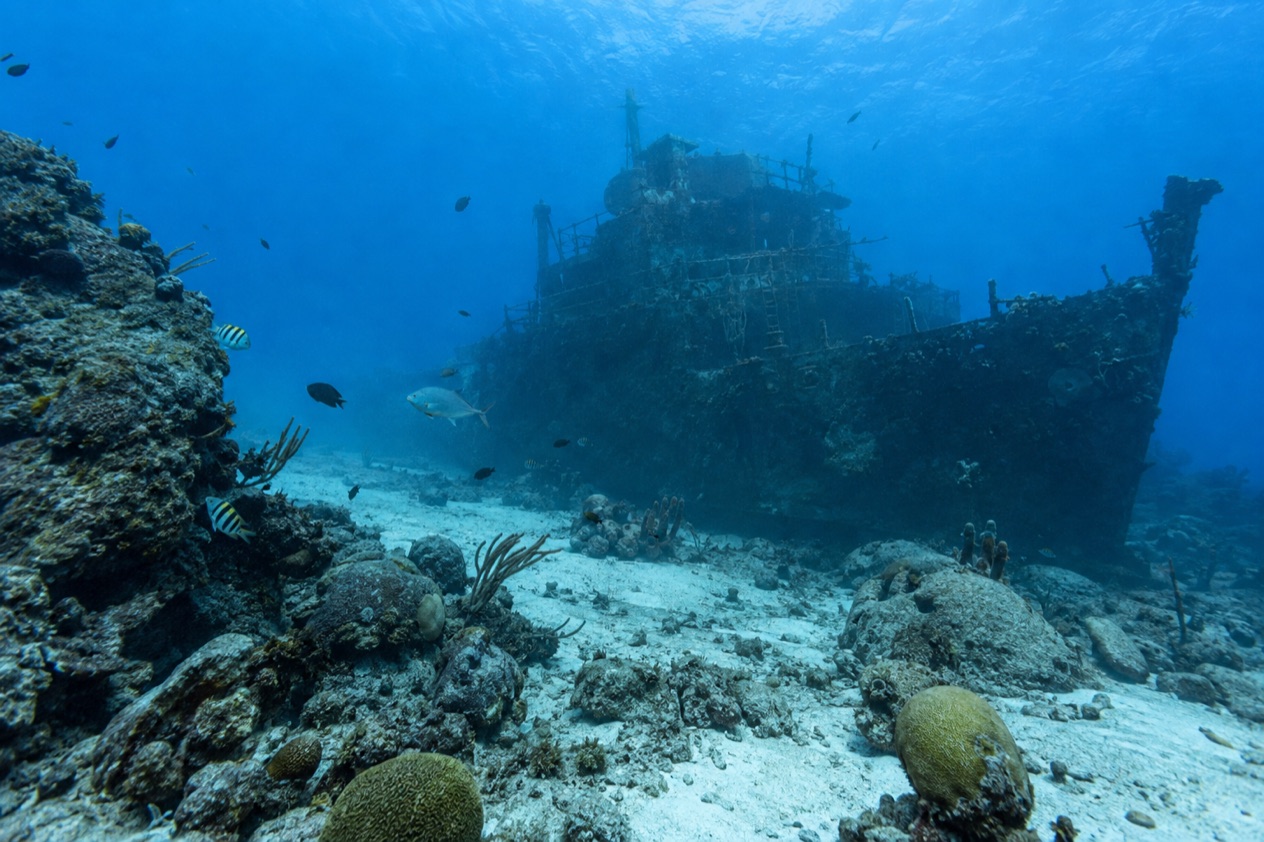
Out past the reef, the water turns from pale turquoise to a deep, clear blue, and a school of blue parrotfish drifts across the sand below the boat. A few minutes later you are sinking toward the rusting hull of a ship that has lain on the bottom since the early years of World War II. Aruba’s sea is warm all year, and that makes diving here an easy habit to fall into, whether you arrive as a certified diver or want to try breathing underwater for the first time.
Where can you dive in Aruba?
Divers in Aruba head to a handful of named sites: several shipwrecks, the Spanish Lagoon and the Barcadera Reef. The mix suits the island well, because one trip can combine a wreck dive with an unhurried drift over coral, and the clear water lets you take in both from a good distance.
The ocean stays warm year-round, so the season you choose matters less than it would on many islands. In October the sea off Oranjestad is at its warmest of the year in our table, and in the cooler months it is still comfortable.
What you meet below depends on the day, but damselfish are common over the reef and schools of blue parrotfish often cruise past. Four species of sea turtle live in Aruba’s waters, and snorkelers might cross paths with one, though it is a chance and never a promise.
| Month | Sea surface temperature (°F) |
|---|---|
| January | 81.0 |
| April | 80.8 |
| July | 82.2 |
| October | 86.5 |
Wrecks, the Spanish Lagoon and Barcadera Reef
The wrecks are the heart of Aruba diving. Alongside the Antilla, the island’s dive sites include other sunken ships, and these artificial reefs have grown crusts of coral and attract fish that shelter in the hulls. If you like to peer into dark corners and trace the outline of a vessel on the seabed, this is where you spend your tank.
The Spanish Lagoon and the Barcadera Reef offer a different mood, more about coral, light and the slow rhythm of reef life than about steel and rust. Divers who mix the two kinds of site in one stay get a fuller picture of the underwater island. Classes are offered for expert and new divers alike, so you can build up to the more demanding sites in steps.
Snorkeling from the beach
You do not need a tank to see the reef. Aruba is regarded as one of the best islands for snorkeling in the Caribbean, thanks to its weather, clear water and sea life, and getting into the underwater world from shore takes little more than a mask and a snorkel. The beaches named for snorkeling are Malmok Beach, Boca Catalina, Mangel Halto and Baby Beach.
Boat tours add the Antilla to the list, and snorkelers on those trips stop above the wreck. It is a good way to see the ship if a group dive is not for you.
SNUBA, SEABOB and underwater tours
SNUBA sits halfway between snorkeling and diving. You breathe through a hose while the air tank stays in a boat at the surface, so there is no heavy gear on your back. It asks for no prior diving or snorkeling experience, and the minimum age is 8. SEABOB, a powerful underwater scooter, is another way to try the sea in Aruba.
If you would rather not get in at all, underwater tours run by semi-submarine, real submarine or sea trek. Non-swimmers can join them, the commentary is narrated, and the views include shipwrecks, coral reefs and colorful fish. Submarine and glass bottom boat tours let you stay dry throughout.
What is the Antilla wreck?
The Antilla is a World War II shipwreck, the SS Antilla, a vessel from 1939 that was scuttled in 1940 and now lies on the seabed off Aruba. It is the wreck most people mean when they talk about diving the island, and it appears on snorkel tours as well as on dive itineraries.
The story gives the dive its weight. A ship built in the late 1930s ended up on the bottom a year after its launch year, and today it is an enormous steel shape that fish treat as a reef. Swimming along it, you get a real sense of scale, and the hull becomes a backdrop for the same damselfish and parrotfish you meet elsewhere on the island.
Seeing it as a diver
For certified divers the Antilla is a wreck dive in clear, warm water, with the light playing across the metal and coral growing where it can. Wrecks reward patience: hover, look into the openings from the outside, and watch how fish move between the structure and the open water. A slow pace makes the dive richer than a quick lap around the hull.
Because it is the island’s best-known wreck, the Antilla is often the dive that people plan their trip around. Combine it with a reef dive on another day to see how different the two worlds feel.
Seeing it without scuba
Popular snorkel tours stop at the Antilla, so you can float over the wreck with only a mask and snorkel. From the surface you look down at the long dark form of the ship and the fish around it, a different view from the diver’s but a memorable one.
Submarine tours also pass shipwrecks, along with coral reefs and colorful sea life, and they stay dry from start to finish. That makes wreck viewing possible for families, for non-swimmers and for anyone who prefers a seat to a wetsuit.
Do you need to be certified?
No, you do not need to be certified to enjoy the underwater world in Aruba, though you do for a full scuba dive on the wrecks and reefs. The island suits expert and new divers, with a variety of classes offered, so a beginner can start here and an experienced diver can come for the sites.
What you choose depends on how deep into the sea you want to go. There is a ladder of options, from floating at the surface to learning to dive with an instructor, and every rung gives a different view of the same clear water.
If you are already certified
Certified divers can go straight to the named sites: the wrecks, the Spanish Lagoon and Barcadera Reef. The warm sea makes long, comfortable dives possible, and the clear water makes the most of each one. It helps to plan a mix, one wreck and one reef at least, to see the two faces of Aruban diving. If it has been a while since your last dive, the classes on offer are also a way to sharpen your skills before heading to the deeper sites.
If you are new to diving
Beginners have several doors into the sea. Scuba classes are available for new divers, and SNUBA needs no prior experience at all, only a minimum age of 8. With SNUBA the tank stays on a boat at the surface, so you breathe underwater without carrying heavy gear.
Snorkeling from the beach is the gentlest start, since it takes only a mask and snorkel. For a first taste of the reef, it is hard to beat the beaches named for it: Malmok Beach, Boca Catalina, Mangel Halto and Baby Beach.
If you would rather stay dry
Underwater tours by semi-submarine, real submarine or sea trek bring the sea to you. Non-swimmers can come along, a narrator explains what you see, and the views include wrecks, reefs and colorful fish. Atlantis Submarines Aruba is a featured operator for this kind of tour.
What should divers know about medical care?
The key point is that there is no decompression chamber in Aruba, so anyone suffering from decompression sickness must be medically evacuated for proper treatment. It is a fact worth knowing before you dive, and it is a good reason to follow your training and dive conservatively.
Access to quality medical care in Aruba is limited in general, and facilities may not meet the standards you expect in the United States. Ambulance services are widely available on the island, which helps in getting to a facility quickly.
Evacuation and who pays
If a medical evacuation is authorized by the patient’s insurance carrier or funded privately, the cost of a transfer to the United States is approximately $15,000 to $25,000. Critically ill patients who need services unavailable in Aruba are transferred to neighboring countries, such as Colombia, at the patient’s expense.
U.S. Medicare and Medicaid do not apply overseas, and most hospitals and doctors abroad do not accept U.S. health insurance. Most care providers overseas only accept cash payments. For a diver, it makes sense to think about coverage before getting in the water.
Medication and mosquitoes
If you take prescription medication, carry it in its original packaging with your doctor’s prescription, and check with the government of Aruba that it is legal on the island. The range of drugs available locally is smaller than in the U.S., and for most medicines you will need a local prescription, so you may not find everything you take at home.
Zika virus, dengue and chikungunya are prevalent in Aruba. The U.S. Centers for Disease Control and Prevention recommends mosquito repellents, and sleeping under insecticide-impregnated mosquito nets, which is useful after a long day on the water when the evening comes.
Good to know before you go
The U.S. State Department rates Aruba Level 1, ‘Exercise normal precautions,’ and says Aruba is generally a safe destination for travelers, with petty crime the main concern in popular tourist areas.
Because care providers overseas often accept only cash and U.S. insurance is generally not taken, keep a way to pay for medical needs in mind alongside your dive plans. Hurricane season is a factor for any Caribbean trip, and Aruba sits on the southern fringes of the hurricane belt, where damaging storms are rare. The sea stays warm all year, so the choice of month rests on your own calendar, and October brings the warmest water in our table.
Sources
- Aruba Tourism Authority, Scuba and snorkel (https://www.aruba.com/us/things-to-do/on-the-water/scuba-snorkel), checked October 9, 2026
- Wikipedia, SS Antilla (https://en.wikipedia.org/wiki/SS_Antilla), checked October 9, 2026
- Aruba Tourism Authority, On the water (https://www.aruba.com/us/things-to-do/on-the-water), checked October 9, 2026
- U.S. Department of State, Aruba Travel Information, Health (https://travel.state.gov/content/travel/en/international-travel/International-Travel-Country-Information-Pages/Aruba.html), checked October 9, 2026
- Aruba Tourism Authority, Underwater tours (https://www.aruba.com/us/things-to-do/on-the-water/underwater-tours), checked October 9, 2026
- Open-Meteo Marine API, average 2015-2024, checked October 9, 2026
- U.S. Department of State, Aruba Travel Advisory, Level 1, issued August 19, 2026 (https://travel.state.gov/content/tsg_aem/us/en/home/international-travel/travel-advisories/destination.abw.html), checked October 9, 2026
To plan your stay
- Best Time to Visit Aruba: Weather by Month, Peak Season and Festivals
- Where to Stay in Aruba: Palm Beach, Eagle Beach, Oranjestad and All-Inclusives
- Aruba Airport (AUA): Arrival, Getting to Your Hotel, U.S. Preclearance and Departure
- Know Before You Go to Aruba: Entry Forms, Money, Water and Local Customs