
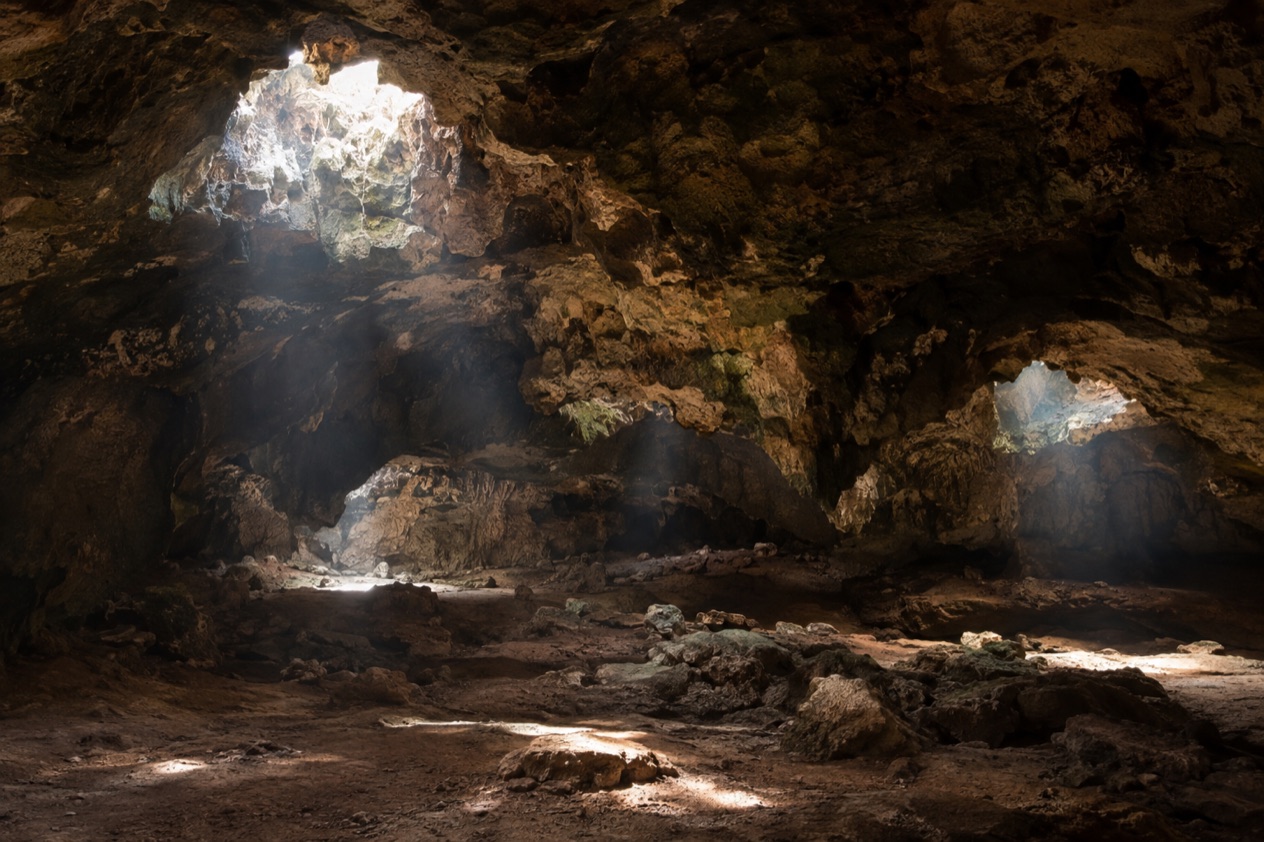
You step out of the bright, dry scrub of Arikok National Park and into a hollow in the rock where the air turns heavy and warm. Then your eyes adjust, and thin shafts of sunlight come falling through holes in the ceiling onto the stone floor. Quadirikiri is the cave most people picture when they think of Aruba’s underground, a short wander through light, shadow and wings that suits anyone curious about the island’s wild interior.
Is visiting Quadirikiri Cave worth it?
Yes, if you like places that feel a little raw and unpolished, and you can put up with heat and darkness for the sake of something you will remember. Quadirikiri is described as the most famous cave in Aruba, and the reason is easy to understand the moment the first beam of sun lands on the floor.
Nothing here is staged. There are no ornate walkways and no light show, just rock, daylight and the animals that live in it.
What sets it apart from the other caves in the park is the light. Aruba’s caves hold stalactites, stalagmites, old rock drawings and bats, but Quadirikiri is the one known for its chambers lit from above by the sun.
Fontein Cave, its neighbor in the park, is the more popular of the two and the only one with Arawak drawings on the ceilings. Quadirikiri answers with its glowing domes, its tunnels and its colony of bats, so the two visits feel quite different.
It is also a good fit for people who would rather not spend the whole day on a trail. The cave is one stop inside a large protected park, so it slots in beside the coast, the lava formations and the quiet bays rather than demanding a day of its own. It is less suited to anyone who dislikes enclosed, hot, dim spaces, because the conditions inside are exactly that.
What to see at Quadirikiri Cave
The sunlit chambers
The cave is built as three large domes joined by tunnels, and the sun reaches in through openings in the roof. The two best-known chambers are the ones where those beams fall, and they are the reason photographers and curious families come. Rays slice through the dim air, pick out the pale rock and leave bright patches on the ground that slide slowly as the sun moves.
Take your time in these spaces. Look up at the ragged holes that let the light in, then let your eyes drift down the walls, where the stone looks worn and pitted. The contrast between the glare of the opening and the dark corners around it is the real show here.
Petroglyphs on the walls
The walls carry prehistoric petroglyphic figures drawn by Amerindians, the island’s earliest inhabitants. They are faint, simple shapes rather than grand murals, and part of their charm is the effort of finding them. Think of the cave as a place that people used and marked long before roads and signs reached this part of the island.
Park rangers stationed at the cave entrances can offer tours with information on the rock drawings and the cave formations. A ranger helps you tell a real figure from a stain in the stone, and gives the dark chambers a human story.
Bats in the darker passages
Bats live in the cave, and hundreds of harmless ones nest in its darker portions. You may hear them shifting and squeaking before you see them, and on a quiet visit you may notice them stirring overhead. They are part of what keeps the cave feeling alive instead of like a museum piece.
The tunnels linking the domes are where the cave turns darkest, and where its character changes from sunlit and airy to damp and close. The cave is dark, damp and incredibly hot inside, so the contrast between the glowing chambers and these passages is sharp. That is a good moment to slow down and let your senses adjust.
Hours, tickets and rules
The caves are open to the public during the day, within the opening hours of the national park. You cannot reach Quadirikiri without first entering Arikok National Park, so the park ticket is the one you need.
| Site | Open | Ticket |
|---|---|---|
| Quadirikiri Cave | 8:00 am to 4:00 pm (national park hours) | Arikok National Park ticket required |
| Arikok National Park | 8:00 am to 4:00 pm | Ticket required to enter the park |
Park rangers at the cave entrances can provide tours with information on the rock drawings and the formations. Organized tours led by park rangers are also highly recommended for experiencing the park’s plants, wildlife and viewpoints as a whole.
How to get to Quadirikiri Cave
The cave sits inside Arikok National Park, so the journey is really a journey to the park. The park takes up about 18% of the island, which gives you a sense of how much of Aruba’s land is wild, rocky and undeveloped. Quadirikiri is one of the places inside that protected area, and you reach it by entering the park and buying your ticket.
The park is where the island’s other natural sights are gathered too. Its key attractions include caves, Indian rock drawings, lava formations, quartz diorite, limestone and secluded bays such as Moro, Boca Prins and Dos Playa. That makes the approach part of the outing, since you pass from the resort side of the island into a landscape of rock and cactus.
Plan your arrival within the park’s opening hours, because the caves are open to the public only during the day, between 8:00 am and 4:00 pm. Fontein Cave is also in the park, so if you want to see both caves you can do it in one entry to Arikok.
When to visit Quadirikiri Cave
Time of day matters more than month here. The cave is open only during park hours, and the sunbeams are the main draw, so the brightest part of the day shows them off best, when the sun is high enough to send light down through the roof. Early and late in the opening window the light is lower and the chambers feel dimmer and moodier.
Heat is the other consideration. The cave is dark, damp and incredibly hot, so the hours before the day’s full warmth are likely to be kinder to you, while the sun is not yet at its strongest outside. Pick the time that suits how you handle warmth in an enclosed space.
For the month, Aruba as a whole is best from February to August. The peak season runs from December to April, so a visit early in the year falls in the busier part of the calendar, while May through August sits in the best-time window outside that peak. The cave itself is open every season, and the island has a single climate, so the choice comes down to the rest of your trip.
Tips for your visit
Treat Quadirikiri as one stop in a larger day. The park is a great place to spend an entire day enjoying its dramatic landscapes, and the cave is one of its highlights. A private guided hike is available for visitors who want to explore the birds, flowers and geology at their own pace.
Pairing the cave with Fontein Cave makes a natural contrast, since one is known for its sunlit chambers and the other for Arawak drawings on its ceilings. Beyond the caves, the park’s secluded bays, lava formations and viewpoints give you plenty to fill the rest of the day.
- Linger in the two lit chambers, where the sunbeams fall, then walk the tunnels to feel the change in atmosphere.
- Look for the petroglyphs on the walls, and ask a ranger at the entrance about the rock drawings and formations.
- Remember the bats are harmless and live in the darker portions, so expect to hear or see them overhead.
- Expect heat, damp and darkness inside, and decide beforehand whether that suits everyone in your group.
Think about who is coming with you. The cave is dark, damp and incredibly hot, so it may suit some people better than others, and you know your own group best. If part of the group would rather stay outside, the park’s open landscapes are just beyond the entrance.
Good to know before you go
The U.S. State Department rates Aruba Level 1, ‘Exercise normal precautions,’ and says Aruba is generally a safe destination for travelers, with petty crime the main concern in popular tourist areas.
The small entrance fee for Arikok National Park supports preservation, educational programs and the animals, and the park is protected by the Aruba Tourism Authority, so your visit helps keep the caves as they are. Petty crime is the main concern in popular tourist areas of the island, so keep an eye on your belongings as you would anywhere.
Sources
- Aruba Tourism Authority, Quadirikiri Cave (https://www.aruba.com/us/explore/quadirikiri-cave), checked October 9, 2026
- Aruba Tourism Authority, Caves of Aruba (https://www.aruba.com/us/explore/caves), checked October 9, 2026
- Aruba Tourism Authority, Arikok National Park (https://www.aruba.com/us/explore/arikok-national-park), checked October 9, 2026
- Aruba Tourism Authority, Best time to visit (https://www.aruba.com/us/our-island/one-happy-island/when-is-the-best-time-to-visit-aruba), checked October 9, 2026
- U.S. Department of State, Aruba Travel Advisory, Level 1, issued August 19, 2026 (https://travel.state.gov/content/tsg_aem/us/en/home/international-travel/travel-advisories/destination.abw.html), checked October 9, 2026
To plan your stay
- Best Time to Visit Aruba: Weather by Month, Peak Season and Festivals
- Where to Stay in Aruba: Palm Beach, Eagle Beach, Oranjestad and All-Inclusives
- Aruba Airport (AUA): Arrival, Getting to Your Hotel, U.S. Preclearance and Departure
- Know Before You Go to Aruba: Entry Forms, Money, Water and Local Customs