
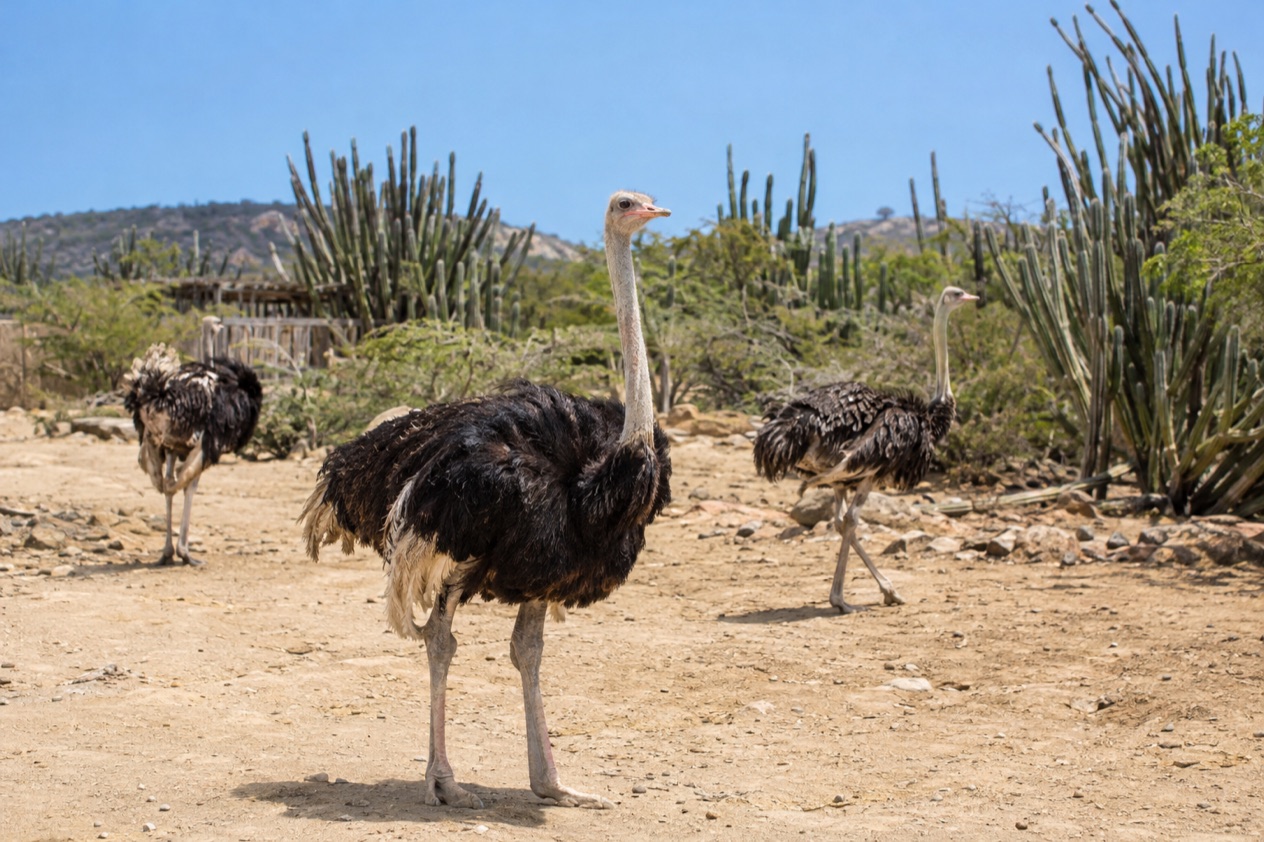
Out on Aruba’s northern side, the dry cunucu (the Papiamento word for the island’s rocky countryside) suddenly produces a very tall bird with a long neck, watching you over a fence with the calm of an animal that has never been hurried in its life. Nearby, an emu paces along the wire, shaggier and just as curious. The Aruba Ostrich Farm is a working farm turned visit, with a guided tour, a small art shop and a lodge restaurant looking out over the coast.
Is visiting the Aruba Ostrich Farm worth it?
Yes, if you like animals and want a break from the beach, and it suits anyone traveling with children or with a curiosity about how birds actually behave. The farm is built around meeting the animals up close, with a guide who explains what you are looking at rather than leaving you to peer over a fence. A visit gives you a different Aruba from the resort strip: scrubby, open, windswept land and the roughness of the northern coast in the distance.
What sets it apart from the other stops around this part of the island is the encounter. Most places in the north are about scenery, such as ruins, rock formations and wild shoreline. Here the main attraction is alive and has a personality. The tour covers the natural behavior and survival instincts of ostriches and emus, and it includes personal encounters with the birds, so you leave knowing why these animals do what they do.
It also works as a complete stop. There is a guided tour to follow, an art shop for local crafts, and a lodge with home-cooked meals and drinks, so you can arrive with an empty stomach and a free stretch of the day.
The farm keeps over 80 farm animals, including the ostriches and emus, which means there is more to look at than a single pen. Pair it with the ruins close by and you have a satisfying northern morning or afternoon.
It will not suit someone who wants only beaches, or who would rather skip animals entirely. For everyone else, it is one of the more unusual hours you can spend on the island, and the kind of outing that tends to be the story told back home at dinner.
What to see at the Aruba Ostrich Farm
The guided tour
The tour is the heart of the visit, and visitors are encouraged to take it. A guide walks you through the farm and explains how ostriches live: how they watch for danger, how they respond to it, and why a bird that cannot fly is still very well equipped to survive in open country. These are the survival instincts the tour is built around, and hearing them explained while the birds are right in front of you makes them stick.
Personal encounters with the birds are part of the experience. Look at the eyes, which are large for the size of the head, and at the long legs and the two-toed feet, which tell you what these animals are made for. Ostriches are curious and a little comical in close view, and the tour gives you time to take that in rather than rushing to the next stop.
Ostriches and emus
The stars are the ostriches, the largest living birds, native to Africa. Next to them are the emus, which come from Australia and are a little smaller, with shaggier plumage and a more rounded, shuffling look. Seeing the two side by side is half the fun, because the differences in build and feathering become obvious within seconds.
The farm describes its animals as more than 80 in total, ostriches and emus among them, so the enclosures are lively. Watch how the birds move their heads, how they stand together and how they react when something new walks up to the fence. Bring your camera, because a bird looking straight at you over its own beak makes an excellent photograph.
The Art Shop
Guests can visit an Art Shop with a collection of local art and craft. It is a good place to look for something made on the island rather than the usual souvenir shelf: paintings, handmade pieces and small objects that carry a little of Aruba’s character with them.
Browsing here fits naturally after the tour, when you are in a relaxed mood and in no hurry. Handmade things take a moment to appreciate, so give yourself time to pick them up and look at them properly.
Savanna Lodge Bar & Restaurant
The Savanna Lodge Bar & Restaurant serves home-cooked meals and drinks, and it has the best seat on the property. From the lodge you look out over panoramic views of the island’s northern coast, a landscape of low scrub, rock and a sea that arrives with force on this wind-battered side of Aruba.
Sit here after the tour and let the view do its work. The contrast is memorable: you have just stood beside African and Australian birds, and now you are looking at the wild edge of a Caribbean island, with a cold drink in your hand and nowhere in particular to be.
Hours, tickets and rules
The visit is organized around the guided tour, which visitors are encouraged to take, and around the other parts of the property: the Art Shop for local art and craft, and the Savanna Lodge Bar & Restaurant for meals and drinks. Think of it as a stop with a clear rhythm: meet the birds, browse, then sit down to eat or drink with the view.
Because the tour is the centerpiece, it makes sense to plan your visit around it rather than around the shop or the restaurant. Allow yourself a relaxed pace, since the encounters with the birds are the part most people want to savor rather than hurry through.
How to get to the Aruba Ostrich Farm
The farm lies on the northern side of Aruba, the windward stretch of the island where the land is open and the coast is rough. The lodge looks out over that northern shoreline, which gives you a sense of where you are even before you arrive. This is a different part of the island from the resort beaches along the western coast, and the change in scenery is part of the trip.
The best landmark for placing it is Bushiribana Gold Mill Ruins, which stand within one mile of the farm. Bushiribana is a well-known stop on the north coast, and the two sit close enough that they naturally belong to the same outing. If you know where Bushiribana is, you know roughly where the farm is.
From your base, whether that is Palm Beach, Eagle Beach or Oranjestad, you are heading to the north of the island, away from the calm leeward side and toward the wilder coast. Plan the trip as a northern outing rather than a quick detour, and treat the farm and the ruins as the two halves of one half-day.
When to visit the Aruba Ostrich Farm
The best time to visit Aruba in general is from February to August, and that is a sensible guide for the farm too. The island is dry and windy all year, so this is not a place where a rainy spell cancels the plan, and the farm is an outdoor visit that depends mostly on your own comfort in the sun and breeze.
Peak season on the island runs from December to April, when more visitors arrive and the island is at its busiest. If you are traveling then, the farm is a good way to fill a day that does not involve the beach. Outside those months you are likely to find the island a little quieter overall.
As for time of day, the northern side of Aruba is open country with little to hide behind, so the sun and wind are part of the experience. A tour taken in the cooler part of the day feels more relaxed, and finishing with a drink at the lodge with the northern coast in view is a pleasant way to end it. Choose the hour that suits your own energy and the rest of your plans.
Tips for your visit
Take the guided tour, because it is the reason the farm exists as a visit. The information about natural behavior and survival instincts turns a look at some large birds into something you actually understand, and the personal encounters are the moments you will remember afterward.
Leave time for the rest of the property. Visit the Art Shop for local art and craft, then settle in at the Savanna Lodge Bar & Restaurant for home-cooked food and a drink. The panoramic views of the northern coast are best enjoyed when you are not watching the clock, so do not schedule something tight right after.
For the rest of the outing, combine the farm with Bushiribana Gold Mill Ruins, which are within one mile. The ruins give you the history and the coastline, and the farm gives you the animals, so together they fill a northern half-day with variety. Travelers with children or with an interest in wildlife will find the farm the more memorable stop of the two.
If you want to read what other visitors made of it, the farm has a TripAdvisor Traveler Rating and reviews are available there, which can help you decide what to look forward to.
Good to know before you go
The U.S. State Department rates Aruba Level 1, ‘Exercise normal precautions,’ and says Aruba is generally a safe destination for travelers, with petty crime the main concern in popular tourist areas.
The farm is a stop that rewards an unhurried mood: a tour, a browse, a meal and a view. Pair it with the ruins nearby and let the northern side of the island, so different from the resort coast, set the pace of the day.
Sources
- Aruba Tourism Authority, Aruba Ostrich Farm (https://www.aruba.com/us/explore/aruba-ostrich-farm), checked October 9, 2026
- Aruba Tourism Authority, Best time to visit (https://www.aruba.com/us/our-island/one-happy-island/when-is-the-best-time-to-visit-aruba), checked October 9, 2026
- U.S. Department of State, Aruba Travel Advisory, Level 1, issued August 19, 2026 (https://travel.state.gov/content/tsg_aem/us/en/home/international-travel/travel-advisories/destination.abw.html), checked October 9, 2026
To plan your stay
- Best Time to Visit Aruba: Weather by Month, Peak Season and Festivals
- Where to Stay in Aruba: Palm Beach, Eagle Beach, Oranjestad and All-Inclusives
- Aruba Airport (AUA): Arrival, Getting to Your Hotel, U.S. Preclearance and Departure
- Know Before You Go to Aruba: Entry Forms, Money, Water and Local Customs