
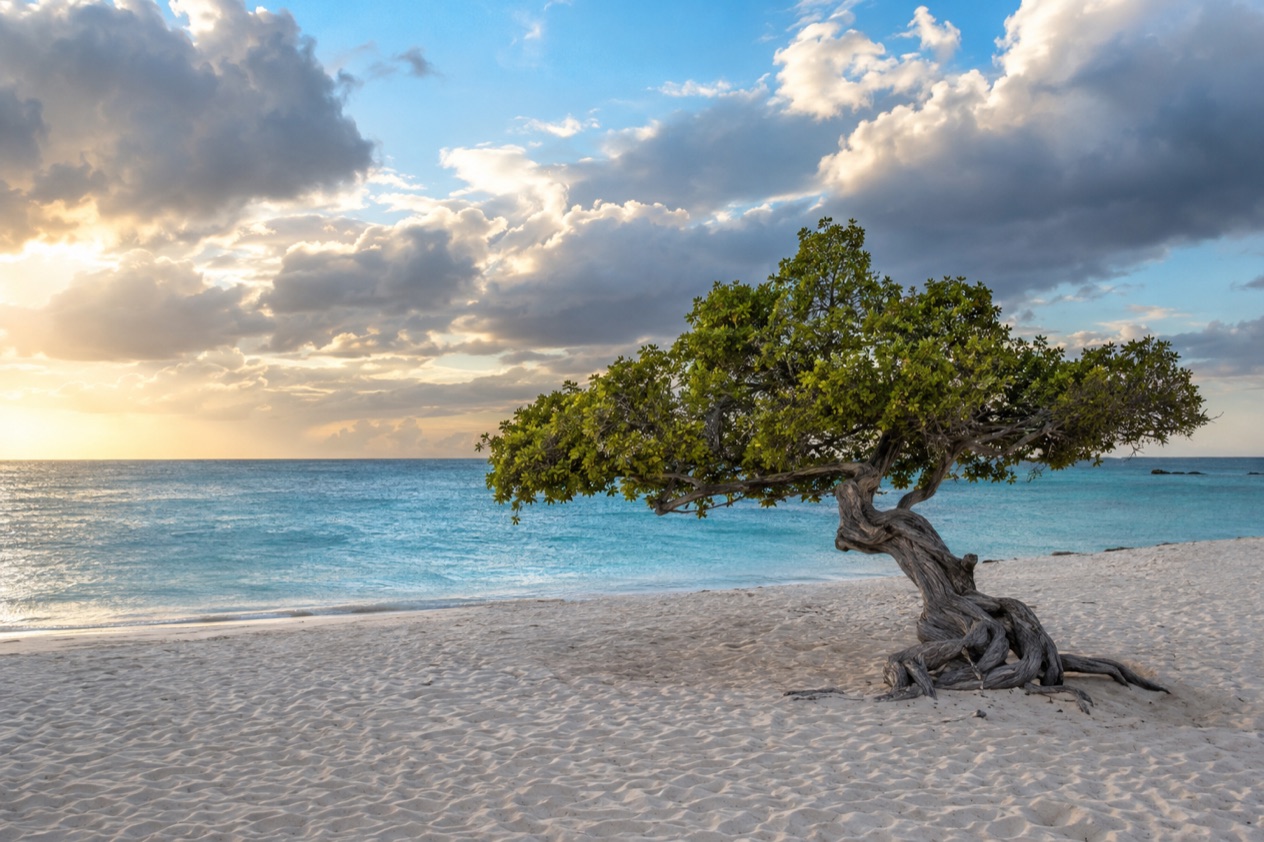
Early on a November evening in Oranjestad, the trade wind pushes the fofoti trees of Eagle Beach a little further sideways, and the harbor lights come on over boats tied up along the waterfront. Shoes come off, the sea is still bathwater warm, and a passing shower sometimes drums on the tin roofs and is gone before the pastechi (fried turnovers) get cold. November is the quiet turn between the long dry stretch and the busy winter months, a gentle window for anyone weighing a beach vacation in Aruba.
What is the weather like in Aruba in November?
November is hot, breezy and a little showery: afternoons stay in the upper 80s, nights barely cool down, and the sea is warm enough that you step in without hesitation. The island sits in its rainy season, which runs from October to December, so you should expect short passing showers rather than gray weeks.
| Place | Average high (°F) | Average low (°F) | Rain (in) | Rain days | Sea (°F) |
|---|---|---|---|---|---|
| Oranjestad (island weather station) | 88.7 | 78.8 | 3.43 | 9.6 | 85.0 |
The wind is the other half of the weather. It blows from the east all year, and in November it averages 13 mph, which is why the heat feels gentler than the thermometer suggests, especially on a terrace facing the water. When a tropical system passes somewhere in the Caribbean, the island can see more rain, gusty wind, or the opposite, a day with no wind at all and a heavier, stickier feel.
The sea is warm everywhere on the leeward side. Off Palm Beach it runs a shade warmer than off Oranjestad, and off San Nicolas, at the south end, it is a hair cooler. The differences are tiny and you will not feel them. The real contrast on the island is exposure: the west and southwest coast sits sheltered from the trade wind and carries the resort beaches, while the north and east coast takes the wind head on and is rough and wild.
Compared with October, the air is a touch less fierce and the sea has lost a little warmth, but the number of rainy days has crept up. Daylight lasts a bit under twelve hours in mid-month, so evenings arrive early enough for a long dinner after the beach.
Where to go in Aruba in November
The island is small, so you can base yourself on one coast and still explore the others, but its interior is rugged. What changes in November is mostly the mood: fewer people on the sand, a few clouds drifting in on the wind, and a sea that is still very inviting.
The leeward coast: Palm Beach, Eagle Beach and Oranjestad
This is the sheltered west and southwest side, home to the strip of resorts at Palm Beach in the Noord district, the broad sand of Eagle Beach with its leaning fofoti trees, and the pastel Dutch-colonial facades of Oranjestad. In November, mornings are the time for a long beach walk before the sun climbs, and the late afternoon light turns the waterfront gold.
Oranjestad rewards a slow wander in the cooler part of the day: the harbor, the shops, a table on the water for fresh fish. A passing shower is a good excuse to duck into a café or a museum. Beach days here suit anyone who wants warm water, a resort or restaurant close by and the sunset facing the open sea.
The windward coast: rough shores and Arikok National Park
On the north and east coast the trade wind and the Atlantic swell have carved a rugged shoreline of limestone, pounding surf and scrubby cactus country. This coast is rough, and it looks it: come to watch the waves, see the ruins of the Bushiribana gold smelter and explore Arikok National Park.
November light is kind to this landscape, with long shadows in the morning and a softer sun by mid-afternoon. A shower may leave the rocks dark and glistening before the wind dries them. It suits travelers who like open, wild scenery more than a lounge chair.
The south and the northwest tip: San Nicolas, Baby Beach and the lighthouse
San Nicolas, at the southeast end, is the island’s second town, known for its colorful murals and a growing art scene. Baby Beach lies near it, and Savaneta, a fishing village along the south coast, is a place for a seaside meal. Snorkelers will know Baby Beach and Mangel Halto, two of the beaches named for snorkeling in Aruba.
At the opposite end, the northwest tip, the California Lighthouse stands above a windswept stretch of coast, and nearby Malmok Beach and Boca Catalina are also named among the island’s best for snorkeling. Because the south and the northwest tip lie at opposite ends of Aruba, treat them as separate outings rather than one hurried morning.
What to do in Aruba in November
November has no giant national festival on the island, and that is part of its charm. Days are built around the water, the table and the landscape, with a Dutch touch added as the year winds down and Sinterklaas, the gift-bringing saint of the Netherlands, is welcomed in the weeks before December 5.
In and under the water
Aruba’s water stays warm year-round and the clear water lets snorkelers and divers explore reefs and wrecks. Malmok Beach, Boca Catalina, Mangel Halto and Baby Beach are the beaches the island is known for when it comes to snorkeling. Boat trips often stop at the Antilla, the World War II shipwreck that is among the most famous snorkel sites on the island.
With the sea this warm in November, a long morning in the water feels natural. Showers may pass quickly, but the breeze does not reduce sun exposure on land. Pair a snorkel stop with lunch at a beach restaurant and a slow afternoon back at your hotel.
Eating the island
Aruban home cooking blends Amerindian, European, African and Asian influences, and the first Caquetio inhabitants fished and gathered conch that still turns up on menus. Look for keshi yena, a baked cheese shell stuffed with spiced meat, and pastechi, the crisp turnovers filled with cheese, meat or fish that locals eat for breakfast or a snack.
Fresh fish is the natural order at a seaside table in Savaneta or along the Oranjestad harbor. Papiamento, the island’s own language, mixes Portuguese, Spanish, Dutch and African roots, and a few words go a long way: bon bini means welcome, and the smile you get back is part of dinner.
Art, murals and rough coastline
Plan a walk through San Nicolas between showers to enjoy its street murals. Out on the north coast, the Bushiribana ruins and the surf below make a different kind of afternoon, wilder and windier.
Arikok National Park rounds out the island’s landscape with rocky interior terrain, caves and the Natural Pool. Hooiberg, a prominent hill in the middle of the island, stands like a marker you can spot from many places as you travel around.
Is Aruba busy in November?
No, November counts as part of the off-season, which runs from September to November, and the beaches and restaurants feel noticeably more relaxed. The peak season arrives in December and runs through April, so this month sits just before that wave.
Americans do travel in November, especially around the Thanksgiving week, so the mood picks up toward the end of the month. Even then, the island does not feel like it does in midwinter. Palm Beach, with its line of resorts, is naturally the liveliest stretch, while Eagle Beach is wider and more open, and the south and the windward coast feel calm and spread out.
Quieter beaches mean more room for a long walk, a snorkel stop without a crowd and a table at sunset. In San Nicolas and Savaneta, life goes on at a local pace, and Oranjestad keeps its everyday rhythm of shops, harbor and cafés. Arikok National Park and the rough north coast feel open and empty almost anywhere you stop.
The Sinterklaas season adds a festive note to the towns, and early-season holiday decorations begin to appear toward the end of the month. It is a gentle build-up rather than a rush, and it gives November a character of its own between the quiet of autumn and the winter high season.
What to pack for Aruba in November
Packing is simple because the island is one small, hot place: light clothes for the leeward coast, a bit more coverage for the windy, rocky north and east, and something to handle a passing shower. The sun is strong for nearly twelve hours of daylight, and the trade wind makes a light extra layer welcome on an open terrace in the evening.
- Breathable, quick-drying clothes and swimsuits, since the days stay hot and the water is warm.
- A light rain jacket or a compact umbrella for the short showers of the rainy season.
- Sunglasses and a hat that will stay on in a steady east wind.
- A snorkel mask if you like your own, for the reefs off Malmok, Boca Catalina, Mangel Halto and Baby Beach.
- Sturdy sandals or walking shoes for the rocky ground of Arikok National Park and the north coast.
- A thin layer for evenings on a windy terrace.
Good to know before you go
The U.S. State Department rates Aruba Level 1, ‘Exercise normal precautions,’ and says Aruba is generally a safe destination for travelers, with petty crime the main concern in popular tourist areas.
The Atlantic and Caribbean hurricane season runs through November 30, so this month falls at its very end. Aruba sits on the southern fringes of the hurricane belt, where damaging storms are rare, though systems passing elsewhere in the Caribbean can bring extra rain, gusty wind or a day without any breeze.
U.S. citizens do not need a visa. They need a passport valid for the whole stay, the Aruba ED Card (Embarkation and Disembarkation Card) completed within 7 days before travel, proof of return or onward travel, and enough money to cover the stay.
Is November a good time to visit Aruba?
Yes, for travelers who want warm water, a relaxed pace and long beach days without the winter crowds, and the best place to base yourself is the sheltered leeward coast around Palm Beach, Eagle Beach and Oranjestad. The sea is still warm and the sun is reliable between showers, though it is not the island’s best-known season, and the best time to visit overall is considered February through August.
Compared with October, November feels a little softer: the air is slightly cooler, the sea has lost a bit of its peak warmth, and showers come more often. December brings still more rainy days and a cooler sea, but also the start of the high season, with the atmosphere livelier and the island fuller.
For snorkelers, warm water and clear conditions are the draw. For hikers and landscape lovers, the north coast and Arikok National Park are open and uncrowded. For anyone who simply wants to read by the sea, a chair on Eagle Beach under the fofoti trees does the job.
What makes November in Aruba its own is the in-between feeling: the wind still steady, the sea still warm, a shower sweeping through and out again, and the first hint of Sinterklaas in the streets of Oranjestad before the winter crowds arrive.
Sources
- Meteorological Department Aruba (meteo.aw), Summary Climatological Normals 1991-2020, Queen Beatrix Airport station (http://www.meteo.aw/files/Download/climatnormals19912020.pdf), checked October 9, 2026
- Open-Meteo Marine API, average 2015-2024, checked October 9, 2026
- sunrise-sunset.org, sunrise and sunset calculated for the 15th of the month, checked October 9, 2026
- Aruba Tourism Authority, Weather and climate (https://www.aruba.com/us/our-island/island-facts/weather-and-climate), checked October 9, 2026
- Aruba Tourism Authority, Best time to visit (https://www.aruba.com/us/our-island/one-happy-island/when-is-the-best-time-to-visit-aruba), checked October 9, 2026
- Aruba Tourism Authority, Where is Aruba (https://www.aruba.com/us/our-island/island-facts/where-is-aruba), checked October 9, 2026
- NOAA National Hurricane Center, Climatology (https://www.nhc.noaa.gov/climo/), checked October 9, 2026
- Aruba Tourism Authority, Aruba hurricane season (https://www.aruba.com/us/blog/aruba-hurricane-season), checked October 9, 2026
- Aruba Tourism Authority, Passports and visas (https://www.aruba.com/us/plan-your-visit/getting-to-aruba/passports-and-visas), checked October 9, 2026
- Aruba Tourism Authority, Sustainability (https://www.aruba.com/us/our-island/island-facts/sustainability), checked October 9, 2026
- Aruba Tourism Authority, Beaches and coves (https://www.aruba.com/us/things-to-do/beaches-and-coves), checked October 9, 2026
- Aruba Tourism Authority, On the water (https://www.aruba.com/us/things-to-do/on-the-water), checked October 9, 2026
- Aruba Tourism Authority, Scuba and snorkel (https://www.aruba.com/us/things-to-do/on-the-water/scuba-snorkel), checked October 9, 2026
- Aruba Tourism Authority, Local Aruba cuisine (https://www.aruba.com/us/things-to-do/dining/local-aruba-cuisine), checked October 9, 2026
- U.S. Department of State, Aruba Travel Advisory, Level 1, issued August 19, 2026 (https://travel.state.gov/content/tsg_aem/us/en/home/international-travel/travel-advisories/destination.abw.html), checked October 9, 2026
To plan your stay
- Things to Do in Aruba: Beaches, Arikok National Park, Island Tours and Food
- Where to Stay in Aruba: Palm Beach, Eagle Beach, Oranjestad and All-Inclusives
- Aruba Airport (AUA): Arrival, Getting to Your Hotel, U.S. Preclearance and Departure
- Know Before You Go to Aruba: Entry Forms, Money, Water and Local Customs