
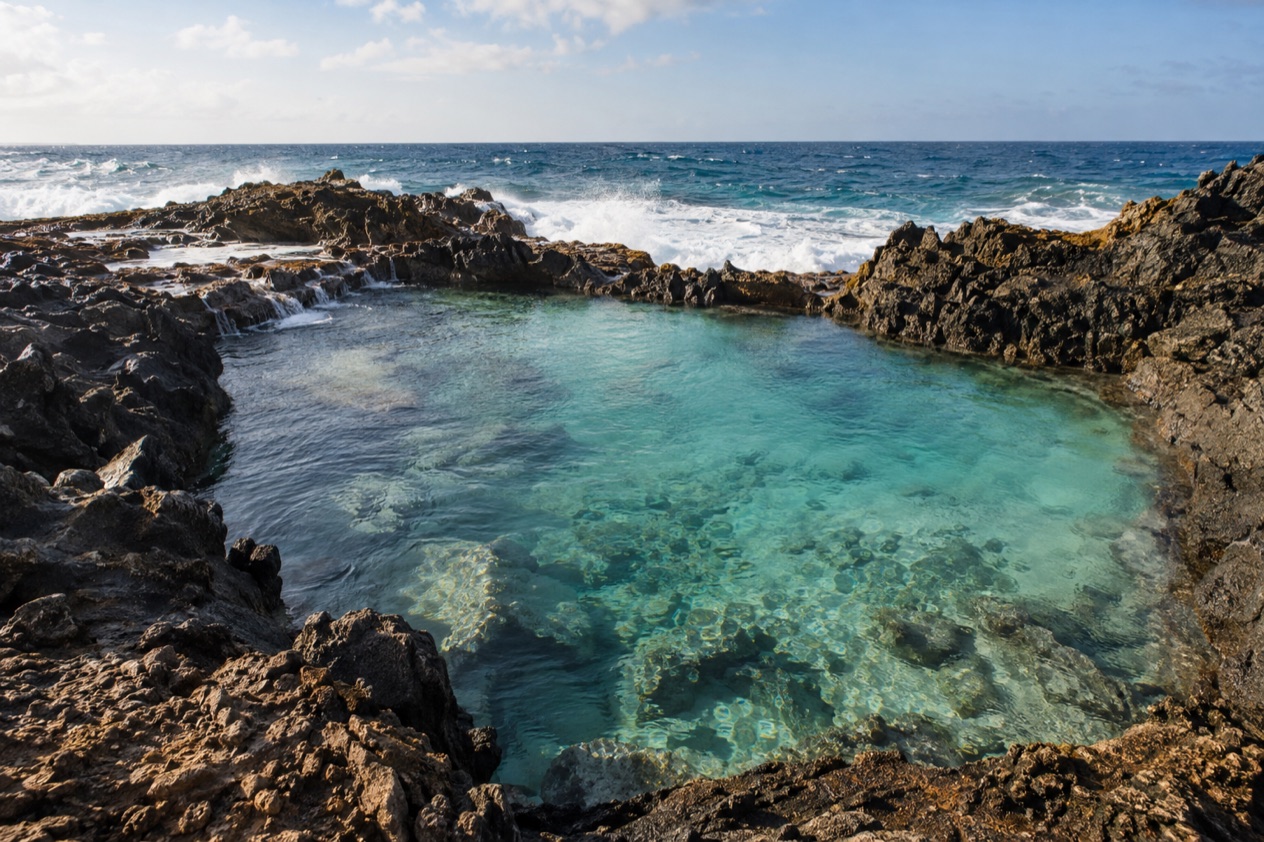
The last stretch of the road to the Natural Pool is all rock and rattle, and then the land simply stops at the sea. Below a set of steep stone steps, a ring of dark volcanic rock holds back the surf and shelters a quiet basin of water, known locally as Conchi. It is a half-day adventure on the wild northeast coast of Aruba, inside Arikok National Park, for travelers who like the journey as much as the swim.
Is visiting the Natural Pool (Conchi) worth it?
Yes, if you want a wild, out-of-the-way corner of Aruba and don’t mind a bumpy ride to reach it. It suits adventurous couples, groups of friends and families with older children who enjoy a rough trail, and it suits snorkelers who would rather look at fish in a sheltered basin than lie on a resort beach. It is a poor fit for anyone who needs smooth paths, since the site is not wheelchair accessible.
What sets the pool apart from the beaches on the leeward side is the setting. The resort strips of the west and southwest coast are lined with sand, shade and services. Here you get black rock, open sea and almost nothing built. Facilities are limited, and the only sign of commerce is a small snack and refreshment stand that is often open at the top of the stairs.
The pool itself is formed by volcanic stone circling a small depression on a deserted stretch of coastline. It is also called Cura di Tortuga, a Papiamento name (the island’s own language, a blend of Portuguese, Spanish, Dutch and African influences) that points to turtles. Much of the pleasure lies in the approach: the dry, cactus-studded landscape, the sense of leaving the paved island behind, and the sudden view of the surf breaking against the outer rocks while the water inside stays sheltered.
Those who want a story to tell should know the sea here is usually rough, and conditions change from day to day and beach to beach. Those who want a story to tell when they get home will find it here. The ride or hike is part of the day, and the pool is the reward at the end of it.
What to see at the Natural Pool (Conchi)
The pool and its volcanic rim
The centerpiece is a rounded basin walled in by dark volcanic stone. The rock was shaped over a very long time by the waves that still pound the coast, and the rim acts as a natural breakwater. From above, the contrast is striking: deep blue open water outside, a calmer, clearer pool within.
Look at the texture of the rock, jagged and pitted, and at the way the surf climbs the outer edge and drops back. Waves can occasionally crash over the rocks, and conditions can change quickly, so it pays to watch the sea for a few minutes before you settle in. Swimming here is only safe when ocean conditions are calm, and park ranger advisories and posted warnings are the rule to follow.
Swimming and snorkeling in the basin
Visitors can swim in the protected pool, and snorkeling lets you watch tropical fish and coral inside the basin. Bring your own mask and fins if you have them, since this is not a place with a rental shop on the doorstep.
The fish are the draw here, drifting between the rocks and the coral heads. Float quietly and let them come to you. Even on a good day, keep an eye on the rim, where the sea meets the stone.
The stone steps and the snack stand
Getting down to the water means using steep natural stone steps, which are part of why the site is not wheelchair accessible. The steps are uneven, so shoes with grip make the climb down and back up far more comfortable than flip-flops.
At the top of the stairs, a small snack and refreshment stand is often available. It is a handy place to sit with a cold drink and look down over the pool and the coast before or after your swim.
The wild coast around it
The pool sits inside Arikok National Park, whose landscapes include caves, Indian rock drawings, lava formations, quartz diorite and limestone, along with secluded bays such as Moro, Boca Prins and Dos Playa. The coast around the pool is a good example of that dramatic terrain, with rough rock, low scrub and a horizon of open sea.
Take a moment on the walk in and out to look at the plants and the stone. Park rangers lead organized tours of the park, which are highly recommended for understanding its flora, fauna and viewpoints.
Hours, tickets and rules
The pool lies inside a national park, so the ticket that matters is the park entrance pass. It is required, and the fee is small, supporting conservation, education programs and the animals of the park. The pool itself has no separate gate.
| Site | Open |
|---|---|
| Natural Pool (Conchi), inside Arikok National Park | Hours not specified |
Swimming is allowed in the protected pool, but only when ocean conditions are calm, and park ranger advisories and posted warnings must be followed. The site cannot be reached by a regular car: it requires a 4×4, ATV, UTV or a guided tour. Sunscreens containing oxybenzone have been banned in Aruba since 2019, and mineral-based reef-safe sunscreens are the recommended choice.
How to get to the Natural Pool (Conchi)
The Natural Pool is on the northeast coast of Aruba, inside Arikok National Park, and the way in is rough. A regular rental car will not do: the terrain is rocky and demands a 4×4 vehicle. The site is only accessible by 4×4, ATV, UTV or guided tour.
By 4×4 or guided tour
Guided 4×4 tours are one of the popular ways to reach the pool. A driver who knows the track handles the rocks and the ruts, and you can concentrate on the scenery. Park rangers also lead organized tours of Arikok, which are highly recommended for seeing the park’s flora, fauna and viewpoints.
If you drive yourself, the vehicle must be a 4×4. Keep in mind some Aruban road basics along the way: speed limits are 25 miles/h in towns and 37 miles/h out of town unless signs say otherwise, there are no turns on red, and at intersections without signs, traffic from the right has the right of way.
On horseback
Horseback riding excursions are another popular way to reach the site. Riding across the dry landscape toward the sea gives the trip a different rhythm from an engine, slower and quieter, with time to take in the cacti and the long views toward the coast. It suits visitors who want the journey to be part of the memory and who are comfortable in the saddle on uneven ground.
On foot
Experienced hikers can reach the pool on a round trip of 3 to 4 hours. That is a real outing in a dry, open landscape, so it is a plan for people used to walking on rocky ground. Carry water: the running water on the island is safe to drink, so you can fill a bottle before you set out. A private guided hike is also available within the park, letting you explore birds, flowers and geology at your own pace.
When to visit the Natural Pool (Conchi)
The best time to visit Aruba in general is from February to August, and that is a sensible window for the pool as well. The peak season runs from December to April, which means the island as a whole is at its busiest in those months.
October sits outside the peak season, and it also falls within the Atlantic hurricane season. Aruba lies on the southern fringes of the hurricane belt, where damaging storms are rare.
For the day itself, the sea matters more than the clock. Swimming is only safe when ocean conditions are calm, and conditions can change quickly, with waves sometimes crashing over the rocks. If the surf looks heavy when you arrive, the better move is to enjoy the view, the stairs and the coastline, and save your swim for another day or another beach.
The island is dry and exposed, and the trail to the pool offers little cover, so an early start makes sense for a hike or ride, leaving you a long, unhurried stretch at the water. A swim and a cold drink from the stand at the top of the stairs make a good reward after the rough road.
Because the park is a place where you could spend an entire day, it is worth treating the pool as one stop in a longer outing rather than a quick photo. Allow the light, the sea and your own energy to decide how long you stay.
Tips for your visit
Pack as if you were heading to a remote cove, because in many ways you are. Facilities are limited, so bring water, a towel, a swimsuit and your snorkel gear if you own it. Wear shoes with grip for the rocky paths and the steep natural stone steps, and keep beach attire for the beach, since it is meant to be worn only on beaches or by the pool, not elsewhere.
Use a mineral-based reef-safe sunscreen, which is more likely to be biodegradable and gentler on the coral you have come to see. If you forget, sunscreen can be bought on the island from local companies such as Aruba Aloe and Arubalife Organics.
Combining it with the rest of the park
Arikok National Park is a place to spend an entire day, with caves, Indian rock drawings, lava formations and secluded bays such as Moro, Boca Prins and Dos Playa. Pairing the pool with a ranger-led tour is a good way to see more of the landscape and learn what you are looking at.
The private guided hike option suits visitors who like to linger over birds, flowers and rocks. Keep in mind that the park fee supports preservation, educational programs and the animals, so your visit helps look after the place.
Families and mobility
The site is not wheelchair accessible, with uneven terrain, rocky paths and steep stone steps. Anyone with limited mobility will find the descent to the water difficult, though the view from the top of the stairs, with the snack stand close by, still gives a good sense of the place.
Families should weigh the rough ride and the stairs, and should treat the sea with respect, since waves can come over the rocks and conditions shift quickly. Follow every park ranger advisory and posted warning.
Good to know before you go
The U.S. State Department rates Aruba Level 1, ‘Exercise normal precautions,’ and says Aruba is generally a safe destination for travelers, with petty crime the main concern in popular tourist areas.
The Natural Pool is a wild spot, so travel with the right expectations and a little patience.
Tap water on the island is safe to drink, which makes refilling a bottle before the trip simple. Because the park is protected by the Aruba Tourism Authority, your entrance fee goes straight into keeping the coast the way it is.
Sources
- Aruba Tourism Authority, Natural Pool (Conchi) (https://www.aruba.com/us/explore/natural-pool), checked October 9, 2026
- Aruba Tourism Authority, Arikok National Park (https://www.aruba.com/us/explore/arikok-national-park), checked October 9, 2026
- Wikivoyage, Aruba (travel guide) (https://en.wikivoyage.org/wiki/Aruba), checked October 9, 2026
- Aruba Tourism Authority, Best time to visit (https://www.aruba.com/us/our-island/one-happy-island/when-is-the-best-time-to-visit-aruba), checked October 9, 2026
- Aruba Tourism Authority blog, Responsible guest (https://www.aruba.com/us/blog/how-to-be-a-responsible-guest-protecting-arubas-beaches-and-marine-life), checked October 9, 2026
- U.S. Department of State, Aruba Travel Advisory, Level 1, issued August 19, 2026 (https://travel.state.gov/content/tsg_aem/us/en/home/international-travel/travel-advisories/destination.abw.html), checked October 9, 2026
To plan your stay
- Best Time to Visit Aruba: Weather by Month, Peak Season and Festivals
- Where to Stay in Aruba: Palm Beach, Eagle Beach, Oranjestad and All-Inclusives
- Aruba Airport (AUA): Arrival, Getting to Your Hotel, U.S. Preclearance and Departure
- Know Before You Go to Aruba: Entry Forms, Money, Water and Local Customs