
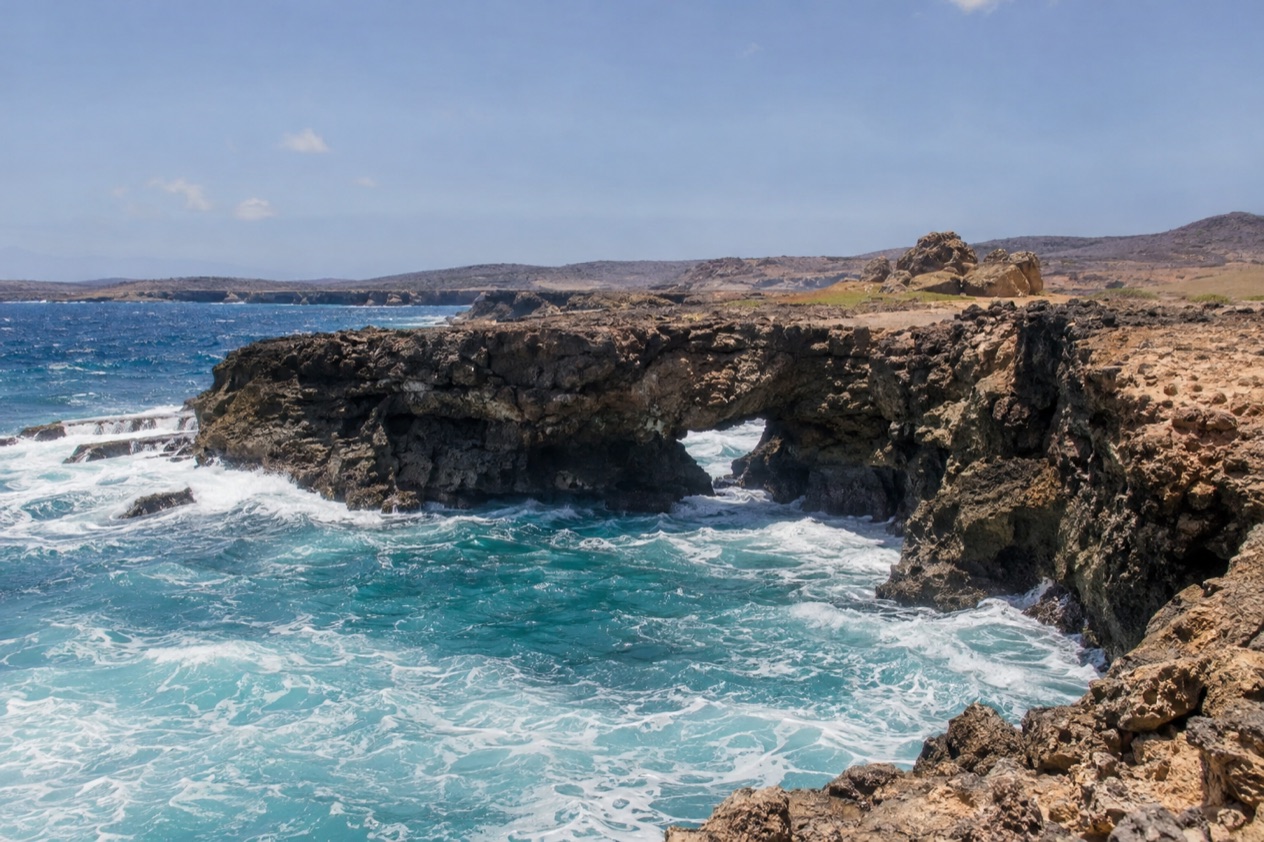
On Aruba’s north coast the land stops abruptly. Limestone ledges the color of old bone drop to a sea that throws itself at them, spray hangs in the air, and the wind pulls at your hat.
Somewhere in that noise stands the place where the island’s best-known stone arch once reached over the surf, and where its remains and a smaller arch beside them still draw people to the edge. It is a short, windswept stop on the wild side of the island, more about the force of the water than about a single photograph.
Is visiting the Natural Bridge worth it?
Yes, if you like seeing what the ocean does to rock, and especially if you are already exploring the rugged north coast. It suits travelers who prefer a lookout over a beach towel, photographers who enjoy dramatic coastlines, and anyone curious about how this dry, flat island was shaped. If you expect a giant stone arch to walk beneath, you will find something different, and it helps to know why.
The largest and most photographed natural bridge on Aruba collapsed in 2005. For years it was the image on postcards, a wide span of limestone with the sea churning through the opening below.
What remains is still a stop on island tours, and people still walk to the edge to look at the broken stone and the water that brought it down. The collapse is part of the story rather than the end of it, because the same waves are working on the neighboring rock right now.
What sets this stop apart from similar places nearby is how much sits close together. The original site lies between the ruins of the Bushiribana gold mine and Andicuri Beach, and the adjacent Baby Bridge stands right beside it.
Aruba counts four natural bridges among its wonders of nature, and this is the one with a shop, a snack bar and the easiest approach. Others are wilder and take more effort to reach, which makes this area a sensible first look before you decide how far to go.
The Wariruri Bridge has become the most visited since the original fell, and it is a regular on tours, mountain biking outings and horseback rides. The Seroe Colorado Natural Bridge asks for a little effort to climb down to, and the hill above it still holds remnants of massive turret cannons from World War II.
The Indjueq triple bridge, also called the tripod bridge, sits at Black Stone Beach. Each has a different character, and the Natural Bridge area is the gentlest introduction.
What to see at the Natural Bridge
The visit is built around the coast itself. You stand on a bare limestone shelf, the sea rolls in from the open Atlantic side, and the shapes around you show what thousands of years of waves and wind can carve. The pieces below are the ones worth slowing down for.
The remains of the original bridge
The collapsed span is the reason the place has a name. Look at the stone left behind: the pale, pitted limestone, the broken edges, the deep channel where the water used to pass under a roof of rock. It is easy to picture the arch because the geometry is still readable in what survives.
The spot is between the Bushiribana gold mine ruins and Andicuri Beach, so the surrounding landscape is just as striking as the stone. Low scrub, cacti and bare rock run to the horizon, and the sea sounds like constant thunder. People still come to see the remains, and tours still include them, which says something about how strong the place’s pull remains even without the arch.
Baby Bridge
Baby Bridge stands right next to the original and is the most accessible of all the island’s bridges. You can even reach it with your rental car. It is a smaller arch of the same limestone, with the sea working through the opening beneath it, and it gives you a complete bridge to look at after seeing the broken one.
Its size is part of its charm. You see how the process starts: a notch in the cliff, a hollow, then an opening that the waves keep widening. The bridge is worth studying from different angles, since the light and the spray change how the arch reads. Photographers tend to wait for a wave to surge through the gap before pressing the shutter.
The replica cunucu house
A souvenir shop and snack bar occupy the Natural Bridge area, housed in a replica cunucu house. Cunucu is the Papiamento word for the countryside, and the traditional cunucu house is a small, sturdy rural home, usually painted in bright colors, built for a hot and windy climate. Here the style is borrowed to give the stop a bit of local flavor.
The shop sells souvenirs, and the snack bar is where you can sit with something to drink after time in the wind. It also offers restrooms, which at a coastal stop like this one is a plain, welcome fact. Stepping inside, you get a small taste of the island’s rural building tradition before you head back out to the cliffs.
The trail toward Indjueq
A nice hiking trail leads from the collapsed Natural Bridge to Indjueq, the natural triple bridge, also called the tripod bridge, at Black Stone Beach. It turns a quick viewpoint stop into a walk through open coastal country, with the sea on one side and the dry interior on the other.
Along such a route you notice the details a car window skips: the way cacti lean away from the wind, the dark stones that give Black Stone Beach its name, and the restless surf below the cliffs. The trail suits those who like to see a coastline on foot and turn a viewpoint into part of a longer outing.
Hours, tickets and rules
This is an open coastal landscape rather than a ticketed monument, and the experience is simple: you walk out onto the rock, look, take photos and enjoy the shop and snack bar housed in the replica cunucu house. The shop offers food, beverages, restrooms and souvenirs, which covers the basic comforts of the stop.
Baby Bridge also has a guest shop with the same kinds of things. Both the original site and the smaller arch beside it are easy to take in together, and the approach to Baby Bridge works with a rental car. Because the cliffs are exposed and the waves are powerful, it makes sense to treat the edge with respect and let the sea set the pace of your visit.
One rule concerns what you put on your skin. Aruba has banned sunscreens containing oxybenzone since 2019, and visitors are encouraged to use mineral-based reef-safe sunscreens, which are more likely to be biodegradable and gentler on the environment. Local companies such as Aruba Aloe and Arubalife Organics sell sunscreen on the island, so you can pick one up after you land.
How to get to the Natural Bridge
The Natural Bridge sits on Aruba’s north coast, between the Bushiribana gold mine ruins and Andicuri Beach. That puts it on the rough, windward side of the island, far from the calmer resort beaches along the western shore. The island is small, with an area that matches a modest county, yet the north coast feels like another world compared with the hotel strips.
Baby Bridge is the most accessible of the island’s natural bridges, and you can even get there with your rental car. That is the most useful practical fact for planning: the approach to the smaller arch next to the original site does not need a hike or a special vehicle. If you are staying in Oranjestad, Palm Beach or Eagle Beach, you reach the north coast by heading across the island, and you will notice the landscape drying out and turning wilder as you go.
Tours also include the remains of the collapsed bridge, so you can see it as part of a guided circuit of the island. The Wariruri Bridge appears on tours, mountain biking trips and horseback rides, which gives you several ways to see this coast without driving yourself.
If you want to go further on foot, the hiking trail from the collapsed Natural Bridge leads to Indjueq. The Seroe Colorado Natural Bridge is a different matter, since reaching it takes a little effort to climb down. Among all of these, the Natural Bridge area is the one that asks the least of you.
When to visit the Natural Bridge
Aruba has a dry climate and an arid landscape, unlike much of the Caribbean, so the north coast is a place of sun, rock and wind in most months. The general best time to visit the island runs from February to August, and the peak season falls between December and April. A visit to the Natural Bridge fits well into any of those stretches, since it does not depend on a beach day.
Time of day changes how the place feels. Early in the day the light is softer on the pale limestone, and the shadows show the hollows in the rock. Later, the sun hits the sea and the spray flashes white against dark water. With so little shade on an exposed shelf of stone, the cooler hours are kinder to those who want to linger and take photographs.
The waves are the true attraction, and they pound the north coast all year. In calm weather the surf is a steady roar, and when it gets bigger the spray reaches higher against the cliffs. Winter and spring, when many travelers arrive, bring plenty of visitors to the island, so a stop here can pair well with a morning on the road before the day warms up.
If you are building a loop of the north coast, think of the Natural Bridge as the middle of the route: the gold mine ruins on one side, Andicuri Beach on the other, and the rest of the rugged shoreline stretching beyond. Giving it a slot when you are not rushed lets the place work on you, and the sound of the sea does most of the talking.
Tips for your visit
Bring sun protection, and make it a mineral-based reef-safe sunscreen, since sunscreens with oxybenzone have been banned. A hat that stays on in strong winds helps, as does water to drink. The shop and snack bar are there for a cold drink or a snack, and the restrooms at the guest shop are a convenience on a coast with little else around.
Plan this as a stop in a larger day rather than a full outing in itself. It combines well with the Bushiribana gold mine ruins, whose broken walls once held a smelter and now stand against the sky, and with Andicuri Beach, on the other side of the Natural Bridge area. Anyone with energy and a taste for walking can take the trail toward Indjueq and Black Stone Beach.
For families, Baby Bridge is the most accessible of the bridges, and that makes it the natural choice if you want to see an arch without a climb. Children often enjoy the replica cunucu house and the sight of waves slamming into the rock. Anyone thinking about the Seroe Colorado bridge should know that the way down takes effort.
Take your time at the edge and let a few waves come in before you move on. The best moments here are small ones: spray lifting over the rim, the color of the water shifting from deep blue to churned white, a lizard on the warm stone. Photos help, but standing still for a while teaches you more about this coast than any picture will.
Good to know before you go
The U.S. State Department rates Aruba Level 1, ‘Exercise normal precautions,’ and says Aruba is generally a safe destination for travelers, with petty crime the main concern in popular tourist areas.
The currency of Aruba is the Aruban florin, and Papiamento and Dutch are the official languages, so a few words of Papiamento at the snack bar are a pleasant touch. Treat the cliff edge with respect, since this is open, wave-battered rock, and keep your belongings close as you would at any popular stop. Wear shoes with good grip for the uneven limestone, and let the wind and the surf set the mood for an unhurried visit.
Sources
- Aruba Tourism Authority, Natural Bridges (https://www.aruba.com/us/explore/natural-bridges), checked October 9, 2026
- Aruba Tourism Authority blog, Natural bridges (https://www.aruba.com/us/blog/wonders-of-nature-natural-bridges-in-aruba), checked October 9, 2026
- Wikipedia, Aruba (https://en.wikipedia.org/wiki/Aruba), checked October 9, 2026
- Aruba Tourism Authority, Best time to visit (https://www.aruba.com/us/our-island/one-happy-island/when-is-the-best-time-to-visit-aruba), checked October 9, 2026
- Aruba Tourism Authority blog, Responsible guest (https://www.aruba.com/us/blog/how-to-be-a-responsible-guest-protecting-arubas-beaches-and-marine-life), checked October 9, 2026
- U.S. Department of State, Aruba Travel Advisory, Level 1, issued August 19, 2026 (https://travel.state.gov/content/tsg_aem/us/en/home/international-travel/travel-advisories/destination.abw.html), checked October 9, 2026
To plan your stay
- Best Time to Visit Aruba: Weather by Month, Peak Season and Festivals
- Where to Stay in Aruba: Palm Beach, Eagle Beach, Oranjestad and All-Inclusives
- Aruba Airport (AUA): Arrival, Getting to Your Hotel, U.S. Preclearance and Departure
- Know Before You Go to Aruba: Entry Forms, Money, Water and Local Customs