
At a beachfront restaurant on Palm Beach, a server greets the next table in English, turns to a colleague and answers in Papiamento, then switches to Spanish for a couple from Colombia. That small shuffle is everyday life on the island. English will carry you through a vacation, and a few words of the local language will earn you a smile.
What language do they speak in Aruba?
Aruba has two official languages, Dutch and Papiamento, and the island lives in several more. Papiamento became official alongside Dutch on March 19, 2003, which put in law what had long been true in the streets, kitchens and radio stations. Dutch is the language of official documents and of education, while Papiamento is the one people use to joke, argue, flirt and call across a yard.
Most Arubans speak at least four languages, and English and Spanish are usually among them. That is not a party trick. It comes from the island’s position, a short hop from the Venezuelan coast and a long history of welcoming visitors. A single family dinner can move between three languages without anyone noticing.
Dutch: the language of paperwork and school
Aruba is a constituent country within the Kingdom of the Netherlands. It manages its own internal affairs and shares powers such as defense and foreign policy with the Netherlands, so Dutch is the thread that ties the island to that larger kingdom. The Dutch first settled here in the 17th century, and the language has stayed in the legal and administrative life of Oranjestad ever since.
As a visitor you will mostly meet Dutch in print: official forms, government buildings, some signs and the names of streets and institutions. It is rarely the language you need to speak. You may also hear it from Dutch travelers who fly in directly from the Netherlands, a long trip from an island that lies far across the Atlantic.
Papiamento: the voice of everyday life
Papiamento is the language commonly spoken in everyday communication. Listen at a bakery counter or a bus stop and you will hear it in full flow, with a rhythm that sounds a little Spanish, a little Portuguese and entirely its own. Local radio, church services and neighborhood chatter all run on it.
You do not need to speak it, but you will notice it everywhere: on menus, on the names of dishes such as keshi yena (a stuffed cheese dish), on pastechi (fried pastries) signs and in the greetings that shop owners toss at you as you walk in.
English, Spanish and the rest
Many Arubans are fluent in English and Spanish thanks to tourism and to proximity to Venezuela and other Caribbean islands. English is often taught in schools, and people who work in the tourism industry are generally proficient in it. Spanish is just as natural to many, so you may overhear it at a market stall or in a taxi line.
The island’s mix does not stop there. You may meet someone who can talk with you in French, Chinese, Italian or something else entirely. For a small island, the conversation is wonderfully international.
What is Papiamento?
Papiamento is a Creole language that originated in the region and became the everyday voice of Aruba. A Creole grows out of the meeting of several tongues, and this one has kept absorbing. Over time it has grown in syntax and vocabulary through borrowings from Dutch, English and Spanish, which is why a visitor with a little Spanish will catch a word here and there and a Dutch speaker will recognize others.
That blend is the best clue to the island’s story. A language that takes from Dutch, English and Spanish tells you who sailed, traded, governed and settled here, and who still arrives today. Its official status since 2003 reflects how much islanders value it as part of their identity.
Words worth learning
A few phrases go a long way, and Arubans tend to appreciate the effort. The classic is bon dia (good morning), followed by bon tardi (good afternoon) and bon nochi (good evening). Danki means thank you, and the island’s famous welcome, bon bini, means welcome. You will see it on signs at the airport and in hotel lobbies.
Say them with a smile and do not worry about pronunciation. Most people respond warmly, often with a grin and a quick answer in English to keep things moving. Treat the words as a way to greet people rather than a test you must pass.
- Bon dia: good morning, a friendly opener at any shop or breakfast table.
- Bon bini: welcome, which you will read and hear constantly.
- Danki: thank you, useful after every meal and every ride.
- Mi gusta means you like it, a nice compliment for a dish at lunch.
Where you will meet it
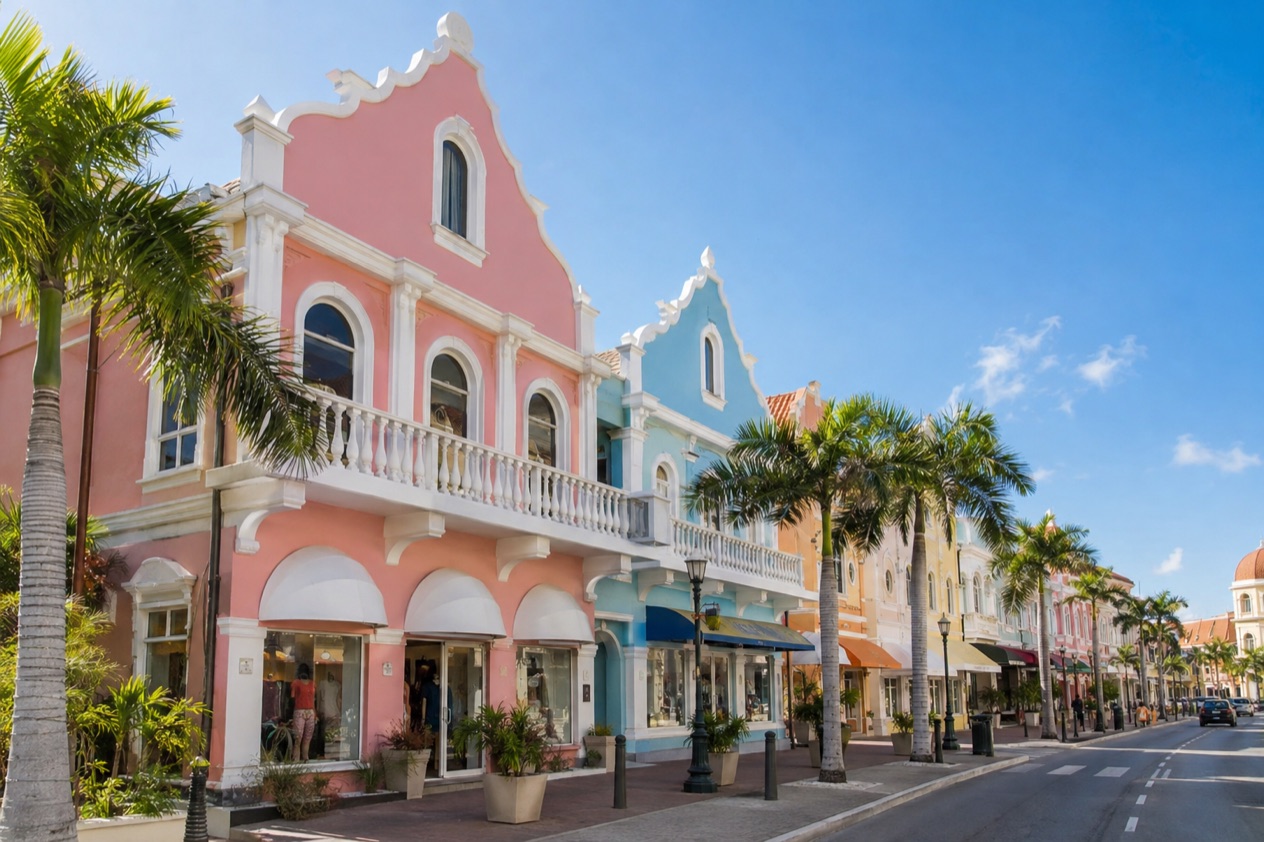
Papiamento shows up most on menus, in music, and in conversation between staff. In Oranjestad, the capital and largest city, it is the language of the street and the shop counter. In towns such as San Nicolas, Santa Cruz and Savaneta, it is the one you will hear drifting out of doorways and from porches in the evening.
Ordering a local dish by its Papiamento name is a pleasant small moment. Ask for keshi yena or a pastechi by name and you will often get a nod of approval, and sometimes a short explanation of how the cook makes it.
Will English get you by?
Yes, English will get you through a vacation in Aruba without trouble. It is widely understood on the island, and many Arubans who work in tourism are proficient in it, so hotels, restaurants, tour desks and shops are all comfortable places to use it.
One honest caution: widely understood does not mean everyone speaks it fluently. Away from the resort strip, you may meet someone whose English is limited, and a slower pace, simple words and a smile solve nearly everything. Spanish can be a useful backup, since many people speak it easily.
On the resort strip and in Oranjestad
Along Palm Beach and Eagle Beach, English is the working language of daily visitor life. Servers, front desk staff, activity hosts and bartenders handle it with ease, and you can order, ask questions and make plans without ever reaching for a phrasebook. The capital works the same way for shops, cafés and restaurants.
Even so, you will often hear staff speaking Papiamento among themselves, and then easily switching to you in English. Think of it as the island’s natural rhythm rather than anything aimed at you.
Beyond the resorts
Once you wander toward neighborhoods like San Nicolas or small local spots, the language of the room shifts. You will hear more Papiamento and more Spanish, and some people may be shy with English. This is where a bon dia and a danki do real work, opening the door to a friendly exchange.
Arubans are used to visitors from all over, and the chances are good that someone nearby can bridge the gap. You may find yourself talking with a person who can switch among English, Dutch, Spanish and more, which is part of the pleasure of a small island with big connections.
Little habits that help
- Greet first in Papiamento, then continue in English. It sets a warm tone right away.
- Speak a little slower than at home and skip slang, which can blur across languages.
- Learn the Spanish numbers and basic courtesies as a backup for local markets.
- Expect Dutch on official documents and forms, but not in conversation.
Good to know before you go
The U.S. State Department rates Aruba Level 1, ‘Exercise normal precautions,’ and says Aruba is generally a safe destination for travelers, with petty crime the main concern in popular tourist areas.
The currency is the Aruban florin (AWG). Aruba is a dry island with an arid landscape, unlike much of the Caribbean, so the climate is a pleasant backdrop to conversations on the terrace. Whatever language you use, a friendly greeting costs nothing and tends to be returned. The people you meet are likely to be happy to practice English, share a word of Papiamento and tell you where to eat next.
Sources
- Aruba Tourism Authority, Language (https://www.aruba.com/us/our-island/island-facts/language), checked October 9, 2026
- Aruba Tourism Authority, Is Aruba a country (https://www.aruba.com/us/our-island/history-and-culture/is-aruba-a-country), checked October 9, 2026
- Wikipedia, Aruba (https://en.wikipedia.org/wiki/Aruba), checked October 9, 2026
- U.S. Department of State, Aruba Travel Advisory, Level 1, issued August 19, 2026 (https://travel.state.gov/content/tsg_aem/us/en/home/international-travel/travel-advisories/destination.abw.html), checked October 9, 2026
To plan your stay
- Best Time to Visit Aruba: Weather by Month, Peak Season and Festivals
- Where to Stay in Aruba: Palm Beach, Eagle Beach, Oranjestad and All-Inclusives
- Aruba Airport (AUA): Arrival, Getting to Your Hotel, U.S. Preclearance and Departure
- Know Before You Go to Aruba: Entry Forms, Money, Water and Local Customs