
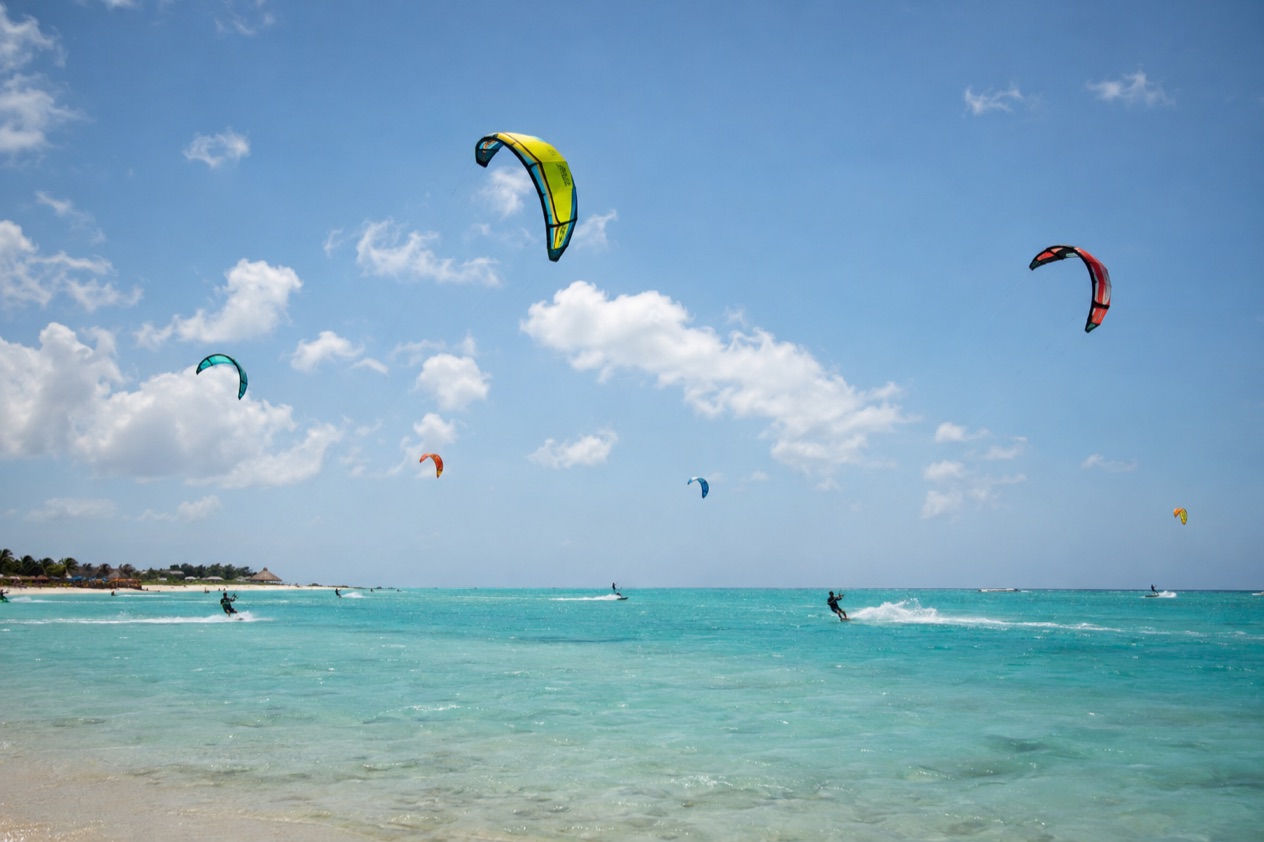
Out past the shore, a row of bright kites hangs over the water, snapping taut each time a rider cuts across a wave, while the trade wind hums steadily from the east. On the sand, windsurfers carry their sails like sheets drying on a line, and everyone watches the sky for the next gust. This is the Aruba that wind lovers come for, a dry island where the breeze is the main attraction, with a rough coast for experts and a gentler shore for people just starting out.
Where can you kitesurf and windsurf in Aruba?
You can ride in two very different settings: the rugged coast around Boca Grandi, where waves and strong currents test advanced kitesurfers, and the south shore, where flat-water spots and gentler winds suit people learning. Aruba is one of the most popular places on earth for windsurfers and kitesurfers, and the island offers both flat-water locations and challenging wave conditions. Choosing between them is really choosing how much of a fight you want from the sea.
The appeal goes beyond the sport itself. Beach bars, a friendly crowd on the sand and a sky full of colored canopies make even a spectator’s afternoon worthwhile. Many visitors who never touch a board still spend an hour or two watching the action, and the rhythm of the place, with riders launching, crashing, laughing and trying again, is part of the island’s character.
Boca Grandi, for advanced kitesurfers
Boca Grandi is a bay on the rugged coast, a five-minute drive from downtown San Nicolas, the second largest city in Aruba. A bright red giant anchor marks the entrance to the beach, and it makes a gorgeous backdrop for photos. Beyond it, the scene is wild: steady trade winds, challenging waves and a sea that feels nothing like the resort beaches on the other side of the island.
The beach attracts advanced and adventurous kitesurfers, both locals and visitors, and it is described as a Caribbean beach paradise for exactly those riders. Swimming is strongly discouraged here because the current is strong, so this is a place to watch, walk and photograph if you are not riding. Beachcombers find driftwood, corals and all sorts of curiosities washed ashore, which makes a slow stroll along the waterline rewarding even on a day without a board.
A beach bar serving chilled drinks has recently been added, so you can settle in and watch the kites with something cold in hand. Boca Grandi also makes a natural stop on a drive toward Baby Beach, in the south near San Nicolas, which turns a windy morning into a half-day outing along the coast.
Fisherman’s Huts and the Aruba Hi-Winds
Fisherman’s Huts is the center of the island’s windsurfing scene and the home of the Aruba Hi-Winds, the largest windsurfing event in the Caribbean. The competition is held every year in late June or early July and lasts five days. Professional and amateur windsurfers and kitesurfers take part, and kids and juniors compete too, so the shoreline fills with young riders as well as veterans.
The event features slalom racing and freestyle competition. Kitesurfers compete at Boca Grandi, while the rest of the program unfolds at the Huts. During the weekend, kitesurfers also demonstrate their skills at The Huts, even after dark, which turns the beach into something close to a festival. If your vacation overlaps with that stretch of early summer, it is a lively time to see the sport packed together like nowhere else.
Outside the competition days, the Huts remain a base for wind and water sports. Paddle board rentals are available from many resorts and water sports companies along Palm Beach, Fisherman’s Huts and Eagle Beach, so non-windsurfers in your group have something to do nearby.
Surf and paddle boards on the same winds
The wind that fills your sail also shapes the island’s waves. Most surf breaks are located along the north coast, where waves are typically of decent size but choppy because of the strong trade winds, and they are best navigated on a shortboard. Aruba may not be known as the best surfing island in the Caribbean, but seasoned surfers appreciate the challenge of its fast-breaking waves.
Longboarders can catch smaller waves with a longer, smoother ride just offshore from Arashi Beach. The local surfing community is especially friendly and gracious toward guest surfers at the breaks, and several surf contests are held throughout the year, with winners representing Aruba at international competitions. A visiting surfer who greets people with a smile is usually welcomed into the lineup.
How windy is Aruba?
Very windy, and reliably so: the island has constant trade winds of 15 knots, blowing from the east all year. That steadiness is the whole reason the sport thrives here. Riders do not wait for a storm or a season, because the breeze is simply part of every day, which makes planning a lesson or a session far less of a gamble than on most islands.
The airport station records an average of 16 mph in January, which gives you a feel for the baseline. On land, you notice it in small ways: palm fronds streaming westward, the fofoti trees on Eagle Beach leaning in the same direction, and hair that never stays where you put it. On the water, it means a sail or kite that comes alive the moment you step into the shallows.
What an east wind means for each coast
Because the wind arrives from the east, it meets the island’s windward coast first. That side, on the north and east, is rough and wild, with the kind of waves and currents that make Boca Grandi a challenge. The leeward coast, to the west and southwest, is where the resort beaches sit, and the winds there feel different on the shoreline even though the same breeze is blowing across the island.
The south shore is the sweet spot for newcomers, with gentler winds for novice windsurfers and kitesurfers. That contrast is the real map of Aruba for this sport: the same trade wind, but a rugged stage for experts on one side and a more forgiving one for learners on the other. Pick your coast according to your skills, not your ambition.
The sea you ride in
Warm water is part of the pleasure, since a wetsuit is not what the sea off Oranjestad asks of you. The sea feels warm for four months across the year, and a full day’s average is a shade lower.
| Month | Sea surface off Oranjestad (°F) |
|---|---|
| January | 81.0 |
| April | 80.8 |
| July | 82.2 |
| October | 86.5 |
Falls in the water, which every kitesurfer and windsurfer has plenty of, are a lot more pleasant when the sea feels like this. Between sessions, the wind dries you off quickly on the sand, and a cold drink at a beach bar is rarely far away.
Wind through the year
There is no true off season for wind. The constant trade winds mean riders find a breeze in every month, and the one event that gathers the community, the Hi-Winds, lands in late June or early July.
If you want to see the sport when it is most social, that is the time. If you would rather have a quieter beach and your own space on the water, any other stretch of the calendar offers the same reliable breeze.
Dry land and constant wind also shape how a day feels. Mornings and afternoons both carry the breeze, and a hat tied under the chin is not a bad idea. The wind keeps the heat from feeling heavy, though it can also hide how much sun you are taking, so give your skin the respect you would on any open water.
Can beginners learn in Aruba?
Yes, and the south shore is the place to do it. It has gentler winds for novice windsurfers and kitesurfers, and there is an abundance of rental equipment and instructors along it. You do not need to arrive with any experience, just with a willingness to fall in warm water a few times and get up again.
Learners gain a lot from the steady wind, because they can build on one session after the next without the conditions changing wildly. The island also has flat-water locations, which is what a first-timer wants underfoot while working out how the board, sail or kite behaves. Boca Grandi, by contrast, is for advanced kitesurfers, so keep it as a destination to watch until your skills have grown.
Learning on the south shore
With instructors and gear close at hand along the south shore, a lesson becomes a simple part of a beach day rather than a big expedition. You spend time on land first, getting a feel for the sail or the kite, and then move into the shallows. The reward for patience is that first moment when the wind takes hold and you glide a short way across the surface.
Progress comes in small, satisfying steps, and the sight of experienced riders nearby helps. Watching them hold a line or launch off a wave shows you what the next level looks like, while the local community around the sport tends to be welcoming to newcomers. It suits couples, friends and families who want one shared challenge on a vacation otherwise spent on sand.
Paddle boarding as a gentle start
If a sail or a kite feels like too much at first, stand-up paddle boarding is a friendly way to get used to the water. The sport originated in the Pacific and has become hugely popular in Aruba. Paddle board rentals are available from many resorts and water sports companies along Palm Beach, Fisherman’s Huts and Eagle Beach, which makes it easy to try for an hour or an afternoon.
SUP tours take visitors to the calm waters and mangrove lagoons along Aruba’s southern fringe, which is protected by Arikok National Park. There, paddleboarders can see exotic local and migratory bird species and other flora and fauna in the protected area. It is a quieter, more observant side of the island’s water life, and a good rest day between sessions of fighting the wind.
Moving up to waves and wind
Once the basics feel natural, the island has places to grow. Aruba offers challenging wave conditions, and Boca Grandi remains the benchmark for advanced kitesurfers, with steady trade winds and testing waves. Treat it as a goal rather than a first stop, and spend your early days on the south shore building confidence.
Some riders also try the surf breaks along the north coast, where fast-breaking waves reward a shortboard and a sharp eye. Whatever you choose, the island gives you room to progress, from flat water and gentle winds to a rugged coast that keeps even experienced riders humble.
Good to know before you go
The U.S. State Department rates Aruba Level 1, ‘Exercise normal precautions,’ and says Aruba is generally a safe destination for travelers, with petty crime the main concern in popular tourist areas.
Swimming is strongly discouraged at Boca Grandi because the current is strong, so treat it as a place for advanced kitesurfers and for watching. The Aruba Hi-Winds takes place every year in late June or early July, and its weekend demonstrations at The Huts run even after dark. For lessons and rentals, the south shore is where instructors and equipment gather, and a beach day there often ends with a view of the kites against the evening sky.
Sources
- Aruba Tourism Authority, Kite and windsurfing (https://www.aruba.com/us/things-to-do/on-the-water/kite-windsurfing), checked October 9, 2026
- Aruba Tourism Authority, Boca Grandi (https://www.aruba.com/us/explore/boca-grandi), checked October 9, 2026
- Aruba Tourism Authority, Surf and paddleboard (https://www.aruba.com/us/things-to-do/on-the-water/surf-paddle-board), checked October 9, 2026
- Open-Meteo Marine API, average 2015-2024, checked October 9, 2026
- Meteorological Department Aruba (meteo.aw), Summary Climatological Normals 1991-2020, Queen Beatrix Airport station (http://www.meteo.aw/files/Download/climatnormals19912020.pdf), checked October 9, 2026
- U.S. Department of State, Aruba Travel Advisory, Level 1, issued August 19, 2026 (https://travel.state.gov/content/tsg_aem/us/en/home/international-travel/travel-advisories/destination.abw.html), checked October 9, 2026
To plan your stay
- Best Time to Visit Aruba: Weather by Month, Peak Season and Festivals
- Where to Stay in Aruba: Palm Beach, Eagle Beach, Oranjestad and All-Inclusives
- Aruba Airport (AUA): Arrival, Getting to Your Hotel, U.S. Preclearance and Departure
- Know Before You Go to Aruba: Entry Forms, Money, Water and Local Customs