
On a January weekend in Oranjestad, brass and steel-drum bands rehearse in the evening air, and groups of sequined costumes spill out of community halls as the Carnival season gathers speed. Out on the beaches the east wind keeps the palapas rattling and the kites high over the water. January is the heart of Aruba’s dry season, with Carnival building toward its February finish, and it suits anyone who wants beach days, music in the streets and a little local color.
What is the weather like in Aruba in January?
January in Aruba is hot, breezy and mostly sunny, with a few quick showers passing through, and the sea is warm enough that you will not hesitate at the water’s edge. The island is small and flat, and the same trade wind crosses all of it.
| Place | Average high (°F) | Average low (°F) | Rain (in) | Rain days | Sea (°F) |
|---|---|---|---|---|---|
| Oranjestad | 86.5 | 76.6 | 1.73 | 10.8 | 81.0 |
The wind is the real feature of the month. It blows from the east all year and averages about 16 mph in January, which takes the edge off afternoons in the mid-80s and makes shade comfortable even at midday. Nights stay warm, so a light layer is for the breeze rather than for cold.
Rain falls on roughly one day in three, usually as a short shower that leaves the sun to dry the pavement within the hour. The dry season runs from January to April, but January is the wetter edge of it, a little rainier than February.
The sea runs a shade warmer off Palm Beach than the cooler water off San Nicolas, at 80.7°F and 80.4°F, a difference you will barely feel. The windward north and east coasts are rougher than the resort side.
Where to go in Aruba in January
Aruba covers less than 70 square miles, so you do not choose a region the way you would on a big country. You choose a coast, and in January the choice is between the sheltered west, the quieter south and the wild windward side.
The leeward coast: Palm Beach, Eagle Beach and Oranjestad
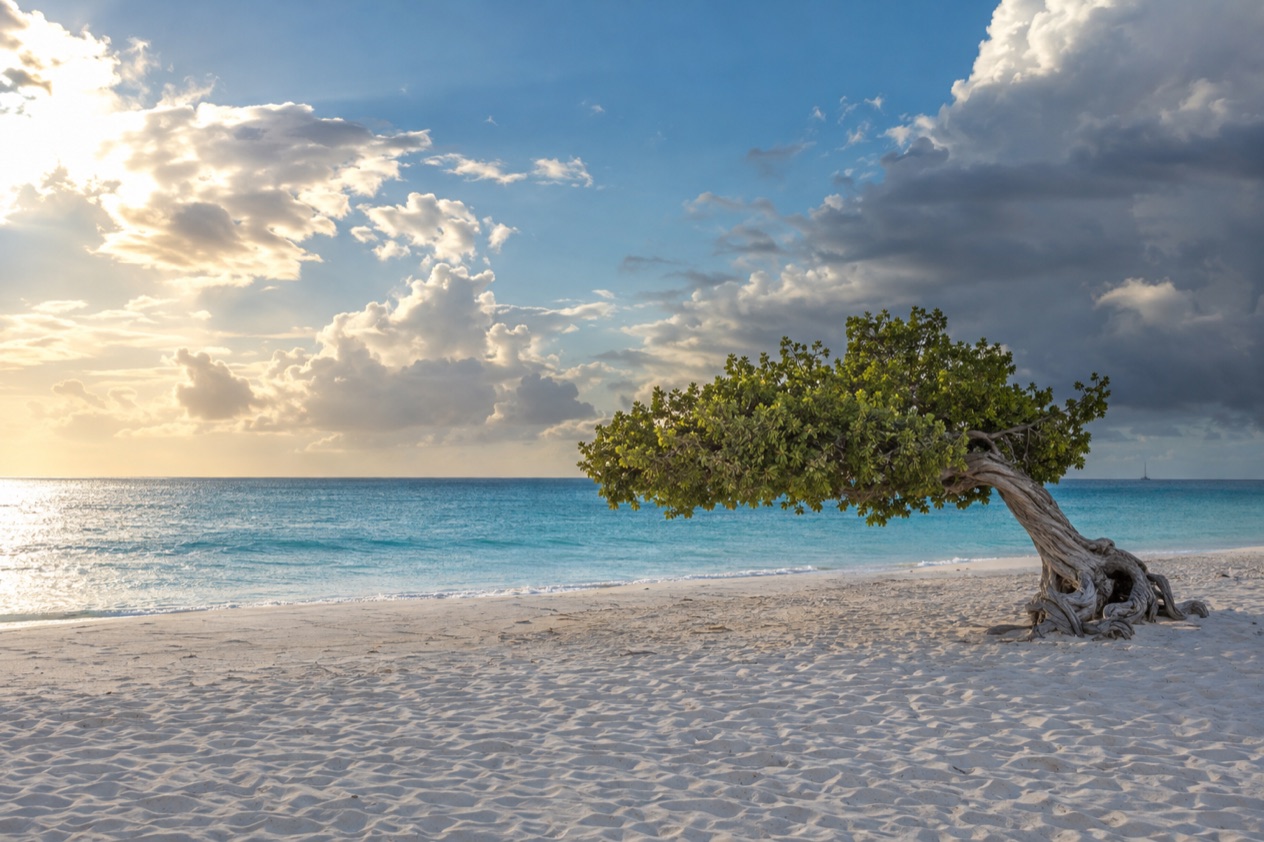
The west and southwest coast carries the resort beaches, and January is when they feel most alive. Palm Beach, the strip of resorts in the Noord district, has beach bars, water sports and evening walks past lit-up terraces. Eagle Beach is wider and more open, famous for the fofoti trees that lean over the sand, shaped by years of trade wind.
Oranjestad, the capital, is where Carnival shows up in January, with practice nights, parades and pop-up stages. Its harbor is lined with pastel Dutch colonial buildings, and a morning wandering the shops and waterfront cafés makes a good break from the sun. Evenings suit dinner outdoors, since the air stays warm after dark.
The south: San Nicolas and Baby Beach
San Nicolas, at the southern end, is the town to visit for its murals. Large painted walls cover buildings and side streets, and in January there is often music and a street feel, with Carnival energy spilling into the neighborhood. A slow walk with a camera and a pastechi (a fried pastry filled with cheese, meat or fish) in hand is a good way to spend a morning.
Baby Beach lies in the south near San Nicolas and is one of the best beaches for snorkeling. Savaneta, along the same stretch, is where you can look for local seafood restaurants by the water. The south feels less polished than the resort strip, which is the point of coming.
The windward coast: the north and east
The north and east coasts face the trade wind head-on, and the sea there is rough and wild. January is a fine month for them, with the dry season keeping the land drier and the light clear. The ruins of the Bushiribana gold smelter stand on the north coast, and Arikok National Park covers a large share of the island’s rugged interior and shore.
Hooiberg, the lone hill in the middle of the island, gives a view across the flat land to both coasts. The California Lighthouse marks the northwest tip. Pair a day out here with an afternoon on a sheltered beach on the west side, since the windward coast is for looking and walking rather than lounging.
What to do in Aruba in January
Carnival is the big story. The season officially begins every year on November 11 at 11:11 a.m., and the best dates are in January and February, when most events, celebrations and parades take place. It ends on Shrove Tuesday with the midnight burning of King Momo, the figure who presides over the festivities.
Carnival in Oranjestad and the neighborhoods
In January, Carnival is a string of events more than a single day. Bands and groups practice, neighborhoods stage their own parades and Oranjestad hosts the bigger gatherings. The Grand Parade in Oranjestad comes in February, so January is the build-up, with the costume-making and rehearsals that make the season feel local.
There are queen elections too. The Children’s Carnival Queen Election features contestants aged 6 to 9, and the Aruba Carnival Queen Election welcomes participants between 17 and 25. Both are staged shows, full of sequins and music, and they give a good sense of how seriously the island takes the season.
On and in the water
The ocean is warm year-round, and the clear water lets snorkelers and divers explore reefs and wrecks. Malmok Beach, Boca Catalina, Mangel Halto and Baby Beach are among the best beaches for snorkeling. Snorkel tours stop at the Antilla, the World War II shipwreck.
The steady trade wind, about 15 knots, makes Aruba one of the most popular places on earth for windsurfing and kitesurfing. Even if you do not sail, watching the colorful kites cross the sky is an easy way to pass an afternoon.
Eating the island
Aruba’s home cooking draws on Amerindian, European, African and Asian influences. The first people, the Caquetio, ate freshly caught fish and conch, and both still turn up on menus. Look for keshi yena, a baked cheese dish filled with spiced meat, and pastechi at breakfast or as a snack.
Is Aruba busy in January?
Yes, January sits inside the peak season, which runs from December to April, and the island feels lively from the airport to the beach bars. Travelers come to escape the northern winter, and Carnival adds locals and visitors to the mix at events around the island.
The resort side, Palm Beach and Eagle Beach, is where the crowds gather, with sun loungers, restaurants and water-sports operators all in full swing. Oranjestad has extra energy on Carnival evenings, when streets close for parades and music carries over the harbor.
The quieter pockets are away from the resort strip. The south around San Nicolas has a local pace, and the windward north and east coasts have wide stretches of rock and surf with few people. Arikok National Park rewards a visit for its landscape rather than its facilities.
Mornings and evenings tend to feel more relaxed than the middle of the day on any beach. If the wind is strong, the sheltered west side is where most people settle, while kiteboarders head for the breezier spots.
What to pack for Aruba in January
Packing is simple because the weather is the same for the whole island: warm days, warm nights and a steady wind. The one difference is between the sheltered west coast, where light clothes are enough, and the windward coast, where the breeze and spray call for a layer.
- Light, breathable clothes for afternoons in the mid-80s, plus one or two outfits for evenings out.
- A windbreaker or light jacket for the trade wind, especially on the north and east coasts.
- Swimwear and a rash guard or snorkel gear if you plan to explore the reefs.
- A compact rain jacket or small umbrella for the short showers that pass through.
- Sunscreen, a hat and sunglasses, since the breeze hides how strong the sun is.
- Comfortable sandals plus closed shoes for rocky trails around Arikok National Park.
Good to know before you go
The U.S. State Department rates Aruba Level 1, ‘Exercise normal precautions,’ and says Aruba is generally a safe destination for travelers, with petty crime the main concern in popular tourist areas.
The hurricane season runs from June 1 to November 30, so January falls outside the official season. Aruba sits on the southern fringes of the hurricane belt, where damaging storms are rare. U.S. citizens do not need a visa, but they do need a passport valid for the entire stay, the Aruba ED Card completed within 7 days before travel, proof of return or onward travel, and enough money to cover the stay.
Is January a good time to visit Aruba?
Yes, January is a very good time for beach lovers, Carnival fans and anyone who likes a steady breeze, and the leeward coast around Palm Beach and Eagle Beach is the best base. The dry season has begun, the sea is warm and the island is in full festive mode.
Compared with December, the month is a little less rainy. December brings more rain at 3.15 inches, while January is lighter at 1.73 inches, and the sea is slightly warmer in December. The air feels about the same, with highs in the mid-80s both months. If you are weighing the two, January trades the holiday rush for a more settled pace, though it stays part of the peak season.
February is drier still, with far fewer rain days, and Carnival reaches its high point with the Grand Parade in Oranjestad. The sea is a touch cooler, but the weather is the most reliable. If you want the sunniest days, February wins. If you want to see Carnival taking shape, with rehearsals, queen elections and neighborhood parades before the big finish, January gives you the build-up.
The best time to visit Aruba in general is February to August, so January sits just outside that window, but the difference is small. The showers are short, the wind keeps you comfortable and the beaches, reefs and murals are all open to you. What makes January special is the sound of Carnival rehearsals drifting through Oranjestad while the east wind fills the kites over the beach.
Sources
- Meteorological Department Aruba (meteo.aw), Summary Climatological Normals 1991-2020, Queen Beatrix Airport station (http://www.meteo.aw/files/Download/climatnormals19912020.pdf), checked October 9, 2026
- Open-Meteo Marine API, average 2015-2024, checked October 9, 2026
- sunrise-sunset.org, sunrise and sunset calculated for the 15th of the month, checked October 9, 2026
- Aruba Tourism Authority, Weather and climate (https://www.aruba.com/us/our-island/island-facts/weather-and-climate), checked October 9, 2026
- Aruba Tourism Authority, Best time to visit (https://www.aruba.com/us/our-island/one-happy-island/when-is-the-best-time-to-visit-aruba), checked October 9, 2026
- Aruba Tourism Authority, Where is Aruba (https://www.aruba.com/us/our-island/island-facts/where-is-aruba), checked October 9, 2026
- Aruba Tourism Authority, Carnival in Aruba (https://www.aruba.com/us/our-island/history-and-culture/carnival-in-aruba), checked October 9, 2026
- Aruba Tourism Authority, Aruba Carnival (https://www.aruba.com/us/calendar/aruba-carnival), checked October 9, 2026
- Aruba Tourism Authority, Passports and visas (https://www.aruba.com/us/plan-your-visit/getting-to-aruba/passports-and-visas), checked October 9, 2026
- Aruba Tourism Authority, Sustainability (https://www.aruba.com/us/our-island/island-facts/sustainability), checked October 9, 2026
- Aruba Tourism Authority, Beaches and coves (https://www.aruba.com/us/things-to-do/beaches-and-coves), checked October 9, 2026
- Aruba Tourism Authority, On the water (https://www.aruba.com/us/things-to-do/on-the-water), checked October 9, 2026
- Aruba Tourism Authority, Scuba and snorkel (https://www.aruba.com/us/things-to-do/on-the-water/scuba-snorkel), checked October 9, 2026
- Aruba Tourism Authority, Local Aruba cuisine (https://www.aruba.com/us/things-to-do/dining/local-aruba-cuisine), checked October 9, 2026
- Aruba Tourism Authority, Kite and windsurfing (https://www.aruba.com/us/things-to-do/on-the-water/kite-windsurfing), checked October 9, 2026
- U.S. Department of State, Aruba Travel Advisory, Level 1, issued August 19, 2026 (https://travel.state.gov/content/tsg_aem/us/en/home/international-travel/travel-advisories/destination.abw.html), checked October 9, 2026
To plan your stay
- Things to Do in Aruba: Beaches, Arikok National Park, Island Tours and Food
- Where to Stay in Aruba: Palm Beach, Eagle Beach, Oranjestad and All-Inclusives
- Aruba Airport (AUA): Arrival, Getting to Your Hotel, U.S. Preclearance and Departure
- Know Before You Go to Aruba: Entry Forms, Money, Water and Local Customs