
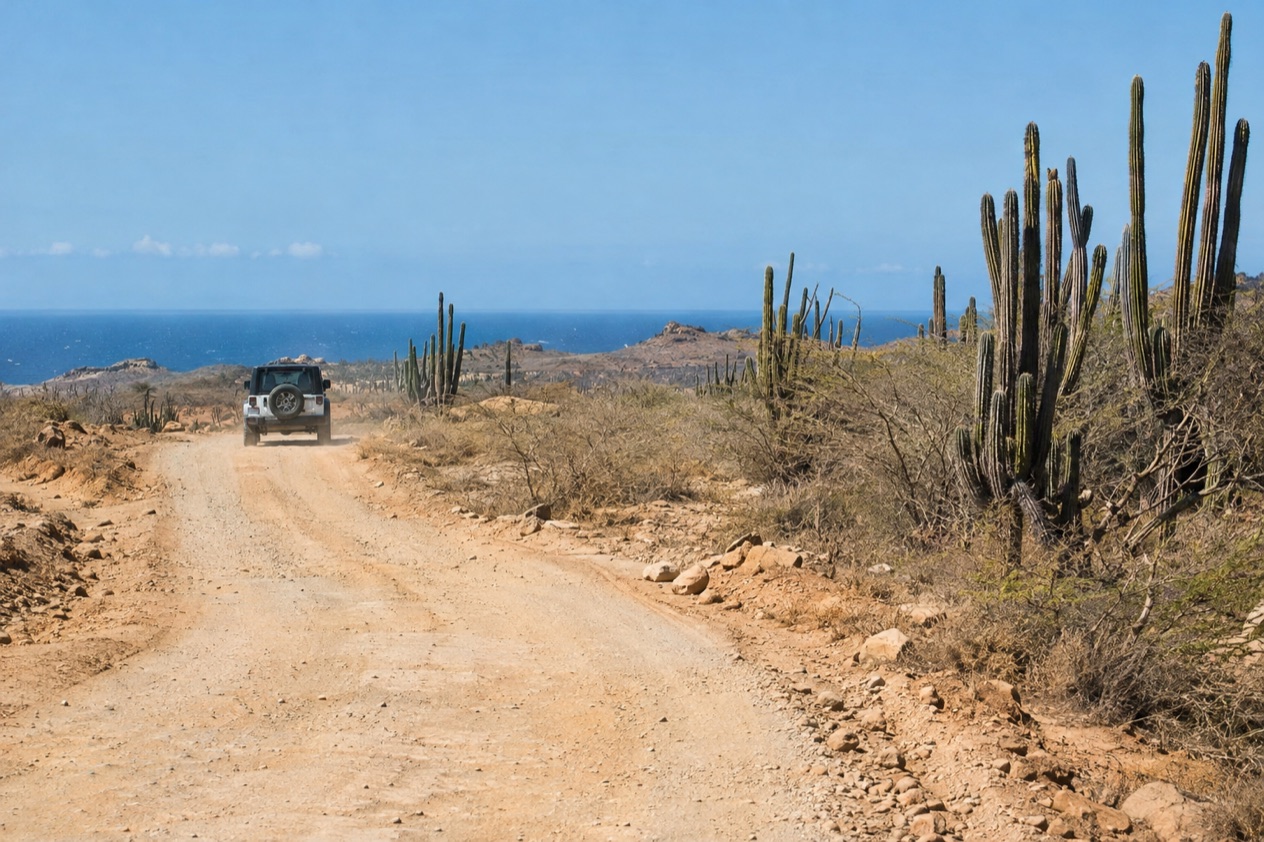
A line of open 4x4s rolls off the paved road and onto crushed limestone, and the dust hangs in the trade wind long after the last vehicle has passed. Ahead lie cactus fields, a rough northern coast and a chapel painted white against the brown hills.
Aruba is small, flat and dry, which is exactly why a day of touring it by jeep, bus, ATV or horse reveals so much of it. A jeep, bus, ATV or horse carries you past the beach to the island’s small, flat, dry interior.
What are the best tours in Aruba?
The best tours in Aruba are the guided ones that leave the resort strip for the wild side of the island, and the main choices are a jeep or bus circuit of the landmarks, a ranger-led day in Arikok National Park, an ATV ride and a horseback trail. Each gives you something different, so the right pick depends on whether you want to ride, walk, sit in air-conditioning or get dusty.
Aruba’s character changes quickly as you leave the leeward coast. The west side holds the resort beaches, while the north and east are rocky, windswept and mostly empty. Almost every tour is built around that contrast, and most of them end with a swim stop or a beach lunch to wash the dust off.
Guided jeep and bus circuits
The classic way to see the island in one outing is a guided circuit by 4×4 or bus. Jeep adventures run as convoys of ten or more vehicles, Jeeps and Land Rovers among them, so you travel in a group and stop together at each site. Both jeep and bus tours are led by local guides who fill the drive with stories of the island’s gold rush, its chapels and its desert plants.
Bus tours suit travelers who prefer air-conditioning and a seat out of the sun. Jeeps suit those who want the wind in their faces and the rougher tracks. Tours are sold by several island companies, including El Tours, ABC Tours, De Palm Tours, Fofoti Tours and Watapana Tours, and many finish at a private island or one of the island’s best beaches for swimming and snorkeling.
A day in Arikok National Park
Arikok is where the island looks most like itself: lava formations, limestone, quartz diorite, caves, Indian rock drawings and secluded bays such as Moro, Boca Prins and Dos Playa. The park deserves a full day, and it rewards slow travelers who like to stop at viewpoints and read the landscape.
Visitors need a ticket to enter, and the small fee goes toward preservation, educational programs and the animals. Tours led by park rangers are the way to understand what you are looking at, from the flora and fauna to the viewpoints. A private guided hike is also available for those who want to look at birds, flowers and geology at their own pace.
Tours from the cruise port
If you arrive by ship, many Aruban operators pick up cruise passengers at the port in Oranjestad, and you can also hop on a tour bus at a nearby hotel. The menu stretches beyond the landmark circuit. On the water you will find paddleboarding, surfing, parasailing, jet-skiing, canoeing, snorkeling, sky-diving and JetLeving, and on land there is shopping, sightseeing, off-roading, dining and gaming.
Reserve your favorite excursion beforehand so it is open on the day you dock. Check the ship’s departure schedule before you set off, so you know exactly when you need to be back at the pier.
What do jeep and bus tours visit?
Jeep and bus tours usually string together the island’s landmarks: the California Lighthouse, Alto Vista Chapel, Seroe Crystal, the Bushiribana gold mill ruins, Natural Bridge and the Guadirikiri caves. The route sweeps across the northern half of the island and into its wilder interior, with the order depending on the company.
What ties the stops together is the story of an island shaped by wind, wave and a short-lived gold industry. A good guide connects the lighthouse and the chapel to the people who lived and worked here, so the day feels like a story rather than a checklist.
California Lighthouse and Alto Vista Chapel
The California Lighthouse stands in the area known as Hudishibana, near the island’s northwestern tip. It watches over a stretch of coast where the land runs out in low rock and scrub, and the trade wind never really stops. Arashi Beach lies on the road toward it, just beyond Malmok, so tours often pass through that corner of the island.
Alto Vista Chapel is a small, quiet church that draws people from all over the island, especially for the annual pilgrimage on January 18th, the Feast of Santa Filomena. On an ordinary day it is a calm, whitewashed pause in a rugged landscape, a place to step inside and listen to the wind outside.
Bushiribana and the gold story
The ruins of the Bushiribana gold mill sit on the northern coast, a heap of stone walls that once processed ore from mines in the nearby hills during the nineteenth-century gold rush. Gold was discovered on Aruba in 1824, and prospectors had been drawn here as far back as the 1400s and 1500s. Over time the industry produced more than 3 million pounds of gold.
Standing among the ruins with the sea beside you, you can picture how isolated the work was. The Balashi Gold Mill, built at the tip of the Spanish Lagoon, is another remnant of the same story, so guides often use the two to explain how a small, dry island once had a mining boom.
Natural Bridge, Seroe Crystal and the Guadirikiri caves
The natural bridges of the north coast were carved from limestone cliffs by thousands of years of pounding waves and strong winds. The collapsed Natural Bridge is the best-known example, and Andicuri Beach lies just to its south on the windward coast. The sea here is rough, and you come to watch it rather than to linger.
Seroe Crystal and the Guadirikiri caves round out the circuit with a more inland, geological feel. The caves add a cool, dim contrast to the sunny coast, and a stop there is a welcome break from the open road before the tour heads for its finish on a private island or a beach.
Can you tour the island on your own?
Yes, you can piece together your own tour of Aruba, and the island is compact enough that the landmarks make natural stops one after another. Public buses and a free trolley cover the towns and hotel area, while the wilder sites in the northeast ask for a 4×4 or a guide.
Going solo means setting your own pace: a long lunch in Savaneta, an hour at a quiet bay, a detour to a rock formation that caught your eye. The trade-off is that the best-known rugged spots are not reachable by regular car.
By bus and trolley
The Arubus system is the budget way to cover the hotel area and Oranjestad. Bus line 10 runs through the main hotel area, and in Oranjestad a free trolley loops through the center. The trolley follows its full route in the morning and early afternoon, then cuts back to a shorter loop later in the day, which makes it handy for a downtown wander.
| Service | Runs | Notes |
|---|---|---|
| Bus line 10, daytime | 5:45 am to 6 pm | Every 15 minutes through the main hotel area |
| Bus line 10, evening | 6 pm to 11:30 pm | Every 40 minutes |
| Free trolley, Oranjestad | Monday to Saturday, 10:00 am to 4:30 pm | Full route of about 45 minutes until 1:30 pm, then a shorter loop of about 25 minutes |
| Bus ticket | Cost | What it gives you |
|---|---|---|
| Roundtrip bus card | $5 | 2 trips |
| Day pass | $10 | Unlimited travel all day |
Beaches and landmarks along the roads
A self-guided day can follow the coast. In the south, Baby Beach sits close to San Nicolas, and Rodger’s Beach is about a minute’s drive away. Boca Grandi is a five-minute drive from downtown San Nicolas, the island’s second largest city, which lies southeast of Oranjestad. On the southwestern coast, Savaneta is about a 20-minute drive from the capital.
In the middle of the island, Hooiberg rises as a lone, unmistakable hill, and the Casibari formations sit in a residential area just off the main road to Santa Cruz, near Oranjestad. Ayo Rock Formation offers large tonalite boulders and a trail. Near Palm Beach, the Butterfly Farm stands just across from the Aruba Divi Phoenix, while the Donkey Sanctuary is in Bringamosa.
On the north side, Arashi Beach lies on the road to the California Lighthouse, and the reefs and sunken wrecks off Malmok afford excellent diving. At Boca Catalina, weekdays can leave the bay all to yourself, while weekends bring local families and island guests.
Places that need a 4×4 or a guide
The Natural Pool is the clearest example. It sits inside Arikok National Park on the northeast coast, a tranquil basin formed by volcanic stone circling a small depression on a deserted stretch of shore. Locals know it as Conchi or Cura di Tortuga. A regular car cannot reach it, because the terrain is rough and rocky and a 4×4 is needed.
Experienced hikers can walk in on a round trip of 3 to 4 hours. Guided 4×4 tours and horseback excursions also lead there. The uneven terrain, rocky paths and steep natural stone steps mean the site is not wheelchair accessible.
Are there ATV and horseback tours?
Yes, Aruba has both, and each is a different way to reach the rugged side of the island. ATV rides trade the convoy for a noisy, hands-on trip over dirt tracks, while horseback trails give you a slower, quieter pace through the same dry country.
ATV tours with Aruba Go Cherry
Aruba Go Cherry ATV Tours is a family-owned and operated business that runs ATV tours and also offers car rental. Its rides are led by experienced tour guides, which matters on terrain this loose and rocky. The company offers both group tours and private tours, so you can ride with other travelers or arrange an outing just for your own party.
The company also arranges private island tours by van, a comfortable alternative for those who would rather see the landmarks without riding an ATV. It provides van transportation to and from Aruba International Reina Beatrix Airport, so the same operator can bring you in at the start of the trip and take you out at the end.
Horseback trails at Rancho La Ponderosa
Rancho La Ponderosa runs trail rides in intimate groups, which allows more attention to each rider and a service that can be customized. The owner, Luis “Lucho” Claro, has more than 30 years of experience and is one of Aruba’s most respected horsemen. The ranch matches each rider with a horse suited to their skill level and offers additional instruction to trail ride clients.
The ranch describes a more complete equestrian experience with better quality horses, and Princess Cruise Line elected it twice as Tour of the Season. For many riders the trail leads toward the island’s wild northeast, and horseback is one of the ways to reach the Natural Pool inside Arikok National Park.
Choosing between the options
Pick the ATV when you want to cover ground and feel the terrain under you. Pick the horse when the pace matters more than the distance and you want to hear the wind and the hooves. Pick the jeep or bus convoy when you want the widest sweep of landmarks with a guide telling the stories.
Whichever you choose, the dusty tracks, the rocky coast and the empty hills are the point. Plan the outing around the sites that interest you most, whether that is the gold mill ruins, a cave, the Natural Pool or a quiet bay in Arikok.
Good to know before you go
The U.S. State Department rates Aruba Level 1, ‘Exercise normal precautions,’ and says Aruba is generally a safe destination for travelers, with petty crime the main concern in popular tourist areas.
Tour operators on Aruba offer pickup for cruise passengers at the Oranjestad port and from nearby hotels, so you rarely need to arrange your own way to the start of a tour. Reserve your favorite excursion ahead of time, and if you are arriving on a ship, keep the departure schedule in mind so the day ends with plenty of room to spare. In the busy tourist areas, keep an eye on your belongings, since petty crime is the main concern there.
Sources
- Aruba Tourism Authority, Bus and jeep tours (https://www.aruba.com/us/explore/bus-and-jeep-tours), checked October 9, 2026
- Aruba Tourism Authority, ATV tours (https://www.aruba.com/us/explore/aruba-go-cherry-atv-tours), checked October 9, 2026
- Aruba Tourism Authority, Horseback riding at Rancho La Ponderosa (https://www.aruba.com/us/explore/rancho-la-ponderosa), checked October 9, 2026
- Aruba Tourism Authority, Shore excursions (https://www.aruba.com/us/plan-your-visit/aruba-by-cruise/shore-excursions-tours), checked October 9, 2026
- Aruba Tourism Authority, Arikok National Park (https://www.aruba.com/us/explore/arikok-national-park), checked October 9, 2026
- Aruba Tourism Authority, Natural Pool (Conchi) (https://www.aruba.com/us/explore/natural-pool), checked October 9, 2026
- Aruba Tourism Authority, Historic Gold Mines (https://www.aruba.com/us/explore/historic-gold-mines), checked October 9, 2026
- Aruba Tourism Authority blog, Transportation guide (https://www.aruba.com/us/blog/guide-to-aruba-transportation-and-getting-around-the-island), checked October 9, 2026
- Aruba Tourism Authority, Baby Beach (https://www.aruba.com/us/explore/baby-beach), checked October 9, 2026
- Aruba Tourism Authority, Rodgers Beach (https://www.aruba.com/us/explore/rodgers-beach), checked October 9, 2026
- Aruba Tourism Authority, Bushiribana Gold Mill Ruins (https://www.aruba.com/us/explore/bushiribana-gold-mill-ruins), checked October 9, 2026
- Aruba Tourism Authority, California Lighthouse (https://www.aruba.com/us/explore/california-lighthouse), checked October 9, 2026
- Aruba Tourism Authority, Natural Bridges (https://www.aruba.com/us/explore/natural-bridges), checked October 9, 2026
- Aruba Tourism Authority, Hooiberg (https://www.aruba.com/us/explore/hooiberg), checked October 9, 2026
- Aruba Tourism Authority, Casibari Rock Formations (https://www.aruba.com/us/explore/casibari-rock-formations), checked October 9, 2026
- Aruba Tourism Authority, Ayo Rock Formation trail (https://www.aruba.com/us/ayo-rock-formation-trail), checked October 9, 2026
- Aruba Tourism Authority, Alto Vista Chapel (https://www.aruba.com/us/explore/alto-vista-chapel), checked October 9, 2026
- Aruba Tourism Authority, Donkey Sanctuary (https://www.aruba.com/us/explore/donkey-sanctuary), checked October 9, 2026
- Aruba Tourism Authority, Aruba Ostrich Farm (https://www.aruba.com/us/explore/aruba-ostrich-farm), checked October 9, 2026
- Aruba Tourism Authority, Aruba Aloe museum and factory (https://www.aruba.com/us/explore/aruba-aloe-museum-and-factory), checked October 9, 2026
- Aruba Tourism Authority, Butterfly Farm (https://www.aruba.com/us/explore/butterfly-farm), checked October 9, 2026
- Aruba Tourism Authority, Arashi Beach (https://www.aruba.com/us/explore/arashi-beach), checked October 9, 2026
- Aruba Tourism Authority, Malmok Beach (https://www.aruba.com/us/explore/malmok-beach), checked October 9, 2026
- Aruba Tourism Authority, Boca Catalina (https://www.aruba.com/us/explore/boca-catalina), checked October 9, 2026
- Aruba Tourism Authority, Savaneta region (https://www.aruba.com/us/our-island/regions/savaneta), checked October 9, 2026
- Aruba Tourism Authority, Boca Grandi (https://www.aruba.com/us/explore/boca-grandi), checked October 9, 2026
- Aruba Tourism Authority, Andicuri Beach (https://www.aruba.com/us/explore/andicuri-beach), checked October 9, 2026
- Aruba Tourism Authority, Boca Prins (https://www.aruba.com/us/explore/boca-prins), checked October 9, 2026
- Wikipedia, San Nicolaas, Aruba (https://en.wikipedia.org/wiki/San_Nicolaas,_Aruba), checked October 9, 2026
- Aruba Tourism Authority, Fort Zoutman Historical Museum (https://www.aruba.com/us/explore/fort-zoutman-historical-museum), checked October 9, 2026
- Aruba Tourism Authority, Eagle Beach (https://www.aruba.com/us/explore/eagle-beach), checked October 9, 2026
- Aruba Tourism Authority, Palm Beach (https://www.aruba.com/us/explore/palm-beach), checked October 9, 2026
- Aruba Tourism Authority, Renaissance Island (https://www.aruba.com/us/explore/renaissance-island), checked October 9, 2026
- U.S. Department of State, Aruba Travel Advisory, Level 1, issued August 19, 2026 (https://travel.state.gov/content/tsg_aem/us/en/home/international-travel/travel-advisories/destination.abw.html), checked October 9, 2026
To plan your stay
- Best Time to Visit Aruba: Weather by Month, Peak Season and Festivals
- Where to Stay in Aruba: Palm Beach, Eagle Beach, Oranjestad and All-Inclusives
- Aruba Airport (AUA): Arrival, Getting to Your Hotel, U.S. Preclearance and Departure
- Know Before You Go to Aruba: Entry Forms, Money, Water and Local Customs