
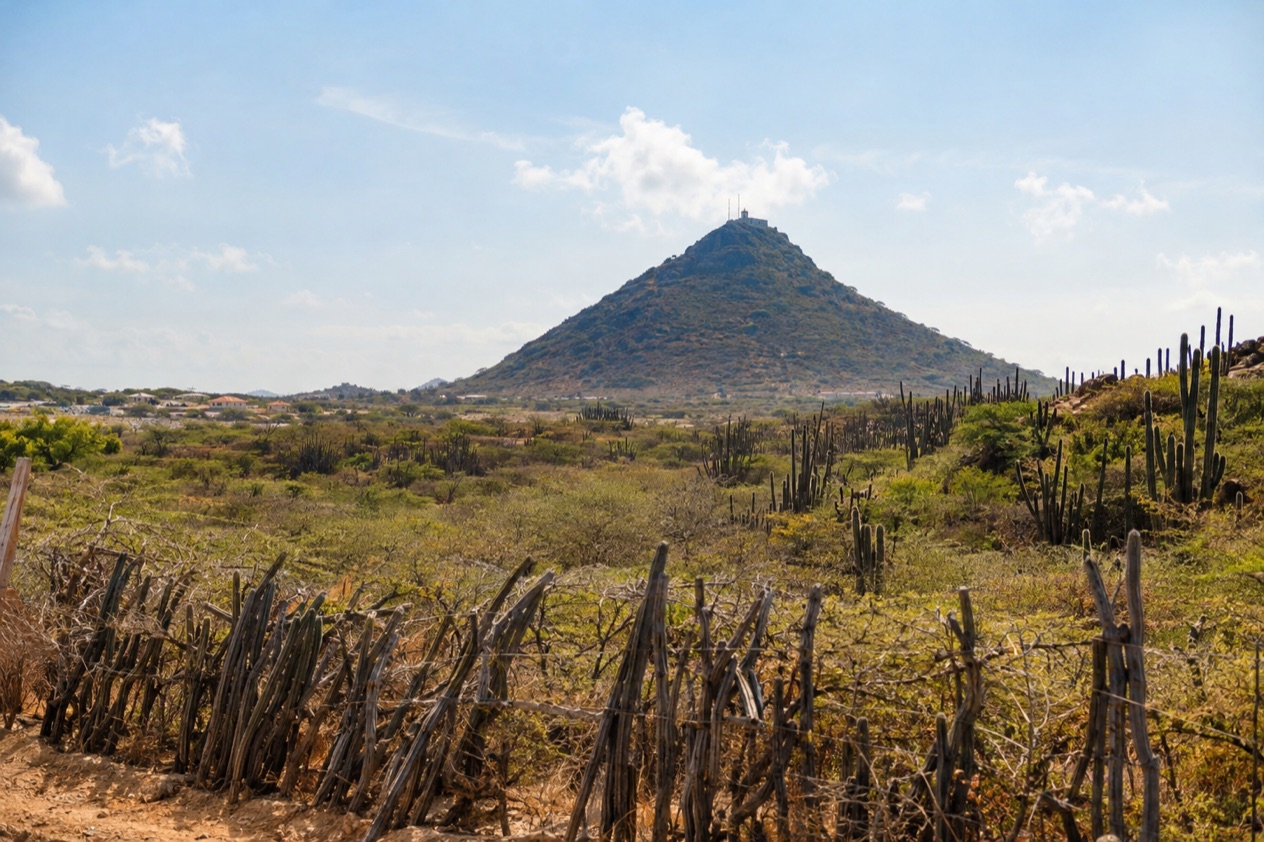
Hooiberg shows up long before you reach it. Out on Aruba’s flat, scrubby interior, a single cone of dark rock stands over the cacti and the low houses, with a thin concrete stairway running straight up its side.
Up close you hear parakeets and the wind in the brush, and then you start climbing. This is a hike for anyone who wants Aruba’s middle seen from above, with the whole island laid out below.
Is visiting Hooiberg worth it?
Yes, if you like a good view earned on foot and you want something from Aruba that has nothing to do with a beach chair. It suits hikers, curious families with older children, and anyone who likes to understand the shape of an island from its highest convenient point. If you only want to lie on sand, it will not be your day.
Part of its charm is where it sits. Most of Aruba’s attention goes to the coastlines, the resort strip and the surf. Hooiberg stands in the center of the island, so its panorama shows you the land the other outings skip: the dry interior, the rooftops and the sea at the edges. It is also not the island’s tallest formation.
Jamanota, at 617 feet, holds that title. Yet Hooiberg feels like the hill everyone knows, because it is a lone cone with a staircase you can follow with your eyes from the car window. Hikers describe it as a workout with a view, and the summit as deeply rewarding.
What separates it from other nearby attractions is the mix of effort and payoff. The trail is the staircase, the reward is a sweeping vista, and the whole outing fits comfortably around other plans in the middle of the island. You do not need equipment or a guide to understand what you are looking at. You just climb, stop when you need to, and look back at how far you have come.
What to see at Hooiberg
The concrete staircase
The staircase is the heart of the visit. It was poured in 1951 for a practical reason: crews needed to reach the radio and television masts and a navigation light on the hill. It was built for work, not for hikers, but it has become the way almost everyone goes up. Today it counts roughly 587 steps, and hikers often round that to about 600.
The steps climb in a fairly steady line, so the effort is a long, rhythmic grind rather than a scramble. Expect to stop, drink some water in your head if not in your hand, and turn around for the view that grows with each landing. The masts you pass are a reminder of why the stairs exist at all.
The summit and its panorama
At the top you get a panoramic view across Aruba. Because Hooiberg stands in the middle, the picture runs in every direction: the dry flatlands, the scattered settlements and the sea along the edges. The island is small, flat and windy, so the horizon is wide and the sky takes up most of what you see.
Take your time up there. This is the moment the climb pays off, and the trade wind from the east is a constant companion. Look for the places you have already visited or plan to visit, and notice how the island’s coasts differ from the interior you have just crossed.
Wildlife along the way
Climbers may meet wild goats, parakeets and colorful lizards on the way up. None of them is guaranteed, and they tend to keep their distance, but the lizards on the warm stones and the parakeets calling from the cacti are part of what makes the climb more than a staircase. The goats are a typical Aruban sight, and when one appears on the slope it often watches hikers pass.
Go at a pace that lets you look around. The best wildlife moments come when you stop on a landing and stay quiet for a minute, rather than when you push for the top.
The rock and the name
Hooiberg is a conical hill made of hooibergite, a hornblende-rich mela-diorite, a dark, dense rock that explains why it holds its shape above the softer surrounding land. The name is Dutch for haystack, and the silhouette fits: a loose, rounded heap rising out of the plain.
There is also local lore attached to the staircase. Rudy Carti holds the record for fifty ascents in under a day, a feat that sounds absurd to anyone halfway up on a first visit. It is a good story to tell yourself at the next landing.
Hours, tickets and rules
Hooiberg is a hill with a staircase, not a ticketed museum, and what matters most for planning is its size and the climb itself. The table gives the hill’s height and the number of steps you will take.
| Site | Elevation | Steps to the top |
|---|---|---|
| Hooiberg | 541 ft | About 587 |
Hikers take the concrete staircase to the summit, where the panoramic view is the reward. Plan your climb around the staircase itself and the pace you can sustain, since the number of steps is the real measure of this outing.
How to get to Hooiberg
Hooiberg stands in the center of Aruba, at the heart of the island, so it sits between the coasts rather than on one of them. That is its great advantage as a stop: wherever you are staying on the island, the hill is somewhere in the middle of your map, and you can see it rising on the horizon before you arrive.
Once you are in the area, the landmark is hard to miss. A lone cone with a stairway climbing its flank stands out against the flat interior, and that makes it an easy thing to aim for as you cross the island. The staircase starts at the foot of the hill, and from there the route is simply up.
A handful of other attractions lie within a mile of the hill, including Aruba Go Cherry ATV Tours, AGW Tours & Services, Feel Flow Grow Wellness Center, Steven De Cuba Wedding Photographer and Huchada. They give you a sense of the neighborhood around the base, and they make the hill a natural pairing with other stops in the middle of the island.
The locality of Hooiberg is a real residential area, with a population of 3,413. So the base of the hill is part of a living neighborhood rather than an isolated park, and the surroundings feel like everyday Aruba.
When to visit Hooiberg
The best time for the island overall runs from February to August, and Hooiberg fits that pattern. The climb is a physical effort in the open, on a dry, windy island, so it rewards a day when you are fresh and the sky is clear. Visibility from the summit is part of the point, so pick a day when the horizon is sharp.
Peak season runs from December to April. That is when the island is busiest overall, so the hill may see more visitors on its staircase too. If you want the stairs more to yourself, the shoulder months around the best stretch give you the same views with a little more room on the landings.
Within the day, think about the sun. The staircase is exposed, and the cone gives little shade, so the cooler part of the day makes for a more comfortable ascent. Morning light also tends to make the view crisp, and the wind keeps blowing across the summit whatever the hour. Late in the day the light turns warmer over the interior, which is a lovely time to be looking out from the top, though you will want to plan your descent with the fading light in mind.
No special festival date is tied to the hill, so the choice comes down to season, weather and your own energy. A clear day in the stretch from February to August is the simplest recommendation.
Tips for your visit
Bring water, a hat and shoes with good grip. The staircase is concrete, and the climb is steady, so you will be glad of footwear that holds up. Sunglasses help at the top, where the light is wide open, and a light layer is useful for the wind that keeps blowing across the summit.
Give yourself time to take the climb in stages. Stopping on the landings is part of the experience, since the view widens with every few flights. Rather than chase the record Rudy Carti set, treat the hill as a half-morning outing with a long pause at the top for the panorama and a calm walk back down.
Because other attractions lie within a mile, you can build a loose plan around the hill. Aruba Go Cherry ATV Tours and Feel Flow Grow Wellness Center are among the neighbors, so the area suits a morning that mixes effort with something more relaxed afterward. Keep your eyes open on the way up for the goats, parakeets and lizards, which add a little life to a walk that is otherwise just steps and sky.
For families, think about the length of the staircase when you look at the ages and energy of the group. It is a real workout, and anyone who will struggle with a long ascent should set expectations accordingly. If someone prefers to stay at the bottom, the hill is visible from the foot, and the climbers can bring the view back in photographs.
Good to know before you go
The U.S. State Department rates Aruba Level 1, ‘Exercise normal precautions,’ and says Aruba is generally a safe destination for travelers, with petty crime the main concern in popular tourist areas.
Hooiberg is a place to take at your own pace, and the habits that serve you anywhere on the island apply here too: keep your belongings close and carry only what you need for the climb. It is a hill, so the real preparation is physical rather than logistical. Come with water, patience for the steps, and enough time to enjoy the view once you reach the top.
Sources
- Aruba Tourism Authority, Hooiberg (https://www.aruba.com/us/explore/hooiberg), checked October 9, 2026
- Wikipedia, Hooiberg (https://en.wikipedia.org/wiki/Hooiberg), checked October 9, 2026
- Aruba Tourism Authority, Best time to visit (https://www.aruba.com/us/our-island/one-happy-island/when-is-the-best-time-to-visit-aruba), checked October 9, 2026
- U.S. Department of State, Aruba Travel Advisory, Level 1, issued August 19, 2026 (https://travel.state.gov/content/tsg_aem/us/en/home/international-travel/travel-advisories/destination.abw.html), checked October 9, 2026
To plan your stay
- Best Time to Visit Aruba: Weather by Month, Peak Season and Festivals
- Where to Stay in Aruba: Palm Beach, Eagle Beach, Oranjestad and All-Inclusives
- Aruba Airport (AUA): Arrival, Getting to Your Hotel, U.S. Preclearance and Departure
- Know Before You Go to Aruba: Entry Forms, Money, Water and Local Customs