
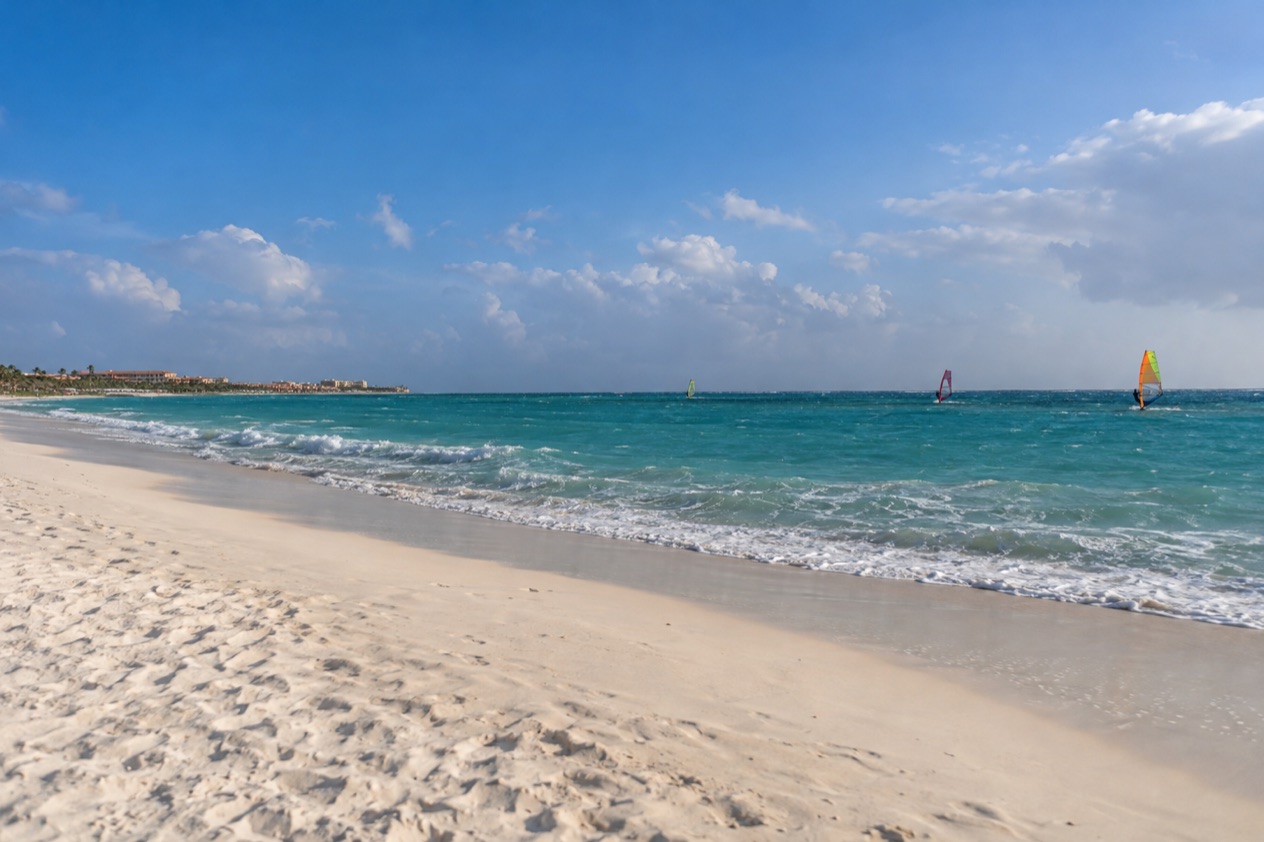
Colorful sails rise and tilt over the water at Hadicurari, and the steady trade wind snaps the kites out in long arcs while a few paddle boarders drift in the shallows below. The shore here is rockier and less polished than the resort sand just down the coast, and that is part of its charm. This is the beach on Aruba’s Palm Beach side where wind and kite surfing take over, and a good stop for anyone who likes to watch the sport, try it, or simply sit by shallow water with the wind in their face.
Is visiting Hadicurari Beach worth it?
Yes, especially if you are curious about wind and kite surfing, or if you like a beach with a working, lived-in feel rather than a lineup of hotel loungers. Hadicurari is the most popular spot on the island to learn and practice both sports, so there is always something happening on the water, even when you never touch a board yourself.
What sets it apart from the beaches next door is its character. Palm Beach is the island’s long, white-sand strip of high-rise hotels, casinos, piers and beach bars.
Hadicurari lies just past the Marriott Aruba Resort, a rocky strip known to locals as Fisherman’s Huts or simply The Huts. The water is very shallow and calm, which is why local families with children favor it, and the schools, boards and sails give it a sporty, informal mood you do not find in front of the resorts.
It suits watchers as much as doers. Bring a towel, find a spot along the shore, and spend an hour following the kites as they climb and swoop.
It is also a pleasant change of pace from the resort strip for travelers staying nearby who want to see how Arubans spend a windy afternoon. If you are looking for a long, soft, sandy stretch with beach service and a row of umbrellas, the beaches around it fit that picture better.
What to see at Hadicurari Beach
The rocky shore and the Fisherman’s Huts
The first thing you notice is the shoreline itself. Unlike the smooth white sand of Palm Beach, Hadicurari is a rocky strip, with stones and patches of sand along the water’s edge. The nickname Fisherman’s Huts points to the beach’s past as a working shore, where local fishermen once kept their boats and gear before the resorts rose along the coast.
That history still colors the place. The beach feels more like a neighborhood spot than a resort frontage, and you see locals setting up for the afternoon alongside visitors with boards. Look for the small details, the sandals lined up at the water’s edge, the sails drying on the shore and the casual gatherings that form around the schools.
The shallow water and the water sports schools
The water at Hadicurari is very shallow and calm, which makes it a favorite for local families with children. Because the shallows extend out from the shore, the bay is where many people take their first steps on a board. Wind and kite surf schools line the beach, and paddle boards and other non-motorized water sports are found here too.
Watching a lesson is half the fun. You see instructors working with students on the sand before they head out, kites being laid out and launched, and the first wobbly rides across the bay. Paddle boarders glide along the quieter edges, giving the water a mix of speeds and colors all afternoon.
The kites and sails over the water
The trade wind blows from the east across Aruba all year, and this is the corner of the island where that wind becomes entertainment. Kites hang high in the sky while riders skim across the surface, and windsurfers tilt their sails against the breeze. On a good day the sky above the bay is a moving patchwork of color.
The best seat is simply the shoreline. Stand near the water and you can follow a rider from the launch to the turn, hear the snap of the sail and see how the more experienced surfers jump and turn. It is a lively scene, and a good one for photographs, particularly when the late light catches the sails.
The Aruba Hi-Winds
Every year in June or July, Hadicurari becomes the stage for the Aruba Hi-Winds, the largest windsurfing event in the Caribbean. The racing and freestyle take place off the beaches at Fisherman’s Huts, so the water in front of the beach fills with sails and spectators gather along the shore.
If your trip falls in those months, it is worth building a day around it. The beach takes on a festive air, with competitors, fans and locals sharing the same stretch of shore. Outside the event, the same bay still offers the everyday show of lessons and practice sessions.
Hours, tickets and rules
Hadicurari is an open stretch of shoreline past the Marriott, not a gated attraction, and the one rule the island states clearly for beachgoers concerns sunscreen. The schools and rental stands along the beach run their own schedules, and what you pay depends on what you choose to do, whether that is a lesson, a board or simply an afternoon watching from the sand.
Aruba has banned sunscreens containing oxybenzone since 2019. The ban protects the reefs, and it applies to anyone who brings a bottle from home. Mineral-based, reef-safe sunscreens are the ones to choose, because they are more likely to be biodegradable and have a lighter effect on the environment.
If you arrive without the right bottle, sunscreen can be bought on the island from local companies such as Aruba Aloe and Arubalife Organics. That means you can stock up after landing and avoid carrying a bottle that falls under the ban.
How to get to Hadicurari Beach
Hadicurari Beach is a rocky strip located past the Marriott Aruba Resort, so the Marriott is the landmark to aim for. Anyone staying along Palm Beach is already in the right neighborhood, since the beach sits just beyond that resort on the same coast of the island.
Palm Beach is the natural base for a visit. It is the island’s strip of high-rise hotels, casinos, restaurants and shops, with public transport and public parking among its amenities. From there, you head past the Marriott until the resort frontage gives way to the rocky shore and the colorful sails of the schools.
Once you spot the sails and the beach huts, you have arrived. The alternate names are useful to know when asking for directions, because both Fisherman’s Huts and The Huts are what people commonly call the place. The setting is informal, so there is no grand entrance to look for, just the water, the rocks and the activity along the shore.
When to visit Hadicurari Beach
The best months for Aruba in general run from February to August, and Hadicurari fits that pattern well because its main appeal is the wind. The trade wind blows from the east all year, so kites and sails fill the bay in any season, but the stretch from late winter through summer pairs the steady breeze with the island’s best overall conditions.
If you want to see the sport in its most spectacular form, aim for June or July, when the Aruba Hi-Winds takes over the beach. The largest windsurfing event in the Caribbean brings competitors and spectators to Fisherman’s Huts, and the water in front of the shore turns into a racecourse. Plan ahead for that trip, because the dates shift from year to year.
December to April is the island’s peak season, so the neighboring resort strip is at its busiest then. A visit to Hadicurari during those months is a good way to enjoy a more relaxed corner of the coast. Late in the day, the western light and the tangerine sunsets of Palm Beach make the shore a pleasant place to linger as the kites come down.
Through the day, the mood changes with the wind and the light. The sails are most active when the breeze is steady, and the beach has a calmer, softer look toward evening. Pick your hour according to what you came for, the action on the water or a slow walk along the rocks.
Tips for your visit
Bring a mineral-based, reef-safe sunscreen, a towel and a hat, plus shoes you do not mind getting wet, since the shore is rocky rather than soft sand. A camera is a good idea, because the kites against the sky make easy subjects. If you plan to try a lesson, the many wind and kite surf schools along the beach are the place to ask.
Give the beach a relaxed stretch of time. Watching the riders, wandering the shore and settling into the shallows fits a leisurely morning or afternoon, and it combines well with the rest of Palm Beach. After the beach, the strip offers beach bars, restaurants and shops, and nearby you find the Stellaris Casino, Le Petit Café, Amore Mio Pizzeria Napoletana Aruba, The Lobby and Laguna.
Families with children often favor the bay because the water is very shallow and calm, and local families treat it that way. The paddle boards and other non-motorized water sports give older kids and adults something to try while the youngest play near the edge.
For an evening, Palm Beach offers walks at sunset, candle-lit barefoot dining on the sand and lively clubs and casinos after dark. Two of the island’s largest shopping malls are nearby too, with cinemas, water fountain shows, bowling and spa facilities, which makes them a useful plan for a break from the wind.
Good to know before you go
The U.S. State Department rates Aruba Level 1, ‘Exercise normal precautions,’ and says Aruba is generally a safe destination for travelers, with petty crime the main concern in popular tourist areas.
Hadicurari is a casual beach, so a small bag with the essentials is all you need. The sunscreen rule is the main thing to keep in mind, and local brands on the island make it easy to follow. Petty crime is the main concern in popular tourist areas, so it is sensible to keep valuables with you rather than leaving them unattended while you head out on the water.
Sources
- Aruba Tourism Authority, Hadicurari Beach (https://www.aruba.com/us/explore/hadicurari-beach), checked October 9, 2026
- Aruba Tourism Authority, Palm Beach (https://www.aruba.com/us/explore/palm-beach), checked October 9, 2026
- Aruba Tourism Authority, Best time to visit (https://www.aruba.com/us/our-island/one-happy-island/when-is-the-best-time-to-visit-aruba), checked October 9, 2026
- Aruba Tourism Authority blog, Responsible guest (https://www.aruba.com/us/blog/how-to-be-a-responsible-guest-protecting-arubas-beaches-and-marine-life), checked October 9, 2026
- U.S. Department of State, Aruba Travel Advisory, Level 1, issued August 19, 2026 (https://travel.state.gov/content/tsg_aem/us/en/home/international-travel/travel-advisories/destination.abw.html), checked October 9, 2026
To plan your stay
- Best Time to Visit Aruba: Weather by Month, Peak Season and Festivals
- Where to Stay in Aruba: Palm Beach, Eagle Beach, Oranjestad and All-Inclusives
- Aruba Airport (AUA): Arrival, Getting to Your Hotel, U.S. Preclearance and Departure
- Know Before You Go to Aruba: Entry Forms, Money, Water and Local Customs