
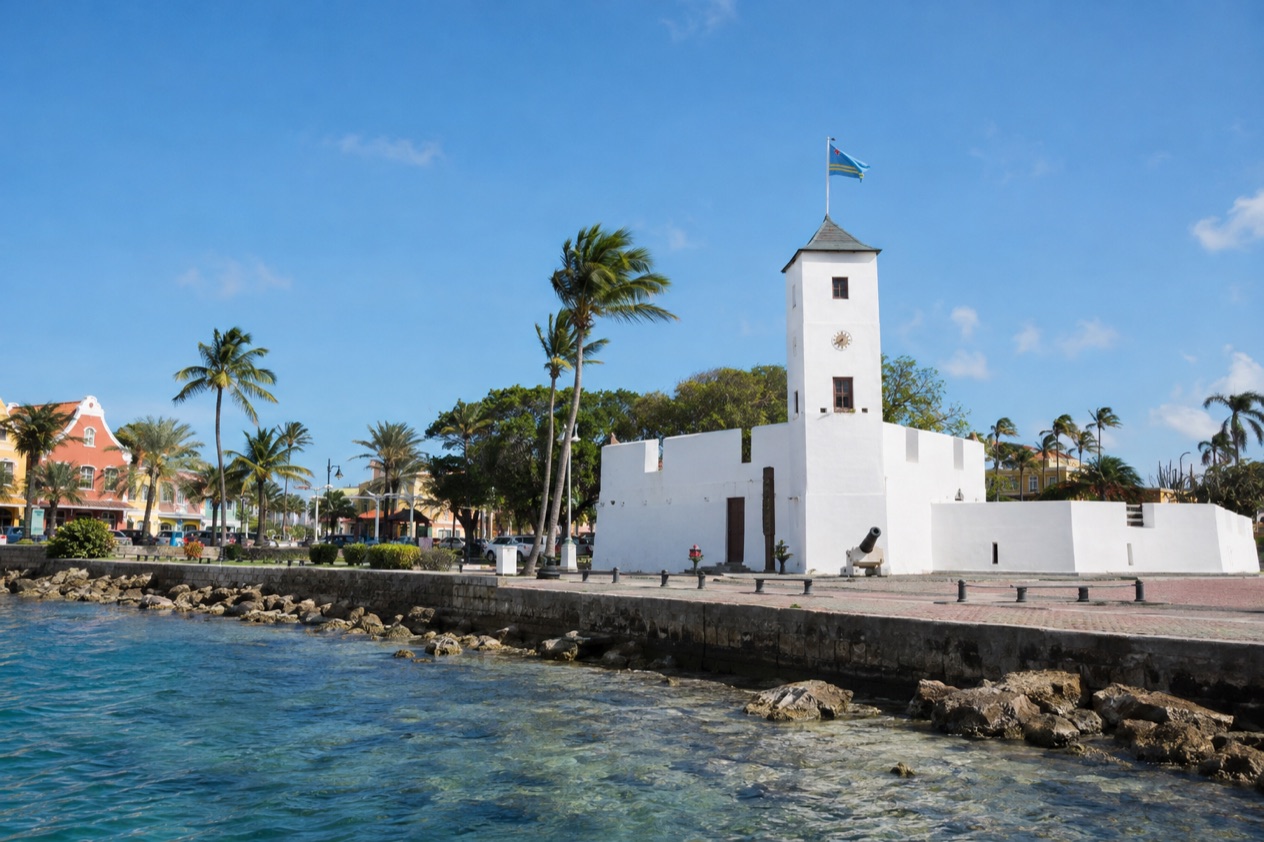
Walk toward the harbor in Oranjestad and a pale tower with a clock face rises over the low rooftops, the first sign that something older than the shopping streets stands here. Behind it, thick walls enclose a courtyard where the town’s colonial story is laid out in rooms and objects. A visit to Fort Zoutman and the Historical Museum is a quiet, unhurried stop that gives the rest of the island some context.
Is visiting Fort Zoutman and the Historical Museum worth it?
Yes, if you like to know what lies under the pastel facades of a Caribbean town, and especially if you are curious about how Aruba lived before resorts. The fort is the oldest remaining building in Oranjestad, and the museum inside gives it a purpose beyond a photo stop. It suits history lovers, families with children old enough to enjoy a replica kitchen, and anyone who wants a few indoor, shaded hours between beach days.
What sets it apart from the other places in town is that the building itself is the main exhibit. You are not stepping into a modern gallery with a story attached.
You stand inside the walls that were raised to guard this coast, beneath a tower that once guided ships and told the town the time. The Archaeological Museum, a short distance away on Schelpstraat, goes much further back, into the Amerindian past, so the two together cover the island from its earliest peoples to its Dutch colonial years.
It will not suit someone who wants spectacle. The pleasure here is in details: a date on a plaque, a clock tower, a kitchen set up as it once was, a document that shows how the island was run. Come with a little curiosity and the place rewards it.
What to see at Fort Zoutman and the Historical Museum
The fort and the admiral it was named for
Fort Zoutman was built in 1796 to protect the coastline and finished two years later. It is the oldest standing building in Oranjestad, which means the town grew up around it rather than the other way round. Look at the thickness of the walls and the way the structure sits close to the water, and you can picture why a small settlement wanted a stronghold here.
The name comes with a nice irony. It honors Dutch Rear Admiral Johan Arnold Zoutman, who never set foot on Aruba. He was celebrated for defeating the English in the North Sea, and the islanders borrowed his reputation for their fort. Spend a minute with that story before you go in, because it explains how far this small outpost sat from the great events of its day.
The Willem III Tower
The tower is the image most visitors take away. It was built in 1868 and marked the fort’s original entrance, and it did double duty as a lighthouse and a public clock tower. delete
The lamp went dark in 1963, after 95 years of service. What remains is the sturdy white tower with its clock, a good place to stop for a photograph and to imagine the harbor before the cruise ships. Photograph it in the softer light of morning or late afternoon, when the wall catches a warm color against the blue sky.
The courtyard and the replica kitchen
Step through into the courtyard and the visit turns from exterior to everyday life. A replica kitchen shows how cooking was done in Aruba’s past, with the simple tools and the hearth arrangement of a household that had no gas ring or refrigerator. It is the part children tend to remember, because it turns history into something you can picture: where the pots went, where the fire burned, how much work a meal was.
Take your time here and think about what you have eaten on the island. Dishes like keshi yena, the baked cheese shell filled with spiced meat, and pastechi, the fried turnover found at breakfast counters, came out of kitchens like this one, shaped by what was available on a dry island.
The historical collection
Inside, the museum holds a historic collection of documents and developments from Aruba’s past. This is the quiet, reading side of the visit: papers, records and displays that trace how the island changed under Dutch rule and beyond. It rewards a slow pace, a few minutes at each case, rather than a quick walk-through.
If a case catches your eye, linger and read the labels in full. The collection is what turns the fort from an old wall into a place with a narrative, and it prepares you for the street names, the architecture and the Papiamento phrases (the island’s own language, a blend of several tongues) that you will meet in the rest of Oranjestad.
Hours, tickets and rules
For the Archaeological Museum, which pairs naturally with a visit to the fort, the doors are open on weekdays while the sun is up, and that easy daytime rhythm feels made for wandering in. Fort Zoutman is a place to see in daylight, when the tower is visible against the sky and the courtyard is bright.
| Site | Open |
|---|---|
| Archaeological Museum, Schelpstraat 36-38 | Monday through Friday, 9:30 AM to 4:30 PM |
The Archaeological Museum’s hours leave the weekend open, so plan a pairing of the two for a weekday. No specific rules about climbing, swimming, drones, tripods or sunscreen are stated for either place, so enjoy the grounds as you would any historic building: look closely and move gently around the displays.
How to get to Fort Zoutman and the Historical Museum
The fort stands in the center of Oranjestad on Zoutmanstraat, at the map location GX97+4P3, so it is a stop within town rather than an excursion. If you are staying in or near Oranjestad, you are already close, and if you are based elsewhere on the island, Oranjestad is the place to head for. Type the address or that map code into your phone and the tower will appear in front of you as you near it.
The Archaeological Museum sits at Schelpstraat 36-38, also in Oranjestad. It occupies the renovated historic home of the Ecury family, which gives the visit a domestic, residential flavor quite different from the fort. Both addresses are in the same town, so you can plan them as two stops of one outing and decide on the spot how to move between them.
Arriving is part of the experience. As you approach, notice the old tower first, then the walls, then the entrance, and think about how a ship’s crew would have seen the same shape coming in from the sea long ago.
When to visit Fort Zoutman and the Historical Museum
Aim for the daytime and the cooler end of it. The temperature in Oranjestad barely shifts through the year, hovering around 82°F, so the heat you feel depends on the hour rather than the month. Early in the morning the courtyard is pleasant, the light is soft on the tower and you can read the displays without feeling the sun on your neck.
As for the season, Aruba as a whole is best from February to August, and the busiest stretch runs from December to April. A museum visit works in any month, because it is mostly indoors and rain is light and steady rather than dramatic. If you are in town in the busy winter months, a morning at the fort is a calm contrast to the crowded beaches.
The practical timing rule is the one for the Archaeological Museum: weekdays only. Fit that into your week and plan the fort around it, so you see the Amerindian past and the colonial past in one tidy day. On a cruise-ship day the town center is livelier, so an early start is the pleasant way to see the tower with room to look around.
Tips for your visit
Bring a hat, sunglasses and water for the walk between stops, and wear comfortable shoes for the courtyard and the town streets. A camera helps, since the tower, the old walls and the replica kitchen all photograph well. Allow a relaxed stretch for the fort, then keep some time for the Archaeological Museum, so that neither visit feels rushed.
Pair it with the Archaeological Museum
This is the natural companion. The Archaeological Museum preserves Aruba’s Amerindian cultural heritage and shows artifacts going back to the Pre-Ceramic period of 2500 BC. A film on ancient Amerindian life from the Field Museum in Chicago is part of the displays, and special technology lets guests take an active part in discovering the past, which is a good way to keep younger visitors engaged.
The building tells its own story. The oldest part is a cunucu house (a traditional country house) from 1870, the newest is a large mansion from 1929, and the mansion now holds a 21st-century museum.
Boy Ecury, a young Aruban hero of World War II, lived here from 1922 to 1937. Look for the cistern the Ecury family used to collect rainwater from the roof, and for works by contemporary island artists with historical themes.
Add a free factory tour
For a lighter change of pace in the Oranjestad area, the Aloe Vera factory offers free tours every 15 minutes during opening hours, with no booking needed. It fits well after a morning of history, when you want something hands-on and short. It also shows a product the island is known for, so it adds a bit of local business to the cultural picture.
Families will find the replica kitchen, the interactive displays and the factory tour a good trio for children, who tend to prefer things they can see and do. For anyone with mobility concerns, the fort is an old structure, so look at the layout when you arrive and set your pace to suit.
Good to know before you go
The U.S. State Department rates Aruba Level 1, ‘Exercise normal precautions,’ and says Aruba is generally a safe destination for travelers, with petty crime the main concern in popular tourist areas.
Oranjestad is considered an easy, comfortable town to visit, with panhandlers not an issue and locals who do not pressure tourists, so you can stroll between the fort and the museum at a relaxed pace. The legal drinking age is 18, though many establishments do not enforce it strictly, which is worth remembering if you stop for a drink after your visit. Keep a small amount of curiosity for the details and the visit will give you a clearer picture of the island.
Sources
- Aruba Tourism Authority, Fort Zoutman Historical Museum (https://www.aruba.com/us/explore/fort-zoutman-historical-museum), checked October 9, 2026
- Aruba Tourism Authority, Archaeological Museum (https://www.aruba.com/us/explore/archaeological-museum), checked October 9, 2026
- Wikivoyage, Oranjestad (Aruba) travel guide (https://en.wikivoyage.org/wiki/Oranjestad), checked October 9, 2026
- Aruba Tourism Authority, Best time to visit (https://www.aruba.com/us/our-island/one-happy-island/when-is-the-best-time-to-visit-aruba), checked October 9, 2026
- U.S. Department of State, Aruba Travel Advisory, Level 1, issued August 19, 2026 (https://travel.state.gov/content/tsg_aem/us/en/home/international-travel/travel-advisories/destination.abw.html), checked October 9, 2026
To plan your stay
- Best Time to Visit Aruba: Weather by Month, Peak Season and Festivals
- Where to Stay in Aruba: Palm Beach, Eagle Beach, Oranjestad and All-Inclusives
- Aruba Airport (AUA): Arrival, Getting to Your Hotel, U.S. Preclearance and Departure
- Know Before You Go to Aruba: Entry Forms, Money, Water and Local Customs