
On a February evening in Oranjestad, steel bands and tumba drums roll down the streets, and dancers in feathered, sequined costumes cross the pavement under strong tropical light. Carnival is reaching its peak, and the whole island seems to be humming along with it.
The weather is warm and bright, the beaches along the leeward coast are open and the trade wind keeps blowing. February is a month for parades by night and the sea by day.
What is the weather like in Aruba in February?
February is warm, sunny and mostly dry, with the steady trade wind from the east keeping the air moving all day. It falls in the dry season, which runs from January to April, so rain tends to come as a brief passing shower rather than a gray, wet day. The sea stays warm enough that a day on the beach rarely feels like a decision.
| Place | Region | Average high (°F) | Average low (°F) | Rain (in) | Rain days | Sea (°F) |
|---|---|---|---|---|---|---|
| Oranjestad | Leeward (southwest) coast | 87.1 | 76.6 | 0.77 | 4.5 | 80.3 |
If you want the full feel of Aruba in February, think of the island as one warm, breezy whole. Afternoons are hot but rarely oppressive, and nights stay balmy enough for dinner outdoors without a sweater. The wind averages 17 mph, which makes the sun feel gentler than the thermometer suggests and gives the windward coast its rough, white-capped look.
The sea is where the small differences show. Off Palm Beach it averages 79.7°F, and off San Nicolas in the south it is a shade warmer at 79.8°F. Both are the kind of water you enter without hesitating, and it feels like bathwater compared with a Northeast February. Days are a little shy of twelve hours long, so sunset arrives around dinnertime.
Compared with January, February brings noticeably fewer showers, and March is drier still and a touch warmer. Palm Beach, Eagle Beach and Oranjestad all sit on the leeward side, while the north and east coasts take the wind head on and are rough.
Where to go in Aruba in February
Palm Beach and Eagle Beach
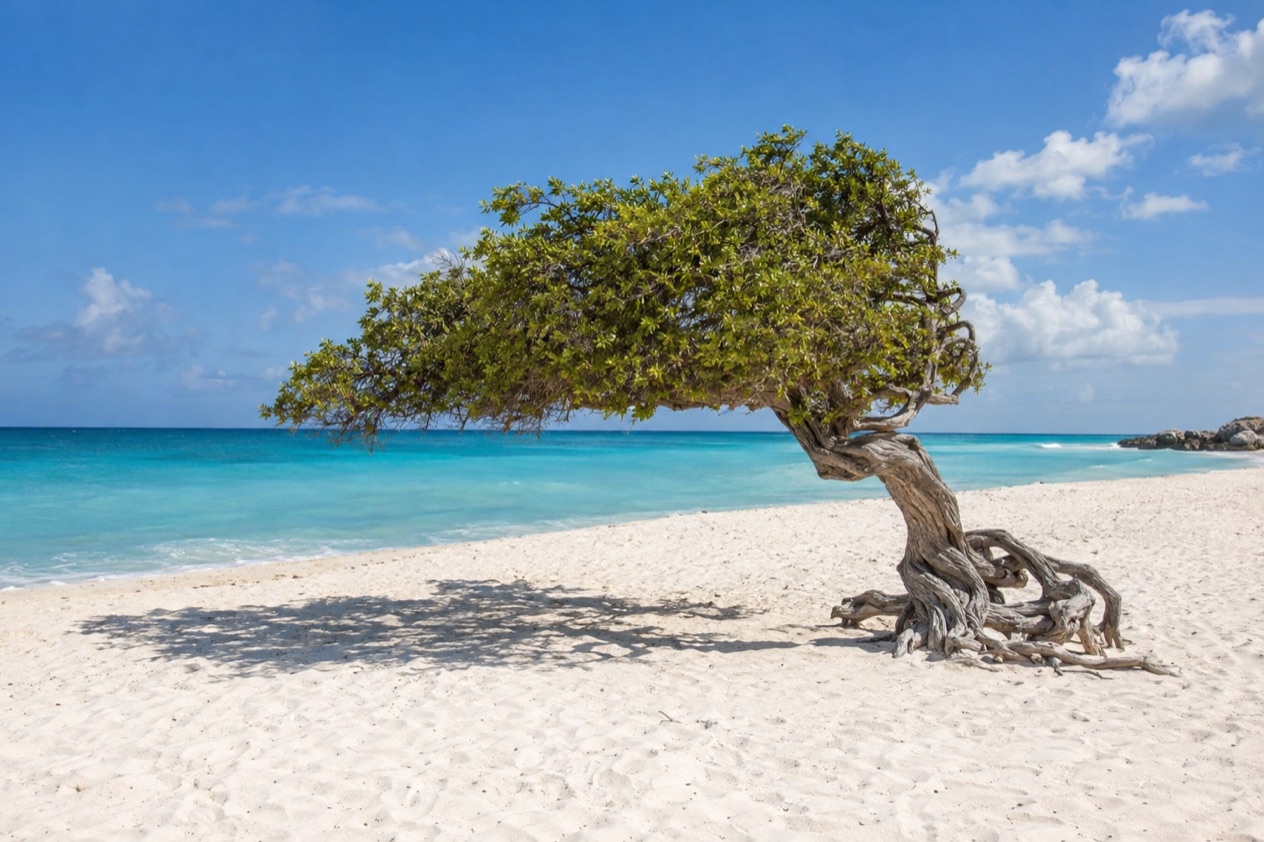
Palm Beach is the strip of resorts in the Noord district, and in February it hums from breakfast to the last cocktail. The sand is lined with beach bars, water sports and restaurants, and the evenings fill with people heading to dinner. Further down the coast, Eagle Beach is a wider, quieter stretch, and the fofoti trees that lean over the sand make the most photographed silhouette on the island.
February suits anyone who wants long beach days with little risk of a rained-out afternoon. The dry season does most of the work, and the trade wind takes the edge off the midday heat. Aruba has more than 20 public beaches and coves, and every one of them is public, so you are never locked out of the sand by a resort.
Oranjestad
The capital is where Carnival takes over in February. Its harbor, pastel Dutch-colonial facades and waterfront streets turn into a stage for the parades, and the days leading up to them are full of rehearsals, costume fittings and street music. Between events, the city is a good place to eat pastechi, the fried pastry with a savory filling, and to sit down to a plate of local fish.
This is the month to arrive curious. Wander along the waterfront in the late afternoon, when the heat eases and the wind carries the sound of drums from somewhere nearby, and let the evening decide where you end up.
San Nicolas and the south
San Nicolas, at the southern end of the island, is a former refinery town that has turned into the island’s street-art district, and its murals reward a slow walk. Nearby, Baby Beach is one of the best beaches for snorkeling in Aruba, along with Malmok Beach, Boca Catalina and Mangel Halto. The clear water lets snorkelers and divers see reefs and wrecks.
Snorkel tours also call at the Antilla, a WWII shipwreck. Savaneta, along the south coast, is where you go for a quieter pace and a plate of fresh fish. This part of the island is a good choice for days that have no schedule.
The windward coast and the interior
The north and east coasts are wild and rough, with limestone cliffs, crashing surf and almost no development. Arikok National Park covers much of this side, and its landscape is cactus-studded, rocky and very different from the resort beaches. Bushiribana, on the north coast, is a ruined gold smelter that sits right on the shore.
The hill called Hooiberg rises from the middle of the island, and the California Lighthouse marks the northwest tip. February’s dry weather and steady wind make this a comfortable month for exploring, though the wind is strongest on the exposed side.
What to do in Aruba in February
Carnival
Carnival is the reason many people choose February. The season officially opens every year on November 11 at 11:11 a.m., and the best dates for events, celebrations and parades fall in January and February. The Grand Parade in Oranjestad is the high point, with troupes in elaborate costumes, floats and bands moving through the capital.
The season closes on Shrove Tuesday, the day before Ash Wednesday, when King Momo is burned at midnight. That date moves with Easter, so the final weekend lands in either February or early March depending on the year. The crowning of the queens is part of the run-up as well, with a Children’s Carnival Queen Election for contestants aged 6 to 9 and an Aruba Carnival Queen Election for ages 17 to 25.
Snorkeling, beaches and the sea
The ocean stays warm year-round, and the clear water is the draw for snorkelers and divers. Malmok Beach, Boca Catalina, Mangel Halto and Baby Beach are the top snorkeling spots, and the Antilla wreck is a regular stop on snorkel tours. In February, the dry weather means the sky is usually blue above you as well.
With more than 20 public beaches and coves to choose from, you can spend a week moving from one to another. The leeward beaches are the resort strip, and the windward coast is rough and wild, so the two sides of the island offer very different days.
Eating on the island
Aruba’s home cooking draws on Amerindian, European, African, Asian and merchant traditions. The first inhabitants, the Caquetio, ate freshly caught fish and conch, and both are still on today’s menus. Look for keshi yena, a baked dish built around a hollowed round of cheese with a savory filling, and for pastechi at breakfast.
Carnival season adds street snacks and long evenings of eating outdoors. Papiamento, the island’s own language, shows up on menus and signs, and a few words of it go a long way.
Is Aruba busy in February?
Yes, February sits inside the peak season, which runs from December to April, and Carnival adds energy on top of it. The island is lively, especially around Oranjestad on parade days and along the resort beaches of Palm Beach and Eagle Beach.
The island is small, less than 70 square miles, so the busy areas are compact and the quiet ones are never far away. The resort strip and the capital carry most of the activity, while Arikok National Park, the windward coast and the south feel more open. San Nicolas and Savaneta keep a slower rhythm outside the parade schedule.
February also lines up with the general best stretch for Aruba, which runs from February to August. Many travelers come for the dry season and the Carnival at once, so the mood is festive rather than hushed. If you want the island at a quieter pace, build your days around the south and the interior, and keep evenings for the capital. The off-season runs from September to November, which is the opposite end of the year, and February is the other side of that calendar.
What to pack for Aruba in February
Packing for February is simple because the island is warm and dry, with a steady wind from the east. Light, breathable clothes handle the days, and the sea is warm enough that swimwear and snorkel gear get the most use. The windward coast and breezy evenings call for one extra layer, and a Carnival night in Oranjestad calls for comfortable shoes.
- Lightweight, quick-drying clothes for afternoons in the high 80s.
- Swimwear and snorkel gear for the clear, warm water.
- A light windbreaker for the trade wind, especially on the rough north and east coasts.
- A thin rain layer for the occasional short shower.
- Comfortable shoes for walking Oranjestad streets on parade nights and for rocky trails in Arikok National Park.
Good to know before you go
The U.S. State Department rates Aruba Level 1, ‘Exercise normal precautions,’ and says Aruba is generally a safe destination for travelers, with petty crime the main concern in popular tourist areas.
February falls outside the official hurricane season, which runs from June 1 to November 30. Aruba sits on the southern fringes of the hurricane belt, where damaging storms are rare.
U.S. citizens do not need a visa. They need a passport valid for the entire stay and the Aruba ED Card (Embarkation and Disembarkation Card), completed within 7 days before travel. They must also show proof that they can return to the country of departure or transit through another country, and enough money to cover the stay.
Is February a good time to visit Aruba?
Yes, February is a very good month for beach lovers, snorkelers and anyone who wants Carnival, and the leeward coast around Palm Beach, Eagle Beach and Oranjestad is the best base for it. The dry season is in full swing, the sea is warm and the wind keeps the heat comfortable.
Compared with January, February is clearly drier, with fewer showers and more settled skies. March goes a step further, with even less rain and slightly warmer air, so February is a good balance between a lively Carnival month and dry-season weather. The sea changes very little between the three months.
For travelers who prefer the island at a gentler pace, the south and the interior still offer plenty. San Nicolas has its murals, Baby Beach and the snorkel spots are within reach, and Arikok National Park and Hooiberg give the days some variety away from the resort strip. The windward coast stays rough and dramatic whatever the month.
What sets February apart is the sound of it. Carnival season has been building since November, and in February it fills Oranjestad with drums, costumes and the midnight burning of King Momo on Shrove Tuesday.
Sources
- Meteorological Department Aruba (meteo.aw), Summary Climatological Normals 1991-2020, Queen Beatrix Airport station (http://www.meteo.aw/files/Download/climatnormals19912020.pdf), checked October 9, 2026
- Open-Meteo Marine API, average 2015-2024, checked October 9, 2026
- sunrise-sunset.org, sunrise and sunset calculated for the 15th of the month, checked October 9, 2026
- Aruba Tourism Authority, Weather and climate (https://www.aruba.com/us/our-island/island-facts/weather-and-climate), checked October 9, 2026
- Aruba Tourism Authority, Best time to visit (https://www.aruba.com/us/our-island/one-happy-island/when-is-the-best-time-to-visit-aruba), checked October 9, 2026
- Aruba Tourism Authority, Where is Aruba (https://www.aruba.com/us/our-island/island-facts/where-is-aruba), checked October 9, 2026
- Aruba Tourism Authority, Carnival in Aruba (https://www.aruba.com/us/our-island/history-and-culture/carnival-in-aruba), checked October 9, 2026
- Aruba Tourism Authority, Aruba Carnival (https://www.aruba.com/us/calendar/aruba-carnival), checked October 9, 2026
- Aruba Tourism Authority, Passports and visas (https://www.aruba.com/us/plan-your-visit/getting-to-aruba/passports-and-visas), checked October 9, 2026
- Aruba Tourism Authority, Sustainability (https://www.aruba.com/us/our-island/island-facts/sustainability), checked October 9, 2026
- Aruba Tourism Authority, Beaches and coves (https://www.aruba.com/us/things-to-do/beaches-and-coves), checked October 9, 2026
- Aruba Tourism Authority, On the water (https://www.aruba.com/us/things-to-do/on-the-water), checked October 9, 2026
- Aruba Tourism Authority, Scuba and snorkel (https://www.aruba.com/us/things-to-do/on-the-water/scuba-snorkel), checked October 9, 2026
- Aruba Tourism Authority, Local Aruba cuisine (https://www.aruba.com/us/things-to-do/dining/local-aruba-cuisine), checked October 9, 2026
- U.S. Department of State, Aruba Travel Advisory, Level 1, issued August 19, 2026 (https://travel.state.gov/content/tsg_aem/us/en/home/international-travel/travel-advisories/destination.abw.html), checked October 9, 2026
To plan your stay
- Things to Do in Aruba: Beaches, Arikok National Park, Island Tours and Food
- Where to Stay in Aruba: Palm Beach, Eagle Beach, Oranjestad and All-Inclusives
- Aruba Airport (AUA): Arrival, Getting to Your Hotel, U.S. Preclearance and Departure
- Know Before You Go to Aruba: Entry Forms, Money, Water and Local Customs